
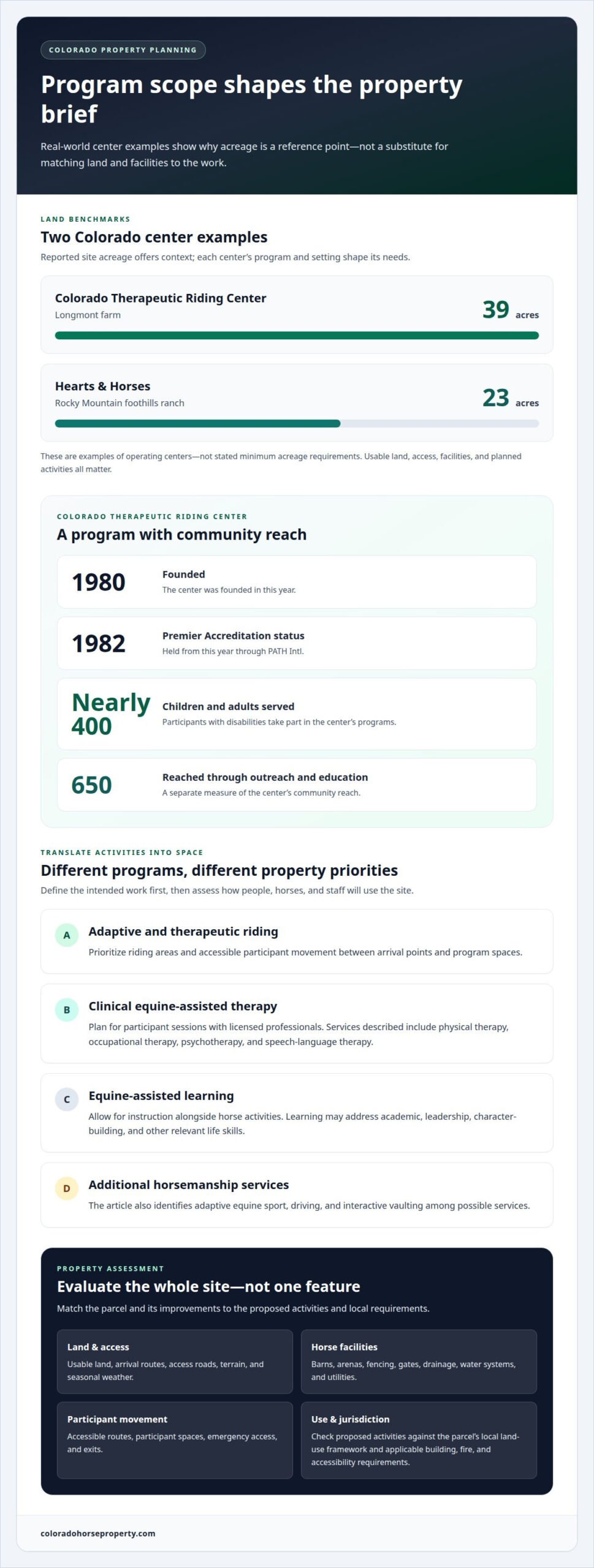
The right Colorado property is defined by program fit, not acreage alone. Finding a Colorado property for a therapeutic riding center means matching land, access, and equine facilities to the services planned. As a local benchmark, the Colorado Therapeutic Riding Center’s farm covers 39 acres in Longmont.
Acreage matters, but it is only one part of finding a Colorado property for a therapeutic riding center. Therapeutic riding and equine-assisted therapy can involve different activities and professional roles, so facility needs depend on the center’s programs, horses, and daily operations. A property that suits one model may not work for another.
This article explains how program goals shape facility needs, what to consider when choosing a Colorado location, and how to assess land, barns, arenas, water, and access as a connected property. Just as occupier-focused advisors like Resolute Global emphasize aligning physical spaces with operational mission, a focused property search and dedicated buyer representation help clarify priorities for specialized centers.
Key Takeaways
- Define whether the center will focus on adaptive riding, clinical therapy, equine-assisted learning, or a mix, since each model shapes facility priorities.
- Assess the whole site, including access, usable land, barns, arenas, water, and space for safe daily operations.
- Evaluate zoning in the context of the planned activities and the property’s local jurisdiction before settling on a site.
- Compare Colorado regions by weighing land, existing improvements, water access, and how well each property fits the center’s needs.
Therapeutic riding and equine-assisted therapy
Therapeutic riding and equine-assisted therapy describe related, but distinct, ways people work with horses. At the Colorado Therapeutic Riding Center, the work involves people with special needs and horses. The center was founded in 1980 and has held Premier Accreditation status from PATH Intl. since 1982. Its programs serve nearly 400 children and adults with disabilities, while outreach and education reach 650 individuals. These examples show why a property search should begin with the center’s intended activities, not a generic idea of an equestrian facility.
Equine-assisted therapy incorporates horses into clinical treatment or interventions. At the Temple Grandin Equine Center, licensed therapy professionals use horses to address individualized goals and support function, health, and wellness. Its equine-assisted services include physical therapy, occupational therapy, psychotherapy, and speech-language therapy. For a center planning clinical services, this model highlights the need to consider how participants, horses, and therapy professionals will use the site. A riding arena alone may not support the full scope of the program.
Equine-assisted learning has a different purpose. At the Temple Grandin Equine Center, learning activities can address academic, leadership, character-building, and other relevant life skills. Its instructors are specialized teachers, not therapists. This distinction matters when defining the center’s program mix and planning space for instruction alongside horse-related activities. Adaptive equine sport, adaptive and therapeutic riding, driving, and interactive vaulting are also among the center’s horsemanship services.
For property planning, identify the activities the center expects to offer and how they will work together. A program focused on adaptive riding may prioritize riding areas and accessible participant movement. A center combining therapy, learning, and horsemanship needs to account for each activity’s use of the property. The Colorado Therapeutic Riding Center and Temple Grandin Equine Center illustrate how equine-assisted work can include community programs, clinical services, education, and riding. Define the model first, then build a practical property brief around the people, horses, and activities the center will serve.
Therapeutic riding center location and facilities
A workable site must support program access, horse operations, and participant movement. Assess location, land-use permission, buildings, and inspection findings together.
Zoning for Riding Centers
Colorado zoning depends on the property’s jurisdiction and proposed activities. Assess whether the site’s land-use framework accommodates horse keeping, riding instruction, therapy appointments, and public access. A property suited to private horse use may not automatically suit a center serving participants or hosting programs.
When finding a Colorado property for a therapeutic riding center, treat zoning fit as an early search filter. Map each planned activity to the parcel before comparing locations. For a center combining lessons and clinical appointments, consider the proposed uses alongside barns, arenas, parking, and arrival routes. Existing equestrian improvements do not establish that every planned use is permitted.
Building, Fire, and Accessibility Requirements
Building, fire, and accessibility requirements depend on jurisdiction, building use, and planned occupancy. Review the requirements that apply to each structure and program area, including barns, arenas, offices, and participant spaces. Consider how people enter, move through, and leave the facility, as well as how horses and vehicles circulate.
An existing barn may support horse operations but need changes before it can host participant activities. Assess accessible routes between arrival areas and program spaces, along with emergency access and exits across the site. Applicable requirements and potential adaptations are part of evaluating a property for its intended use.
Property Inspection and Facility Due Diligence
Finding a Colorado property for a therapeutic riding center calls for an inspection that covers both building condition and equestrian function. Review barns, arenas, fencing, gates, drainage, water systems, utilities, access roads, and participant spaces. In Colorado, assess how terrain and seasonal weather affect site access and facility use.
Due diligence should also examine whether routes connect safely, structures suit planned activities, and land supports daily operations. Hearts & Horses operates a 23-acre ranch in the Rocky Mountain foothills, illustrating how setting and acreage can shape a center’s property needs. A focused Colorado horse property search can surface relevant equestrian features.
What zoning permits a therapeutic riding center in Colorado?
No single zoning label answers the question for every Colorado parcel. The practical test is whether the property’s land-use framework accommodates the center’s specific activities, buildings, and public access. A site intended for horse keeping and private riding may have a different use profile from one serving lessons, therapy appointments, or community programs.
Start by defining each proposed activity in plain terms. For example, list horse keeping, adaptive riding, clinical sessions, instruction, participant visits, and events separately. Then match that operating plan to the parcel’s zoning designation and the applicable local land-use process. The word “agricultural” alone does not describe every use a therapeutic riding center may plan.
Location affects the review. A parcel near Longmont, for example, may involve a different local process from a rural site near Dacono. Identify the property’s governing jurisdiction and assess permitted uses against the actual program, not just the listing description. If plans include several activities, review each one rather than assuming approval for horse use covers the entire operation.
Also consider the site’s physical layout. An arena, barn, parking area, signs, and participant arrival routes can each affect how the proposed center functions on the property. Compare the intended layout with the land-use review, and identify proposed changes to existing buildings or site access. This connects zoning review to facility planning before a purchase decision.
A useful sequence is straightforward: define the program, identify the parcel’s jurisdiction, map its proposed activities and structures, then assess land-use compatibility. Record unresolved use questions as part of the property review, alongside facility condition and operating needs. This gives a real estate professional a clear basis for comparing Colorado properties and avoids relying on broad labels such as “ranch” or “equestrian” to judge suitability.
How much does suitable equestrian property cost in Colorado by region?
Colorado property costs vary with location, acreage, improvements, and land suitability, so a regional label alone will not set a useful budget. A therapeutic riding center needs more than a residence or horse-ready acreage. Compare parcels by the facilities already in place and the work needed to support the planned program.
On the Front Range, evaluate each property against its access, existing barns or arenas, and proximity to the communities the center plans to serve. A smaller parcel with useful equestrian infrastructure may fit better than larger acreage requiring substantial improvements. Around Longmont, the Colorado Therapeutic Riding Center’s 39-acre farm offers a local example of a center operating on defined acreage, not a universal size or price benchmark.
In foothill locations, terrain and access can affect how much of a parcel is practical for daily operations. Hearts & Horses operates a 23-acre ranch in the Rocky Mountain foothills. That example shows why buyers should consider usable land and site layout, rather than treating total acreage as the only measure of value. Road access, slopes, drainage, and existing facilities all shape a property’s fit.
On the eastern plains or Western Slope, compare each candidate’s water resources, pasture, buildings, and distance from the intended service community. These factors can affect both a property’s appeal and the improvements a buyer must plan. No region is automatically the lowest-cost choice for a center; condition, location, and program fit drive the comparison.
Build a property budget around the purchase and the site work needed for the intended use. Separate existing features from upgrades, then compare parcels using the same criteria: usable acreage, water, barns, arenas, access, and location. This keeps regional comparisons grounded in operational value, not headline price alone. Explore Colorado equestrian properties to focus the search on relevant land and facility features.
The Colorado Therapeutic Riding Center’s work site does not accommodate Spanish-speaking workers. This is a separate consideration from acreage, facilities, and regional property costs.
Colorado Horse Property
Colorado Horse Property can translate a therapeutic riding program’s needs into a focused property search. Its AI-Powered Horse Property Search helps surface equestrian features such as barns, arenas, water rights, and pasture. Real Estate Listing Services and Buyer Representation support the property process, while Transaction Management helps coordinate the transaction.
Turn to Colorado Horse Property when your program priorities are taking shape and you are ready to compare Colorado land and facilities. A clear brief covering location, intended activities, usable acreage, and existing improvements helps focus the search. As properties emerge, buyer representation can keep those priorities central to the decision and transaction.
Contact Colorado Horse Property to discuss your search for a therapeutic riding center property in Colorado.
Turn Your Program Vision Into a Property Search
A therapeutic riding center’s property should support its work for years to come. Before moving forward, align the center’s mission with a realistic property brief. Define the activities, community it intends to serve, preferred location, and features essential from day one. Keep flexibility in view, too: a site that supports future program growth may be more useful than one chosen for a single attractive feature.
Finding a Colorado property for a therapeutic riding center is a major real estate decision shaped by both the land and the purpose behind it. Clear priorities help keep the search focused as properties differ in layout, infrastructure, and setting. Put those priorities into a professional search, then evaluate each opportunity against the center’s goals.
Start a property conversation with Colorado Horse Property and move your vision toward a site that fits.
Frequently Asked Questions
What property features are needed for therapeutic riding, including acreage, arena, barns, and accessible facilities?
Choose acreage and facilities around the center’s planned programs, horse capacity, and participant flow. No single acreage figure fits every operation. A site brief can distinguish essentials, such as a usable arena and appropriate horse housing, from features that could be added later. Also consider whether participants can travel from arrival areas to program spaces, including the arena, on accessible routes suited to the center’s activities.
Which Colorado regions have suitable climate, terrain, and access for a therapeutic riding center?
Suitable locations can be found across Colorado, but compare individual parcels rather than choosing a region by reputation. Front Range communities, foothill areas, the eastern plains, and the Western Slope each offer different settings to assess. Consider how terrain affects daily site circulation, how seasonal conditions affect access, and how easily participants and staff can reach the property. Let the center’s service community and program schedule guide the location choice.