
A horse property can look right on paper yet fall short in daily use. Finding an equestrian buyer’s agent in Colorado starts with choosing someone who understands horse ownership and can assess land, barns, arenas, water, and other rural features alongside the home. The right agent can also help you consider local land-use rules in relation to your plans.
Buying for horses involves more than choosing a house and acreage. An agent who understands equestrian properties can help you focus on how a property fits your horses, routine, and plans, while keeping practical costs and financing in view.
This guide explains what to look for in an equestrian buyer’s agent, how to match your priorities with suitable properties, and which features and intended uses deserve attention. It also covers budgeting and financing considerations to help you approach your search with a clearer plan.
Key Takeaways
- Prioritize an agent who understands horse ownership and can assess land, facilities, and intended use alongside the home.
- Define your horse-care routine and property priorities so the search can focus on a practical match.
- Build your budget around the full property picture, including financing, upkeep, and features such as barns, arenas, and water access.
- Expect buyer representation to support the search, property evaluation, inspections, and transaction through closing.
Choosing an agent with equestrian experience
Look beyond residential sales experience. An agent familiar with horse ownership can discuss turnout, pasture, barn layout, arena access, and daily care. These practical details help distinguish a functional setup from attractive features that may not suit your operation.
Compare rural, suburban, and equestrian community properties by weighing location, land use, infrastructure, and access to riding facilities. For example, Colorado Springs-area searches may include acreage-oriented locations such as Black Forest, northern 80908, and the rural edge of the city.
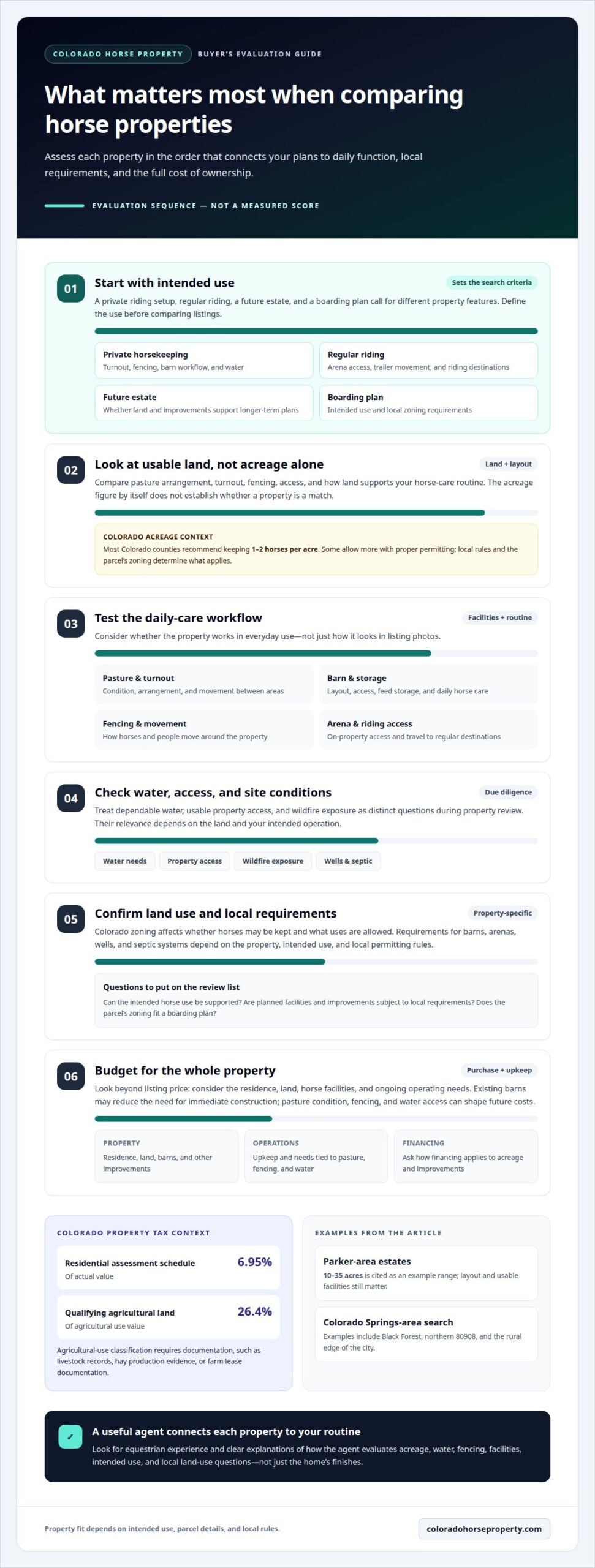
Colorado zoning rules affect whether horses may be kept on a property and what uses are allowed. Most Colorado counties recommend keeping 1-2 horses per acre, although some allow more with proper permitting; local rules and the parcel’s zoning determine what applies.
Requirements for barns, arenas, wells, and septic systems depend on the property, intended use, and local permitting rules. During a property review, an experienced agent can help identify questions to address and organize due diligence around relevant local requirements.
Ask about the agent’s experience with horse properties and familiarity with Colorado land use. Find out how they assess acreage, water, fencing, and existing improvements, and ask for an example of how they matched a buyer’s horse-care needs to a property.
- Property function: Can the agent assess pasture condition, barn access, and the layout for daily horse care?
- Intended use: Can they help identify zoning questions tied to keeping horses or operating a boarding facility?
- Resale considerations: Can they explain how equestrian features may affect future selling appeal?
Use those conversations to set priorities before touring. A buyer looking for private turnout near Black Forest may value different land and access features than someone seeking a suburban home with a small horse setup. Clear priorities make comparisons more useful.
During conversations, look for clear explanations of how an agent’s firsthand horse ownership and riding experience informs property evaluation. Practical familiarity can help buyers frame questions about whether the land and rural features suit their intended use, rather than relying on a polished presentation alone.
For horse property in Colorado Springs, make sure the agent can assess land use and rural features alongside home finishes. This broader evaluation helps keep attention on the property’s function as well as its appearance when deciding which options merit closer consideration.
Matching buyers with an equestrian real estate agent
Start with how you intend to use the property, not a generic checklist. An agent familiar with horse properties can connect a property’s layout and features to your priorities. A private riding setup, for example, calls for different considerations than a facility planned for boarding. A practical first step in finding an equestrian buyer’s agent in Colorado is determining whether the agent understands your intended use.
Turn your plans into clear search criteria before reviewing listings. Separate essential features from preferences: horse capacity, pasture arrangement, barn configuration, arena access, water needs, and distance to regular riding destinations. Parker-area estates described as covering 10-35 acres illustrate why acreage alone doesn’t define a match; the land’s layout and usable facilities matter too.
Treat wildfire exposure, water, and property access as separate due-diligence questions. Wildfire exposure can affect how you evaluate the land and its surroundings, while dependable water and usable access matter to daily horse care and property operations. An agent can help organize these questions for property review.
Ask how the agent will turn your priorities into a focused shortlist. A useful answer connects each property’s features to your routine, such as moving horses between pasture and barn, storing feed, or reaching an arena. It should also explain how the agent evaluates equestrian features beyond acreage and listing photos. Finding an equestrian buyer’s agent in Colorado means finding someone who can make those details useful when comparing properties.
- For private horsekeeping: Compare turnout, fencing, barn workflow, and water access against your horse-care routine.
- For regular riding: Include arena access, trailer movement, and travel to your usual riding destinations.
- For a future estate: Consider whether the land and improvements support your longer-term plans.
- For a boarding plan: Treat intended use and local zoning as core search criteria.
A tailored search can make those criteria easier to apply across listings. Explore an AI-powered horse property search to focus your Colorado property search on equestrian features.
Budget and financing considerations
Set your budget around the whole property, not just its listing price. Consider the residence, horse facilities, land, and ongoing operating needs. An existing barn may reduce the need for immediate construction, while pasture condition, fencing, and water access can shape future costs.
Colorado price ranges vary by location and property type.
Financing depends on the property and your circumstances. Ask how financing may apply to a residence combined with acreage, barns, or other improvements. A horse-property agent can help identify property details relevant to the purchase and discuss financing questions as part of your planning.
Property taxes also deserve attention. Colorado’s residential assessment schedule applies a rate of 6.95% of actual value; qualifying agricultural land may be assessed at 26.4% of agricultural use value. Agricultural-use classification requires documentation, such as livestock records, hay production evidence, or farm lease documentation. On a 10-35 acre equestrian estate, the estimated annual tax reduction from agricultural-use classification is $4,000-$12,000. Stopping agricultural use after purchase can trigger reassessment and potential back-tax liability under Colorado’s deferred-tax provisions.
- Compare property types: Separate horse-property asking prices from broad residential market figures.
- Review financing fit: Include the home, acreage, and equestrian improvements in the property discussion.
- Assess tax classification: Consider current use, supporting records, and the effect of future changes.
Build a budget for each property before making an offer. For example, compare a Black Forest property’s existing facilities with a Parker estate’s land and improvements, then consider financing and ongoing costs together.
Buyers considering a Colorado boarding facility should check whether zoning allows the property to be used for that purpose. Buyers of Colorado equestrian properties should consider an agent with firsthand horse ownership and riding experience when evaluating a property and its fit for their plans.
What does an equestrian buyer’s agent do in Colorado?
An equestrian buyer’s agent helps you find a suitable horse property by connecting your priorities with available listings. The search can reflect how you plan to use the land, whether for private horsekeeping, riding, or another purpose. This focus helps narrow choices beyond home size and appearance.
For each property, assess how the home, land, and equestrian features work together. Barn placement, pasture access, fencing, water, and trailer movement all affect daily use. A property with an arena, for example, may still fall short if its layout does not support your horse-care routine.
Due diligence is another important part of the purchase. A horse-property agent can help coordinate structural inspections of the home, barn, and other buildings. Inspection findings give you practical information about the structures before you proceed. The agent can also help organize questions about intended use, local zoning, and existing improvements.
Throughout the transaction, the agent helps guide property evaluation and the steps toward closing. This includes keeping the search focused and coordinating details involved in the purchase. A Colorado acreage property may combine a home, outbuildings, and land features that need to be considered together.
- Search: Match listings to your intended horse use and essential property features.
- Evaluate: Consider the home, acreage, barn, and other improvements as one working setup.
- Inspect: Arrange structural inspections for the residence, barn, and other buildings.
- Proceed: Keep property review and transaction steps aligned with your priorities.
Before touring, clarify which features are essential and which are flexible. A buyer focused on a functional barn may rank that above finished home details; another may prioritize usable acreage. A focused Colorado horse-property search can help put those preferences into practice.
Colorado Horse Property: Buyer Representation
Colorado Horse Property provides Buyer Representation for people seeking equestrian properties that fit their plans. Use this service when you’re ready to move from general research to a focused search and purchase process.
AI-Powered Horse Property Search helps you explore listings by equestrian features, while Buyer Representation supports your search and purchase. Transaction Management helps coordinate the process as you move toward a decision. Together, these services connect the search for a suitable property with the steps involved in moving a purchase forward.
Bring your priorities into the search, including intended horse use, land needs, and essential facilities. This gives your search direction as you consider Colorado properties and assess how each fits your plans.
Contact Colorado Horse Property to discuss your equestrian property search.
Move your horse-property plans forward
Turn your priorities into a defined search plan. Decide which features are essential for your horses and daily routine, then identify where you can be flexible. That clarity helps keep property decisions tied to how you intend to use the land.
A focused approach to finding an equestrian buyer’s agent in Colorado brings your property goals and purchase decisions into one process. Colorado Horse Property offers Buyer Representation, AI-Powered Horse Property Search, and Real Estate Listing Services for people exploring Colorado equestrian properties. Reach out when you’re ready to discuss your search and the kind of property that fits your plans.
Contact Colorado Horse Property to take the next step toward your Colorado horse property.
Frequently Asked Questions
How are buyer-agent fees and commissions handled in Colorado?
Buyer-agent compensation depends on the agreement and transaction, so do not assume one rate applies to every purchase. Before representation begins, review how the fee is calculated, when it is due, and how it will be paid. Clarify whether the written terms describe a commission, another fee structure, or compensation connected to the transaction. Review the complete terms in writing before committing.