
Imagine closing on a ten acre parcel in Douglas County only to find out the local zoning ordinance limits you to exactly zero horses. You’ve likely spent months scrolling through listings of beautiful barns and rolling pastures, dreaming of that perfect rural lifestyle. It’s easy to fall in love with a mountain view while overlooking the complex fine print that governs the land underneath it.
Understanding what to know before buying horse property in Colorado is the difference between a dream realized and a six figure legal headache. We’ve spent nearly four decades helping buyers master the technicalities of Colorado water rights and zoning laws before they sign a contract. Our goal is to ensure your investment is legally protected and your equine lifestyle is secure from day one.
This guide provides a clear due diligence checklist, a breakdown of how “Animal Units” impact your herd size, and the essential details of well and septic inspections you need to verify before closing.
Key Takeaways
- Decode “Animal Unit” (AU) restrictions to determine exactly how many horses a specific county legally allows on your acreage, regardless of the listing description.
- Understand the “Prior Appropriation” doctrine and the vital difference between domestic and household-only well permits to secure your livestock’s water future.
- Identify the structural requirements for Colorado barns and the specific drainage features that prevent arena failure in unique regional soil types.
- Master what to know before buying horse property in Colorado by following a non-negotiable due diligence checklist for well, septic, and private road maintenance.
- Leverage specialized equine expertise and AI-powered search tools to find properties that standard MLS filters and generalist agents often overlook.
Understanding Colorado Zoning and “Animal Unit” Restrictions
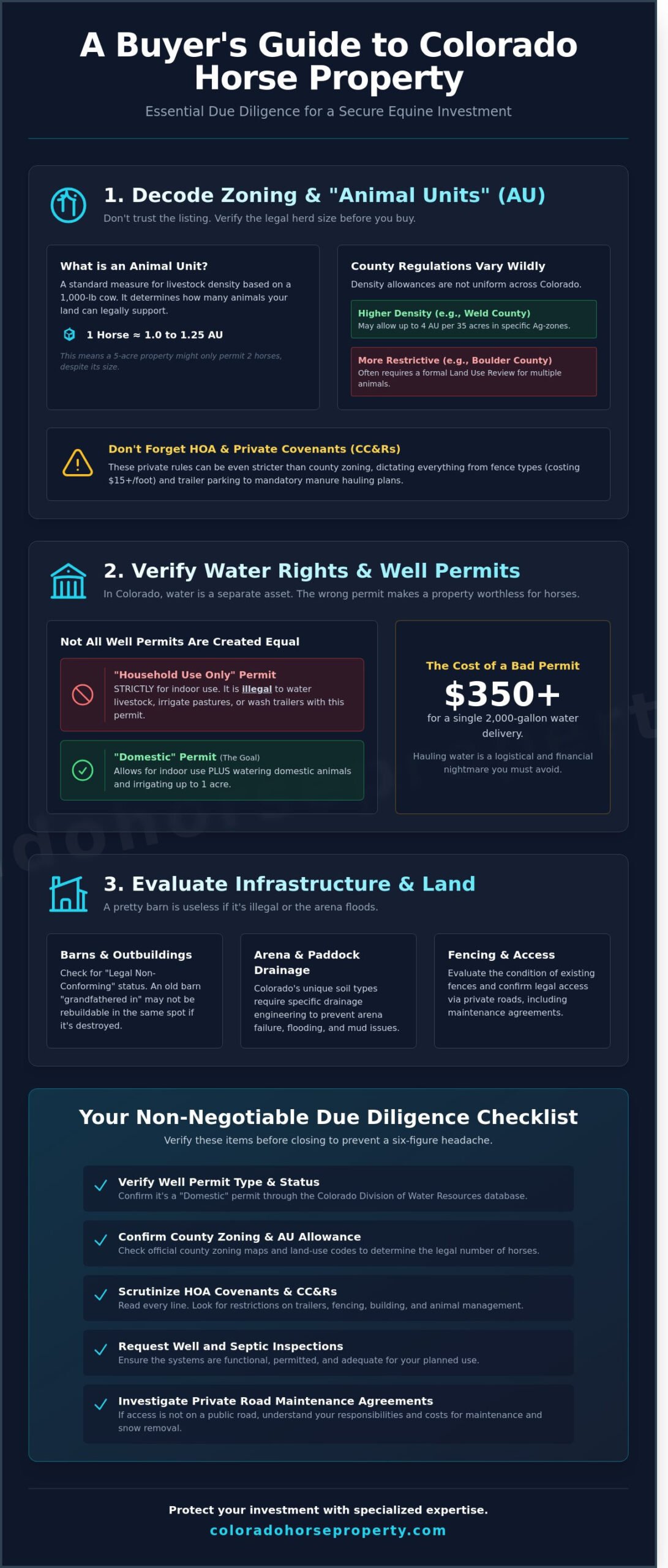
Buying your dream ranch requires more than just looking at a barn and a fence. You need to understand how local governments define livestock density through “Animal Units” (AU). An AU is generally based on the nutritional needs of one 1,000-pound cow and her calf. In many Colorado counties, a horse is calculated as 1.0 or 1.25 AU. Just because a listing says “horse property” doesn’t mean the law agrees. You might find a beautiful five-acre lot that only legally permits two horses, which could ruin your plans for a four-horse boarding business. An Animal Unit Equivalent is the standard for local land-use density.
Zoning laws often intersect with environmental protections and resource management. For instance, Colorado water law dictates how much water you can pump from a domestic well to sustain your livestock. If your zoning allows for ten horses but your well permit only covers two, you’ll face a legal and logistical nightmare. Understanding these technicalities is a vital part of what to know before buying horse property in Colorado.
To better understand this concept, watch this helpful video:
County vs. State Regulations
Weld County often allows higher density, sometimes up to 4 AU per 35 acres in specific agricultural zones. Boulder County is significantly more restrictive, often requiring a Land Use Review for anything exceeding basic residential limits. Always verify the “Legal Non-Conforming” status for older properties. If a barn was built in 1978 before current setbacks existed, it might be “grandfathered in,” but if it burns down, you might not be allowed to rebuild it in the same spot. Check official zoning maps and land-use codes before signing any contracts.
HOA and Private Covenants
Marketing materials often highlight “equine-friendly” features while ignoring the fine print in the Covenants, Conditions, and Restrictions (CC&Rs). An HOA can ban trailer parking on the street or mandate expensive three-rail white vinyl fencing that costs over $15 per linear foot. Reviewing these documents during your due diligence period is non-negotiable. Some neighborhoods even dictate manure management plans, requiring you to haul waste off-site weekly at your own expense. This is a critical factor in what to know before buying horse property in Colorado to ensure your lifestyle remains uninterrupted.
The Critical Reality of Colorado Water Rights and Well Permits
Water is the most valuable asset on any rural parcel. In Colorado, water is governed by the “Prior Appropriation” doctrine. This system dictates that the first person to take water from a stream and put it to beneficial use holds the senior right. Junior rights holders often see their supply cut off during drought cycles. Understanding Colorado water rights is essential because your ability to hydrate your herd depends entirely on where you sit in this priority line. If you aren’t first in time, you aren’t first in right.
One of the most common mistakes buyers make is assuming every well permit allows for livestock. It doesn’t. A “Household Use Only” permit strictly limits water to indoor use. You cannot legally use it to water horses, wash trailers, or irrigate a small paddock. For equine enthusiasts, a “Domestic” permit is the requirement. It typically allows for the watering of domestic animals and up to one acre of irrigation. You can verify any permit status through the Colorado Division of Water Resources online database using the permit number or legal description. If a well fails or the permit is restricted, the cost of hauling water can exceed $350 for a single 2,000-gallon delivery. This logistical nightmare is a key factor in what to know before buying horse property in Colorado.
Well Permits and Augmentation Plans
If a property has a restricted permit, you might need an augmentation plan to legally water your horses. These are court-approved plans that replace the water you consume to protect senior water rights holders downstream. They’re common in larger equestrian operations but add significant layers of cost and legal oversight. Always require a well production test during your due diligence period. A flow rate of 5 gallons per minute (GPM) is the standard benchmark for a functional horse property. Don’t skip water quality testing; high mineral content or bacteria can lead to chronic health issues in your horses. If you’re unsure about a specific listing, our team can help you search for properties with verified water sources.
Irrigation Ditches and Surface Rights
Surface water rights often come as “shares” in a ditch company. These shares allow you to pull water from a shared ditch system to irrigate your pastures. Owning land with a ditch running through it doesn’t give you the right to the water; you must own the actual shares. Additionally, ditch companies have legal easements to access your land for maintenance. You can’t build fences, barns, or structures that block their equipment. For a deeper dive into these complexities, read our guide on Water Rights in Colorado: What Every Buyer Must Know. This remains a primary element of what to know before buying horse property in Colorado to ensure your pastures stay productive through the dry summer months.
Evaluating Infrastructure: Barns, Arenas, and Colorado Soil
Buying a ranch is about more than a pretty view. You must inspect the structural integrity of every building on the site. Colorado snow loads are heavy. In the foothills and mountains, roofs should be rated for at least 40 to 60 pounds per square foot to handle wet spring snows. Check for internal support beams that show signs of bowing or moisture damage from previous winters. This structural check is a vital part of what to know before buying horse property in Colorado, as retrofitting a weak roof can cost tens of thousands of dollars.
Soil quality dictates your long-term maintenance costs. The Front Range is notorious for “bentonite,” an expansive clay that swells when wet and shrinks when dry. This movement cracks foundations and ruins arena bases. Before you close, check the property’s soil maps. If you see deep cracks in the ground or doors that won’t shut in the barn, you’re likely dealing with expansive soil. In 2026, building a professional-grade 100×200 outdoor arena with a proper multi-layer base and drainage costs between $40,000 and $75,000. Don’t assume a flat piece of dirt is “arena ready.” Drainage is the most overlooked feature. A poorly graded arena becomes a swamp for days after a single afternoon thunderstorm.
Equestrian Facility Essentials
Standard 12×12 stalls are the baseline for safety and comfort. Proper ventilation is mandatory in Colorado’s dry climate to prevent respiratory issues like heaves. Look for barns with high ceilings and ridge vents. Fencing is another major expense. Barbed wire is a deal-breaker for most horse owners because it causes devastating injuries. High-visibility tape, smooth wire with an electric top strand, or traditional post-and-rail are the preferred standards. For a deeper dive into these choices, read our guide on Horse Barns for Sale: Buying vs. Building Your Colorado Equestrian Dream.
Pasture Management and Soil Health
Colorado land is often fragile. Most small-acreage properties cannot support full-time grazing. According to the CSU Extension’s research on Equine Management, it can take 25 to 40 acres of native range to support one horse without supplemental hay. If you’re looking at 10 or 20 acres, plan to feed hay year-round. You also need to identify noxious weeds like Leafy Spurge or Dalmatian Toadflax. These invasive species can take over a pasture and are toxic to livestock. Evaluate the terrain carefully. Flat land is easier for hay production, but sloped land provides natural drainage and better muscle conditioning for your horses during turnout.
Understanding these physical limitations is essential for what to know before buying horse property in Colorado. Infrastructure costs for 2026 are high. Adding a three-stall shed-row barn now averages $25,000 to $45,000 depending on materials. Always factor these potential upgrades into your initial offer price.
The Due Diligence Checklist for Rural Colorado Estates
Buying a ranch isn’t like buying a suburban home. One of the most critical things what to know before buying horse property in Colorado is that the burden of discovery lies entirely with you. You’re buying an ecosystem, not just a house. A professional well and septic inspection is non-negotiable. In rural Colorado, approximately 15% of private wells fail to meet state drinking water standards or yield less than the 5 gallons per minute required for a household and livestock. You don’t want to find out your well is dry after the closing date.
Legal access is another hurdle. Many rural properties are reached via unpaved or private roads. You must verify that a recorded maintenance agreement exists. Without one, you might find yourself solely responsible for a $10,000 snow removal bill or a $25,000 gravel resurfacing project. Always review the Improvement Location Certificate (ILC). This document reveals if a neighbor’s fence is two feet onto your land or if a utility company has the right to dig up your primary riding arena.
Don’t overlook the agricultural tax status. Properties that qualify for “Greenbelt” status can see property tax reductions of 50% to 80%. To maintain this, you’ll need to prove the land is used for a primary purpose like grazing or hay production. Losing this status because of a filing error can cost you thousands of dollars annually.
Septic and Environmental Systems
Many Colorado counties, including Jefferson and Douglas, require a Use-to-Transfer (UTT) inspection before a sale. This ensures the system is sized correctly for the home’s occupancy. If you plan to build a larger barn or a guest house in 2026, you’ll need a soil “perc” test to see if the ground can handle increased drainage. Additionally, you must have a plan for manure disposal. State regulations prohibit runoff into local watersheds, so budget for a designated composting site or a removal service that visits every 30 days.
Access and Easements
Your 40-foot gooseneck trailer needs room to breathe. Confirm that the driveway and gates offer at least a 14-foot height clearance and a 20-foot turn radius. Check for “floating” easements that might allow neighbors to cross your pastures. Ideally, your property should offer direct or nearby gate access to BLM or National Forest land. This adds significant value and eliminates the need to trail your horses to every ride.
Ensure your investment is protected by working with experts who understand rural land. View our latest Colorado ranch listings to find a property that meets your specific equine needs.
Why Expert Representation Matters for Equestrian Assets
Buying a home in a Denver suburb is a standard transaction; buying a ranch in the Front Range is a complex land acquisition. A “city agent” often focuses on granite countertops and school districts. They might miss critical red flags like restrictive covenants that prohibit livestock or a well permit that doesn’t allow for outdoor watering. Understanding what to know before buying horse property in Colorado requires an expert who evaluates the land first and the house second.
Our team brings 40 years of specialized experience to the table. We analyze soil composition for arena drainage and verify that zoning laws allow for the specific number of horses you plan to keep. Moving from a 0.20-acre suburban lot to a 35-acre ranch involves a steep learning curve. We bridge that gap by identifying properties that provide the infrastructure you need to succeed from day one. Our seasoned approach ensures you don’t get stuck with a property that looks beautiful but lacks the legal water rights to sustain your animals.
Leveraging AI in Your Property Search
Traditional MLS filters are notoriously bad at identifying true equestrian assets. Our proprietary AI-powered search platform goes deeper. It scans thousands of listings to identify specific keywords like “indoor arena,” “loafing shed,” and “senior water rights” with 98% accuracy. This technology saves you dozens of hours by vetting agricultural viability before you ever step foot on the property. If a property claims to be “horse-ready” but lacks the appropriate acreage for your county’s animal units, our system flags it. For a deeper dive into the technical side of the market, read our Equestrian Real Estate Colorado: A Complete Buyer’s Guide.
The Realty Oasis Advantage
We don’t just find you a house; we build a support system. Our network includes specialized title companies, water rights attorneys, and ranch-focused transaction managers who understand the nuances of rural Colorado contracts. We focus on your “Lifestyle and Dreams” by ensuring the property supports your specific riding discipline, whether that’s cutting, dressage, or trail riding. We’ve spent nearly four decades perfecting this niche, helping buyers find what to know before buying horse property in Colorado through hands-on guidance.
Closing the deal is just the beginning of your journey. We help manage the transition to ranch life by connecting you with trusted local hay suppliers and fence contractors. Our goal is to ensure your investment is protected and your horses are safe. Start your AI-powered horse property search today and see the difference four decades of experience makes.
Secure Your Colorado Equestrian Legacy
Owning a ranch in the Centennial State is about more than finding a beautiful view. You must navigate complex water rights and specific county “animal unit” restrictions that dictate how many horses your land can actually support. Understanding the technical side of well permits and soil health is exactly what to know before buying horse property in Colorado to avoid costly legal mistakes in 2026. These details determine whether your property remains a functional facility or becomes a liability.
We’ve spent nearly 40 years helping buyers find the right acreage. Our team includes licensed experts specialized in the fine details of Colorado zoning and water law. We combine this deep experience with proprietary AI search technology to filter listings by the exact features you need, from arena size to pasture quality. Don’t leave your rural investment to a generalist who doesn’t understand the dirt.
Find your next Colorado Horse Property with our AI-powered search and take the first step toward your lifestyle and dreams today. The Rocky Mountain landscape is waiting for you and your horses.
Frequently Asked Questions
How many acres do I need for two horses in Colorado?
You generally need a minimum of 2.5 to 5 acres for two horses in most Colorado counties. For example, Douglas County requires 2.5 acres for the first horse and additional space for more animals. You’ll need larger parcels if you plan on rotational grazing rather than supplemental feeding. Always check the specific zoning codes for your county, as Larimer and El Paso counties have different density requirements.
Can I use a household-use-only well to water my horses?
No, a household-use-only well permit strictly prohibits using water for livestock or any outside irrigation. This is a critical detail in what to know before buying horse property in Colorado. You must have a domestic well permit or a stock well permit to legally water your animals. If the property is under 35 acres, the Colorado Division of Water Resources often restricts these permits to indoor use only.
What is the agricultural tax status and how do I qualify?
Agricultural tax status reduces your property taxes by up to 50 percent compared to standard residential rates. To qualify under Colorado Revised Statute 39-1-102, the land must be used for a profit-motivated agricultural purpose, like hay production or breeding livestock, for at least two consecutive years. Simply keeping horses for pleasure doesn’t qualify you. You’ll need to provide proof of income or a valid lease agreement to the county assessor.
What are the most common deal-breakers found during a horse property inspection?
Structural foundation issues in barns and failing septic systems are the two most frequent deal-breakers. In 2025, roughly 15 percent of inspections failed because of inadequate drainage that caused soil erosion near stalls. High levels of nitrates or bacteria in the well water also stop sales. Replacing a commercial-grade septic system can cost $30,000 or more, which often leads buyers to walk away from the deal.
Do I need a special permit to build a riding arena in Colorado?
Yes, most Colorado counties require a grading permit for any arena project over 5,000 square feet. You’ll also need a building permit if you plan to add a roof or permanent lighting. Boulder County has strict site-review processes for any structures exceeding 1,000 square feet. Failure to secure these permits can result in fines starting at $500 per day and legal orders to remove the structure entirely.
Is it better to buy raw land and build, or find a property with existing barns?
Finding a property with existing infrastructure is usually more cost-effective in 2026. Building a 4-stall barn with a tack room currently costs between $150 and $250 per square foot due to high material prices. Buying existing structures saves you the 12 to 18 month wait time for permits and construction. Ensure the existing layout fits your specific equine needs so you don’t spend more on renovations later.
How do I check if a property has access to public riding trails?
Use the Colorado Trail Explorer (COTREX) app or visit the local county GIS mapping website to verify trail easements. Don’t rely on verbal promises from a seller or agent. Check for recorded equine easements on the property deed. In areas like Jefferson County, proximity to a trailhead can increase property value by 10 percent, so verifying legal access is essential for your lifestyle and dreams.
What is the average cost of horse property in the Colorado Front Range in 2026?
The average price for a 5-acre horse property with a functional barn in the Front Range is $1.2 million as of early 2026. Prices in premium areas like Parker or Niwot often exceed $2.5 million for similar acreage. This data helps you understand what to know before buying horse property in Colorado. Budget an additional 2 percent of the purchase price for specialized inspections and water rights valuations.