
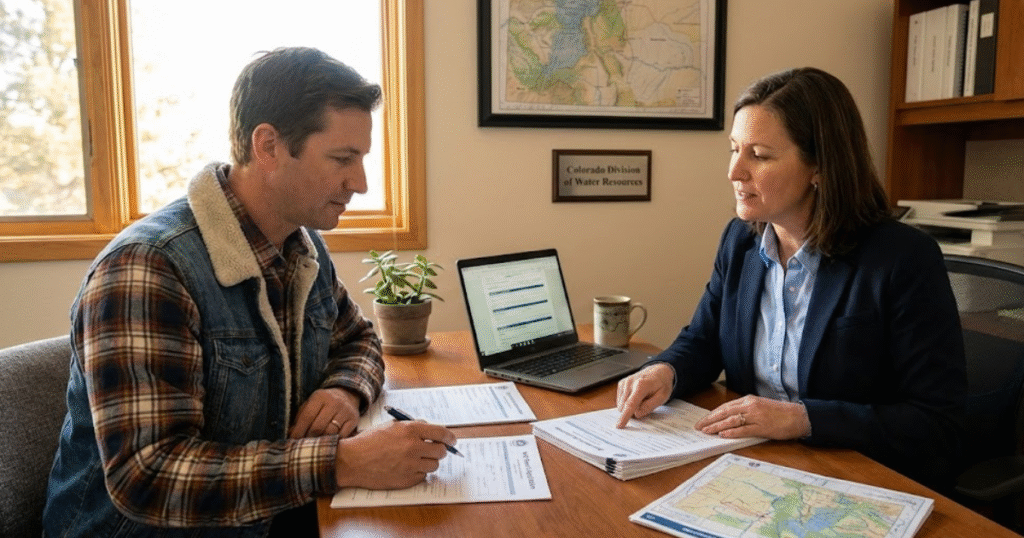
Many rural Colorado wells are “Household Use Only” no watering horses or irrigating pasture allowed. Domestic permits are required for… livestock.
Just because water comes out of a spigot near the barn doesn’t mean it’s legal to use for horses.
What Kind of Well Permit Does the Property Have?
Quick Summary: The Most Critical Paperwork You Will Ever Read
- The Two Big Types: In Colorado, most rural wells fall into two categories. "Household Use Only" means you cannot use a drop of water outside the house (no horses, no garden). "Domestic" means you can typically water livestock and irrigate up to one acre.
- The Deal-Breaker: If you buy a horse property with a "Household Use Only" permit, you legally cannot water your horses from that well. You would have to haul water in or face fines.
- The 35-Acre Rule: Generally, parcels of 35 acres or more are eligible for Domestic permits. Parcels under 35 acres are often restricted to Household Use unless they have a specific "grandfathered" status or an augmentation plan.
- Verify, Don't Trust: Never assume a well is legal just because you see a hydrant near the barn. The seller might be using it illegally. You must pull the permit records from the State Engineer's Office.
You found a beautiful 5-acre property in the foothills. It has a barn, a fenced pasture, and a water hydrant right next to the stall. It looks perfect.
But before you make an offer, you have to ask the single most important question in Colorado rural real estate: "What does the well permit say?"
1. The Danger Zone: "Household Use Only"
This is the permit that breaks hearts. You will often see this on parcels smaller than 35 acres, especially in the mountains or foothills.
- The Restriction: This permit allows water for use inside the single-family dwelling only.
- What It Means for Horses: You cannot run a hose outside. You cannot fill a water trough. You cannot wash your truck. You cannot water a garden.
- The Reality Check: If you buy this property, you have no legal way to water your horses unless you truck in water from a municipal source or buy a separate water tap (if available).
2. The Golden Ticket: "Domestic"
This is the permit every horse owner needs.
- The Allowance: A Domestic well typically allows for in-house use, watering of domestic animals (livestock), and irrigation of up to one acre of land.
- The "35-Acre" Rule: In Colorado, if you own 35 acres or more, you are generally entitled to this type of permit. This is why you see so many ranches that are exactly 35 acres.
- Grandfathered Wells: Some properties under 35 acres have Domestic wells if they were drilled before May 8, 1972. These are incredibly valuable "grandfathered" rights.
3. The Workaround: Augmentation Plans
What if you find a perfect 10-acre property that only has a Household Use permit? Is there any hope?
Sometimes, yes. But it is complicated.
- Augmentation: This is a court-approved plan where you pay to put water back into the river system to offset what you pump out.
- The Cost: If the property is already part of a subdivision with a blanket augmentation plan, you might be able to upgrade your permit for a fee. If not, buying your own augmentation water can cost tens of thousands of dollars and take months of legal work.
4. How to Verify the Permit
Never rely on the listing description. Real estate agents often confuse "Domestic" with "Household" because they don't know the difference.
- Get the Permit Number: Ask the seller for the Well Permit Number. It usually looks like "12345-F" or similar.
- Search the DWR Database: Go to the Colorado Division of Water Resources website and use their "Well Permit Search" tool.
- Read the "Conditions of Approval": Look for the section on the permit that explicitly states "Proposed Use." It must say "Livestock" or "Domestic Animals." If it says "Ordinary household purposes inside one single family dwelling," it is a no-go for horses.
We Don't Let You Buy a Dry Well
Water law is complex, and the stakes are high. A horse drinks 10 to 15 gallons of water a day. You cannot fake that.
When we represent you, we pull the well permit before we even write the offer. We verify the flow rate, the allowed uses, and the pump test records. We ensure that your horses will have legal, reliable water from day one.
Contact Us Today to verify the water rights on a property you are eyeing.
Browse Active Colorado Horse Properties with verified Domestic wells. View All Available Listings
Frequently Asked Questions (FAQ) About Well Permits
Can I upgrade a Household Use permit to a Domestic permit later?
Usually, no. Unless you can purchase augmentation water (which is rare and expensive) or acquire more land to reach 35 acres, the permit status is permanent.
What happens if I get caught watering horses on a Household permit?
The State Engineer can issue a Cease and Desist order. You can be fined, and they can legally shut off your well until you comply. It also opens you up to lawsuits from neighbors who own senior water rights.
Does a "cistern" solve the problem?
Yes, but at a cost. If the well is restricted, you can install a large underground tank (cistern) and pay a water delivery company to fill it with trucked-in municipal water. This is legal, but it is expensive and requires strict management during winter storms when trucks can't deliver.