
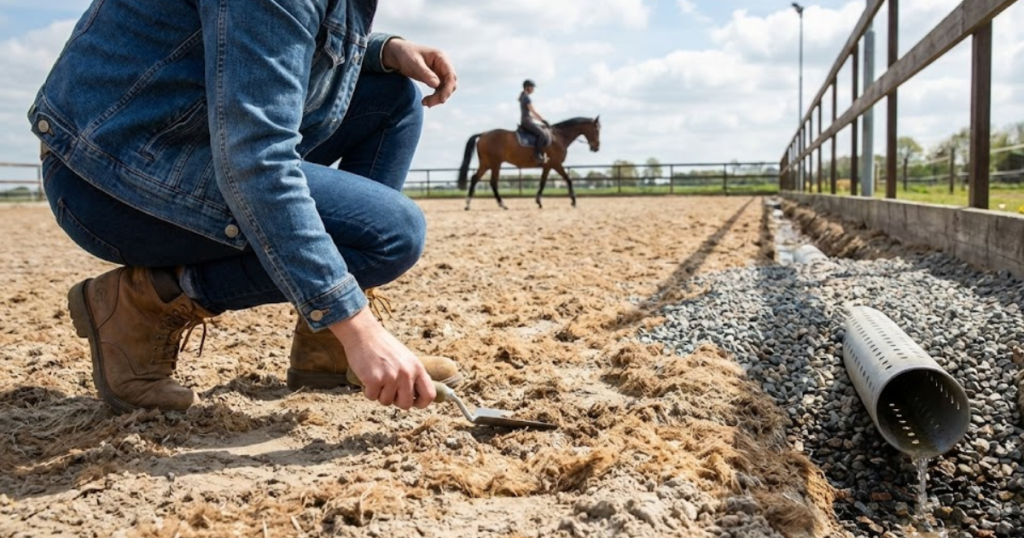
Arenas are the ultimate optical illusion: a flat rectangle of “dirt” that can still chew up tendons, ruin shoes, and hand you a surprise $20,000–$40,000 repair bill after closing.Lorem ipsum dolor sit amet, consectetur adipiscing elit. Ut elit tellus, luctus nec ullamcorper mattis, pulvinar dapibus leo.
What Kind of Footing Is in the Arena and Does It Have Proper Drainage?
Quick Summary: Saving Your Horse’s Legs
- The base is everything: The pricey part isn’t the sand on top. It’s the compacted “road base” underneath. If the base is soft or uneven, hooves punch through and injuries follow.
- Depth matters: Too deep (often 3–4+ inches) strains soft tissue. Too shallow increases concussion. Most arenas live in a “Goldilocks” range around 2.5–3 inches.
- Drainage is non-negotiable: Outdoor arenas need a gentle 1%–2% slope or a crown so water sheds fast. Standing water softens the base and creates boggy failure zones.
- Sand quality changes everything: Round sand rolls under the hoof. Angular, washed sand locks together for traction and support.
If the footing is wrong, your horse pays first. If the base is wrong, your wallet pays forever. The goal isn’t “pretty arena.” The goal is “consistent, safe, predictable ground.”
1. The Foundation: The Base Is Everything
Think of arena footing like a rug. The top layer is the rug. The base is the floor underneath. If the floor is warped, the nicest rug in the world still trips you.
What a proper base should be
- Material: Compacted limestone, granite, or true road base.
- Depth: Commonly 4–6 inches of compacted base (your build may vary, but “thin and soft” is never the answer).
- Feel: Firm. Ideally “hard as concrete,” because that’s what keeps the top layer consistent.
The “Punch Through” test
- Step into the footing and press your heel down.
- Good sign: You hit a solid, flat layer quickly.
- Bad sign: Your heel keeps sinking, or you feel mush instead of firm base.
- Big warning: If base rock is mixing into the sand, the arena is essentially failing. Fixing it often means stripping footing, regrading, recompacting, and rebuilding.
Check high-traffic zones: the rail, the landing side of jumps, and corners. That’s where base failure shows up first.
2. Footing Depth: The Goldilocks Zone
Footing depth is where arena injuries get sneaky. Too deep feels soft and “cushy” to humans, but horses do the equivalent of running in loose beach sand.
- Too deep: Often 3–4+ inches creates extra strain on tendons and ligaments, especially in turns and transitions.
- Too shallow: Increases concussion, joint stress, and bruising.
- Target range: Many general-purpose arenas land around 2.5–3 inches, with discipline-specific exceptions.
Arenas don’t “wear out” evenly. If the middle is bare and hard while the outside is deep and churned, you’re not riding in one arena—you’re riding in three different surfaces.
3. The Material: Angular vs. Round Sand
“Sand is sand” is the sentence that starts the injury timeline. The shape of the grains changes traction, stability, and how the hoof loads the limb.
Round sand (the problem)
- River or beach-style sand has rounded particles.
- Rounded grains roll against each other like marbles.
- That “slippery” feel can cause excess sliding and joint strain (think hocks, stifles, and soft tissue trying to stabilize).
Angular sand (the goal)
- Washed, angular concrete sand or masonry sand tends to lock together.
- That locking action creates traction and a more predictable ride.
- It also holds grade better when maintained, so you’re not constantly chasing uneven spots.
Additives you might see
- Fiber/textiles: Stabilize footing and can help retain moisture (useful in dry climates).
- Rubber: Sometimes added for cushion, but it doesn’t fix a bad base or bad grading.
4. Drainage: Slope, Crown, and the Puddle Test
Outdoor arenas have one job during a storm: move water off the riding surface quickly. If water sits, it turns your “hard base” into a soft, shifting mess.
What proper drainage looks like
- Slope/crown: A gentle 1%–2% slope, often with a slight crown in the center to shed water toward the edges.
- Fast runoff: Water should not linger in low spots or corners.
- Consistent grade: A perfect rectangle that’s perfectly flat is usually not a drainage win.
The Puddle Test (simple, brutally honest)
- Look for standing water, water lines, or stains on boards/posts.
- Check for deep ruts where water has channeled through the footing.
- If puddles are normal, base softening is already in progress.
Once the base softens, hooves punch through. Then footing and base mix. Then your arena becomes a repair project with a fancy fence around it.
5. Indoor Arenas: Dust, Moisture, and Reality Checks
Indoors, the enemy isn’t rain. It’s dust. Dry footing breaks down into fine particles that can be rough on both horse and human lungs.
Questions that matter immediately
- Watering system: Is there an overhead sprinkler system, a water wagon plan, or an actual routine?
- Moisture management: If it’s constantly bone-dry, dust control becomes a daily battle.
- Dust binders: Some barns use magnesium chloride to help retain moisture. It can work well, but like everything: maintenance matters.
Stand in the arena while a horse trots by. If you get a visible dust cloud, you’re not “being picky.” You’re seeing a management cost the listing didn’t advertise.
6. Red Flags Buyers Miss
- Soft corners or boggy spots: Often indicates poor slope, clogged drainage, or base softening.
- Base rock showing through: Usually means footing has migrated and the surface is becoming hard and concussive.
- Uneven depth: Deep on the outside, bare in the middle, churned in the corners—classic “needs consistent maintenance” clue.
- Round/fill sand: Feels cheap because it is. It tends to be unstable and can worsen sliding.
- “It rides great” with no proof: Ask when it was last rebuilt, what material was used, and how it’s watered/dragged.
We Dig Deeper (Literally)
When we tour a property, we don’t just admire the arena fence line. We check the footing depth in high-traffic areas. We look for base integrity problems. We watch for drainage clues that hint at a future rebuild.
Contact Us Today if you want help evaluating arenas so you don’t inherit someone else’s shortcuts.
Browse Active Colorado Horse Properties: View All Available Listings
Frequently Asked Questions (FAQ) About Arena Footing
How deep should arena footing be?
For many general disciplines (dressage, jumping, pleasure), a common target is around 2.5 to 3 inches. Deeper footing can be tiring and risky for tendons. Too shallow increases concussion. Discipline, sand type, and additives can shift the “right” number, but consistency matters as much as the depth.
Can I just add more sand to fix a bad arena?
Not if the base is the problem. Adding sand over an uneven, soft, or rocky base is like putting a plush rug over a broken floorboard. The arena may feel better for a minute, but the underlying failure still wins. Fix grading and compaction first.
How do I know if drainage is failing?
Look for puddles, ruts, soft corners, and water staining. A properly built outdoor arena sheds water quickly via a gentle slope or crown. If water sits, it softens the base and creates punch-through zones that can destroy the footing/base separation.
What sand should I avoid?
Round sand (often river or fill sand) tends to roll under the hoof and can feel unstable. Washed, angular sand is generally preferred because it locks together for traction and support.
How often should an arena be dragged/harrowed?
Often. Many barns drag every few rides (or daily in heavy use) to keep depth consistent and prevent a deep rail with a bare, hard center. The “right” frequency depends on usage, moisture, and footing type—but “rarely” is how arenas become uneven fast.