
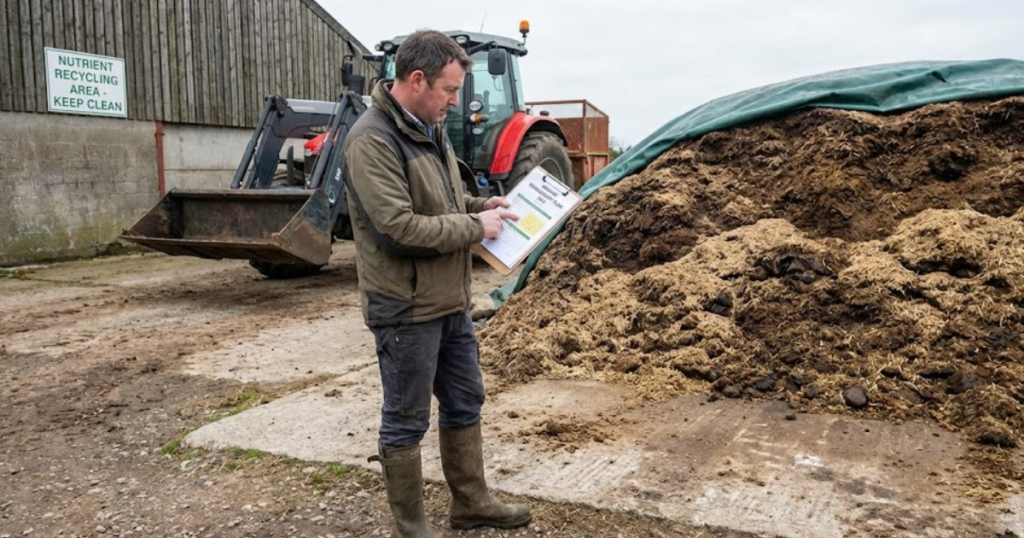
You buy the farm for the horses. You rarely think about what comes out of the horses.
But waste management is the single biggest daily chore on a horse property. It affects your curb appeal, your relationship with neighbors, and the health of your herd.
When looking at a property, don’t just look at the clean stalls. Look out back. Is there a dumpster? A neatly turned compost row? Or is there a mountain of manure that has been growing since 1995? If it is the latter, you are inheriting an expensive cleanup project.
Here is how to evaluate the “poop logistics” of a new property.
What Is the Current Manure Management Plan?
Quick Summary: The 50-Pound Problem
- The daily reality: An average horse produces 50 pounds of manure per day. That is 9 tons per year, per horse. If you have 4 horses, you are managing 36 tons of waste annually.
- The “pile” is not a plan: Simply piling manure behind the barn eventually becomes a legal issue. Counties have strict rules about flies, odors, and runoff. If the pile gets too big or too close to the fence, neighbors will call the county.
- Haul away vs. spread: You usually have two choices: pay a service to haul it away (expensive but easy) or spread it on your pastures (free fertilizer but requires equipment).
- The Colorado compost challenge: Composting is the gold standard, but our dry climate can cause piles to mummify instead of decomposing unless you actively water and turn them.
Manure management is a system. If the property doesn’t have one, you will build one fast—because the pile never stops.
1. The Math: 9 Tons Per Horse
It is hard to visualize 50 pounds a day until you are shoveling it.
- The volume: One horse can fill a standard wheelbarrow daily.
- The annual load: With 4 horses, you generate enough manure to fill a large dump truck every few months.
- The space need: You need a designated “sacrifice area” or bunker to store material before disposal. A 10x10-foot spot isn’t enough. You need space for a tractor to turn and load.
Look for where the current owner puts manure. If you can’t see it anywhere, ask where it goes.
2. Option A: The Dumpster Service (Haul Away)
For properties under 10 acres, this is often the simplest—and sometimes the only legal—option.
How it works
- You rent a 10- to 30-yard dumpster from a waste company.
- You wheelbarrow stalls directly into it.
- When full, they swap it out.
The cost
- Expect $300 to $600 per month, depending on size and pickup frequency.
The benefit
- Clean and neighbor-friendly: fewer flies, less odor, no tractor required.
3. Option B: Spreading (The Cycle of Life)
If you have enough pasture (usually 10+ acres), you can recycle the nutrients—if you do it correctly.
The equipment
- You need a manure spreader (PTO-driven trailer).
- A new one can cost $5,000+; a used one might be $1,500.
The rule
- You can’t spread on frozen ground (runoff risk).
- You can’t spread on grass that is too short.
- You must rotate pastures.
The parasite risk
- Spreading fresh manure on grazing land can re-infect horses with worm larvae.
- You must drag/harrow and let the sun kill parasites for weeks before horses return.
4. Option C: Composting (The Gardener’s Dream)
This is the most eco-friendly method—but it takes work.
The process
- A 3-bin system is ideal.
- You pile manure, wet it, and turn it with a tractor every few weeks for oxygen.
- Proper compost can hit 140°F, killing weed seeds and parasite eggs.
The Colorado factor
- Our arid climate dries piles out; they “mummify” instead of breaking down.
- You often have to water the pile to compost properly.
The payoff
- After ~6 months, you get odorless “black gold” for gardens—or to sell to neighbors.
We Check the Pile
We don’t mind getting our boots dirty.
When Mark Eibner and Belinda Seville tour a property, we look for the manure management system. We check if the current pile is illegally encroaching on a creek (a massive compliance risk). We calculate if the property has enough acreage to spread legally, or if you will be forced to budget for a dumpster.
- Contact Us Today to find a property with a clean and manageable setup.
- Browse Active Colorado Horse Properties that are ready for your herd.
Browse Active Colorado Horse Properties: View All Available Listings
Frequently Asked Questions (FAQ) About Manure
Can I burn the manure?
Generally, no. Burning manure creates thick, acrid smoke that triggers nuisance complaints. Most fire marshals in Colorado restrict or ban it.
Can I give it away for free?
Yes. Many owners post “Free Manure” on Craigslist or Nextdoor. Gardeners will often pick it up. But you can’t rely on this year-round—winter piles still grow fast.
Does manure smell?
Fresh manure has an odor that usually dissipates quickly in dry air. The real smell comes from wet, anaerobic piles that aren’t getting oxygen. Regular turning keeps odors minimal.