
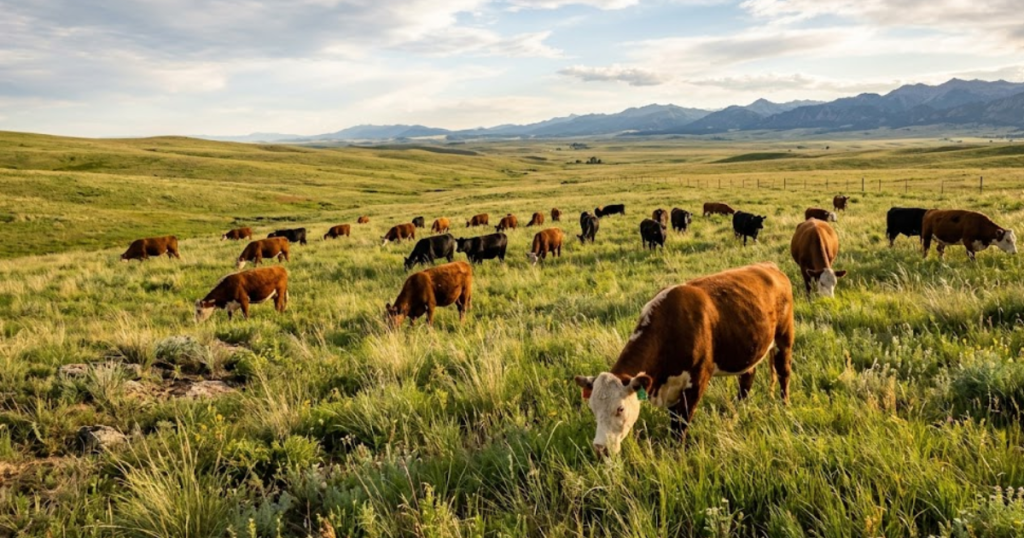
You look out over the rolling acres of your new Colorado property. The native grass is waving in the wind, and you imagine your horses grazing happily all summer long, saving you thousands of dollars in hay bills.
But a few months later, the grass is gone, the dirt is blowing, and toxic weeds are taking over. What went wrong?
When buyers move to the rural West, they often drastically overestimate how much livestock their land can actually feed. You cannot simply count the acres; you must calculate the math of the meadow. Native dryland grass is fragile. If you put too many horses on too little land, you will destroy the root systems in a single season.
Understanding the “Carrying Capacity” and the “Animal Unit Month” (AUM) of a property is the single most important factor in maintaining healthy pastures. Here is how to evaluate the true grazing potential of native Colorado grass before you buy.
What Is the "Carrying Capacity" (AUM) of the Native Grass?
Quick Summary: The Math of the Meadow
- The Limit of the Land: Carrying capacity is the maximum number of animals your land can support sustainably without destroying the vegetation. It is measured in Animal Unit Months (AUM).
- The Horse Multiplier: The standard "Animal Unit" is a 1,000-pound cow. Because horses are larger, highly active, and trample the ground, an average horse is rated at 1.25 Animal Units, meaning they require significantly more grass.
- The Arid Reality: Colorado is a dry climate. Unlike the lush pastures of the Midwest, it can easily take 10 to 30 acres of non-irrigated native Colorado grass to support a single horse for a year.
- The Dirt Lot Destiny: If you exceed the land's carrying capacity, your horses will eat the native grass down to the roots. The pasture will quickly become a barren dirt lot overtaken by noxious weeds.
On horse property, acreage alone tells you very little. The real question is how much forage the land can produce without being permanently damaged.
1. Defining the "Animal Unit Month" (AUM)
To manage agricultural land, you need a standard unit of measurement. Range scientists use the Animal Unit Month (AUM).
- The Standard Unit: One Animal Unit (AU) is traditionally defined as a standard 1,000-pound beef cow.
- The Monthly Consumption: One AUM is the amount of dry forage that a 1,000-pound animal needs to eat to survive for one month. Because an animal eats about 2.5% to 3% of its body weight daily, one AUM equals roughly 750 to 800 pounds of air-dried grass.
- The Land's Production: Carrying capacity is determined by how many total AUMs a specific pasture can produce in a growing season without the vegetation being destroyed.
2. The Equestrian Multiplier (AUE)
Horses are not cows. They graze differently, they move much more, and they are generally larger.
- The Weight Factor: The average saddle horse weighs between 1,100 and 1,300 pounds. Therefore, a horse is not 1.0 AU. Range managers assign mature horses an Animal Unit Equivalent (AUE) of 1.25.
- The Trample Tax: Horses are highly active. They do not just eat the grass; they trample it, roll in it, and run over it with heavy hooves. You must factor in that horses will damage or waste up to 25% of the available forage in a pasture.
- The True Requirement: Because of their size and activity level, a single horse actually requires well over 1,000 pounds of forage every single month to maintain its body weight.
Horse land should never be evaluated with cattle math alone. Horses demand more forage and create more wear on the pasture surface.
3. The Reality of Native Colorado Grass
This is where the math hits the dirt. Many buyers assume one acre equals one horse. In the arid West, that assumption is a recipe for disaster.
- The Dryland Deficit: Native pasture in Colorado grows slowly due to minimal rainfall. A non-irrigated, dryland pasture might only produce a few hundred pounds of usable forage per acre, per year.
- The "Take Half, Leave Half" Rule: To keep the grass alive, you can only let the animals eat 50% of the plant. The root system desperately needs the remaining 50% of the leaf surface to photosynthesize, survive the harsh winter, and regrow next spring.
- The Acreage Reality: Depending on the specific county, the soil quality, and the annual rainfall, it can conservatively take anywhere from 10 to 30 acres of dryland native grass to support just one horse for an entire year without supplemental feeding.
4. The Cost of Overstocking
Exceeding the carrying capacity is the fastest way to ruin a valuable equestrian property.
- Root Destruction: If horses are left on a pasture too long, they will graze the grass down to the bare dirt. This starves the root system, permanently killing the native, drought-resistant species.
- The Weed Invasion: Weeds thrive in bare, disturbed dirt. When the good grass dies, toxic, deep-rooted noxious weeds like Leafy Spurge and Russian Knapweed immediately take over the pasture.
- The Forever Hay Bill: Once a native pasture is destroyed, revegetating it is incredibly difficult and expensive. You will likely be forced to buy baled hay year-round because your land can no longer produce food for your herd.
We Calculate the Capacity Before You Buy
We do not just look at the acreage, we evaluate the forage.
When Mark Eibner and Belinda Seville help you purchase a horse property, we look closely at the health of the native grass. We help you realistically assess the carrying capacity of the land so you know exactly how many horses it can safely support, and how much supplemental hay you will need to budget for.
Contact Us Today to find a property that can sustainably support your herd.
Browse Active Colorado Horse Properties: Browse Active Colorado Horse Properties with healthy, established pastures
Frequently Asked Questions (FAQ) About Carrying Capacity
Can I increase the carrying capacity by planting better grass seed?
On dryland pastures, usually no. The carrying capacity is strictly limited by the lack of rainfall, not the type of seed. If you do not have irrigation water rights, planting "better" or thicker grass will fail because there is simply not enough natural moisture in the soil to sustain it.
How can I keep my horses on small acreage without ruining it?
The most effective strategy is utilizing a "dry lot" or "sacrifice area." You confine the horses to a small dirt paddock with run-in sheds where they eat baled hay most of the day. You only turn them out onto the native grass pastures for a few hours a day to strictly manage their grazing impact.
Does rotational grazing help native grass?
Yes, immensely. By dividing your property into multiple smaller pastures and rotating the horses frequently, you allow the native grass critical time to rest and recover between grazing periods, which maximizes the overall long-term production of the land.