
Would you trade a 20 minute commute for an extra 10 acres of irrigated pasture and a guaranteed domestic well? For many buyers looking at Colorado equestrian communities in 2026, that’s the $500,000 question. You likely already realize that the dream of owning a horse property is about more than just finding a beautiful trail. It’s about evaluating a landscape where hay prices can fluctuate by 25% from one county to the next and where a horse-friendly label doesn’t always mean the zoning laws are on your side. We understand that you’re looking for a place where your lifestyle and dreams can actually take root without the stress of water scarcity or restrictive covenants.
In this roundup, you’ll discover the four most sought-after regions that balance luxury living with functional ranching needs. We’ll help you understand the distinct vibe of different neighborhoods, from the high-end enclaves of the Front Range to the rugged, wide-open spaces of the Western Slope. You’ll also learn the three critical questions every buyer must ask about water rights and HOA rules before signing a contract. This guide provides a clear roadmap to finding a property that offers the space you need and the security your horses deserve.
Key Takeaways
- Learn how to distinguish premier horse-friendly neighborhoods from standard rural zoning by identifying essential infrastructure like shared trails and integrated private stables.
- Compare the benefits of different regions, from the urban accessibility of the Front Range to the rugged beauty and longer growing seasons found in Western Slope Colorado equestrian communities.
- Understand the critical technicalities of water rights and well permits to ensure your land can legally and sustainably support your horses and livestock.
- Discover how to leverage AI-powered search tools to bypass the limitations of traditional real estate sites and filter for specific equine features like arenas, barns, and soil quality.
What Defines a Premier Colorado Equestrian Community?
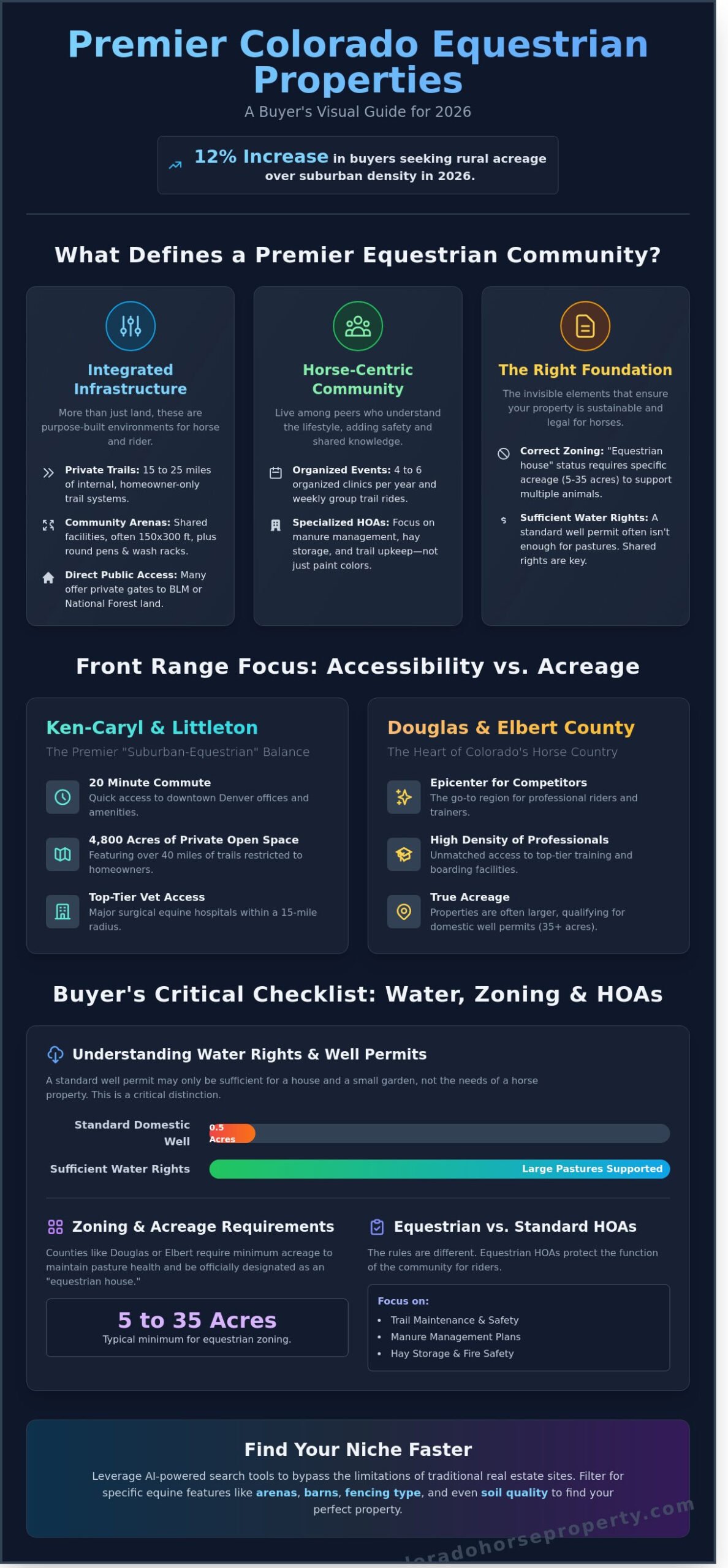
A premier Colorado equestrian community offers more than a simple “horses allowed” zoning designation. These developments cater to a specific way of life where the property is a tool for fulfilling long-held lifestyle and dreams. In 2026, Colorado remains a top-tier destination for riders because of its 23 million acres of public land and a culture rooted in the Colorado Ranger horse history. With nearly four decades of expertise in this market, we’ve seen that the 2026 market shows a 12% increase in buyers seeking rural acreage over suburban density. You aren’t just looking for a house; you’re searching for integrated infrastructure that supports daily training and trail riding.
To better understand the scale and design of these properties, watch this helpful video:
Key Infrastructure: Trails, Arenas, and Stables
Top-tier Colorado equestrian communities prioritize connectivity. While some properties offer direct gate access to BLM or National Forest land, others provide 15 to 25 miles of private, internal trail systems. Shared amenities often include 150-foot by 300-foot community arenas, round pens, and professional wash racks. Zoning is critical. In counties like Douglas or Elbert, “equestrian house” status often requires a minimum of 5 to 35 acres to accommodate multiple animals while maintaining pasture health. We also look for communities with shared water rights, as a standard domestic well might only allow for 0.5 acres of irrigation, which is often insufficient for large pastures.
The Social Element: Horse-Centric Neighborhoods
Living among fellow horse owners adds a layer of safety and shared responsibility. If a horse gets loose at 2:00 AM, your neighbors understand the urgency. These Colorado equestrian communities often host 4 to 6 organized clinics per year and weekly group trail rides. Equestrian HOAs differ from standard suburban boards. They focus on manure management, hay storage safety, and trail maintenance rather than just paint colors. This specialized oversight ensures the community remains functional for riders for decades, protecting both the land and your investment.
Front Range Favorites: Accessibility Meets Acreage
The Front Range remains the primary target for buyers who need to reach offices in Denver or Colorado Springs while keeping their horses at home. It’s about the commute. In 2026, the demand for properties within a 45-minute drive of the major tech centers has solidified specific equestrian corridors. These Colorado equestrian communities offer a unique trade-off. You get the professional salary of the city and the manual labor of the barn in the same afternoon. You’ll find everything from 1-acre “ranchettes” in established subdivisions to 35-acre estates that qualify for domestic well permits. 2026 market data shows a 12% increase in buyers seeking these larger parcels as remote work remains a permanent fixture for Denver professionals. Understanding the Colorado Division of Water Resources well permitting process is essential here. It determines if you can water livestock or just a small garden.
The Ken-Caryl and Littleton Corridor
Ken-Caryl Ranch stands out as a premier example of suburban horse living. It features 4,800 acres of private open space and a dedicated equestrian center. Residents enjoy over 40 miles of private trails restricted to homeowners. You’re located just 20 minutes from downtown Denver. This proximity makes it possible to ride before your morning meeting. Major surgical equine hospitals are within a 15-mile radius. This provides peace of mind for performance horse owners who value quick access to specialists. Littleton offers a “suburban-equestrian” balance that’s hard to find elsewhere. It’s possible to shop at a high-end grocery store and be back in your boots within 15 minutes.
Douglas and Elbert County: The Heart of Horse Country
Parker and Elizabeth serve as the epicenter for competitive riders. These areas house a high density of professional trainers and indoor arenas. Access to these amenities is vital for training through the winter months. The Pinery offers dedicated bridle paths that weave through the neighborhood. Elbert County provides the space needed for “off-grid” setups and larger pastures. In Elbert, 35-acre parcels are more common. They offer the privacy that smaller Douglas County lots lack. This county is the go-to for owners who want to manage their own hay production or install large-scale private tracks. If you’re looking for more room to roam, you can search current listings by acreage to find your ideal match.
Mountain and Western Slope Enclaves: Rugged Beauty
Living in the shadow of the Rockies offers a lifestyle rooted in the state’s 19th-century ranching heritage. These Colorado equestrian communities prioritize privacy and direct access to millions of acres of public land. While the Front Range offers convenience, the High Country and Western Slope provide lower population densities and a deeper connection to the rural landscape. Owners here often manage properties that have remained in agricultural use since the late 1800s, preserving water rights and historic grazing patterns.
Managing horses in these regions requires specific technical knowledge. In the High Country, you’ll deal with snow depths exceeding 100 inches annually, necessitating heated tack rooms and structural snow-load ratings for indoor arenas. Conversely, the Western Slope requires robust irrigation systems to combat high desert heat. Understanding Colorado equestrian zoning laws is vital here, as these regulations define how local governments must maintain the infrastructure that supports your lifestyle and dreams.
Roaring Fork and Eagle River Valleys
Luxury estates near Aspen and Vail cater to riders who demand performance and scenery. Properties at altitudes of 8,000 feet or higher provide significant high-altitude training advantages, increasing a horse’s cardiovascular efficiency. You’ll find exclusive enclaves with private trail connectivity to the White River National Forest. These communities often feature professional-grade amenities, including GGT footing and 24-hour on-site barn management, ensuring your equine athletes receive elite care in a mountain setting.
Grand Junction and Fruita: The Desert Equestrian
The Western Slope offers a distinct advantage for year-round riders: a 180-day growing season and over 300 days of annual sunshine. Colorado equestrian communities in Grand Junction and Fruita focus heavily on Western disciplines and “cattle ranch” style properties. You’ll have immediate access to the Colorado National Monument trails and the North Desert’s expansive terrain. These properties typically feature larger acreage for the price compared to mountain valleys, often including senior water rights essential for maintaining lush pastures in a semi-arid climate.
- Elevation Benefits: High-altitude conditioning for endurance and performance.
- Trail Access: Direct entry to BLM and National Forest lands from your back gate.
- Climate Variety: Choose between alpine meadows or mild, year-round desert riding.
- Heritage: Properties often include historic barns and established water shares.
Evaluating Horse Properties: Water, Zoning, and Soil
The most critical question for any buyer in Colorado equestrian communities isn’t about the square footage of the house. It’s about the water. In our semi-arid climate, owning land doesn’t automatically grant you the right to use the water beneath it for your animals. You must verify the specific well permit type before you move forward with a purchase. A “Household-only” permit is strictly for indoor use and won’t allow you to fill a trough or irrigate a single blade of grass. You need a “Domestic” permit, which typically allows for the watering of livestock and the irrigation of up to one acre of land.
Water Rights and Well Permits
Adjudicated water rights are court-decreed legal entitlements to a specific volume of water from a defined source, whereas non-adjudicated rights are administrative permits that haven’t undergone this formal judicial verification process. To verify a permit, search the Colorado Division of Water Resources (DWR) database using the permit number or the property’s legal description. In high-country communities where well yields might drop below 2 gallons per minute, many owners install 1,500-gallon to 2,500-gallon cisterns to ensure a consistent supply for their herd during peak demand.
Soil Quality and Zoning Density
Soil composition dictates your daily workload and your horses’ health. Much of the Front Range contains “bentonite,” an expansive clay that swells when wet and shrinks when dry. This soil type is notorious for cracking foundations and creating slick, dangerous pastures. Look for sandy loam instead. It offers superior drainage and a stable footing for arenas. Zoning is equally vital. Don’t assume 10 acres means 10 horses. Most counties, such as Jefferson or Douglas, have strict density limits, often allowing only 1 or 2 horses per acre. If you plan on a commercial boarding operation, you’ll likely need a property of at least 35 acres to meet state exemptions.
HOA Restrictions and Covenants
A property labeled “horse-friendly” isn’t always “barn-ready.” Homeowners Association (HOA) covenants often include hidden restrictions that can derail your plans. Common rules include barn height limits capped at 15 or 20 feet, specific requirements for three-rail white PVC fencing, and strict manure management protocols that forbid on-site composting. You might find that while horses are allowed, the HOA prohibits any permanent outbuildings. Review the recorded plat and covenants during your due diligence period. For a deeper dive into these technical requirements, read our Buying Horse Property in Colorado: The Ultimate Guide.
Ready to find a property that meets all your technical requirements? Contact our expert team to start your search today.
How to Find Your Niche with AI-Powered Search
Most real estate platforms treat a 40-acre ranch like a 4,000-square-foot cul-de-sac home. They focus on bedrooms and bathrooms while ignoring the infrastructure that actually matters to horse owners. If you’re searching for Colorado equestrian communities, you need to filter for senior water rights, soil composition for arenas, and existing barn configurations. Generalist sites often mislabel properties or omit critical details like “A-1” versus “A-2” zoning; these codes determine if you’re legally allowed to board horses or build a second dwelling. We solve this by using technology that understands the specific nuances of rural land.
Navigating the Market with Colorado Horse Property
Our platform uses AI to categorize listings into precise acreage tiers: 1 to 10, 10 to 35, or 100 plus acres. This saves you from sifting through thousands of irrelevant residential lots. Mark and Alison Eibner bring nearly 40 years of specialized experience to every transaction. This “founder-forward” representation means you aren’t handed off to a junior assistant who doesn’t know a paddock from a pasture. This background is vital when managing complex land sales. We coordinate title and escrow details that general agents often overlook, ensuring that easements and mineral rights are fully disclosed before you sign. Our team understands that horse properties require a higher level of due diligence than a standard suburban home.
Take the Next Step Toward Your Lifestyle Goal
Don’t wait for a “For Sale” sign to appear on a neighbor’s fence. Setting up a custom search alert ensures you see new listings in Colorado equestrian communities the moment they hit the market. We view 2026 as a strategic year for land acquisitions because market cycles suggest a stabilization of rural property values, offering a window for long-term investment. Your equine lifestyle depends on finding the right dirt. Find your next Colorado Horse Property with AI and let our decades of negotiation experience work for you. We’ve spent 38 years learning how to spot the hidden value in a property and how to steer clear of costly land-use traps.
Secure Your Future in the Colorado Landscape
Choosing between the Front Range and the Western Slope requires a clear understanding of your specific goals for 2026. You’ve seen how soil quality, strict zoning laws, and senior water rights determine the long-term value of Colorado equestrian communities. These technical details matter just as much as the view from the barn door. Don’t settle for general real estate advice when you can rely on nearly 40 years of specialized experience. Mark and Alison Eibner have spent four decades navigating these complex rural transactions to help buyers protect their lifestyle investments.
Finding a property with a 100 foot arena or a specific 4 stall barn shouldn’t take months of manual searching. Our proprietary AI tool filters listings by barns, arenas, and water rights to save you hours of frustration. This technology matches your specific needs with the most current data available across the state. It’s time to turn your vision of a mountain ranch or a prairie estate into a reality with experts who live the lifestyle themselves. Start your AI-powered search for Colorado equestrian communities today. Your ideal Colorado horse property is waiting for you to find it.
Frequently Asked Questions
Which Colorado county is the most horse-friendly?
Douglas County is widely considered the most horse-friendly due to its 300 miles of multi-use trails and equine-centric zoning. The county master plan preserves 46% of its land as open space, much of which allows equestrian access. This dedication to land conservation makes it a top choice for buyers looking at Colorado equestrian communities. Our team has helped clients navigate these specific zoning requirements for over 35 years to ensure their lifestyle and dreams become a reality.
How many acres do I need for two horses in Colorado?
You generally need a minimum of 2.5 to 5 acres to keep two horses, depending on specific county zoning laws. For example, El Paso County typically requires 2.5 acres for the first two horses. In more restrictive areas, like parts of Boulder County, you might need 0.5 acres per animal but must also meet strict manure management and grazing standards. Always check the specific Plat Map for your potential Colorado equestrian communities to confirm these density limits.
What are the best equestrian communities near Denver?
High Prairie Farms and Spirit Ridge in Parker are two of the premier equestrian communities near Denver. These neighborhoods offer direct access to the 1,000 acre Salisbury Equestrian Park and its professional grade facilities. Many homes in these areas sit on 2 to 5 acre lots and include private barns or access to community arenas. These locations are ideal for riders who want a rural feel while remaining within a 30 minute drive of downtown Denver.
Do all horse properties in Colorado come with water rights?
No, only about 15% of residential horse properties include deeded senior water rights. Most owners rely on domestic well permits issued by the Division of Water Resources. A standard domestic well permit allows for the watering of domestic animals and the irrigation of up to 1 acre of land. It’s vital to verify your permit status before closing. We use our 40 years of experience to help you understand these complex water laws during your search.
Are there equestrian communities with shared boarding facilities?
Yes, communities like Plum Creek in Castle Rock and Antelope Heights provide shared boarding or community stables for residents. These setups often feature 12×12 stalls and 100×200 foot outdoor arenas for all members to use. This model allows you to live in a luxury neighborhood without the daily maintenance of a private barn on your own land. It’s a popular choice for 25% of our clients who prefer a lock and leave equestrian lifestyle.
What is the average price for a horse property in Douglas County?
As of late 2023, the average price for a 5 acre horse property in Douglas County is approximately $1.2 million. Prices fluctuate based on the quality of equine infrastructure like heated tack rooms or indoor arenas. Properties with professional grade 4 stall barns often command a 15% premium over standard residential listings. You’ll find that well maintained facilities significantly impact resale value. We track these market trends daily to give our clients a competitive edge in negotiations.
Can I keep horses on a property with a “household-only” well permit?
You can’t legally water horses with a “household-only” well permit, as these are restricted to indoor use only. You must have a “domestic and livestock” well permit to provide water for your animals. If your property only has a household permit, you’ll need to haul water or apply for a permit change through the State Engineer’s office. This process can take 60 to 90 days and isn’t always guaranteed, so checking the permit type is essential before you buy.
What should I look for in a Colorado horse barn for winter protection?
Look for barns with R-19 insulation and east-facing doors to block the prevailing westerly winds. Stalls should have rubber mats over a 6 inch crushed rock base to prevent moisture buildup during snowmelt. Ensure the roof is pitched at a 4/12 ratio or higher to shed heavy snow loads common in the Front Range. Properly ventilated barns prevent respiratory issues, which is a key consideration for 90% of horse owners in the dry Colorado climate.