
In early 2024, a buyer in Douglas County closed on a 35-acre ranch only to discover their “senior water rights” were legally junior to a 1970s decree, leaving their troughs dry by mid-July. It’s a devastating scenario that occurs too frequently in our state’s complex rural market. You’ve likely spent years dreaming of the freedom that comes with owning land where your horses can roam against a Rocky Mountain backdrop. You know that a horse property is more than just a home; it’s a specialized piece of infrastructure that requires a higher level of scrutiny than a standard suburban lot.
This guide delivers the definitive horse property inspection checklist Colorado buyers need to audit land, water, and equine facilities before closing. We’ll show you how to look past fresh paint to identify zoning non-compliance and hidden structural issues in older barns that could cost $50,000 or more to repair. You’ll gain a professional framework for verifying well yields, testing soil safety, and ensuring every fence line is ready for your herd. We’re here to help you move from uncertainty to a confident purchase that secures your lifestyle and your horses’ safety.
Key Takeaways
- Master the nuances of Colorado zoning laws and CC&Rs to ensure your specific equine plans are legally permitted “Use by Right” before you commit.
- Learn how to navigate the complexities of “Domestic” versus “Household-Only” well permits with a professional horse property inspection checklist Colorado buyers can rely on.
- Identify critical safety and structural red flags in existing barns and stalls, from foundation stability to proper equine ventilation and latch integrity.
- Discover how to evaluate land health by identifying invasive Colorado noxious weeds and testing soil for optimal forage growth.
- Establish a strategic pre-closing action plan to verify agricultural equipment inclusions and secure essential seller disclosures before your dream lifestyle begins.
Phase 1: Legal Due Diligence and Zoning Verification
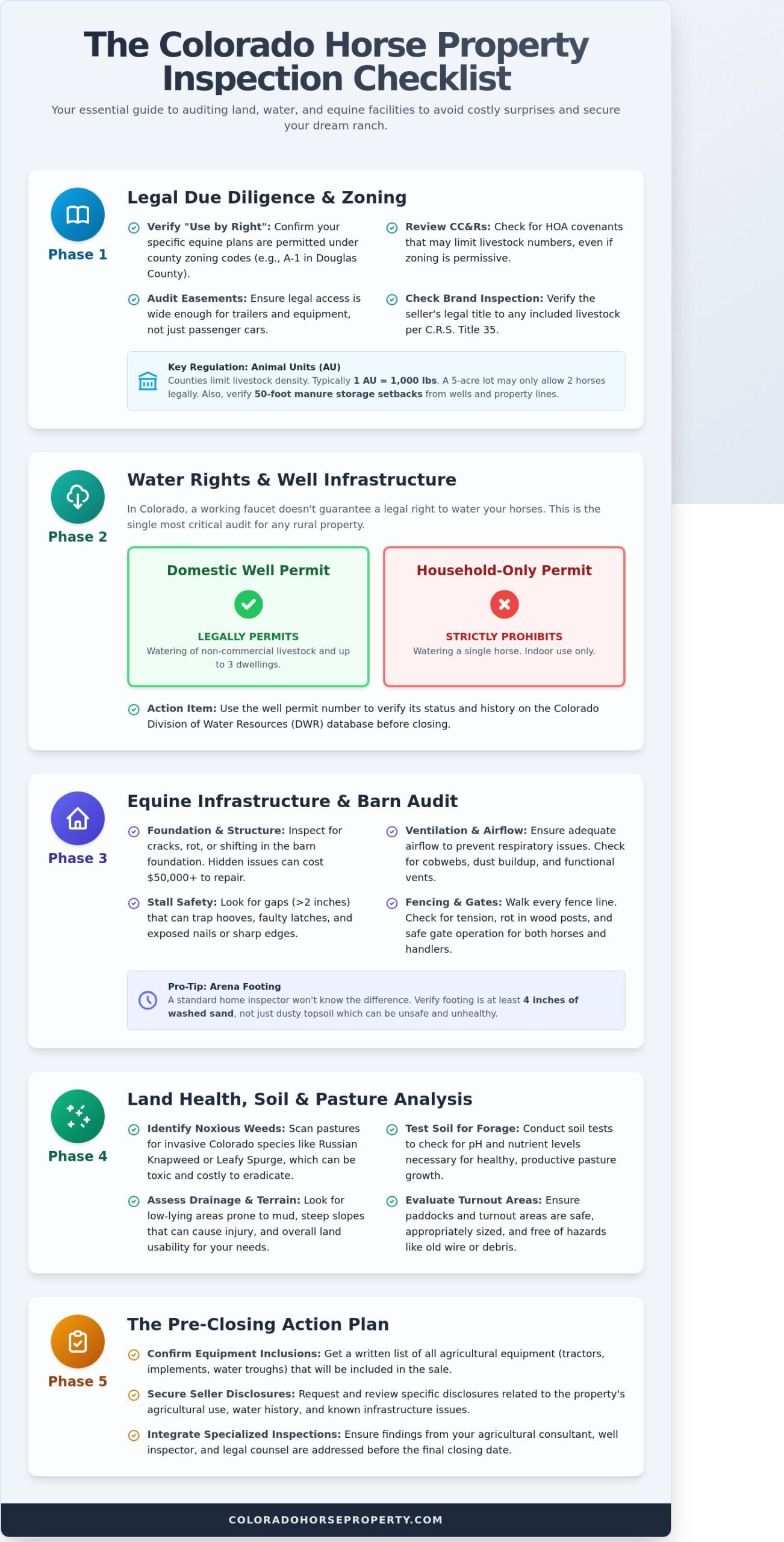
Buying a horse property in Colorado requires more than a scenic view. You must first verify the “Use by Right” within specific county zoning codes. In Douglas County, for example, an A-1 zoning designation typically allows for livestock, but you can’t assume your specific plans fit the code. This verification is the foundation of any horse property inspection checklist Colorado. You need to know if the county permits your intended number of animals before you sign a contract. Understanding horse management best practices starts with ensuring your land is legally equipped to handle the animals you plan to keep.
To better understand the nuances of local property requirements, watch this helpful video:
Review the Covenants, Conditions, and Restrictions (CC&Rs) immediately. Some HOAs in areas like Parker or Elizabeth limit livestock counts even if the county zoning is permissive. You also need to check for recorded easements. A 12-foot wide gate isn’t useful if the legal access easement only allows for a standard passenger vehicle or lacks the turn-radius for a 4-horse slant-load trailer. If horses are currently on the property, check the Brand Inspection history. Under Colorado Revised Statutes Title 35, Article 43, a brand inspection is required for any change of ownership. This ensures the current owner has legal title to the livestock and helps you identify potential liens on the animals or equipment.
Zoning and Animal Units
Most Colorado counties use an “Animal Unit” (AU) calculation to determine carrying capacity. Typically, 1 AU equals 1,000 pounds of livestock. In Jefferson County, you might be limited to 2 AUs per acre. Watch for “grandfathered” non-conforming uses. If a 5-acre lot has 10 horses but only 2 are legally allowed, that right often expires if the property stays vacant for 12 months. Always verify a 50-foot setback for manure storage from any wellhead or property line to stay compliant with local health department regulations.
The Limitations of General Home Inspections
A standard home inspector focuses on HVAC and foundations, not the safety of your equine partners. They won’t evaluate if your arena footing is 4 inches of washed sand or just dusty topsoil. They won’t spot a 2-inch gap in a stall door that could trap a hoof. This is why your horse property inspection checklist Colorado must include a specialized agricultural consultant. You should integrate these specialized findings with your title company’s report to ensure no undisclosed utility easements bisect your future riding arena or barn site.
Phase 2: Colorado Water Rights and Well Infrastructure
Water is the most valuable asset on any Colorado acreage. Without a verified, legal source of water, your equestrian lifestyle dreams can quickly evaporate. This phase of your horse property inspection checklist Colorado focuses on securing your “liquid gold” through both legal audits and physical inspections. You can’t assume that a working faucet equals a legal right to water your herd.
In Colorado, water isn’t just about what comes out of the tap; it’s about what the law allows you to do with it. Most rural properties rely on wells, but not all well permits are equal. You must distinguish between a “Domestic” permit and a “Household-Only” permit. A Domestic Well Permit allows for the use of water for up to 3 single-family dwellings and the watering of non-commercial domestic animals and livestock. If the property only has a “Household-Only” permit, you cannot legally water a single horse. This distinction is non-negotiable for equine owners and often requires a permit change or augmentation plan to rectify.
Well Permit and Augmentation Plan Audits
To verify a well’s status, access the Colorado Division of Water Resources (DWR) database using the permit number or receipt number. This portal provides original well logs, depth data, and pumping levels from the date of construction. In over-appropriated basins like the South Platte or Arkansas River, you might encounter augmentation requirements. These plans require owners to replace the water they consume to protect senior holders under Colorado’s Prior Appropriation Doctrine, which dictates that older rights take precedence over newer ones. Our team at Colorado Horse Property can help you navigate these complex records to ensure your livestock are protected.
Physical Water Delivery Systems
Legal rights mean little if the hardware fails. Hire a licensed technician to perform a four-hour drawdown test to determine the true flow rate. While a 5-gallon-per-minute (GPM) yield is ideal, many Colorado wells produce 1 to 3 GPM. If the yield is low, verify the property has a cistern with at least 1,000 gallons of storage capacity to handle peak demand. Check the pressure tank for corrosion and confirm the pump’s age; most submersible pumps require replacement every 12 to 15 years.
- Automatic Waterers: Test every unit for heating functionality and proper grounding to prevent stray voltage, which can discourage horses from drinking.
- Irrigation Infrastructure: If the land includes water rights for hay production, inspect the physical condition of headgates and lateral ditches for siltation or structural cracks.
- Water Quality: Conduct a laboratory analysis specifically for equine health. Nitrates exceeding 10 mg/L or high levels of sulfate and total dissolved solids (TDS) can lead to colic or chronic dehydration in horses.
Securing these details now prevents the catastrophic expense of hauling water or drilling a new well at a cost of $35,000 or more in the 2026 market. Always verify the seniority of any irrigation rights, as a 1920 right is far more secure than a 1970 right during drought years.
Phase 3: Equine Infrastructure and Barn Audit
A functional barn is the heart of your operation, but a poorly maintained one becomes a financial drain. When you use your horse property inspection checklist Colorado, start with the foundation. Look for vertical cracks wider than 1/4 inch in concrete pads. These often signal shifting from Colorado’s expansive clay soils. Inspect the roof for rust or loose fasteners, especially if the structure is over 15 years old. Proper ventilation is vital; you shouldn’t smell ammonia when entering a stall. If you do, the airflow design is flawed, which leads to respiratory issues for your herd.
Electrical systems require a specialized eye. Standard residential outlets don’t belong in a barn. You need dust-sealed, vapor-proof fixtures to prevent hay dust from igniting. Check that all wiring is encased in conduit to stop rodents from chewing through lines. Fire safety isn’t a suggestion; it’s a requirement for protecting your investment. For the arena, measure the footing depth. Most riders prefer 2.5 to 4 inches of material. If the footing is pulverized into dust or worn down to the base, expect to spend $15,000 to $30,000 on replacement costs within your first 24 months of ownership.
The Barn and Stable Safety Check
Examine stall interiors for safety hazards. Kick-boards must be at least 1.5 inches thick to withstand a direct impact. Check latches to ensure they operate with one hand, as you’ll often have a lead rope in the other. Test the wash rack drainage. If water pools for more than 5 minutes after use, the drain line is likely collapsed or clogged. Verify that the hay loft is structurally rated for at least 150 pounds per square foot to handle winter stockpiles safely.
Fencing and Perimeter Security
Fencing in Colorado faces unique challenges. Our dry climate makes grounding electric fences difficult. Ensure grounding rods reach 8 feet into the soil to maintain a consistent charge. Check post stability by applying pressure; posts set shallower than 36 inches will heave during the spring freeze-thaw cycle. While pipe fencing is durable, inspect all welds for rust. If the property uses high-tensile wire, it must have visible markers every 10 feet to prevent horses from running into it. This level of detail is a core part of any horse property inspection checklist Colorado buyers rely on to avoid post-closing surprises.
Phase 4: Land Health, Soil, and Pasture Analysis
Your land is the foundation of your horses’ health and your long-term budget. A thorough horse property inspection checklist Colorado buyers must use includes a deep dive into soil composition and forage viability. Colorado’s semi-arid climate means pasture isn’t a “set it and forget it” asset. You need to know if the ground can actually grow what your horses need to eat before you sign the closing papers.
Start by requesting a soil test from the local CSU Extension office. This $35 to $50 investment reveals nitrogen, phosphorus, and potassium levels necessary for grass production. Without proper nutrients, you’ll spend thousands on supplemental hay every winter. You also need to scout for Colorado’s “Top 10” noxious weeds. Leafy Spurge and Russian Knapweed are aggressive invaders that can decrease property value by 20% and choke out native grasses. If these are present, factor in the cost of professional herbicide application, which often runs $150 to $300 per acre for initial treatment.
Carrying capacity is a critical metric that varies by county. In the Front Range, where annual rainfall often averages only 14 inches, it may take 15 to 30 acres of dryland pasture to support a single horse year-round without overgrazing. Property drainage is equally vital. Ensure the land slopes away from the barn at a minimum 2% grade. Standing water leads to “mud fever” (equine pastern dermatitis) and thrush, which can result in vet bills exceeding $500 per incident during the spring melt.
Pasture Management and Forage Quality
Distinguish between dryland and irrigated acreage immediately. Irrigated land is more productive but requires water rights and maintenance of gated pipe or pivots. Overgrazed land is a significant liability; restoring a “dirt lot” to a functional pasture can cost $800 per acre in seed and soil prep. Watch for toxic plants like Houndstongue or Locoweed. These species thrive in the disturbed soils of neglected Colorado ranches and can cause irreversible neurological damage to your herd.
Topography and Natural Hazards
Look at the land’s physical layout through the lens of safety. Fire protection is non-negotiable in the Rockies. You must maintain a 30-foot defensible space of lean, clean, and green vegetation around all barns and hay sheds. Check for erosion near seasonal arroyos; a single heavy thunderstorm can wash away feet of topsoil if banks aren’t stabilized with riprap or vegetation. Colorado’s winter winds often exceed 60 mph, so evaluate if the property has natural windbreaks or if you’ll need to install a 3-row shelterbelt of Rocky Mountain Junipers to protect your horses from the wind chill.
Phase 5: The Pre-Closing Action Plan
The final 48 hours before closing are where the most critical details can slip through the cracks. You’ve completed the heavy lifting of the horse property inspection checklist Colorado buyers rely on; now you must verify that every repair and legal transfer is finalized. Request a Supplemental Seller Disclosure that focuses specifically on agricultural infrastructure. This document should detail any recent repairs to frost-free hydrants, solar well pumps, or electric fencing controllers. If a seller replaced a pressure tank in 2025, you need the warranty paperwork in hand before you sign.
Water is the lifeblood of any Colorado ranch. At the title office, verify the Change of Ownership forms for all well permits and the physical transfer of water share certificates. Don’t assume the title company handles the nuances of ditch company bylaws. You must also secure a specialized ranch insurance policy before the closing date. Standard homeowners’ insurance rarely covers equine liability or the replacement cost of a 100-foot by 200-foot indoor arena. Ensure your policy is active the moment the deed is recorded.
Coordinating Your Expert Team
Closing on a ranch requires more than just a standard realtor. You need a team that understands the 40-year history of local land use. Use AI-powered search tools to pull up-to-the-minute comparable sales data for properties with similar barn-to-acreage ratios. Your agent will use this data to negotiate final repair credits if a structural inspection revealed issues with the hay loft. A dedicated transaction manager ensures that zoning affidavits and grazing lease assignments are signed by all parties to prevent future land-use disputes.
Final Walkthrough Priorities
Perform your final walkthrough exactly 24 hours before you sign the papers. This isn’t a casual stroll; it’s a verification of your horse property inspection checklist Colorado requirements. Check the following items carefully:
- Test every gate latch and ensure the heavy 12-foot powder-coated gates don’t sag or drag on the ground.
- Flip every switch for the arena lights and barn fans to ensure no breakers trip under load.
- Confirm the seller removed all hazardous debris, such as old T-posts, rusted wire, or chemical containers, from the back pastures.
- Collect every key for tack rooms, feed sheds, and workshop roll-up doors.
If the seller agreed to leave specific equipment, such as a 2024 arena drag or a zero-turn mower, verify those items are on-site. Check the oil and fuel levels. If anything is missing or damaged, your agent needs to resolve the credit before you leave the property. This final step protects your investment and ensures your horses move into a safe, functional environment on day one.
Secure Your Colorado Equestrian Future
Buying a ranch in the Centennial State isn’t just a real estate deal; it’s the fulfillment of your lifestyle and dreams. Success depends on rigorous due diligence. You must verify equine zoning laws and secure 100% of your water rights before signing. A thorough barn audit and soil analysis ensure your land supports healthy grazing for years to come. By following this horse property inspection checklist Colorado buyers can navigate complex rural regulations with confidence.
Don’t leave your investment to chance. We bring nearly 4 decades of specialized experience to your search, focusing on the technical details of water infrastructure and equestrian zoning that generalists often miss. Our team understands the unique demands of Colorado’s rural landscape and the specific needs of horse owners. You can leverage our proprietary AI search for niche equine features to filter listings by the exact infrastructure your horses require.
Start your AI-powered search for the perfect Colorado horse property today and turn your vision of wide-open spaces into a reality. Your ideal mountain or plains retreat is waiting for you.
Frequently Asked Questions
Do I need a separate inspection for the barn and the house in Colorado?
Yes, you should hire a specialist or request a specific add-on because 85 percent of standard home inspectors exclude outbuildings from their base contract. A barn requires a different lens to evaluate equine safety, such as checking for fire-rated electrical boxes and proper ventilation. You’ll want a professional who understands the structural loads of hay lofts and the specific drainage needs of wash stalls.
How do I verify if a Colorado property has enough water for four horses?
You must verify water capacity by pulling the well permit from the Colorado Division of Water Resources and performing a four hour drawdown test. Each horse needs 10 to 15 gallons of water daily, so four horses require a minimum of 60 gallons per day. It’s vital to confirm the permit allows for “livestock watering” specifically; household-use-only permits often prohibit watering animals.
What are the most common red flags in a Colorado horse property inspection?
The most frequent red flags include improper pasture drainage, unpermitted barn wiring, and deteriorating perimeter fencing. During your horse property inspection checklist Colorado review, look for foundation cracks larger than 0.25 inches in the barn or “heaving” in the arena soil. Approximately 30 percent of rural properties fail due to septic systems that aren’t sized to handle the additional load of barn wash racks.
Is a brand inspection required when I buy a horse property?
No, a brand inspection is only required for the transfer of the horses, not the land itself. Under Colorado Revised Statute 35-43-129, any horse sold or moved more than 75 miles must have a certificate from the state brand inspector. While the real estate closing doesn’t trigger this, you’ll need to coordinate it if the seller is leaving horses behind as part of the deal.
How much does a specialized equestrian property inspection cost?
A specialized equestrian inspection generally costs between $800 and $1,500 depending on the number of structures and total acreage. This is about 40 percent higher than a standard $500 residential inspection. The price covers the primary home, the main stable, and a functional assessment of the fencing and soil quality. Many buyers find this investment prevents tens of thousands in future repairs.
Can I keep horses on a property zoned as “Residential” in Colorado?
You can often keep horses on residential land if the specific sub-zoning and acreage meet the county’s minimum livestock requirements. Most Colorado counties require at least 2.5 or 5.0 acres for a property to be eligible for equine residents. You must check the “Use by Right” section of the local land use code to see the exact animal density allowed for your specific parcel.
What is the “Animal Unit” rule in Douglas County or El Paso County?
The Animal Unit rule assigns a numerical value to livestock to prevent overgrazing, where one horse typically equals 1.0 animal unit. In Douglas County, Rural Residential zoning often allows for 1 unit per 0.5 acres of dedicated pasture. El Paso County uses similar metrics, though you might need a Special Use Permit if your herd exceeds 2 units per acre on smaller lots.
Does a general home inspector check the riding arena footing?
No, a general home inspector focuses on the residential structure and won’t evaluate the quality of your riding arena footing. Using a horse property inspection checklist Colorado guide helps you remember to hire a separate arena specialist. They’ll measure the 4 to 6 inch base and sub-base layers to ensure the sand or GGT mix provides the correct rebound for your specific riding discipline.