
Owning 35 acres in the Front Range doesn’t guarantee you the legal right to water a single horse or build a covered arena. Many buyers realize too late that Colorado’s strict “Use by Right” laws can turn a dream equestrian property into a legal nightmare before the first fence post is even driven. You’ve worked hard to reach a point where you can prioritize your passion, but the search for a perfect ranch often feels like a compromise between a luxury residence and a functional facility.
We understand that you aren’t just looking for a house; you’re looking for a foundation for your lifestyle and dreams. This guide leverages nearly 40 years of specialized experience to help you master the 2026 real estate market. You’ll learn how to verify senior water rights, navigate the 2025 updated zoning regulations for horse counts, and evaluate infrastructure that meets the demands of your specific discipline. We’re going to cover everything from soil composition for outdoor tracks to the legal fine print that ensures your legacy remains secure and your transition is seamless.
Key Takeaways
- Distinguish between hobby farms and professional estates to ensure your land truly supports your long-term equestrian goals.
- Master the essentials of Colorado water rights and county zoning to protect your livestock and your property’s future value.
- Gain the expertise to evaluate barns and arenas for structural integrity and drainage, ensuring they are built for the Colorado elements.
- Use modern AI filtering techniques to find an equestrian property that matches your specific needs for acreage and high-end infrastructure.
- Discover how specialized representation manages the complex “ecosystem” of a sale, from agricultural appraisals to expert well inspections.
Defining the Equestrian Property: More Than Just a House with a Barn
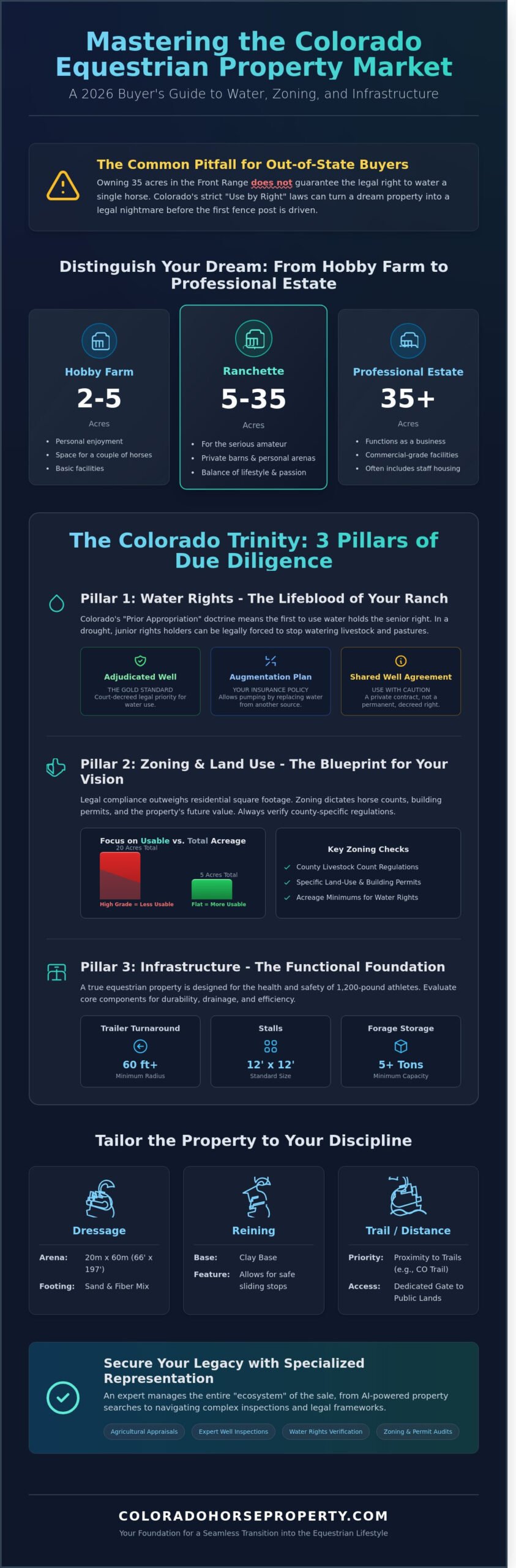
In the 2026 Colorado market, an equestrian property represents a specialized asset class where zoning laws and infrastructure outweigh residential square footage. Buyers often mistake a rural home for a horse property simply because it features a perimeter fence. However, true equestrian classification requires legal compliance with local livestock counts and specific land-use permits. In counties like Douglas or Elbert, a property must meet minimum acreage requirements, often 35 acres to secure specific water rights, to sustain a full-scale operation. You aren’t just buying a home; you’re acquiring a functional facility designed for the health and safety of 1,200-pound athletes.
Distinguishing between property types is the first step in your search. A hobby farm typically consists of 2 to 5 acres, providing just enough space for a couple of retired geldings. A ranchette moves into the 5 to 35-acre range, offering private barns and personal arenas for the serious amateur. Professional equestrian estates, however, function as business entities with 35 or more acres, multiple residences for staff, and commercial-grade facilities. The layout must prioritize equine flow. This means placing the hay storage near the stalls to reduce labor and ensuring trailer turnarounds have a minimum 60-foot radius. Safety always trumps aesthetics. A beautiful wrap-around porch matters less than a perimeter fence that keeps a spooked horse away from a high-speed county road.
Setting realistic expectations is vital for long-term satisfaction. You’ll often face a trade-off between acreage and urban convenience. A 10-acre parcel in Parker might cost more than 40 acres in Kiowa, but it puts you 15 minutes closer to specialized veterinary clinics and major show circuits. Balance your need for on-site amenities with the availability of nearby trails. If the property sits on 5 acres but backs up to 1,000 acres of open space, the “usable” feel of the land increases exponentially.
The Functional Anatomy of a Horse Property
A functional layout requires more than just open space. Core components include 12×12 foot stalls, secure tack rooms, and dedicated storage capable of holding 5 tons of forage. Acreage is often a deceptive metric. A 20-acre parcel with a 30 percent grade is less valuable than 5 flat, usable acres. You must evaluate the percentage of land suitable for turnouts and arenas. We focus on finding an equestrian property that aligns with your lifestyle and dreams, ensuring the physical land supports your daily routine without constant mud or drainage issues.
Equestrian Discipline-Specific Needs
Your riding style dictates the property’s requirements. A dressage rider needs a 20-meter by 60-meter arena with a sand and fiber mix. A reining enthusiast requires a clay base that allows for sliding stops. If you prefer long-distance riding, proximity to the 500-mile Colorado Trail is more vital than an on-site arena. Always evaluate the external connections. Does the property have a dedicated gate to public lands? For more details on building the perfect setup, check our guide on Equestrian Facilities: From Barns to Arenas to understand the costs and specs involved.
The Colorado Trinity: Water Rights, Zoning, and Land Use
Colorado operates under the Prior Appropriation doctrine, a system codified in the 1876 State Constitution. This legal framework dictates that the first person to take water and put it to beneficial use holds the senior right. If you purchase an equestrian property with junior rights during a drought cycle, your taps and irrigation could be shut off while a neighbor with 1880s-era rights maintains a green pasture. Buying “dry” land is a frequent mistake for out-of-state buyers. Without specific, decreed water rights, you’re legally prohibited from growing forage or even watering a small paddock, forcing you to rely entirely on expensive, imported hay.
Understanding Colorado Water Rights
Adjudicated water rights represent a legal priority for CO ranching, determined by a court decree that establishes the date, amount, and use of the water. When reviewing a title report, you must distinguish between adjudicated wells and shared well agreements. A shared agreement is a contract between neighbors, but it doesn’t grant the same permanence as a court-decreed right. You also need to look for augmentation plans. These act as an insurance policy for your land. An augmentation plan allows you to pump water by replacing what you consume with water from another source, ensuring your horses stay hydrated even when senior users make a “call” on the river basin.
- Adjudicated Wells: These are verified by the Colorado Division of Water Resources and tied to the land’s legal description.
- Augmentation Plans: These plans prevent your well from being curtailed during dry summers.
- Title Reports: Ensure your title company has a specialist who understands “Water Schedule” attachments.
Zoning and ‘Right to Farm’ Laws
Don’t assume five acres automatically allows for five horses. Zoning varies wildly across the Front Range. For instance, Douglas County typically requires 2.5 acres for the first two horses, while Weld County might have more lenient standards based on specific Animal Units (AUs). A standard 1,000-pound horse is generally counted as one AU. You must also verify your well permit type. A “Domestic” well usually limits water to indoor use and fire protection. To legally water livestock, you need a “Domestic and Stock” permit, which is often only granted on parcels of 35 acres or more in certain basins. If you’re unsure about the permits on a specific parcel, our team of specialists can help you navigate these technical requirements before you’re under contract.
- Animal Units (AUs): Check the local county code for the exact AU density allowed per acre.
- Permit Limits: Verify if your well permit allows for “irrigation of 1 acre” or is restricted to “household use only.”
- Right to Farm: These laws protect you from nuisance lawsuits regarding smell or noise, but they don’t override zoning limits.
Agricultural tax status is another critical financial pillar. Maintaining this status can reduce your property tax bill by 90%, but it requires proof of production, such as haying records or a grazing lease with a minimum of 12 months of activity. Similarly, be cautious of Conservation Easements. While they offer significant tax credits, they often permanently ban the construction of new indoor arenas or additional barns. Always verify the “building envelope” defined in the easement to ensure your future expansion plans aren’t legally blocked before you even move in.
Evaluating Equestrian Infrastructure: Barns, Arenas, and Fencing
When you tour a potential equestrian property, don’t let a fresh coat of paint distract you from the “Big Three”: structural integrity, ventilation, and drainage. In Colorado, these factors determine if your horses thrive or struggle through the seasons. A barn must withstand snow loads exceeding 30 pounds per square foot in High Country regions. Proper ventilation prevents respiratory issues like heaves, which affect roughly 15 percent of stabled horses. Drainage is equally vital. Water should move away from the foundation at a slope of at least two percent to prevent ice dams and treacherous mud in the spring.
Barn style dictates your daily workload. Center-aisle barns provide a protected, temperature-controlled workspace during sub-zero January mornings. Shed-row barns offer excellent natural airflow but leave you exposed to the wind and snow. Modular options have surged in popularity since 2015. These structures arrive pre-engineered to meet local wind codes, often proving more cost-effective than traditional stick-built barns. Look for high-quality materials like heavy-gauge steel or pressure-treated lumber that can handle the dry, high-altitude climate.
Riding arenas require a deep look beneath the surface. The footing and base represent 90 percent of the total investment. A standard 100-by-200-foot outdoor arena needs a compacted sub-base and approximately four inches of washed sand or a specialized rubber-poly mix. Fencing around the arena is purely aesthetic compared to the quality of the ground. For perimeter fencing, wood remains a classic choice for smaller paddocks. However, PVC can become brittle and shatter when temperatures drop below zero. High-visibility electric tape or coated wire offers a safer, more flexible solution for 40-plus acre pastures where visibility is key to preventing accidents.
The Barn Inspection Checklist
Fire safety is the highest priority for any horse owner. Check that all wiring is housed in metal conduit to prevent rodent damage. Hay storage should ideally be in a separate building at least 50 feet away to reduce fire risk. Standard stalls should measure 12-by-12 feet to allow a 1,200-pound horse to turn comfortably. The gold standard for flooring is 3/4-inch vulcanized rubber mats installed over a leveled base of four inches of crushed stone. This setup protects your horse’s joints and reduces annual bedding costs by 20 percent.
Pasture Management and Soil Quality
Colorado soil varies significantly by region. You’ll find sandy loam in the eastern plains and heavy clay near the foothills. Soil quality dictates your stocking rate. Most experts recommend 2 to 5 acres per horse for sustainable grazing. Use rotational grazing layouts with permanent perimeter fencing and temporary cross-fencing to prevent overgrazing. Every equestrian property needs a “sacrifice lot” or dry lot. This small, non-vegetated area protects your primary pastures during the March mud season. It ensures the grass roots remain healthy for the summer growing cycle.
The Modern Search: Using AI to Find Your Lifestyle and Dreams
Traditional MLS searches often fail the buyer looking for an equestrian property because they prioritize residential data over agricultural utility. A standard search engine treats a 5-acre lot with a house the same as a 5-acre professional training facility. This lack of nuance leads to wasted weekends touring properties that don’t fit your specific needs. We’ve solved this by integrating AI that understands the specific infrastructure required for a functional horse ranch.
Our technology allows you to input specific parameters like “show me 10+ acres with a 60×120 indoor arena.” It scans thousands of listings and tax records to find matches that a human might take 15 hours to identify manually. This data-driven approach also highlights off-market ranch opportunities. By analyzing land use patterns and ownership duration, we identify owners who might be ready to sell before their property is publicly listed. We combine nearly 40 years of local experience with this 21st-century search technology to give you an unfair advantage in a competitive market.
5 Steps to a Smarter Property Search
- Step 1: Define your Must-Haves vs. Nice-to-Haves. Use our AI tool to separate non-negotiables, like a 4-stall barn, from flexible features like a renovated kitchen.
- Step 2: Filter by specific acreage and water right availability. We use data to verify if a property has the necessary well permits or ditch rights to support your livestock.
- Step 3: Analyze historical land use. AI-enhanced satellite imagery reveals if a pasture was overgrazed three years ago or if a seasonal creek actually holds water during the dry month of July.
- Step 4: Schedule high-probability tours. We only visit “horse-ready” properties that meet 90% or more of your criteria, saving you time and fuel.
- Step 5: Vet the bones of the facility. Use our expert buyer representation to inspect the structural integrity of outbuildings and the quality of the fencing.
The Human Element: Why AI Needs an Expert Guide
Algorithms are powerful, but they can’t smell a drainage issue or sense a neighbor’s hostility. They don’t account for local wind patterns that might make a specific outdoor arena unusable during January. This is where nearly 40 years of boots-on-the-ground experience becomes your greatest asset. We combine high-tech filtering with a no-nonsense evaluation of the property’s physical condition and the local zoning landscape. While the AI finds the data, we find the red flags that could cost you thousands in future repairs.
A seasoned expert is also indispensable during the negotiation phase. We understand the market value of a equestrian property beyond the price of the home itself. We factor in the replacement cost of arenas, the value of senior water rights, and the rarity of specific soil types. This ensures you don’t overpay for a facility that looks good on paper but lacks the “bones” to support your long-term goals. To start your journey with the most advanced tools in the industry, Find CO Horse Property Faster with Our AI Search Tool today.
Ready to see what the modern search looks like? Search our exclusive listings and let our AI find your perfect match.
Securing Your Legacy: Why Specialized Representation Matters
A standard residential realtor views a property through the lens of square footage and kitchen finishes. An equestrian specialist looks at the soil’s load-bearing capacity and the legality of your manure management plan. When you’re buying an equestrian property, the stakes involve more than just resale value; they involve the health of your animals and the viability of your lifestyle. We’ve seen buyers lose thousands because a generalist agent failed to verify if a “horse-ready” property actually had the legal zoning for more than two animals. Specialized representation ensures that every fence line and water hydrant is scrutinized before you sign.
We manage the entire ecosystem of the sale to prevent these expensive oversights. This involves coordinating a team of niche professionals that a typical buyer wouldn’t know to hire. We bring in specialized well inspectors to test flow rates for livestock needs and agricultural appraisers who understand that a 100-foot by 200-foot indoor arena adds specific functional value that a standard appraiser might miss. Our team analyzes the last 12 months of comparable ranch sales to help you position an offer that wins in Colorado’s competitive market. We don’t just tell you to bid higher. We use data to craft clean offers with strategic contingency timelines that protect your earnest money while appealing to sellers.
The work doesn’t stop at the closing table. Moving horses is a logistical challenge that requires a localized network. We provide our clients with vetted lists of local hay suppliers who deliver high-quality alfalfa or grass mix, along with contact info for the region’s most reliable farriers and equine vets. This transition support ensures your horses are safe and fed from day one in their new home.
Our Ecosystem of Partners
We rely on Meridian Title & Escrow to handle the heavy lifting of land titles. They specialize in navigating the complex deed restrictions and mineral rights issues common in Colorado rural acreage. To keep the process transparent, we utilize Club Realm technology. This platform streamlines transaction management, allowing you to track every document and deadline in real-time. You’ll also gain immediate access to our private directory of barn builders, fence contractors, and water lawyers who understand the specific needs of a functioning equestrian property.
Your Colorado Horse Property Partner
The Eibner legacy is built on 38 years of Front Range real estate expertise. Mark Eibner and Belinda Seville have spent decades in the dirt, learning the nuances of Colorado land that can’t be taught in a classroom. Our “Founder-Forward” approach means you aren’t passed off to a junior assistant. You get personal accountability and direct access to our decades of experience. We’re fellow horse people who understand that you aren’t just buying a house; you’re building a foundation for your dreams.
Start your AI-powered search for the perfect Colorado horse property today.
Secure Your Colorado Legacy Today
Finding the right home for your herd in 2026 requires more than a standard real estate search. You’ve learned that securing water rights and navigating complex zoning laws are the foundation of a solid purchase. High-quality infrastructure like professional-grade arenas and durable fencing ensures your horses stay safe while your investment grows. Don’t leave these critical details to a generalist who doesn’t know a paddock from a pasture.
At Colorado Horse Property, we’ve spent 40 years mastering the nuances of the rural landscape. Our specialized team of experts understands that you aren’t just buying land; you’re building a future. We combine this deep local knowledge with our proprietary AI search technology to pinpoint the exact equestrian property that matches your specific needs. Whether you’re looking for 10 acres in Boulder or a 100-acre ranch in Douglas County, we have the tools to find it. It’s time to stop scrolling and start living the life you’ve planned.
Start Your AI-Powered Colorado Horse Property Search and let our experts help you secure your lifestyle and dreams. We’re ready to get to work for you.
Frequently Asked Questions
How many acres do I need for two horses in Colorado?
You typically need at least 2.5 to 5 acres to keep two horses in Colorado. Most counties, such as Douglas County, require a minimum of 2.5 acres for the first two horses and additional acreage for more. This ensures enough space for grazing and proper manure management. Always check specific zoning codes for your county before buying an equestrian property to avoid code violations that carry $500 daily fines in some jurisdictions.
What is the difference between a domestic well and a stock well?
A domestic well permit allows you to use water inside your home and for watering livestock and up to 1 acre of lawn. In contrast, a stock well permit restricts water use strictly to watering animals and does not allow for household consumption. If you buy a property with only a stock well, you won’t have legal water for a kitchen or bathroom. This distinction is critical for your lifestyle and dreams in rural Colorado.
Can I build a barn on any property zoned as ‘agricultural’?
You cannot build a barn on every agricultural property because of specific setback requirements and lot coverage limits. For example, El Paso County requires a 25 foot setback from property lines for any permanent structure. Even if the land is zoned agricultural, you must verify that the specific sub-classification allows for the square footage you plan. Always pull the site plan to ensure the barn fits within the 30% lot coverage limit.
What are ‘water rights’ and why do they affect property value?
Water rights are legal entitlements to use a specific volume of water from a source like a stream or aquifer. In Colorado, these rights are separate from land ownership and can account for 20% to 40% of an equestrian property’s total value. Without deeded water rights, you might not have the legal authority to irrigate your pastures. This makes a property worth significantly less than one with senior water rights recorded before 1900.
What is the most common mistake buyers make when purchasing a horse ranch?
The most common mistake is failing to verify that local zoning laws actually permit the number of horses you own. Buyers often assume rural means anything goes, but 15% of transactions face hurdles due to restrictive covenants or county animal units. Another frequent error is ignoring site preparation costs. Leveling a 100 by 200 foot arena can cost $15,000 before you spend a dime on the actual footing or base material.
How does the AI search tool help me find specific equestrian features?
Our AI search tool uses nearly four decades of local market data to filter listings by specific features like indoor arenas, round pens, or loafing sheds. Instead of scrolling through thousands of generic homes, you can target properties with 10 plus acres or existing hay storage. It streamlines the process by identifying the infrastructure you need for your horses immediately. This technology helps you find a home that matches your lifestyle and dreams faster.
Is it better to buy raw land and build, or find an existing equestrian facility?
Buying an existing facility is usually more cost-effective because the infrastructure is already in place. Building a basic 4 stall barn with a tack room now costs between $80,000 and $120,000, not including permits or utility hookups. If you buy raw land, you also face a 12 to 18 month timeline for construction. Existing properties allow you to move your horses in on closing day, saving you over 300 days of planning and labor.
Do I need a special inspection for the barn and arena?
You definitely need a specialized inspection because standard home inspectors rarely evaluate structural integrity in barns or drainage in arenas. A specialist checks for proper ventilation, stall safety, and the condition of the arena base. About 60% of general inspectors don’t have the tools to test well GPM (gallons per minute) for large-scale livestock use. Hiring an expert ensures you don’t inherit a $10,000 repair bill for a failing barn roof or foundation.