
Last June, a buyer in Park County closed on a beautiful 35-acre parcel, only to discover that the hidden costs of owning a ranch in Colorado included a $12,000 legal bill for a water decree dispute before they even broke ground. It’s a sobering reality. Many prospective owners overlook these critical details during the initial excitement of a purchase. You’ve likely spent years dreaming of the freedom and space that comes with the rural Colorado landscape. It’s a powerful vision. However, the sticker price on the listing is just the beginning of your long-term financial commitment.
We’ve spent nearly four decades helping clients find properties that fit their lifestyle and dreams, and we’ve seen how invisible expenses can catch even seasoned investors off guard. Whether it’s a $5,000 annual bill for noxious weed management or the 15% rise in specialized labor costs projected for 2026, the numbers matter. This guide provides a realistic 5-year financial outlook and a due diligence checklist to keep your legacy intact. You’ll learn how to identify legal pitfalls and maintenance traps before you sign, ensuring your property remains a sustainable asset rather than a financial burden.
Key Takeaways
- Prepare for the “Year One” surge by understanding why initial capital improvements frequently exceed 15% of the purchase price for working agricultural properties.
- Navigate the hidden costs of owning a ranch in Colorado, including ongoing legal fees for water decree protection and mandatory ditch company membership assessments.
- Master the logistics of land health by learning the 2026 labor rates for specialized staff and the legal requirements for controlling invasive noxious weeds.
- Protect your legacy by using advanced search technology and expert brokers to identify unrecorded easements and mitigate expenses before you sign the contract.
Beyond the Purchase Price: The 2026 Colorado Ranch Reality Check
Buying a ranch isn’t like buying a suburban home; it’s more like acquiring a small business that never closes. The hidden costs of owning a ranch in Colorado often start with the massive delta between “lifestyle real estate” and “working agricultural property.” A lifestyle buyer might focus on the view of the Sangre de Cristo Mountains, but a rancher looks at the condition of the headgates and the protein content of the pasture. If you don’t understand the difference, your bank account will feel it quickly.
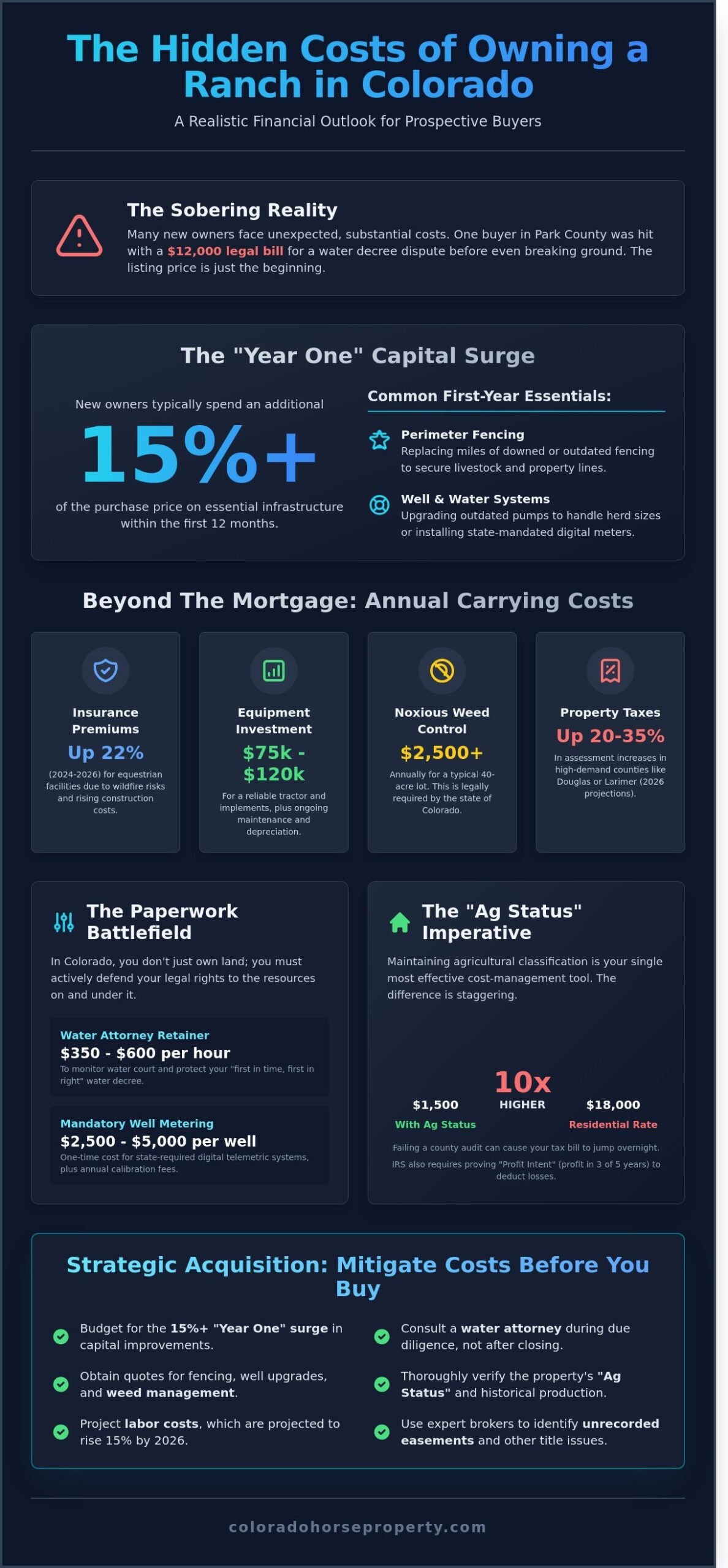
Data from 2025 ranch sales indicates a consistent “Year One” capital surge. New owners typically spend upwards of 15% of the initial purchase price within the first 12 months on infrastructure. This isn’t for aesthetics. It covers essential needs like replacing 2.5 miles of downed perimeter fencing or upgrading a 1990s-era solar well pump that can’t handle a 40-head herd. These expenses are the reality of transition. Furthermore, Colorado’s 2026 property tax assessments reflect the sharp rise in land values from the previous two years. Owners of large-acreage parcels are seeing assessment increases of 20% to 35% in high-demand counties like Douglas or Larimer.
The Carrying Cost vs. The Mortgage
Your monthly mortgage is just the baseline. For 35+ acre parcels, you must track both fixed and variable monthly expenses that many buyers overlook. These include:
- Insurance Premiums: Due to wildfire risks and rising construction costs, insurance for equestrian facilities in the Rockies increased by 22% between 2024 and 2026.
- Equipment Depreciation: A reliable tractor and its implements represent a $75,000 to $120,000 investment with ongoing maintenance costs.
- Noxious Weed Control: Colorado law requires owners to manage invasive species. Professional spraying for a 40-acre lot can cost $2,500 annually.
Don’t ignore the “Opportunity Cost” of your own time. If you spend 15 hours a week dragging arenas or checking fence lines, that’s time diverted from your primary career. On a working ranch, your labor is a line item that belongs on the balance sheet.
Agricultural Classification and Tax Incentives
Maintaining “Ag Status” is the most effective way to manage the hidden costs of owning a ranch in Colorado. Without this classification, your property is taxed at the residential rate, which can be 10 times higher. In 2026, county auditors are more aggressive than ever. They require documented proof of agricultural production, such as hay sales receipts or grazing leases. If you fail an audit, a $1,500 tax bill can jump to $18,000 overnight.
The IRS also applies the “Profit Intent” rule under Section 183. To avoid the “hobby farm” designation, you generally need to show a profit in 3 out of 5 years, or 2 out of 7 years specifically for horse breeding and racing. If you can’t prove you’re running a legitimate business, you lose the ability to deduct ranch losses against your other income. It’s a high-stakes game that requires meticulous record-keeping from day one.
The High Cost of Paperwork: Water Rights, Mineral Claims, and Zoning
Owning a ranch in the Centennial State involves more than just managing livestock and mending fences. The administrative burden carries some of the most significant hidden costs of owning a ranch in Colorado. You aren’t just buying land; you’re entering a complex legal ecosystem where your rights to the resources on and under that land are constantly under scrutiny. If you fail to defend these rights, you risk losing the very utility that makes the property valuable.
Defending Your Water Decree
Colorado operates under the “Prior Appropriation Doctrine,” often summarized as “first in time, first in right.” This means your “Priority Date” is your most valuable asset. To protect it, you’ll likely need a water attorney on retainer. These specialists often charge between $350 and $600 per hour to monitor the monthly Water Court resumes. They ensure that new upstream applications don’t “injure” your decreed surface rights. For a deeper dive into these complexities, read our guide on Water Rights in Colorado: What Every Buyer Must Know.
By 2026, state-mandated reporting has become more stringent. The Colorado Division of Water Resources now requires digital well-metering for many properties that were previously exempt. Installing these telemetric systems can cost $2,500 to $5,000 per well, plus annual calibration fees. Don’t forget ditch company assessments. These mandatory “membership” fees cover the maintenance of shared infrastructure. Depending on your shares, these can range from $500 to several thousand dollars annually, even if you don’t use your full allocation that season.
Mineral Rights and Surface Use Agreements
The “Split Estate” is a common reality in Colorado. This occurs when one party owns the surface land while another owns the minerals beneath it. If you don’t own 100% of your mineral rights, you face the risk of an oil or gas operator requesting access to your property. Negotiating a Surface Use Agreement (SUA) is a critical expense. Legal fees for these negotiations typically start at $7,500. A well-crafted SUA dictates where a company can place pads, roads, and pipelines, which is vital for the safety of your horses and the integrity of your pastures.
- Resale Impact: Properties with severed minerals often see a 10% to 15% reduction in buyer pool interest.
- Financing Hurdles: Some lenders require specific endorsements or refuse to finance properties with active mineral leases.
- Title Gaps: Standard title insurance policies usually exclude mineral ownership. A separate “Mineral Title Search” can cost $1,500 to $3,000 but is essential to know who truly controls your underground assets.
Zoning adds another layer of financial pressure. If you plan to host commercial equestrian events or clinics, you may trigger the need for a 1041 Permit. Named after the 1974 Land Use Act, these permits allow counties to regulate projects of state interest. The application process involves environmental impact studies and public hearings. It’s common for ranchers to spend $20,000 or more on consultants just to navigate the change-of-use process. To ensure your investment is protected from the start, it’s wise to consult with a specialized ranch broker who understands these local regulatory hurdles.
Infrastructure Decay: The Relentless Maintenance of Colorado Land
Owning a ranch isn’t a static investment. It’s a constant battle against the elements. One of the most significant hidden costs of owning a ranch in Colorado is the rapid pace of infrastructure decay caused by extreme temperature swings and high-altitude UV exposure. A quarter-mile gravel driveway requires professional grading and fresh road base every 24 months to remain passable for emergency vehicles. Expect to budget at least $5,200 annually for gravel, grading, and private snow removal services during heavy winter cycles.
High-altitude utility systems demand specialized care that suburban homeowners never encounter. Septic leach fields in rocky, mountain soils are prone to failure if not pumped every three years, a service that costs roughly $650 in rural counties. Wells are equally demanding. Submersible pumps often burn out after 10 to 15 years, and replacing one at a depth of 400 feet can cost $4,500 or more. You must also account for wildfire mitigation. In 2026, insurance providers often mandate a 100-foot defensible space around all structures. Hiring a crew to thin timber and clear ladder fuels typically costs between $1,800 and $3,600 per acre depending on the slope and density of the vegetation.
Equestrian-Specific Infrastructure Costs
Professional arena footing is a complex blend, not just “dirt.” Without a dedicated dust suppression system, Colorado’s dry air turns expensive footing into a respiratory hazard for your horses. Maintaining the proper moisture balance and drainage requires an initial investment in specialized drags and consistent water application. Barn thermoregulation is another critical expense. To prevent colic and frozen pipes during -20 degree cold snaps, you’ll need insulated plumbing and ventilated stall systems. Before you commit to a property, check out our guide on Horse Barns for Sale: Buying vs. Building to weigh the long-term structural costs.
The Open Range and Perimeter Security
Colorado is an “Open Range” state, which places the legal burden on you to “fence out” wandering livestock. If you don’t want a neighbor’s cattle grazing your private pasture, you must maintain a legal fence. This is a primary driver of the hidden costs of owning a ranch in Colorado. Consider these specific expenses:
- Equine Fencing: High-quality no-climb wire with a top pipe rail currently costs $12 to $18 per linear foot installed.
- Automated Gates: Remote solar-powered gates require $500 annual service calls to ensure batteries and hydraulics survive sub-zero nights.
- Security Tech: Monitoring a 35-acre perimeter often requires long-range point-to-point Wi-Fi bridges, adding $1,200 to your initial tech setup.
Perimeter integrity isn’t a one-time project. High winds and heavy snow loads regularly snap T-posts and stretch wire, necessitating monthly inspections and repairs to keep your own horses in and the neighbor’s cattle out.
Managing the Living Ranch: Labor, Livestock, and Land Health
A Colorado ranch is a breathing entity that requires constant financial input to remain productive. One of the most significant hidden costs of owning a ranch in Colorado is the 2026 labor market reality. General ranch hands now command $24 to $30 per hour, while specialized equine managers expect salaries starting at $72,000. You’ll also encounter the “Remote Location Premium.” Mobile veterinarians and farriers often charge trip fees between $125 and $200 just to reach your gate before any services are rendered. In 2026, an emergency colic visit can easily exceed $600 before treatment begins.
Noxious Weed Act Compliance
Colorado law mandates the control of invasive species like Leafy Spurge and Diffuse Knapweed. Under the Colorado Noxious Weed Act, counties have the authority to enter your property to treat weeds and lien your tax bill for the expenses if you fail to maintain a management plan. Professional herbicide application averages $180 per acre as of 2026. You can reduce these costs through managed intensive grazing, which uses livestock to naturally suppress weed growth, but this requires high-tensile fencing that currently costs roughly $3.50 per linear foot.
Soil health directly impacts your bottom line. Fertilizing a 50-acre pasture in 2026 costs approximately $8,500 annually. While this seems high, it’s often cheaper than the alternative. Buying quality mountain grass hay has risen to $14 per small square bale. A ranch with poor soil health will bleed money through external forage purchases every winter. Owners who invest in soil testing (roughly $150 per sample) save an average of 20% on fertilization by targeting specific nutrient deficiencies.
The Human Element: Staffing Your Legacy
Attracting reliable talent in 2026 requires more than a paycheck. Most experienced managers require onsite housing. Constructing a modest 1,100-square-foot staff cottage currently averages $385,000 in rural Colorado. To offset these capital expenses, many owners invest in technology. Automated pivot irrigation systems and remote water sensor kits, which average $4,200 for a basic setup, can reduce weekly labor requirements by 15 hours. These systems pay for themselves within two seasons. Don’t forget liability insurance; coverage for ranch employees and contractors adds an average of $3,000 to your annual premiums to cover the inherent risks of livestock handling.
Strategic Acquisition: How to Mitigate Ranch Expenses Before You Buy
Smart buyers don’t just look at the listing price. They look at the long-term financial drain. You can slash the hidden costs of owning a ranch in Colorado by $15,000 to $40,000 annually simply by selecting a property with optimized, turn-key infrastructure. Purchasing a ranch with failing fences or outdated irrigation systems often leads to a 25% cost overrun within the first 24 months. Mitigating these expenses starts long before the closing date through data-driven search and specialized representation.
The value of specialized representation is universal, whether you’re in the Rockies or exploring the unique terrain of the Midwest. For example, brokerages like Coulee Land Company help buyers navigate the specific challenges of purchasing large land tracts in their region.
AI-Driven Property Analysis
Our proprietary platform uses AI to filter through thousands of listings to identify properties with specific water-right tiers and superior arena quality. We focus on properties with verified Ag-status to prevent the 15% property tax hike that occurs when land is reclassified. This technology reduces search fatigue by 60% and ensures you only visit sites that meet strict 2026 sustainability standards. For a deeper look at these search tactics, check out our Equestrian Real Estate Colorado: A Complete Buyer’s Guide. Using AI to verify infrastructure quality before the first showing saves thousands in wasted inspection fees.
The Power of Expert Representation
Generalist realtors often miss the nuances of “Ditch Company” bylaws. These documents govern your irrigation schedules and maintenance responsibilities. A missed detail here can lead to a $12,000 loss in hay production in a single season. We specialize in identifying “unrecorded” easements that could allow utility companies or neighbors to cross your land. During negotiations, we push for essential equipment like 60-horsepower tractors or brush mowers to remain with the property. This strategy saves buyers an average of $35,000 in immediate capital expenditures. We also coordinate with Meridian Title to manage complex ranch escrows, ensuring every water decree is properly transferred to protect your investment.
Positioning your ranch for future resale requires a balance of spending and saving. Focus your budget on high-impact areas like perimeter fencing and reliable well systems. These improvements typically offer a 75% return on investment. Avoid over-spending on niche luxury features like heated indoor wash racks unless you are in a high-end market. Instead, invest in modular barn components that allow future owners to customize the space. Addressing the hidden costs of owning a ranch in Colorado during the acquisition phase ensures your rural legacy is built on a solid financial foundation. Our 50-point due diligence checklist uncovers mechanical flaws in solar arrays and septic systems before they become your liability.
Mastering the 2026 Colorado Ranch Investment
Navigating the hidden costs of owning a ranch in Colorado requires more than just a passion for the land; it demands a 2026 perspective on fiscal responsibility. You’ve seen how water rights and infrastructure decay can quickly derail a budget if they aren’t audited during the due diligence phase. Our team brings nearly four decades of specialized Colorado real estate experience to your search, ensuring every mineral claim and zoning requirement is scrutinized through our exclusive partnership with Meridian Title and Escrow. We don’t just show you land. We provide the data you need to manage livestock and land health effectively from day one.
Success in rural real estate starts with the right tools. Our proprietary AI search technology filters properties by specific equestrian features, so you spend less time searching and more time building your dream. It’s time to move beyond the purchase price and focus on long-term sustainability. Find your next Colorado Horse Property with our AI-powered search and take the first step toward a lifestyle that lasts for generations. Your future under the Colorado sky is waiting.
Frequently Asked Questions
Is owning a ranch in Colorado a good investment in 2026?
Yes, Colorado ranch land remains a strong investment because of historical appreciation rates averaging 5% to 7% annually over the last four decades. Demand for large acreage near the Front Range and mountain corridors continues to outpace supply in 2026. While the market is competitive, owning land provides a tangible hedge against inflation and secures your lifestyle and dreams in a high-demand region.
How much should I budget for monthly ranch maintenance per acre?
Budget between $15 and $25 per acre each month for basic maintenance like fence repair and fuel. If your property includes irrigated hay fields, these costs can rise to $50 per acre due to ditch assessments and equipment upkeep. Labor rates for skilled ranch hands in rural Colorado counties currently average $22 per hour, so factor in hired help if you aren’t doing the work yourself.
Do I really need a water attorney to buy a ranch in Colorado?
You absolutely need a water attorney to verify the seniority and validity of deeded water rights before closing. Colorado follows the Prior Appropriation Doctrine, where “first in time is first in right,” making older water rights significantly more valuable. A 2025 survey found that 15% of ranch listings contained inaccuracies regarding water ownership. Spending $3,000 on legal due diligence protects you from the hidden costs of owning a ranch in Colorado that lacks legal water access.
What is the “Open Range” law and how does it cost me money?
Colorado is an “Open Range” state, meaning it’s your legal responsibility to fence out neighboring livestock if you want to keep them off your land. If your perimeter fences aren’t “lawful” by state standards, you can’t claim damages for grazed-over pastures. In 2026, building a standard four-strand barbed wire fence costs $3.50 to $5.00 per linear foot. Maintaining this infrastructure is a mandatory expense to protect your forage and soil health.
How can I keep my property taxes low on a large ranch?
Obtain an agricultural classification from the county assessor to reduce your property tax burden by up to 90% compared to residential rates. You must prove the land is used for a primary purpose of making a profit, such as grazing cattle or harvesting hay. Many owners also utilize conservation easements, which can provide a state tax credit worth up to $5 million while lowering the overall valuation of the land.
What are the most common “hidden” infrastructure failures in Colorado ranches?
Well pumps and septic leach fields are the most frequent and expensive hidden failures. Replacing a deep-well pump in 2026 costs between $4,000 and $7,500 depending on the depth. Additionally, aging irrigation headgates often require repairs that can exceed $10,000. These hidden costs of owning a ranch in Colorado typically appear during the first extreme temperature swing of the season when systems are under the most stress.
Is it cheaper to buy a ranch with an existing arena or build one later?
It’s significantly cheaper to buy a property with an existing arena already in place. Construction costs for a basic 100′ x 200′ outdoor arena in 2026 range from $40,000 to $60,000 after accounting for excavation and footing materials. Indoor arenas start at $150,000 and rarely return 100% of their cost in a resale. Buying a “ready-to-ride” horse property saves you months of construction and tens of thousands in capital.
How do noxious weed laws affect my land management budget?
The Colorado Noxious Weed Act requires all landowners to control invasive species like Canada Thistle or Leafy Spurge. If you ignore an infestation, the county can perform the mitigation and bill you at 150% of the market rate. You should budget $500 to $1,200 annually for professional herbicide application or biological control on a 40-acre parcel. Keeping your pastures clean is a legal requirement that also preserves the resale value of your land.