
What if the stunning mountain view from your living room is actually masking a property that violates local equine zoning laws? It’s a common trap for buyers who prioritize aesthetics over the functional demands of a working horse property. You likely recognize that the perfect colorado ranch house must do more than look the part; it needs to serve as a command center for your acreage while providing a seamless, one-story living experience. We understand that balancing residential luxury with the gritty reality of water rights and pasture management feels like a daunting task.
Specialized representation is your greatest asset in this niche market. Many of the best ranch properties never hit the public market. We provide direct access to off market listings and “pocket” ranch properties through a professional network built over 38 years, often using advanced tools like Landvoice to identify expired or for-sale-by-owner listings before they’re widely advertised. These exclusive opportunities often feature superior water rights and established infrastructure that you won’t find on standard listing sites. Our team knows how to spot the hidden value in a property, from the quality of the fencing to the condition of the well pump.
In this guide, you’ll discover the essential architectural styles, horse-friendly features, and buying considerations that define a successful ranch purchase. Drawing on nearly 40 years of specialized experience in the rural market, we help you bridge the gap between architectural beauty and land functionality. We’ll walk through everything from structural footprints to the technicalities of zoning so you can confidently secure a home that fits your lifestyle and dreams.
Key Takeaways
- Distinguish between architectural style and the functional ranching lifestyle to find a home that truly supports your equestrian goals.
- Discover essential design features like “command center” kitchens and mudroom zones that are purpose-built for an active life on the land.
- Navigate the complexities of Colorado water rights and A-1/A-2 zoning to ensure your property can legally accommodate horses and outbuildings.
- Learn how to use AI search technology to identify a colorado ranch house with the specific pasture features and arena types you require.
- Compare the benefits of wide-footprint ranch homes against multi-story estates to determine which structure best fits your acreage and privacy needs.
What is a Colorado Ranch House? Defining the Style and Spirit
Defined by its low-slung, horizontal profile and seamless integration with the surrounding natural terrain, a Colorado ranch house prioritizes unhindered access to the outdoors. This architectural form isn’t just a design choice; it’s a response to the vastness of the Western landscape. While many people use the term to describe any single-story home, the true ranch-style house traces its roots back to the 1920s. It blends Spanish Colonial influences with the practical needs of early working cattle operations, focusing on a long, ground-hugging silhouette that doesn’t compete with the horizon.
Buyers often confuse the architectural style with the functional lifestyle. You can own a ranch-style home on a small suburban lot, but a true colorado ranch house usually implies a deep connection to the land. We see this most often in properties that include 10 to 35 acres of fenced pasture or dedicated equine facilities. The open-concept footprint works here because it allows for 360-degree views of the Continental Divide or the Front Range. This layout eliminates the vertical barriers that often disconnect residents from their livestock and acreage, making it easier to monitor the north pasture or the barn from the kitchen window.
To better understand this concept, watch this helpful video showing a premier example of a high-end ranch property:
The Evolution of the Western Ranch Aesthetic
In the late 1800s, homesteads were built strictly for survival. Today, the colorado ranch house has transformed into a luxury equestrian estate. By 2026, design trends indicate a 15% increase in “Mountain Modern” requests among high-end buyers. These homes often feature 12-inch thick stone walls and reclaimed timber sourced from 19th-century barns. Expansive glass walls are now a standard requirement, replacing the small, heat-trapping windows of the past. This evolution reflects a shift from taming the land to celebrating it, using materials like Colorado fieldstone and Douglas Fir to blur the line between the interior and the rugged exterior.
Why One-Story Living Rules the Front Range
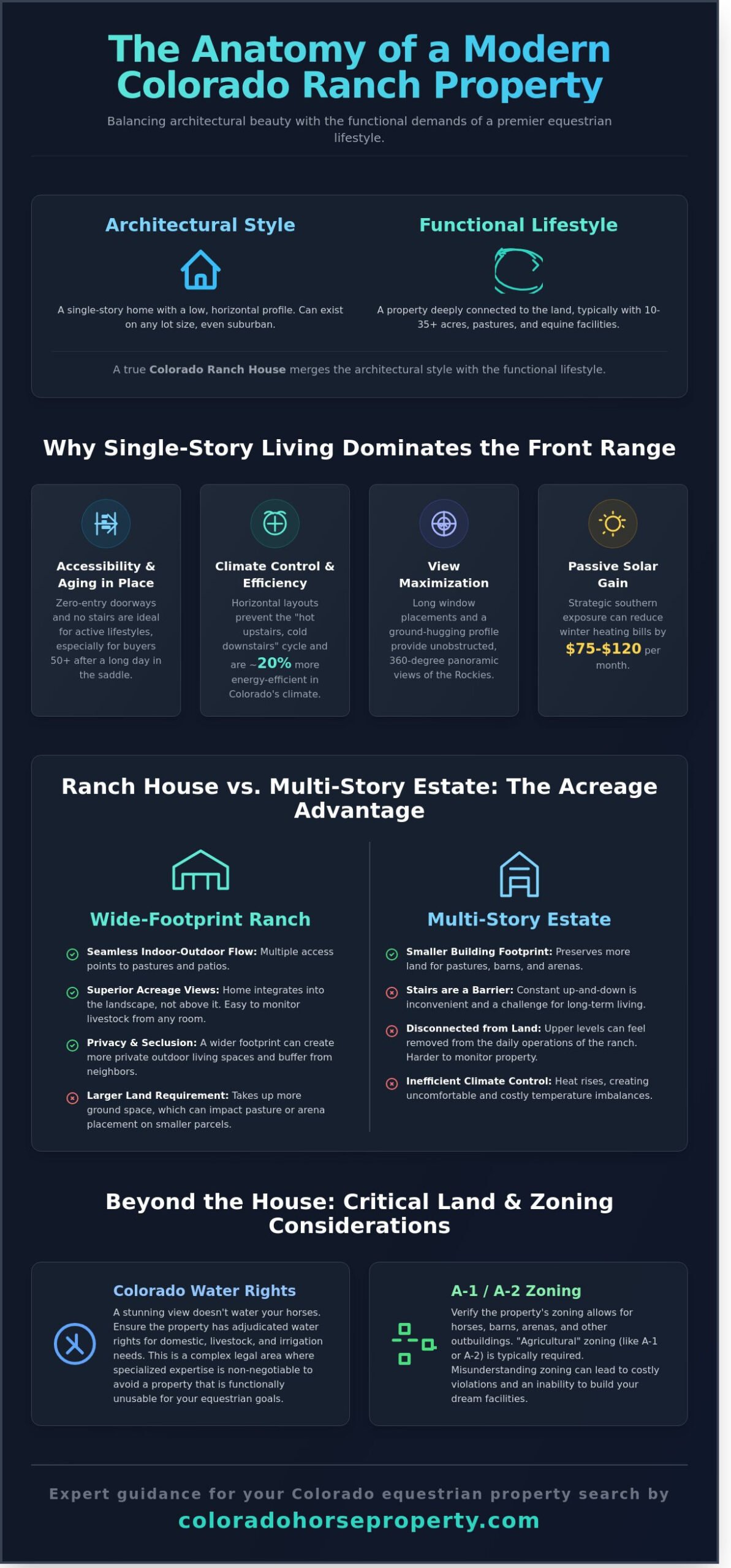
Accessibility is a primary driver for Colorado land buyers. Many horse owners are 50 or older and want to avoid stairs after a long day in the saddle or working in the arena. Single-story homes are also roughly 20% more energy-efficient in Colorado’s Zone 5 and 6 climates. Since heat rises, keeping living spaces on one level prevents the “hot upstairs, cold downstairs” cycle common in traditional two-story builds. This efficiency is vital when managing a large property with multiple outbuildings.
- Aging in Place: Wider hallways and zero-entry doorways accommodate active lifestyles for decades.
- Climate Control: Horizontal layouts allow for better cross-ventilation during 90-degree July days.
- View Maximization: Long window placements capture the purple hues of the Rockies at sunset without the obstruction of upper-level balconies.
- Passive Solar: Strategic southern exposure can reduce winter heating bills by $75 to $120 per month.
Living on one level doesn’t mean sacrificing space. Modern ranch designs often include walk-out basements that follow the natural slope of the land. This adds square footage for guest quarters or tack rooms while maintaining that classic, low-profile Western look from the driveway. It’s a practical, seasoned approach to architecture that matches the no-nonsense spirit of the Colorado horse person.
Essential Features of a Modern Colorado Ranch House
The kitchen in a modern colorado ranch house functions as a tactical hub rather than just a place to prepare meals. Designers now refer to this as the “Command Center” kitchen. It features expansive windows positioned specifically to provide 180-degree views of the turnout paddocks and riding arenas. This layout allows a ranch owner to monitor a training session or check on a grazing horse while the morning coffee brews. It’s about utility and safety; being able to see a gate left open or a horse in distress from the heart of the home is a non-negotiable requirement for the active equestrian.
High-traffic ranch life demands a dedicated “Decontamination Zone.” This isn’t your standard suburban laundry room. A functional mudroom in a colorado ranch house includes industrial-grade floor drains, heavy-duty utility sinks for cleaning bits or boots, and custom lockers for riding gear. By 2024, nearly 75% of new ranch builds in Douglas and Elbert Counties have integrated these zones with direct access from the garage or barn path. This keeps the arena dust and mountain mud out of the primary living quarters, preserving the interior’s longevity.
Outdoor living spaces must account for Colorado’s 300 days of annual sunshine. Seamless transitions to wrap-around porches extend the living area, providing shaded retreats during the intense July heat. These porches often lead to an oversized garage or shop. A standard two-car setup is insufficient for this lifestyle; a 30×40 foot shop with 12-foot overhead doors is the baseline. This space is vital for housing a tractor, a horse trailer, or a winter’s supply of hay, ensuring equipment stays protected from the heavy snow loads common in the Front Range.
Interior Design for the Equestrian Lifestyle
Durability defines the interior choices. Luxury Vinyl Plank (LVP) with a 20-mil wear layer or stained concrete floors are the gold standard. These materials handle the weight of heavy boots and the claws of ranch dogs without scuffing. To balance the ruggedness, vaulted ceilings with Douglas Fir timber framing create a sense of scale that mimics the open horizon. Smart home integration has also become a staple. Owners now use integrated systems to monitor barn temperatures and gate security directly from their phones. If you’re looking for a property with these specific layouts, view our latest listings to see how modern architecture meets utility.
Exterior Amenities that Enhance Ranch Living
Water conservation is a priority since Colorado averages only 15 inches of precipitation annually. Xeriscaping with native Buffalo grass and drought-resistant shrubs reduces water consumption by 50% compared to traditional lawns. Strategic house positioning is another critical factor. By orienting the long axis of the house against prevailing northwesterly winds, the structure acts as a natural windbreak for horse paddocks. This placement strategy draws inspiration from the Historic Ranching Resources of South Park, where early settlers used the landscape to protect livestock. Modern additions like outdoor kitchens and stone fire pits allow for year-round enjoyment, even when temperatures drop in the evening. These features ensure the home remains a place of relaxation after a long day of chores on the land.
Ranch House vs. Multi-Story Estates: Which is Right for You?
Choosing between a sprawling layout and a vertical estate depends on your long-term goals for the land. A colorado ranch house usually occupies a footprint 40% to 60% larger than a two-story home with identical square footage. This requires a wider building envelope. If you’re looking at a 5-acre lot in Douglas County, a wide ranch might push your well or septic field closer to property lines than desired. You’ll need to account for the topography of your specific acreage before committing to a wide-set foundation.
According to the History of the Ranch Style, these homes evolved to embrace the horizontal lines of the Western landscape. This architectural heritage prioritizes a connection to the earth over vertical dominance. Privacy works differently in these layouts. In a multi-story home, the second floor acts as a natural acoustic barrier. In a ranch, you rely on “wing” layouts to separate the primary suite from guest rooms. Many owners prefer this horizontal separation because it keeps everyone on the same level while using hallways or shared living spaces as buffers.
The “Basement Factor” is a unique Colorado advantage. In areas like the Palmer Divide, a colorado ranch house built on a grade often features a walk-out basement. This effectively doubles your living space without increasing the roof’s footprint. This lower level often houses guest quarters or a secondary living room, providing the separation many families crave without the need for a traditional second story.
Maintenance is a major differentiator for rural property owners. Cleaning gutters on a single-story home takes 30 minutes with a standard 6-foot ladder. For a two-story estate, you’ll need a 24-foot extension ladder or a professional service charging $250 to $400 per visit. Painting costs also diverge. A ranch is accessible for DIY upkeep, while a two-story requires scaffolding, often increasing labor bids by 25% or more. Over a 10-year period, these costs add up for those managing large horse properties.
The Pros and Cons of Single-Level Living
The primary draw is accessibility. You won’t struggle with heavy oak dressers or groceries on a staircase. From a technical standpoint, heating and cooling a single level is more efficient if you use a dual-zone HVAC system. However, the financial trade-off is real. Foundations and roofs are the most expensive components of a build. A 3,000-square-foot ranch has double the roofing material of a 3,000-square-foot two-story with a 1,500-square-foot footprint. Expect site preparation costs to be 15% higher due to the extra excavation required.
When a Two-Story Home Makes More Sense
Vertical builds shine on smaller 2-acre to 5-acre parcels where every foot of grazing land matters. By building up, you preserve more pasture space for your horses. Separation is another factor. If you run a home office, placing it on a second floor creates a mental and physical boundary from the kitchen. Finally, consider the view. On the flat plains east of I-25, a second story is often the only way to secure a clear line of sight to the Front Range peaks, fulfilling that specific Colorado lifestyle dream.
Beyond the House: Land and Zoning for Colorado Ranches
A colorado ranch house is only as good as the land it sits on, especially regarding the complex priority system of Colorado water laws. While the architecture provides the shelter, the land provides the utility. You must understand the specific zoning of a property before signing a contract. A-1 and A-2 agricultural designations carry different weights depending on the county. In many Front Range areas, A-1 zoning typically requires a 35-acre minimum to guarantee certain domestic well rights. A-2 zoning often allows for smaller parcels, such as 5 or 10 acres, but it may limit the total number of “animal units” allowed on the property.
Zoning also dictates where you can place structures. You’ll find that setbacks for a barn or a hay shed are often much stricter than for the main house. Some counties require these outbuildings to be 50 to 100 feet from the property line. Beyond the legalities, you have to look at the physical dirt. Colorado’s landscape is famous for expansive bentonite clay. This soil expands when wet and shrinks when dry; a cycle that can ruin a foundation or create deep, dangerous mud in high-traffic paddocks. Proper drainage is not a luxury; it’s a necessity for the structural integrity of your home and the health of your horses’ hooves.
Navigating Colorado Water Rights
Water is the most valuable asset in the West. You’ll encounter three main types of well permits: household-use-only, domestic, and stock wells. Household-use-only wells, common in subdivisions platted after May 1972, often prohibit any outdoor watering or livestock. Domestic wells are the gold standard for a colorado ranch house because they allow for indoor use, watering livestock, and irrigating up to one acre of land. You should always verify the permit number with the Colorado Division of Water Resources during your due diligence period. A property with a senior water right or a robust domestic well maintains its value far better than one with restricted access.
Acreage and Pasture Management
You can’t just put a horse on any patch of dirt and expect it to thrive. Colorado State University Extension guidelines suggest that without irrigation, you need 3 to 10 acres per horse to maintain a sustainable grazing program. If you overgraze a 5-acre lot with four horses, you’ll end up with a dust bowl and a weed problem. Fencing is another critical factor. While barbed wire is common for cattle, it’s a safety hazard for horses. Opt for 4-rail wood, PVC, or no-climb wire with a top rail for maximum safety. Finally, check the 100-year floodplain maps. Building a barn or a septic system in a designated wetland or floodplain can lead to legal fines and environmental hazards that are costly to remediate.
Ensuring your land is as functional as your home requires expert guidance. Search our listings to find a property with verified water rights and ideal zoning today.
Finding Your Perfect Colorado Ranch House with AI
Finding a colorado ranch house requires more than a basic search engine. It demands a sophisticated blend of cutting edge technology and deep rooted local knowledge. At Colorado Horse Property, we’ve spent nearly four decades mastering the nuances of rural real estate. This experience allows us to manage complex transaction details like specialized title reports and escrow accounts that standard residential agents often overlook. We ensure every legal hurdle, from livestock zoning to property line disputes, is cleared before you sign. Our team understands that a ranch purchase isn’t just a home sale; it’s a major asset acquisition that requires professional oversight.
Leveraging Technology in Your Property Search
AI is changing the way you discover land. Our proprietary platform uses advanced algorithms to identify specific equestrian features that matter to your daily operations. You can filter listings by barn type, such as shed row or center aisle; arena dimensions; and exact acreage. By 2026, our custom alert systems will provide real time updates tailored to specific soil types and pasture conditions. We use satellite data to assess pasture health remotely, providing a clear view of forage quality and drainage patterns before you drive to the site.
Our technology simplifies the complex. Instead of scrolling through thousands of irrelevant suburban homes, you get a curated list of properties that meet your agricultural needs. We analyze topography maps to ensure the land is suitable for your specific horse disciplines. Whether you need flat ground for a dressage arena or rolling hills for conditioning, our AI tools find the right match. This data driven approach saves you weeks of wasted travel time and focuses your energy on properties with genuine potential.
The Colorado Horse Property Advantage
Specialized representation is your greatest asset in this niche market. Many of the best ranch properties never hit the public market. We provide direct access to off market listings and “pocket” ranch properties through a professional network built over 38 years. These exclusive opportunities often feature superior water rights and established infrastructure that you won’t find on standard listing sites. Our team knows how to spot the hidden value in a property, from the quality of the fencing to the condition of the well pump.
Negotiating a deal for a colorado ranch house involves technical details that go far beyond the purchase price. It requires a firm grasp of water rights, mineral rights, and agricultural easements. We’ve spent nearly four decades protecting our clients’ interests in these high stakes negotiations. We ensure that the water priority dates are senior enough to protect your livestock during dry seasons. Start your AI-powered Colorado ranch house search today to find a property that perfectly fits your lifestyle and dreams. Our experts are ready to guide you through every gate, from the initial search to the final closing.
Start Your Journey Toward the Perfect Ranch Lifestyle
Owning a ranch isn’t just about a building; it’s about securing a lifestyle that prioritizes open space and functional design. You’ve seen that modern ranch architecture blends single-story convenience with rugged durability. You also understand that navigating local zoning laws and water rights is the most critical step before you sign a contract. Finding the right colorado ranch house requires an expert who understands these technical details. Mark and Alison Eibner provide this exact expertise. They lead a team with nearly 40 years of specialized real estate experience in the rural Colorado market. You don’t have to guess about barn placement or soil quality when you have access to specialized data. Their proprietary AI-powered search tool filters for specific equestrian features that standard platforms miss. It’s time to turn your rural dreams into a tangible asset. Explore the latest Colorado ranch houses for sale and find the land that speaks to you. Your future in the high country is waiting to be built.
Frequently Asked Questions
Is a ranch house more expensive to build in Colorado than a two-story home?
A ranch house costs about 10% to 15% more per square foot to build than a traditional two-story home. This price difference exists because a single-story colorado ranch house requires a much larger foundation and more roofing material for the same amount of living space. Excavation costs for a 2,500-square-foot footprint are significantly higher than those for the 1,250-square-foot base used in a multi-level design.
How many acres do I need for a ranch house with two horses in Colorado?
You generally need a minimum of 2.5 to 5 acres to keep two horses in most Colorado counties. Douglas County regulations typically require 2.5 acres for the first two horses, while other rural regions suggest 1 to 2 acres of pasture per animal to prevent overgrazing. Properties that exceed 35 acres offer the added benefit of easier access to domestic well permits for livestock watering.
What is the difference between a ranch house and a ranchette?
A ranch house refers to the architectural design of a single-story home, whereas a ranchette is a small-scale hobby farm typically ranging from 2 to 15 acres. While a colorado ranch house can sit on a standard suburban lot, a ranchette always implies enough land for a barn, garden, or small livestock. It’s a lifestyle choice for those who want rural space without the workload of a massive operation.
Do Colorado ranch houses usually have basements?
Approximately 85% of ranch homes in Colorado feature full or walk-out basements. Builders must dig below the 36-inch frost line to ensure structural stability, so it’s cost-effective to finish that lower space for extra bedrooms or storage. In areas with sloped terrain, walk-out basements are the local standard. They provide direct access to the lower pasture or backyard, which is ideal for owners with dogs or muddy boots.
What are the most popular areas in Colorado for ranch-style homes?
Parker, Elizabeth, and Castle Rock are the most sought-after locations for ranch-style properties today. Data from 2023 shows a high concentration of single-story homes on acreage in Elbert and Douglas Counties. These specific areas provide the flat or gently rolling terrain that’s perfect for building barns and outdoor riding arenas. Buyers often choose these spots because they balance rural living with a 45-minute commute to Denver.
How do I check the zoning for a Colorado ranch house I want to buy?
You can check zoning by visiting the County Planning and Zoning Department website and using their interactive GIS map. Search for the specific parcel number to see if it’s zoned as A-1 Agricultural or RR Rural Residential. These designations tell you exactly how many animals you’re allowed to keep. They also dictate what types of outbuildings, such as detached shops or hay sheds, you can legally construct on the land.
What smart home features are best for a working ranch house?
Remote water tank sensors and cellular-gate openers are the most practical smart features for a working property. These tools save hours of manual labor by alerting you when a trough is low or allowing you to let deliveries in via your phone. Installing a 4K camera system in the barn provides peace of mind during foaling season. Smart irrigation controllers can also reduce water waste by 30% during dry Colorado summers.