
What if the most famous equestrian hubs in the Rockies are actually the worst investments for your herd in 2026? You already know that finding a dream property is about more than just a sunset view over the Front Range. It’s about securing senior water rights and avoiding the 35% price hike in alfalfa costs recorded since 2022. We understand that the search for the best places to live with horses in Colorado often feels like a battle against hidden zoning restrictions and shrinking pasture land. You deserve a home that supports your lifestyle and dreams without the constant worry of shifting local regulations.
With nearly 40 years of experience in the local market, we’ve identified the top-rated counties and communities that prioritize equine infrastructure. This guide provides the data you need to make an informed decision on where to plant your stakes. We’ll break down five specific regions that offer elite trail access and sustainable land prices for the coming year.
Key Takeaways
- Identify the essential elements of a thriving “Equestrian Ecosystem” to ensure your next home offers the right infrastructure and community for your lifestyle.
- Compare top-rated regions like Douglas County and the Western Slope to find the best places to live with horses in Colorado based on your specific needs for trail access and growing seasons.
- Navigate the complexities of Colorado water rights and zoning laws to protect your investment and ensure your land can legally support livestock and irrigation.
- Learn why traditional real estate filters fail horse owners and how to use advanced search technology to find properties with specific equine amenities like arenas and cross-fencing.
What Makes a Location One of the Best Places to Live with Horses in Colorado?
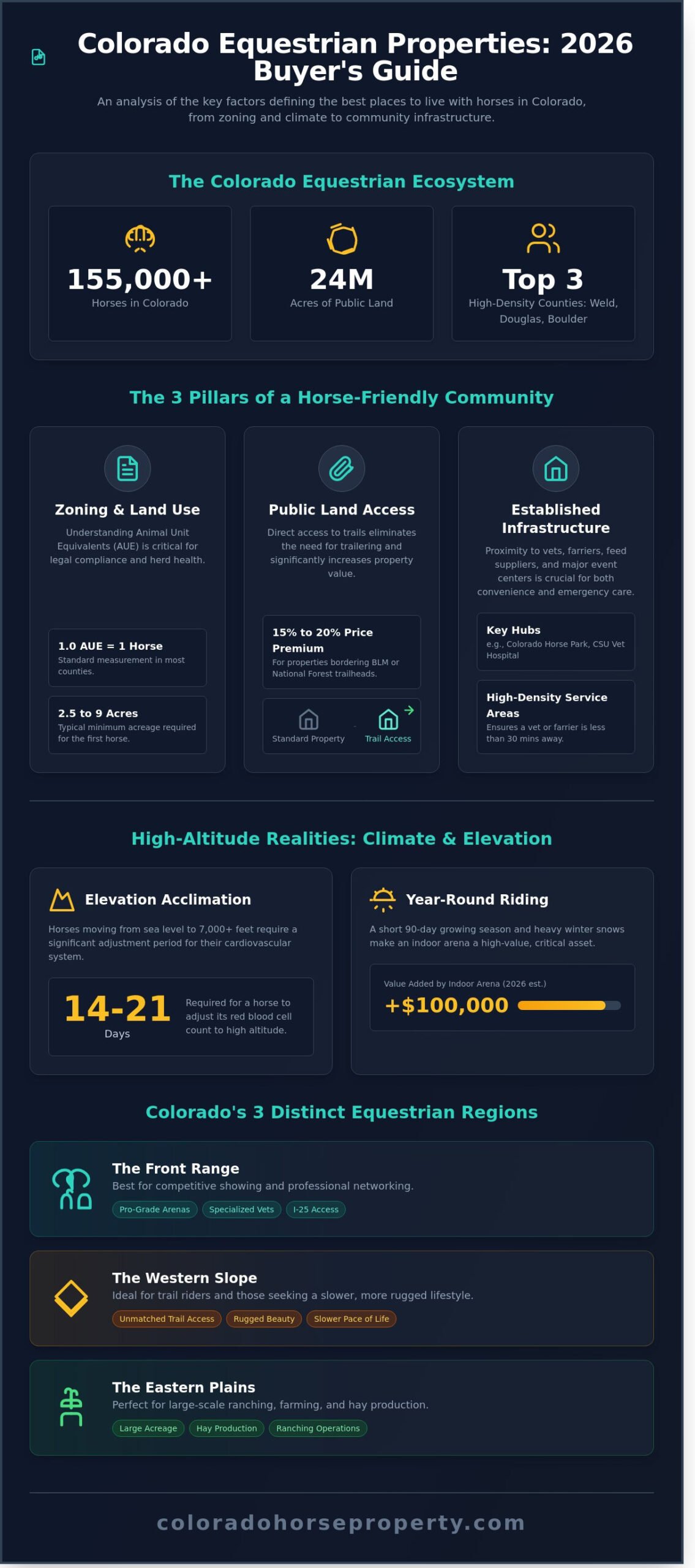
Finding the best places to live with horses in Colorado requires looking past the scenic views. You’re buying into an “Equestrian Ecosystem.” This means you need a balance of specialized infrastructure and a community that supports rural life. In 2026, Colorado remains a premier choice because it combines 24 million acres of public land with a sophisticated network of equine professionals. The state’s horse population exceeds 155,000 animals, creating a massive demand for high-quality services.
Horse density is a vital metric for any buyer. High concentrations of horses in counties like Weld, Douglas, and Boulder ensure that a certified farrier or an equine vet from a top facility like Colorado State University’s Veterinary Teaching Hospital is never more than a 30-minute drive away. You’ll find three distinct environments in the state: the accessible Front Range, the rugged Western Slope, and the expansive Eastern Plains. Each region offers different benefits for your lifestyle and dreams.
The Three Pillars of a Horse-Friendly Community
Success starts with Zoning and Land Use. You must understand Animal Unit Equivalents (AUE). In many Colorado counties, a standard horse counts as 1.0 animal unit. Zoning laws often require at least 2.5 to 9 acres for the first horse, depending on the specific county’s water availability. Access to public land is another pillar. Properties bordering BLM or National Forest trailheads command a 15% to 20% price premium because they eliminate the need for trailering. Finally, look for established infrastructure. Proximity to regional hubs like the Colorado Horse Park in Parker provides access to high-level clinics and feed suppliers who understand high-altitude nutrition.
Climate Considerations for Year-Round Riding
The “300 days of sunshine” claim is a famous Colorado tagline; however, riders know the reality involves heavy wind and rapid temperature swings. Elevation affects everything. Horses moving from sea level to 7,000 feet require 14 to 21 days to adjust their red blood cell counts. Pasture management is also harder at high altitudes where the growing season might only last 90 days. Because of this, an indoor arena is a critical asset. It extends your riding season through the snowy months of January and February. When searching for the best places to live with horses in Colorado, an existing indoor arena can add $100,000 or more to a property’s market value due to rising construction costs in 2026.
- Front Range: Best for competitive showing and professional networking.
- Western Slope: Ideal for trail riders and those seeking a slower pace.
- The Plains: Perfect for large-scale ranching and hay production.
The Front Range: Top Equestrian Communities Near Denver and Fort Collins
The Front Range remains the most popular choice for buyers seeking the best places to live with horses in Colorado. You’ll find a concentrated mix of high-end boarding facilities and private ranches stretching from Douglas County to the Wyoming border. While 2026 market data shows median prices for five-acre parcels in this corridor often exceeding $1.2 million, the access to professional trainers and show circuits is unmatched. You’re paying for proximity to the Colorado Horse Park in Parker, which hosts over 40 weeks of equestrian events annually.
High property values are the primary trade-off for living in this region. Land is at a premium; however, the infrastructure is superior to any other part of the state. Most properties here feature:
- Professional-grade indoor arenas for year-round riding.
- Access to specialized equine hospitals and 24/7 veterinary care.
- Proximity to the I-25 corridor for easy transport to national shows.
- Established hay delivery networks and specialized stable services.
Parker and Castle Rock: The Gold Standard
Parker serves as the heartbeat of the region’s horse culture. The “Horse Alley” corridor along Highway 83 connects dozens of premier training centers and high-density boarding facilities. Douglas County’s 2026 zoning updates prioritize “Large Lot Residential” designations, which helps maintain the rural feel despite nearby suburban growth. Most equestrian-zoned properties in this area require a five-acre minimum. This ensures you have enough space for a barn and small turnout without violating local ordinances. If you’re looking for a community where neighbors understand manure management and fencing needs, this is your epicenter.
Fort Collins and Loveland: Northern Colorado Hubs
Northern Colorado offers a different rhythm and slightly more breathing room. The presence of Colorado State University’s Temple Grandin Equine Center keeps the local industry grounded in science and excellence. You’ll often find 10 to 35-acre plots here for about 15% less than comparable land in Douglas County. Riders who crave distance can head to the 193,000-acre Pawnee National Grassland for endurance training and trail riding. It’s a practical choice for those who need more pasture but want to stay within 30 minutes of a major town. With nearly four decades of experience in this niche, we’ve seen these markets become the best places to live with horses in Colorado for those who balance a career with their passion. If you’re ready to secure your piece of the Front Range, you can search by acres to find the right fit for your herd.
The Western Slope and Mountain Retreats: Rugged Beauty and Trail Access
The Western Slope represents the rugged heart of the state’s equestrian identity. For riders prioritizing trail access and open horizons, this region offers some of the best places to live with horses in Colorado. Unlike the more congested Front Range, the West features vast expanses of BLM land and National Forest acreage that often begin right at your property line. It’s a landscape defined by red rock canyons, high-alpine meadows, and a slower pace of life.
Grand Valley: The Best Climate for Year-Round Riding
Grand Junction and Palisade provide a unique microclimate. At an elevation of 4,583 feet, these areas experience milder winters and earlier spring thaws. The Palisade “fruit belt” is increasingly popular for its 3 to 5 acre ranchettes. These properties often come with senior water rights, which are essential for maintaining green pastures in a high-desert environment. Riders here enjoy 240 days of annual sunshine and immediate proximity to the Colorado National Monument. The desert terrain allows for year-round riding when mountain trails are still buried under several feet of snow.
Durango and La Plata County: Wilderness at Your Back Door
Durango is where the high desert meets the San Juan Mountains. It’s a community where working cattle ranches exist alongside recreational trail estates. If you’re looking for a mountain lifestyle, La Plata County provides direct access to the 1.8 million acre San Juan National Forest. Living here requires practical preparation. Local experts recommend securing 5 tons of grass hay per horse before the first freeze in October. Prices for mountain hay can jump 20% by February if you haven’t pre-purchased your winter supply. You’ll need a sturdy 4-wheel drive truck and a trailer with good brakes for these mountain passes.
Equestrian Estates in the Roaring Fork Valley
The corridor between Basalt and Aspen serves the luxury market. You’ll find high-end equestrian estates with heated barns and professional-grade indoor arenas. Properties in this valley often command prices north of $8 million for 15 or more acres. It’s a sophisticated environment where polo and hunter-jumpers are as common as western trail riding.
Managing High-Altitude Health
Moving horses to 7,000+ feet requires specific care. New arrivals need a 14-day period of reduced exercise to acclimate to lower oxygen levels. Hydration is the biggest challenge; horses often drink 10% less water in cold, high-altitude environments. Installing heated automatic waterers is a non-negotiable requirement for any serious mountain horse property to prevent impaction colic during the winter months.
Critical Considerations: Water Rights, Zoning, and Soil in Colorado
Finding the best places to live with horses in Colorado requires looking beneath the surface of a beautiful pasture. In our high desert climate, “water is gold” isn’t a cliché; it’s a legal reality that determines if your property remains a sanctuary or becomes a dust bowl. You’ve got to distinguish between senior and junior water rights. Senior rights established in the late 1800s take precedence during the frequent drought cycles we expect to continue through 2026, while junior rights may be “called” or shut off during dry spells.
Navigating Colorado Water Law for Horse Owners
Adjudicated water rights are legal entitlements confirmed by a water court that specify the priority, amount, and location of water use. Owning the dirt doesn’t automatically grant you the water beneath it. Most horse properties rely on wells, but a “household use only” permit strictly forbids watering livestock or pastures. To protect your investment, always verify a well permit number through the Colorado Division of Water Resources database before making an offer. A domestic well permit is typically required to support a small herd on parcels smaller than 35 acres.
Zoning and “Right to Farm” Protections
Agricultural tax status is a vital financial tool that can reduce your property tax burden by 40% to 70% compared to standard residential rates. To qualify, you generally need to show active production or meet specific acreage requirements, which often start at 35 acres in many counties. While searching for the best places to live with horses in Colorado, don’t assume “rural” means “no rules.” HOA covenants in some developments restrict the number of horses to just one per two acres, regardless of county zoning. A professional survey is mandatory because roughly 15% of rural land sales involve boundary discrepancies where historical fence lines don’t align with legal descriptions.
Soil quality is the final piece of the equestrian puzzle. Sandy loam is the holy grail for arena footing because it provides natural drainage and impact absorption. Heavy clay soils, common across the Front Range, lead to “pudding” in the spring and “concrete” in the summer. If you find a property with poor soil, factor in the $15,000 to $35,000 cost of hauling in professional footing for a standard 100×200 outdoor arena.
Ready to evaluate a property’s potential? Contact our experts to review water rights and zoning details before you buy.
Finding Your Dream Property with AI-Powered Search
Traditional real estate platforms often fail equestrian buyers because their algorithms prioritize suburban metrics like walkability scores and open-concept kitchens. For a horse owner, these details matter far less than the structural integrity of a hay loft or the presence of secure cross-fencing. In 2026, finding the best places to live with horses in Colorado requires a specialized approach. Our proprietary AI technology analyzes over 500 data points specific to rural land, identifying off-market ranch opportunities that generalist sites miss. This technology scans zoning updates and historical land use to find properties with the potential for indoor arenas or expanded grazing before they hit the public market.
- Precision Filtering: Search specifically for properties with existing loafing sheds, tack rooms, or specific fencing types.
- Off-Market Access: AI identifies owners of large parcels who may be open to selling but haven’t listed.
- Zoning Intelligence: Instantly verify if a property allows for the number of head you intend to keep.
Tailoring Your Search to Your Lifestyle
Generic filters don’t account for the complexity of Colorado land. You can search current Colorado horse properties with our AI tool to filter by “Acres” and “Water Rights” simultaneously. This is critical because a 40-acre parcel without senior water rights is often less valuable than a 10-acre plot with established ditch shares. Expert buyer representation ensures you don’t overlook these details during the 30-day due diligence period.
The Colorado Horse Property Difference
Mark and Alison Eibner bring 40 years of specialized experience to every transaction. They aren’t just realtors; they are equine property experts who understand the logistical challenges of moving a herd. Their team manages everything from title coordination for complex agricultural easements to the actual livestock transition on closing day. They’ve closed over 1,200 rural transactions since 1985, ensuring that your transition to the best places to live with horses in Colorado is handled with professional precision. Closing the deal is just the first step in making your ranch dream a reality.
Secure Your Colorado Equestrian Future
Finding the right home for you and your herd requires a balance of geography and legal due diligence. Whether you prefer the accessibility of the Front Range or the rugged trail access of the Western Slope, you must prioritize water rights and zoning laws. These technical details often determine the best places to live with horses in Colorado. Soil composition and irrigation access aren’t just perks; they’re the foundation of a functional ranch. Mark and Alison Eibner bring nearly four decades of specialized real estate experience to help you navigate these complex variables. They’ve developed proprietary AI search technology that filters for niche land features most general platforms miss. Don’t settle for a property that doesn’t meet your specific equine needs. You can filter by exact acreage, arena type, or barn configuration with a few clicks. Your rural lifestyle is waiting, and the right tools make finding it simple. Start your AI-powered search for the perfect Colorado horse property today. It’s time to turn your mountain lifestyle dreams into a reality on the perfect piece of land.
Frequently Asked Questions
How many acres do I need for two horses in Colorado?
You need a minimum of 2.5 to 5 acres to house two horses on most Colorado properties. In Douglas County, the zoning code requires 2.5 acres for the first two horses, while other regions might require 5 acres to support the same number. These rules prevent land degradation and ensure your animals have enough space. Always verify the specific 2026 zoning requirements for your chosen county before making an offer.
What is the most horse-friendly county in Colorado?
Weld County is the most horse-friendly county because it contains over 30,000 horses, the highest equine population in the state. The local government supports agricultural use across its 4,000 square miles of land. For riders who want access to professional competition, Douglas County is a top choice. It features the 300-acre Colorado Horse Park and 300 miles of public trails, making it one of the best places to live with horses in Colorado.
Do all rural properties in Colorado come with water rights?
No, rural properties don’t always come with water rights. Most horse properties use a domestic well permit, which allows for household use and watering of non-commercial livestock. However, a household-use-only permit, common in 35-acre subdivisions, forbids watering any animals outside the home. You must check the Colorado Division of Water Resources database for the specific permit number during your 30-day inspection period to ensure your horses have legal water access.
Can I have horses in a residential-zoned area in Colorado?
You can have horses in residential-zoned areas only if the property is designated as Residential Estate or has an agricultural overlay. For instance, Arvada allows two horses on lots of 20,000 square feet in specific zones. In contrast, standard R-1 residential lots in Denver or Colorado Springs strictly prohibit livestock. You’ll need to examine the 2026 zoning map for each municipality, as these rules vary significantly between city limits and unincorporated county land.
What is the average cost of a horse property in the Front Range?
The average cost for a 5 to 10 acre horse property in the Front Range currently ranges between $1.2 million and $2.5 million. In 2025, equestrian land in Boulder County reached prices of $350,000 per acre. If you look further east in El Paso County, you can find 35-acre parcels with barns for $750,000. These prices depend on existing infrastructure like perimeter fencing, loafing sheds, and proximity to major trail systems.
Is it difficult to find hay for horses in the Colorado mountains?
Finding hay in the Colorado mountains isn’t difficult, but it’s 40% more expensive than on the eastern plains. High-altitude grass hay often sells for $15 per small square bale, while the same bale costs $9 in the Arkansas Valley. Most mountain owners source their supply from the San Luis Valley, which produces 1.2 million tons of alfalfa annually. You should contract your hay by August 15th to ensure you have enough for the winter season.
What are the benefits of buying a property with an existing riding arena?
Buying a property with an existing arena saves you roughly $65,000 in excavation and material costs. A professional 100 by 200 foot outdoor arena requires specific permits, 4 inches of base rock, and specialized sand footing. When you select the best places to live with horses in Colorado that already have these amenities, you avoid the 9-month construction timeline. Existing facilities also increase the property’s market value by approximately 12% compared to raw land.
How do I check for equestrian-specific HOAs in Colorado?
You check for equestrian-specific HOAs by requesting the Covenants, Conditions, and Restrictions (CC&Rs) from the listing agent or county clerk. These legal documents define Animal Units and specify if you can build a barn or arena. Neighborhoods like High Prairie Farms have 40 pages of rules regarding manure management and trail usage. Our team has analyzed these documents for nearly four decades to ensure our clients find properties that truly fit their lifestyle and dreams.