
A panoramic mountain view is worthless if your horse is struggling to catch its breath or you lack the legal right to fill their water trough. While the dream of riding through the Rockies is powerful, moving to Colorado with horses requires more than just a sturdy trailer and a map. You’ve likely spent years cultivating a bond with your animals, and the thought of altitude sickness or complex brand inspection laws shouldn’t stand in the way of your lifestyle and dreams.
We understand that transition because we’ve spent nearly 40 years helping equestrians find their footing in the high desert and mountain parks. This guide provides the exact roadmap you need to master the 2026 legal landscape and ensure your herd thrives at 5,000 feet and above. You’ll gain access to a step-by-step relocation checklist, a proven 21-day altitude acclimation plan, and expert strategies for identifying properties with valid water rights. By the time you finish reading, you’ll have the confidence to choose a horse-ready home that protects both your investment and your animals’ well-being.
Key Takeaways
- Understand the 2026 legal requirements for entry, including mandatory health certifications and updated Coggins test standards for your equines.
- Prepare for the “High Desert” climate by implementing specific hydration and respiratory strategies to help your horses thrive in Colorado’s unique environment.
- Navigate the logistical challenges of moving to Colorado with horses by identifying safe transport routes that avoid treacherous mountain grades.
- Decode local zoning laws and water rights to ensure your new property legally supports your herd and provides long-term sustainability.
- Connect with the local equestrian community by learning how to source regional hay and access premier public trail systems across the state.
Legal Requirements and Health Paperwork for Entering Colorado
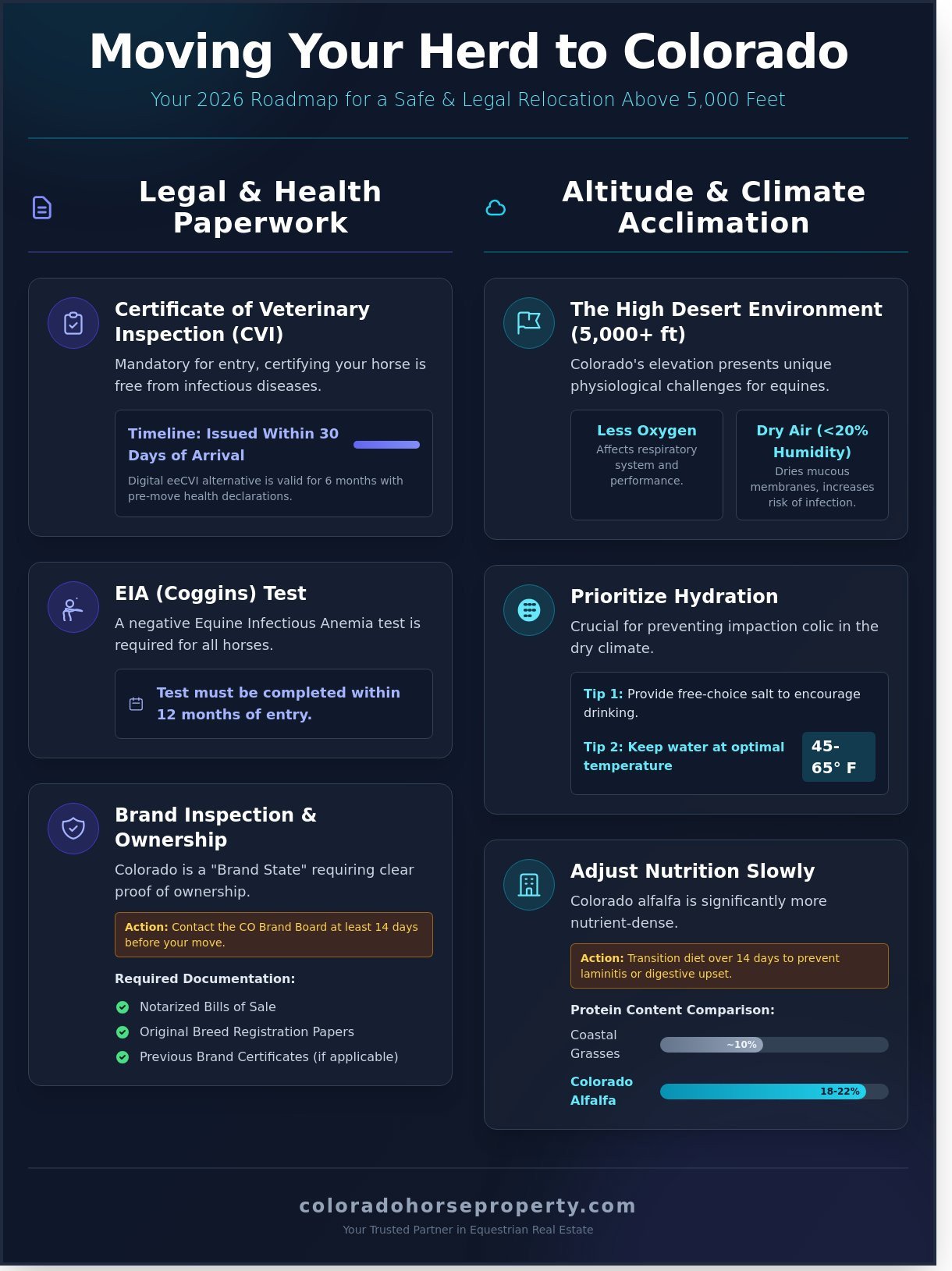
Moving to Colorado with horses requires more than just a trailer and a reliable truck. You’ve got to navigate a specific set of legal hurdles to ensure your animals cross the state line without delay. The primary document you’ll need is the Certificate of Veterinary Inspection (CVI). This must be issued by a federally accredited veterinarian within 30 days of your arrival in the state of Colorado. Every horse needs a unique physical description or official identification, like a microchip or tattoo, listed clearly on this document.
To better understand the logistics of hauling your animals long distances, watch this helpful video:
The Certificate of Veterinary Inspection (CVI)
In 2026, Colorado maintains strict biosecurity standards to protect the local equine population. Your vet must certify that each animal is free from infectious diseases like Vesicular Stomatitis (VSV) or Equine Herpesvirus (EHV-1). The eeCVI provides a digital alternative to standard paperwork that remains valid for six months provided the owner submits a health declaration via the Global Vet Link platform before each move.
EIA (Coggins) and Special Permits
A negative Equine Infectious Anemia (EIA) test, commonly known as a Coggins test, is mandatory for entry. For 2026, Colorado requires this test to be completed within 12 months of your entry date. If you’re importing horses from Contagious Equine Metritis (CEM) affected countries, you must secure a special import permit from the Colorado State Veterinarian’s office at least 48 hours before arrival. This ensures the state can track and verify the health status of high-risk imports.
Brand Inspection and Proof of Ownership
Colorado is one of 14 “Brand States” in the U.S., meaning the Colorado Brand Board has legal authority over livestock ownership. This often surprises owners moving from the East Coast or Midwest. You must provide a clear “chain of title” to prove you actually own the animals you’re hauling. This is essential for anyone moving to Colorado with horses from a non-brand state.
Contact the Colorado Brand Board at 303-869-9160 at least 14 days before your move. They’ll help you determine if you need a permanent travel permit or a local inspection once you cross the border. To avoid transit delays, prepare the following documentation:
- Bills of Sale: Provide notarized bills of sale from the previous two owners if possible.
- Registration Papers: Keep original breed registration certificates in the truck.
- Previous Brand Certificates: If you’re coming from another brand state like Wyoming or New Mexico, have your latest inspection papers ready.
Managing the Altitude and Climate Shift for Equines
Moving to Colorado with horses requires a deep understanding of the High Desert’s physiological demands. At elevations of 5,000 feet or higher, the air contains less oxygen and significantly less moisture. This dry environment affects respiratory health by drying out mucosal membranes, which makes horses more susceptible to dust and allergens. You must also prioritize hydration. Colorado’s humidity frequently dips below 20 percent, causing horses to lose moisture through respiration alone. This creates a high risk for impaction colic if the horse isn’t drinking enough. Providing salt blocks and ensuring water stays between 45 and 65 degrees Fahrenheit will encourage consistent intake.
Nutrition also shifts when you cross the border. Colorado alfalfa is nutrient-dense, often testing at 18 to 22 percent protein. If your horse is coming from a region with lower-protein coastal grasses, you must transition their diet slowly over 14 days to prevent laminitis or digestive upset. Before your trailer arrives, verify you have met all Colorado import requirements, including a current Coggins test and health certificate. Planning your move with these factors in mind ensures your horse stays healthy during the transition to a new Colorado horse property.
Acclimatizing to High Altitudes
Your horse’s body needs time to produce more red blood cells to carry oxygen efficiently. This physiological shift takes roughly 14 to 21 days. Don’t engage in heavy exercise or training during this window. Monitor your horse for signs of altitude stress like lethargy, a resting respiratory rate exceeding 20 breaths per minute, or a sudden lack of appetite. In rare cases, horses can develop High Mountain Disease, a form of pulmonary hypertension that requires immediate veterinary attention. Stick to light walking and turnout until the three-week mark passes.
Winter Prep and Shelter Requirements
The Front Range is famous for 40-degree temperature swings in a single afternoon. Your shelter must include three-sided windbreaks to block the prevailing northwest winds. Heated waterers are mandatory; horses won’t drink enough if they have to break through ice. During the “mud season” from March through May, focus on hoof health. High Rockies moisture can lead to thrush if paddocks aren’t well-drained. Use wood chips or gravel in high-traffic areas around gates and feeders to keep hooves dry. Proper blanketing is also essential when moving to Colorado with horses, as you’ll need to layer based on wind chill rather than just the ambient temperature.
Logistics: Transporting Horses to the Rockies
Moving to Colorado with horses requires a logistical strategy that accounts for extreme elevation changes and unpredictable weather. You aren’t just crossing state lines; you’re climbing into an environment where the oxygen is thinner and the grades are steeper. Successful transport depends on timing your arrival to avoid the heavy congestion of the Front Range while ensuring your horse arrives hydrated and stress-free.
Planning Your Route and Rest Stops
Avoid mountain passes like Vail Pass or Wolf Creek from November 1st through May 1st. Sudden blizzards can close I-70 for 10 hours or more, leaving you stranded on the shoulder with livestock. If you’re moving to Colorado with horses during these months, stick to lower-elevation southern routes until you reach your destination. Plan your arrival in Denver to miss the 6:30 AM to 9:30 AM and 3:30 PM to 6:30 PM rush hours. Sitting in stop-and-go traffic on I-25 with a horse trailer is hard on your brakes and your horse’s legs.
- Overnight Boarding: Look for facilities like the Colorado State Fairgrounds in Pueblo or private equine motels in Brighton that offer 12×12 stalls and 50-amp trailer hookups.
- Horse-Friendly Stops: Use the large paved rest areas near Limon on I-70 or Wiggins on I-76. These locations provide 100+ feet of turn-around space for large rigs.
- Biosecurity: Never use communal water troughs at rest stops. Bring 20 gallons of water from your current home per horse to prevent colic and avoid exposure to local pathogens during the transition.
Hauling for High-Elevation Grades
The Eisenhower Tunnel on I-70 reaches an elevation of 11,158 feet. This climb puts immense strain on your cooling system, while the 7% descent toward Silverthorne tests your trailer brakes. If you aren’t experienced with mountain driving, hire a professional hauler who uses air-ride trailers. These rigs reduce muscle vibration by roughly 25%, helping horses arrive without “trailer legs.”
Check your tire pressure and brake pads 48 hours before departure. High-altitude air is incredibly dry, so maximize trailer ventilation by opening all slats and windows. Electrolyte loading 24 hours before the haul is critical for Colorado moves because the dry mountain air and increased respiratory rate at high altitudes rapidly deplete a horse’s mineral reserves. Pack an emergency kit for the remote stretches of I-70 east of Denver. This should include a satellite messenger, heavy-duty wire cutters, and enough hay to last 24 hours in case of a road closure.
Navigating Colorado Horse Property Laws and Zoning
Finding the right land is only half the battle when moving to Colorado with horses. You’ll need to decode local zoning codes that vary wildly between neighboring counties. In Douglas County, zoning often dictates a minimum of 2.5 acres to keep your first two horses. If you’re looking at Weld County, the rules favor agricultural production, but specific subdivisions may have stricter covenants than the county standard. Elbert County remains a top choice for those seeking fewer restrictions, often allowing more animals per acre on larger parcels. These regulations are subject to change, so checking the 2026 county master plans is a vital step in your due diligence.
Understanding Acreage and Zoning
You must distinguish between “Use by Right” and “Special Use Permits” before signing a contract. A property might be zoned agricultural, but that doesn’t mean you can run a commercial boarding stable without a permit. Most residential-agricultural zones allow a specific number of horses per acre as a standard right. If you plan to build a public arena or host clinics, you’ll likely need a Special Use Permit, which involves public hearings and neighbor notifications. For a deeper dive into these requirements, see our guide on Buying Horse Property in Colorado: The Ultimate Guide.
- Douglas County: Generally requires 2.5 acres for the first two horses; additional horses require more acreage or manure management plans.
- Elbert County: Known for “A-Zoning” which is very horse-friendly, often allowing one horse per 1 or 2 acres depending on the specific parcel size.
- Weld County: Focuses on “Right to Farm” laws, protecting your ability to keep livestock despite encroaching residential development.
Water Rights and Irrigation
Water is the most valuable asset in the West. A standard domestic well permit issued by the Colorado Division of Water Resources typically limits use to indoor household purposes only. It doesn’t legally allow you to water a string of 10 horses or irrigate a three-acre paddock. You need a well permit that specifically includes livestock watering. When moving to Colorado with horses, you’ll want to find land with “adjudicated” water rights. This means a court has decreed the priority and amount of water you’re allowed to use. Learn more about these complexities in our article on Water Rights in Colorado: What Every Buyer Must Know.
Conservation easements are another factor to watch for. These agreements protect the land’s natural state but can prevent you from building a 20,000 square foot indoor arena, even if you own 40 acres. Our AI-powered search tools filter through thousands of listings to identify properties with “horse-ready” infrastructure already in place. This technology analyzes zoning data and historical land use to ensure you don’t buy a property with hidden building restrictions.
Don’t let zoning surprises ruin your dream of owning a ranch. You can search our latest horse property listings to find land that already meets your specific equine needs.
Settling into the Colorado Equestrian Community
Moving to Colorado with horses requires a shift in how you manage your daily routine and long-term care. The state offers unparalleled access to over 24 million acres of public land, but success here depends on your ability to network with local experts. You aren’t just buying a barn; you’re joining a community that prioritizes land stewardship and equine health in a high-altitude, semi-arid climate. Adapting to the local environment is the fastest way to turn your property into a functional home for your herd.
Public Land and Trail Access
Colorado provides expansive riding opportunities through the Bureau of Land Management (BLM) and the U.S. Forest Service. If you plan to ride in State Parks like Fox Run or Cherry Creek, you’ll need a valid Colorado State Parks pass. These currently cost $10 for a daily vehicle pass or $80 for an annual pass. For navigation, use the COTREX (Colorado Trail Explorer) app to access 45,000 miles of mapped trails. Trail etiquette is vital here. Always yield to horses, but be prepared for mountain bikers and hikers who may not know the rules. Equine camping spots like those at Mueller State Park offer specific horse-friendly sites, but these often book up six months in advance during the summer season.
Building Your Local Support Team
The dry Colorado air and rocky soil can be hard on hooves. You’ll need a farrier who understands “mountain hooves,” focusing on moisture retention and durability for granite-filled trails. Many local owners use specialized hoof dressings to prevent cracking in 15% average humidity. For medical care, identify your nearest 24/7 emergency facility immediately. The Colorado State University (CSU) Veterinary Teaching Hospital in Fort Collins is a world-class resource for complex cases. When moving to Colorado with horses, sourcing hay is another priority. Local grass hays like Timothy and Orchard are common, but you should test for sugar content if you have easy keepers. High-altitude grass can be surprisingly nutrient-dense. Joining the Colorado Horse Council provides a voice in state legislation and connects you with dozens of local breed associations.
Finding the right home base is the first step toward this lifestyle. Search for your dream Colorado horse property with our AI tool to find acreage that matches your specific needs for trail access and pasture quality.
Secure Your 2026 Colorado Equestrian Future
Success when moving to Colorado with horses requires more than a sturdy trailer. You must navigate the state’s specific 2026 health certifications and allow your herd at least 14 days to acclimate to the higher altitude. Understanding local zoning and water rights in counties like Douglas or Larimer is equally vital for protecting your investment. While the logistics are complex, the lifestyle of riding through the Rockies is an unmatched reward for your careful preparation.
You don’t need to handle these technical details alone. Mark and Alison Eibner offer nearly 40 years of specialized experience as lifelong horse owners and real estate experts. Our team uses proprietary AI search technology to identify niche land features like sub-irrigated pastures or specific arena footprints that general platforms overlook. This data-driven approach ensures your new ranch meets every functional requirement for your animals and your lifestyle.
Find Your Next Colorado Horse Property with AI and partner with a team that truly understands the needs of the modern horseman. Your mountain dream is ready for its next chapter.
Frequently Asked Questions
Do I need a brand inspection if I already have registration papers for my horse?
Yes, you must have a brand inspection because registration papers don’t serve as legal proof of ownership in Colorado. The Colorado Brand Board requires a physical inspection by a state official to verify ownership before any horse crosses state lines or travels more than 75 miles within the state. This rule applies to all horses, including those that aren’t branded or those with out of state breed registry certificates.
How many acres do I need for two horses in Colorado?
You’ll generally need between 2.5 and 5 acres for two horses, though specific requirements depend on your local county zoning laws. For instance, Douglas County often requires a minimum of 2.5 acres for the first two horses in rural residential zones. When you’re moving to Colorado with horses, it’s vital to check the land use code for your specific municipality since some areas require 35 acres to permit any livestock at all.
What is the “Brand Inspection” fee when moving to Colorado?
The standard brand inspection involves a $25.00 service call fee plus a $1.00 per head assessment as of 2024. If you plan to travel frequently, you should invest $40.00 in a Permanent Travel Permit, also known as a lifetime horse permit. This one time fee covers the horse for its entire life as long as ownership doesn’t change, allowing you to move freely across county and state lines.
Can my horse get altitude sickness when moving to the mountains?
Horses can develop high altitude disease, also known as brisket disease, when relocating to elevations above 7,000 feet. Data shows that approximately 2% of horses moved from sea level to high altitudes experience pulmonary hypertension or brisket edema. Most animals take 14 to 21 days to physically adjust to the thinner air, so you’ll need to limit strenuous exercise during this critical three week acclimation period.
Is a negative Coggins test required for all horses entering Colorado?
Colorado law requires every horse entering the state to have a negative Equine Infectious Anemia (Coggins) test completed within the last 12 months. You must carry the original laboratory certificate during transport to show officials at any of the state’s ports of entry. This requirement is strictly enforced to prevent the spread of disease among the state’s population of over 145,000 horses.
What happens if I move my horse to Colorado without a CVI?
When you’re moving to Colorado with horses, entering without a Certificate of Veterinary Inspection (CVI) can result in fines up to $500 per animal. A licensed veterinarian must issue this health certificate within 30 days of your arrival date to prove the animals are free from contagious diseases. Without this paperwork, state authorities can legally impound your horses or force an immediate quarantine at your expense until a local vet clears them.
Are there specific vaccinations recommended for Colorado horses?
Veterinarians recommend the core vaccines for Rabies, Tetanus, and West Nile Virus, as Colorado reported 78 positive rabies cases in wildlife during 2023. You should also consider the Potomac Horse Fever vaccine if your new property sits near irrigation ditches or marshes where snails thrive. Because our climate is dry, many owners also prioritize the flu and rhino series to protect against respiratory issues common in boarding environments.
How do I find out if a property has water rights for livestock?
You should search the Colorado Division of Water Resources (DWR) online database using the specific permit number or the property’s legal description. Many residential wells are “household use only,” which means they legally forbid watering livestock or gardens. Ensure the well permit specifically allows for “diversion for stock watering” to provide the 15 to 20 gallons of water each horse requires daily.