
What if the 40-acre parcel you just closed on doesn’t legally allow you to drill a well or build a single horse stall? You’ve likely spent months scrolling through listings of land for sale in Colorado, imagining a future where your horses have room to roam and your family has space to breathe. It’s a vision shared by thousands of buyers every year, but the reality of Rocky Mountain real estate is often buried under layers of complex legislation that can turn a dream into a legal headache.
We understand that you want a clear path to your lifestyle goals without the fear of buying unbuildable ground. This definitive 2026 guide provides the exact roadmap we’ve used for 38 years to help buyers secure functional acreage while avoiding the costly traps that catch generalist realtors off guard. We’ll break down the essentials of senior water rights, explain 2026 zoning changes for livestock, and show you exactly how to vet a property’s infrastructure before you sign the contract.
Key Takeaways
- Gain a clear understanding of the 2026 market inventory to distinguish between raw and improved land before starting your search.
- Learn how to navigate the complex hierarchy of zoning regulations to ensure your future property legally supports your ranching or residential lifestyle.
- Uncover why “owning the land” doesn’t guarantee water access by mastering the critical nuances of the Doctrine of Prior Appropriation.
- Follow a strategic five-step process to efficiently identify and secure the ideal land for sale in Colorado using AI-powered tools and expert guidance.
- Protect your investment by understanding the vital role a specialized land expert plays in navigating high-stakes rural transactions and water law.
Understanding the Landscape of Land for Sale in Colorado (2026)
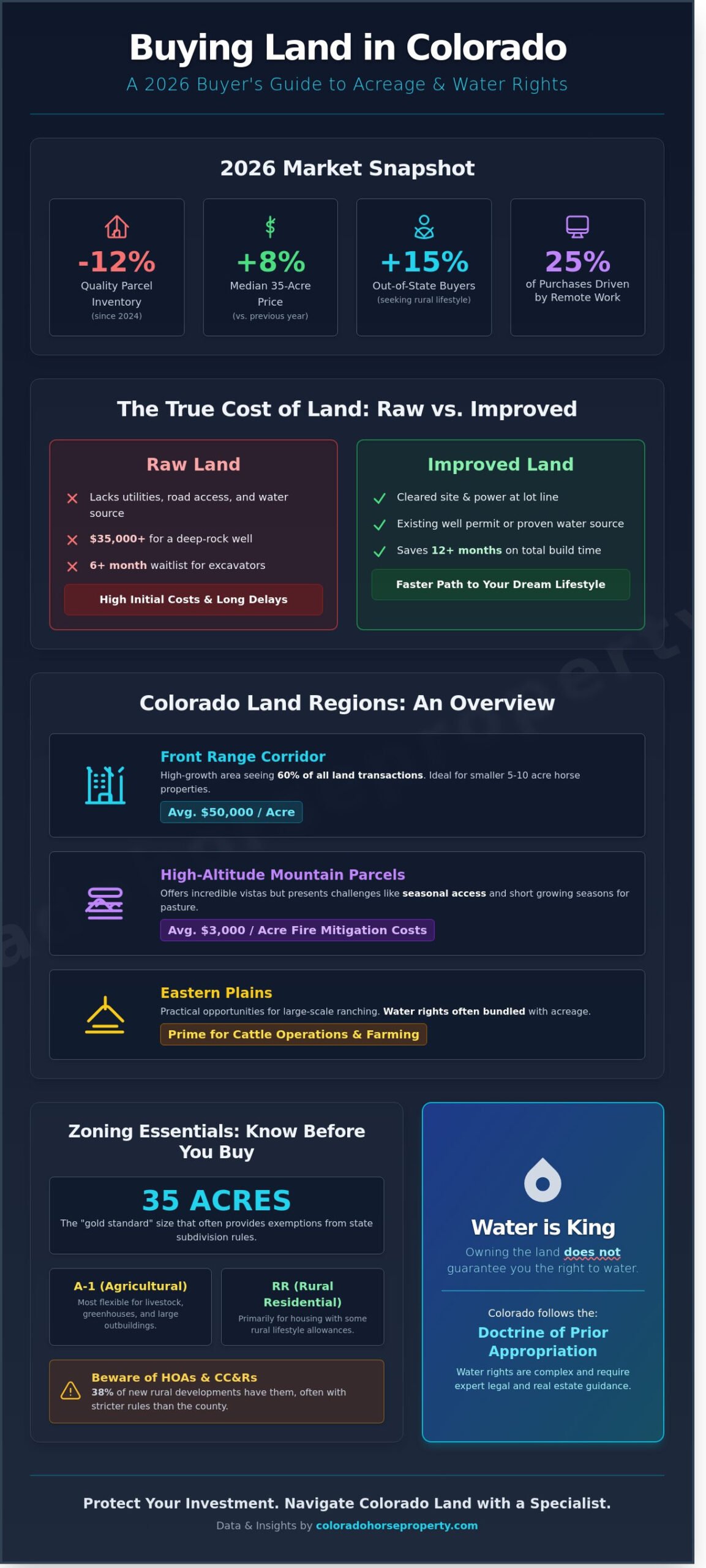
The 2026 market for land for sale in Colorado reflects a sharp shift toward utility and self-sufficiency. Inventory for quality parcels has decreased by 12% since 2024, leaving buyers to compete for properties with proven water access and buildable topography. Colorado’s landscape offers a diverse range of opportunities, from the arid plains to the lush alpine meadows, but each comes with distinct regulatory hurdles. In the first quarter of 2026, the median price for a 35-acre parcel rose by 8% compared to the previous year. This growth is driven by a 15% increase in out-of-state buyers seeking refuge from coastal urban density and looking for a more grounded lifestyle.
To better understand the investment potential of these properties, watch this helpful video:
Distinguishing between raw and improved land is vital for your budget. Raw land lacks utilities, road access, and established water sources. In 2026, drilling a deep-rock well can cost upwards of $35,000, and the waitlist for local excavators often stretches six months. Improved land usually features a cleared building site, power at the lot line, or an existing well permit. For those pursuing their lifestyle and dreams, improved land reduces the timeline to move horses or livestock onto the property by at least 12 months. Colorado is a unique asset class because of its strict water adjudication laws; you aren’t just buying the dirt, you’re buying the legal right to the water beneath it.
Regional Variations: From the Front Range to the Western Slope
The high-growth Front Range corridor, particularly the I-25 corridor, sees 60% of all land transactions in the state. Prices here average $50,000 per acre for smaller 5 to 10 acre horse properties. High-altitude mountain parcels in areas like Park County offer incredible vistas but present challenges like seasonal access and short growing seasons for pasture. You’ll need to account for fire mitigation costs, which averaged $3,000 per acre in 2025. The Eastern Plains provide the most practical opportunities for large-scale ranching. In 2026, cattle operations are expanding in Weld County, where water rights are often bundled with the deeded acreage at a more accessible price point.
The 2026 Market Outlook for Colorado Acreage
The 2026 market outlook remains bullish. Interest rates settled at 5.75% in January, providing much-needed predictability for buyers who sat out during the 2024 volatility. Remote work trends continue to drive 25% of all rural land purchases, as professionals seek properties that accommodate both a home office and a barn. Equestrian hot spots are shifting toward Elizabeth and Kiowa, where zoning laws remain favorable for high animal counts and communal trail systems. Land for sale in Colorado serves as a premier strategic long-term investment in 2026 because it pairs a shrinking supply of developable acreage with the enduring intrinsic value of Western water and mineral rights.
Zoning and Land Use: Defining Your Colorado Lifestyle
Zoning dictates your daily reality and the long term value of your investment. In Colorado, land use follows a strict hierarchy. Federal agencies like the Bureau of Land Management (BLM) oversee 8.3 million acres of state land, often bordering private parcels and providing “backdoor” access to trails. However, your primary regulator is the county planning department. They determine whether you can build a primary residence, a secondary “mother-in-law” suite, or a commercial boarding stable. When searching for land for sale in colorado, you’ll quickly see that 35-acre parcels are a gold standard. This specific acreage often triggers exemptions from certain state subdivision regulations, though you’re still bound by county building codes and local health department rules for septic systems.
Most rural buyers focus on A-1 (Agricultural) or RR (Rural Residential) designations. A-1 is generally the most flexible, allowing for livestock, greenhouses, and large outbuildings. Don’t assume a “rural” label means total freedom. In 2024, approximately 38% of new rural developments in the Front Range are governed by Homeowners Associations (HOAs) or Covenants, Conditions, and Restrictions (CC&Rs). These private rules can be stricter than county laws, often limiting the number of outbuildings, forbidding certain livestock, or requiring specific fencing materials like three-rail vinyl instead of wire.
Legal access to water is the most critical land use constraint in the West. Your ability to maintain a lush pasture or wash down a dusty arena depends on Colorado’s Prior Appropriation water rights system. This “first in time, first in right” legal framework means that during a drought, senior rights holders get their water first. If you’re looking at land for sale in colorado with plans for significant irrigation, you must verify the priority date of the water rights attached to the deed. Without a decree for “augmentation,” a standard domestic well might only allow for in-house use, preventing you from watering even a small garden or a single horse.
Equestrian-Specific Zoning Considerations
Calculating “horse power” is a vital step for any equine enthusiast. Most Colorado counties, including Douglas, Elbert, and Weld, use a density formula to prevent overgrazing. For example, a common standard is two horses for the first 2.5 acres, plus one additional horse for every acre of usable pasture thereafter. You’ll also need to check setbacks for structures. A 100-foot setback from property lines for manure storage or outdoor arenas is standard in many jurisdictions. These specific legal requirements are part of what makes a home an equestrian house rather than just a residential property with a shed. If you plan to host clinics or offer boarding, you’ll likely need a Special Use Permit, which involves a public hearing process.
Environmental and Topographical Constraints
The Colorado landscape presents unique engineering challenges. Expansive soils, which contain high concentrations of bentonite clay, affect roughly 92% of the Front Range. These soils swell when wet and can exert enough pressure to crack a standard concrete foundation. Always demand a soil test before closing. Additionally, the 2023 Colorado State Forest Service updates require strict wildfire mitigation for new builds. This includes creating a 30-foot “Zone 1” defensible space around structures by removing flammable vegetation. If the land includes a conservation easement, you might benefit from a state tax credit of up to $5 million, but you’ll permanently forfeit the right to subdivide or develop the land beyond its current state. For more personalized guidance on these complex regulations, consult with a specialist who understands the nuances of rural Colorado land.
The Critical Factor: Navigating Water Rights and Well Permits
In Colorado, water is a separate real estate interest. You don’t automatically own the water beneath your boots just because you bought the dirt. This reality stems from the Doctrine of Prior Appropriation, a legal framework established in the 1860s. It operates on a “first in time, first in right” basis. Senior rights holders, whose claims may date back to the 19th century, get their full allocation before junior holders receive a drop. When searching for land for sale in Colorado, you’re looking at a property’s history as much as its acreage. If a drought hits, the State Engineer can “call” the river, shutting off junior users to satisfy senior downstream demands.
The Colorado Division of Water Resources (DWR) manages this complex system. They track every cubic foot of surface water and every gallon of groundwater. You’ll encounter two main types of groundwater: tributary and non-tributary. Tributary water connects to surface streams; pumping it affects river flows, so it’s strictly regulated. Non-tributary water is deep underground and doesn’t influence surface water for centuries. Understanding which one your property sits on is vital. A lack of secure water can slash a property’s market value by 25% to 40% compared to a parcel with adjudicated rights. Without a legal right to pump, that scenic mountain retreat is just expensive, dry dirt.
Understanding Well Permits for Rural Land
Most rural land for sale in Colorado relies on individual wells. Don’t assume a hole in the ground equals a right to use it. A “household-use only” permit is the most restrictive. It limits you to indoor plumbing for one dwelling. You can’t water a horse, wash a truck, or grow a tomato. For the lifestyle we facilitate at Colorado Horse Property, you need a “domestic and livestock” permit. These are generally available for parcels larger than 35 acres that aren’t in over-appropriated basins.
By 2026, the DWR has implemented stricter digital monitoring for new wells in the South Platte and Rio Grande basins. If you’re buying a smaller lot, you’ll likely need an augmentation plan. This is a court-approved document where you pay a fee to replace the water you consume, ensuring senior holders aren’t harmed. Always verify that a well’s permit number matches the physical equipment on the property before you sign a contract.
Irrigation Rights and Agricultural Production
If you plan to grow hay or maintain lush pastures, you’ll need irrigation “shares.” These aren’t just suggestions; they’re ownership stakes in a mutual ditch company. Each share represents a specific volume of water delivered during the growing season. However, Colorado law follows a “use it or lose it” principle. If water hasn’t been applied to a beneficial use for 10 consecutive years, it can be declared abandoned.
Check the ditch company’s assessment history and the 2025 decree records to ensure the rights are active. Buying into a property with “paper rights” that haven’t been exercised in a decade is a recipe for a legal nightmare. For a deeper look at these technicalities, read our guide on Water Rights in Colorado: What Every Buyer Must Know. Secure water is the only thing that turns a high-desert parcel into a functional ranch. Verify the seniority of the rights and the delivery infrastructure during your due diligence period to protect your investment.
The 5-Step Process to Securing Your Colorado Acreage
Buying land in 2026 requires more than just a handshake and a map. The process has become increasingly technical, requiring a blend of advanced technology and old-school boots-on-the-ground expertise. To secure the right land for sale in Colorado, you need a systematic approach that accounts for water rights, zoning, and soil health before you sign on the dotted line.
Leveraging AI in Your Property Search
Searching for land for sale in Colorado has evolved past basic filters like price and location. Our proprietary AI tool allows you to filter for specific infrastructure like 72-foot indoor arenas, existing barns, or specific sandy loam soil types ideal for hoof health. Instead of wasting time on “raw acres” that lack utility, you can identify “horse-ready” properties that already meet 90% of your requirements. This precision saves buyers an average of 40 hours in the initial search phase. Try our AI-Powered Horse Property Search today to see the difference for yourself.
- Step 1: Define Your Must-Haves. Use AI to pinpoint properties with existing perimeter fencing or senior water rights. Don’t settle for generic listings; look for parcels that match your specific equine or agricultural needs.
- Step 2: Assemble Your Expert Team. You’ll need a specialized realtor who understands rural zoning, a professional inspector familiar with well and septic systems, and a water lawyer. In Colorado, water law is complex; missing a single filing can render your land unusable for livestock.
- Step 3: Conduct the Feasibility Period. This is your 30-day window for due diligence. You must verify that the soil can support a foundation, the well produces at least 5 gallons per minute, and the zoning allows for the number of horses you plan to keep.
- Step 4: Secure Specialized Financing. Traditional banks often shy away from raw land. You’ll likely work with specialized lenders like Farm Credit or local agricultural banks that understand the long-term value of ranch land.
- Step 5: Navigate the Closing. Closing on land involves specific title and escrow services that can handle the transfer of water rights and grazing leases. This isn’t a standard residential closing; it’s a transfer of a complex asset.
Financing and Appraising Raw Land
Financing land is a different beast than a suburban mortgage. Most buyers should expect to provide a 35% to 50% down payment for raw land, as lenders view these as higher-risk investments. Interest rates for land loans in 2026 typically sit 1% to 2% higher than standard residential rates. You’ll also need an appraiser who specializes in “equestrian real estate Colorado” to ensure the value of outbuildings, arenas, and water rights are accurately captured in the final valuation. Without a specialist, you risk a low appraisal that can derail your funding at the last minute.
The final step involves a thorough review of the title commitment. Your team must ensure there are no hidden easements or environmental liens that could restrict your use of the pasture. We’ve seen buyers lose 15% of their usable acreage because they didn’t spot a utility easement in the preliminary report. Stay diligent, follow the steps, and you’ll secure a legacy property that lasts for generations.
Ready to move from browsing to buying? Contact our expert team at Colorado Horse Property to start your feasibility study today.
Why Expert Representation Matters for Colorado Land Buyers
Buying a parcel of land for sale in colorado involves layers of complexity that a standard residential agent isn’t trained to handle. When you’re looking at 40 acres in the Front Range, you aren’t just buying dirt. You’re buying a legal bundle of rights, access points, and environmental obligations. A generalist might see a beautiful view, but an expert sees a lack of legal access or a high water table that prevents a septic system from being installed. These oversights often lead to tens of thousands of dollars in unexpected costs after the deed is signed. You need a partner who understands the dirt as well as the data.
The risks of using a generalist are particularly high when dealing with ranch transactions. Issues like mineral rights, grazing leases, and conservation easements require a specialized eye. If your agent doesn’t know how to verify a well’s production rate or check the validity of a senior water right from 1895, your investment is at risk. Expert representation ensures that every potential “deal breaker” is identified during the due diligence period, not after the closing date. It’s about protecting your capital and your future peace of mind.
The Realty Oasis Difference: 40 Years of Expertise
Mark and Alison Eibner provide a founder-forward service model that ensures you’re working with the principals of the firm, not a junior trainee. Since 1984, they’ve managed transactions ranging from small hobby farms to expansive ranching operations. They handle the heavy lifting of ranch sales, including the verification of zoning compliance and historical land use permits. For example, a recent client secured a 35-acre plot that others passed over because Mark identified a specific utility easement that allowed for a more efficient building envelope. This expertise turned a challenging piece of ground into a thriving $2.8 million equestrian estate. They don’t just find listings; they solve the problems that come with them.
Our “ecosystem” approach removes the guesswork from land ownership. We connect you with a vetted network of professionals, including:
- Title officers who specialize in agricultural exemptions and legal descriptions.
- Escrow agents familiar with the nuances of multi-million dollar ranch closings.
- Reliable local contractors for fencing, well drilling, and arena construction.
- Land use attorneys who can navigate complex county-specific regulations.
This network ensures your transition to the rural lifestyle is seamless. We don’t just hand you a set of keys and walk away. We provide the infrastructure needed to turn a raw piece of land for sale in colorado into the home you’ve imagined. This specialized approach protects your investment and ensures your property aligns perfectly with your lifestyle and dreams.
Next Steps: Starting Your Colorado Land Journey
Your journey begins with a clear vision. Before our first meeting, prepare a wish list that prioritizes your non-negotiables. Think about total acreage, proximity to trail systems, and necessary outbuildings like barns or indoor arenas. During your initial consultation, we’ll use these details to refine a search that targets high-value opportunities before they hit the broader market. We’re here to guide you through the search, the offer, and the technical inspections. Ready to begin? You can Contact Colorado Horse Property to find your perfect land and start building your future in the West today.
Claim Your Piece of the Centennial State
Finding the right land for sale in colorado requires more than just a map and a dream. You’ve learned that navigating 2026 zoning laws and securing senior water rights are the foundations of a successful purchase. Our 5-step process simplifies these complexities so you don’t get lost in the paperwork. You need a partner who understands that a ranch is more than just dirt; it’s the start of your next chapter.
Colorado Horse Property brings nearly 40 years of real estate experience to your search. We provide comprehensive transaction management for complex ranch deals, ensuring no detail is missed. Our specialized AI-driven equestrian search technology filters through thousands of listings to find the specific acreage, barns, and arenas that fit your criteria. You won’t have to settle for a property that almost works. We’re here to help you find the one that truly fulfills your lifestyle and dreams.
Start Your AI-Powered Colorado Land Search Now
The mountains are calling, and your perfect acreage is waiting for you to find it.
Frequently Asked Questions
How much does an acre of land cost in Colorado in 2026?
In 2026, the average price for land for sale in Colorado is $5,200 per acre for rural grazing land, while parcels near the Front Range often exceed $18,500 per acre. These figures vary based on water access and proximity to metro areas like Denver. Buyers should budget for a 7% increase in land values compared to 2024 USDA data. We’ve helped clients navigate these market shifts for nearly four decades.
Can I build a house on any piece of land for sale in Colorado?
No, you can’t build a house on every parcel because zoning restrictions and soil stability vary by county. For example, Boulder County requires a Site Conservation Plan for most new builds, and many rural areas lack the 35 acre minimum required for an automatic domestic well permit. You must verify legal access and buildability with the local planning department before closing on any land for sale in Colorado. This due diligence prevents costly mistakes.
What is the difference between mineral rights and surface rights?
Surface rights give you ownership of the land’s top layer and structures, while mineral rights allow the owner to extract oil, gas, or coal from beneath the property. In Colorado, these are often severed, meaning someone else could own the minerals under your pasture. Since 1950, split estates have become the standard in the West. It’s vital to conduct a specialized mineral title search to understand if a third party can access your surface.
How do I know if a property has senior water rights?
You identify senior water rights by checking the priority date on the decree via the Colorado Division of Water Resources database. A senior right was established earlier than a junior right, with many dating back to the 1860s. In a drought year, the owner with the 1875 priority date receives their full water allocation before the owner with an 1890 date gets any. Understanding these decrees is essential for maintaining healthy pastures and livestock.
Are there specific taxes for agricultural land in Colorado?
Yes, Colorado offers a lower property tax assessment rate for land classified as agricultural. While residential property is often assessed at 6.7%, agricultural land is valued based on its production capacity rather than market value. To qualify, you must show the land was used for a primary purpose like grazing or crop production for the previous 2 years. This classification can save a landowner thousands of dollars in annual taxes on larger Colorado parcels.
What is a “ranchette” and is it right for a hobby farm?
A ranchette is typically a small rural property ranging from 5 to 35 acres used for residential living and small scale agricultural activities. It’s the perfect size for a hobby farm where you can manage 2 to 4 horses without the overhead of a full scale ranch. These properties allow you to achieve your lifestyle and dreams of rural living while remaining close to town services. This size is manageable for a single family.
How does the “Right to Farm” law protect Colorado landowners?
The Colorado Right to Farm law, specifically Colorado Revised Statute 35-3.5-101, protects landowners from nuisance lawsuits filed by neighbors over standard agricultural smells, noises, or dust. If your farm was established before the complaining neighbor moved in, the law prevents them from forcing you to stop your operations. This protection is vital for maintaining the state’s 31.8 million acres of agricultural land. It ensures your rural lifestyle remains undisturbed by encroaching development.
Do I need a special permit to keep horses on my Colorado property?
You don’t usually need a special permit to keep horses, but you must follow county zoning laws that dictate the number of animal units allowed per acre. In Douglas County, you can typically keep one horse per 0.5 acres of usable pasture. El Paso County has different requirements based on your specific zoning district. Always check the local Land Use Code to ensure your property’s acreage supports your equine companions and any future expansion.