
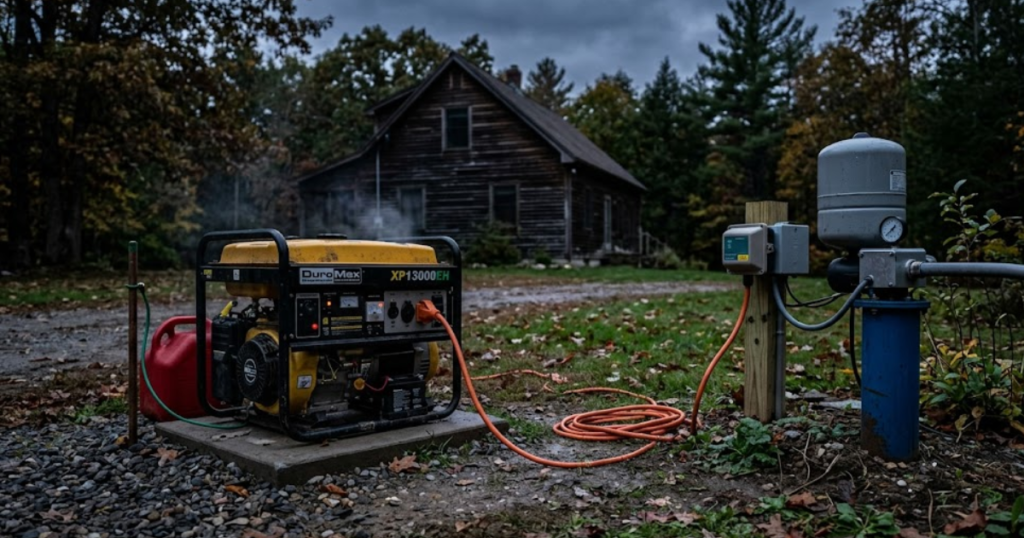
You wake up to two feet of fresh snow and a dead-silent house. A massive winter storm has knocked down the county power lines. You throw on your heavy coat and trudge out to the barn to check on the horses.
They are warm and safe in their stalls, but their water buckets are frozen solid or completely empty. You go to the wash rack, turn the spigot, and nothing happens.
In rural Colorado, grid failures are a matter of “when,” not “if.” Heavy snow, high winds, and summer wildfires frequently knock out utility power for days at a time. While you can bundle up in front of a wood stove to stay warm, your horses absolutely cannot go without water. A lack of hydration in the winter is the leading cause of deadly impaction colic.
If a property relies on a well, emergency power is not an upgrade; it is critical equestrian infrastructure. Here is how to evaluate a property’s emergency water capabilities before you buy.
Is There "Emergency Power" (Generator) for the Well Pump?
Quick Summary: The Off-Grid Lifeline
- The Thirst Reality: An average horse drinks 10 to 15 gallons of water every single day. You cannot stockpile enough buckets to sustain a herd through a multi-day winter power outage.
- The Deep Well Trap: A rural well is completely useless without electricity. If the county grid goes down, your deep-water submersible pump stops working instantly, cutting off your only water supply.
- The 240-Volt Surge: Well pumps require a massive surge of power to start up. A cheap, small hardware store generator will not provide the 240-volt output or the starting wattage required to kickstart a deep well pump.
- The Transfer Switch: You cannot simply plug a hardwired well pump into a portable generator. A safe, code-compliant property requires a manual or automatic transfer switch to safely feed generator power to the well.
On rural horse property, emergency power for the well is not just a convenience. It is a core life-support system for hydration, animal safety, and winter storm resilience.
1. The Vulnerability of the Submersible Pump
Most rural properties utilize a deep submersible well pump.
These pumps sit hundreds of feet underground, pushing water up a pipe and into a pressurized holding tank in your basement or pump house. This entire system runs on high-voltage electricity. When the grid fails, the pump stops. You will have whatever residual water is left inside the pressure tank, usually only 10 to 20 gallons, and after that, the taps run completely dry. You cannot drop a bucket down a modern 6-inch well casing to retrieve water.
2. The 240-Volt "Surge" Requirement
Many buyers see a small portable generator in the seller's garage and assume they are covered for emergencies. They are usually wrong.
- The Voltage Factor: Most standard household outlets and small generators provide 120-volt power. Almost all deep well submersible pumps require a 240-volt circuit to operate.
- The Starting Surge: Electric motors require a massive jolt of electricity to start spinning, known as surge watts. A well pump that requires 2,000 running watts might need 5,000 to 7,000 surge watts just to turn on. If the generator is not sized properly to handle that initial spike, the pump will stall, or the generator's breaker will instantly trip.
A generator must be evaluated for both voltage and startup surge capacity. Looking only at running watts can create a dangerous false sense of security.
3. The Transfer Switch Connection
You cannot just run an extension cord to a well pump. It is hardwired directly into the home's electrical panel.
- The Dangerous Backfeed: Never try to wire a generator directly into an outlet or breaker panel without professional hardware. This creates a lethal backfeed that sends electricity back down the county utility lines, potentially killing the linemen trying to fix the outage.
- The Legal Transfer Switch: To safely power a well, the property must have an installed transfer switch. This heavy-duty mechanical switch legally and safely isolates your house from the grid, allowing you to plug a heavy 240-volt generator cord directly into the side of the house to power the pump breaker.
- Whole-House Standby: The gold standard is an automatic standby generator, like a Generac or Kohler. These are permanently installed, tie directly into the property's massive propane tanks, and automatically turn on within seconds of a grid failure, ensuring your horses never miss a drop of water.
4. Fuel Storage and Reliability
An emergency generator is only as good as the fuel you have stored on the property.
- The Gasoline Trap: Portable generators usually run on gasoline. Gasoline goes bad quickly, gumming up carburetors. In an emergency, the local gas stations will likely have no power either, meaning you cannot buy more fuel to keep the water flowing.
- The Propane Advantage: Propane never degrades. If you are evaluating a property with a generator, look for dual-fuel portable generators or dedicated standby units that are hard-plumbed directly into the home's 500- or 1,000-gallon underground propane tank. This guarantees weeks of reliable power.
We Check the Power Before You Buy
We do not just look at the barn, we evaluate the life-support systems.
When Mark Eibner and Belinda Seville help you purchase a horse property, we ask the hard questions about off-grid survivability. We inspect the well system, check for proper generator transfer switches, and help you determine if the existing infrastructure can actually keep your herd hydrated during a severe Colorado blizzard.
Contact Us Today to find a resilient property that can weather any storm.
Browse Active Colorado Horse Properties: Browse Active Colorado Horse Properties equipped with reliable emergency infrastructure
Frequently Asked Questions (FAQ) About Well Generators
Can a solar panel system run my well pump during a power outage?
Standard grid-tied solar panels shut down when the county power goes out to prevent backfeeding the grid. To run a well pump on solar during an outage, you must have a specialized off-grid capable inverter, a massive battery bank, and ideally a soft-start module installed on the well pump to reduce the massive surge wattage requirement.
How much does it cost to install a whole-house standby generator?
Depending on the size of the unit and the complexity of tying into your existing propane lines and electrical panel, a professionally installed automatic standby generator typically costs between $10,000 and $15,000. It is a major investment, but it adds direct appraisal value to the real estate.
Is there any way to pump water manually if my generator breaks?
Yes. You can have a specialized aerospace-grade manual hand pump, such as the Simple Pump brand, installed directly alongside your electric submersible pump inside the same well casing. This allows you to manually pump fresh water into buckets from hundreds of feet underground with zero electricity.