
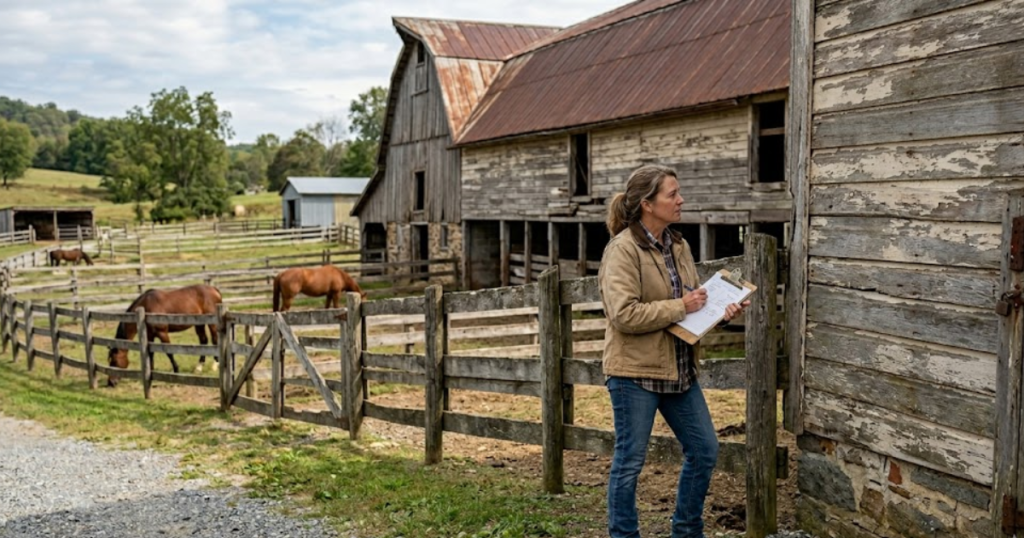
You finally closed on a massive equestrian estate. You are staring at a state-of-the-art indoor arena, miles of steel pipe fencing, and a custom Morton barn. You see a beautiful place to train your horses. The IRS, however, sees a complex web of depreciable capital assets.
Buying a working horse property is not just a lifestyle choice; it is a massive capital investment. When you transition from a residential homeowner to an agricultural landowner, you must start looking at your property like a balance sheet. The infrastructure on a horse farm wears out, requires constant maintenance, and eventually needs to be replaced.
If you are running a legitimate boarding, training, or breeding operation, understanding the tax strategy behind your infrastructure is critical. Properly depreciating the existing equine improvements can save you tens of thousands of dollars in taxes over the life of your farm.
Here is how to look at a property’s infrastructure through the lens of a depreciation schedule.
Is There a "Depreciation Schedule" for Existing Equine Improvements?
Quick Summary: The Tax Strategy of the Farm
- The Non-Depreciable Dirt: Land itself never depreciates in the eyes of the IRS. To maximize your tax benefits, you must legally separate the value of the raw dirt from the value of the man-made improvements.
- The Asset Classes: Farm infrastructure ages out at different legal rates. Under the Modified Accelerated Cost Recovery System (MACRS), agricultural fences are typically depreciated over 7 years, while barns and machine sheds are depreciated over 20 years.
- Cost Segregation: Smart buyers use cost segregation strategies at closing to accurately allocate the purchase price to these specific improvements, maximizing their annual tax deductions.
- The Business vs. Hobby Hurdle: You cannot depreciate the barn if your horses are strictly personal pets. To claim these massive deductions, your farm must operate as a legitimate, profit-seeking business under IRS guidelines.
On a working horse property, infrastructure is not just a lifestyle feature. It may be a depreciable business asset that affects cash flow, tax planning, and the long-term economics of the farm.
1. Allocating the Purchase Price
When you buy a residential house, you generally think of the purchase price as one single number. On an equestrian property, that approach leaves money on the table.
- The Dirt Cannot Depreciate: The IRS strictly mandates that raw land does not wear out, and therefore, it cannot be depreciated. If you buy a farm for $1,500,000 and do not allocate the costs, you are missing out on major deductions.
- The Division of Assets: You must separate the value of the land from the value of the primary residence, and then separate both of those from the agricultural improvements. The fencing, the loafing sheds, the arena base, and the barn all have specific, depreciable monetary values.
- The Appraisal Baseline: A specialized agricultural appraisal is your best defense. It provides a legally defensible baseline, assigning a specific dollar value to the existing equine infrastructure at the time of purchase so you can hand a clean, accurate ledger over to your CPA.
2. Decoding the IRS Asset Classes
Not all improvements age at the same rate. The IRS uses MACRS, the Modified Accelerated Cost Recovery System, to dictate exactly how many years it takes for an asset to fully depreciate.
- 7-Year Property: Agricultural fencing, portable round pens, and specialized livestock handling equipment are generally considered 7-year property. They take a beating from the weather and the animals, so the IRS allows you to write off their value relatively quickly.
- 15-Year Property: Improvements directly related to the land, such as paved driveways, specialized drainage systems for the arena, and established water wells, often fall into the 15-year category.
- 20-Year Property: Permanent farm buildings, including standard horse barns, machine sheds, and hay storage facilities, are typically depreciated over a 20-year schedule.
Different infrastructure categories create different deduction timelines, so accurate classification can materially change the annual tax benefit of the farm.
3. The Power of Cost Segregation
If you are buying a multi-million-dollar equestrian facility, relying on a basic tax return is a mistake.
A formal cost segregation study breaks down the property into its granular components. Instead of depreciating the entire barn over 20 years, a cost segregation study might identify the specialized rubber stall mats, the automatic waterers, and the custom arena lighting as equipment that can be depreciated over just 5 or 7 years. This advanced tax strategy accelerates your deductions, keeping more cash in your operational accounts during those expensive first few years of ownership.
4. The IRS "Hobby Loss" Warning
There is a massive catch to all of these tax strategies. You cannot claim agricultural depreciation if the IRS views your farm as an expensive weekend hobby.
- The Profit Motive: To claim depreciation on barns, fences, and arenas, you must prove you are operating a legitimate business with a clear intent to make a profit.
- The Recordkeeping Standard: Under IRS Section 183, you must run the farm in a businesslike manner, maintain meticulous accounting records, and ideally show a profit in at least two out of every seven consecutive years, which is the specific rule for equine businesses.
- The Audit Risk: If you are audited and classified as a hobby, your depreciation deductions will be disallowed.
We See the Value in the Infrastructure
We do not just evaluate the aesthetics of a barn; we evaluate its financial footprint.
When Mark Eibner and Belinda Seville represent you in buying a working horse farm, we ensure you have the detailed property data you need to set up a powerful tax strategy. We understand the true replacement cost of agricultural infrastructure, and we help you acquire properties that make sense for both your horses and your bottom line.
Contact Us Today to find an equestrian property that works as a solid business asset.
Browse Active Colorado Horse Properties: Browse Active Colorado Horse Properties with extensive, high-value infrastructure
Frequently Asked Questions (FAQ) About Equine Depreciation
Can I use Section 179 to write off a new barn entirely in the first year?
Generally, no. Section 179 allows you to deduct the full purchase price of qualifying equipment, like tractors or portable corral panels, in the year they are placed in service. However, standard permanent buildings and structural components like a pole barn typically do not qualify for Section 179 and must be depreciated over their 20-year MACRS schedule.
Does it matter how old the barn is when I buy the property?
No. For tax purposes, your clock starts on the day you close on the property and place the asset into service for your business. Even if the barn is 50 years old, you establish a new cost basis based on its current value at the time of your purchase, and you begin a fresh 20-year depreciation schedule.
Can I depreciate my personal riding arena if I also give a few paid lessons there?
This is a tricky area that triggers audits. You can only depreciate the percentage of the arena that is strictly and exclusively used for the business. If you use the arena 80% of the time for your personal horses and 20% for paying clients, you can only apply depreciation to that 20% business use.