
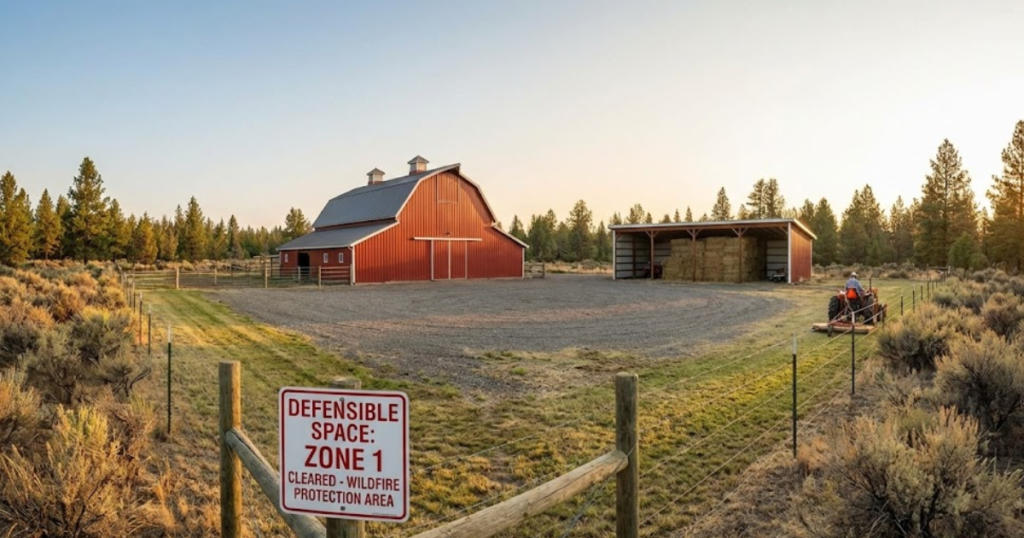
You find a beautiful barn nestled deep in the Colorado pines. It feels secluded, peaceful, and perfectly shaded.
But in the arid West, that dense forest hugging your barn is a massive liability.
Wildfire is a natural and inevitable part of the Colorado ecosystem. When a fire breaks out, emergency responders use a process called “structural triage.” They look at a property and decide if it is safe for them to defend. If your barn is surrounded by thick, dry brush with trees hanging over the roof, the fire department will likely have to drive right past it.
Protecting your horses and your investment requires proactive land management. Here is how to evaluate the defensible space on a horse property before you buy it.
Is There a “Defensible Space” Cleared Around the Barn and Hay Shed?
Quick Summary: The Wildfire Reality Check
- The three-zone system: Defensible space is not clear-cutting. It is a strategic, three-zone buffer system extending up to 100 feet from your structures to slow an advancing wildfire.
- The 5-foot rule: The area immediately touching your barn (0 to 5 feet) must be entirely free of combustible material. If hay, wood chips, or dry weeds are piled against the siding, the barn is at extreme risk from flying embers.
- The hay storage hazard: Storing your entire winter hay supply inside the main barn is convenient, but it is a massive fire liability. Ideally, bulk hay should be stored in a separate shed at least 30 to 50 feet away from where the horses sleep.
- Fire truck access: A cleared perimeter does not help if the fire engine cannot get down the driveway. You need wide gates, 14 feet of vertical tree clearance, and a designated turnaround spot for emergency vehicles.
Defensible space is about embers, fuel, and access. If any one of those fails, the property is high risk.
1. Zone 1: The Non-Combustible Buffer (0 to 5 Feet)
This is the most critical zone for preventing structure ignition. During a wildfire, high winds carry burning embers miles ahead of the actual flame front.
The ground cover
- The dirt touching the barn foundation should be covered in gravel, concrete, or bare mineral soil.
- You should never have wood mulch, pine needles, or dry leaves piled against the siding.
The clutter
- This zone is often a dumping ground for wooden pallets, old fencing, and discarded feed bags.
- All of this must be removed.
The overhang
- Look up at the roofline. There should be no tree branches hanging over the barn or touching the chimney of a heated tack room.
If you see hay stacked against a wall, you’re looking at a direct ember ignition risk.
2. Zone 2: The Lean, Clean, and Green Zone (5 to 30 Feet)
This area is designed to slow the fire down and drop the flames from the tree canopy to the ground.
The grass
- Pasture grass and weeds within this 30-foot perimeter must be mowed to a maximum height of 4 inches, especially during the dry fall season.
The trees
- If the property has trees near the barn, they need “crown separation.” The branches of one tree should be at least 10 feet away from the branches of the next.
The ladder fuels
- Look at the base of the trees. Tall shrubs growing directly under pine branches are “ladder fuels” that allow a low ground fire to climb into the treetops.
- The lower branches of mature trees should be pruned 6 to 10 feet off the ground.
3. The Bulk Combustibles: Hay and Propane
Horse properties have unique fire risks that typical suburban homes do not have.
The hay supply
- Hay is highly combustible and can even spontaneously combust if baled too wet.
- It is normal to keep a few days’ worth of feed in the main barn, but the bulk winter hay stack should be stored in a separate shed located in Zone 3 (30 to 100 feet away).
The woodpile
- Stacked firewood must be kept at least 30 feet away from all structures.
- It is ideally located uphill.
The propane tank
- If the property uses a large above-ground propane tank to heat the barn or water troughs, it must be surrounded by 10 feet of bare mineral soil and placed at least 30 feet from the buildings.
4. Emergency Access and Evacuation Routes
Defensible space also applies to your driveway. If a wildfire approaches, you will be trying to pull a four-horse gooseneck trailer out while a massive fire engine is trying to pull in.
The clearance
- Fire trucks require at least 12 feet of width and 14 to 15 feet of vertical clearance.
- If the tree canopy forms a tight tunnel over the driveway, fire engines cannot enter without damaging their equipment.
The turnaround
- Look for a large, flat gravel parking area near the barn.
- Emergency responders need a place to safely turn their rigs around without backing over a septic tank or getting stuck in the mud.
We Evaluate the Fire Risk Before You Buy
We know that a beautiful forest can quickly become a hazard if it is not managed correctly.
When Mark Eibner and Belinda Seville tour a mountain or foothills property, we look at the forest health. We check the tree spacing around the barn, evaluate hay storage logistics, and help you estimate the cost of hiring a forestry crew to create a safe buffer so you can have peace of mind during fire season.
Contact Us Today to find a property that is beautiful, functional, and fire-ready.
Browse Active Colorado Horse Properties: View All Available Listings
Frequently Asked Questions (FAQ) About Defensible Space
Does a metal barn need defensible space?
Yes. While a metal exterior will not catch fire easily, the intense radiant heat from nearby burning trees can ignite the dry hay, wood shavings, and tractors stored inside. Embers can also blow inside through open doors or un-screened vents.
Can I cut down any tree I want on my property?
Usually, yes, but there are exceptions. If the property is governed by a strict HOA or falls within a county preservation area, you may need permission or permits to remove mature trees. You are almost always allowed to remove dead trees and lower branches for safety.
Is there financial help available for fire mitigation?
Often, yes. The Colorado State Forest Service and many counties/fire districts offer matching grants or free “slash chipping” programs to help property owners offset the high cost of tree removal and defensible space clearing.