
You purchase a stunning equestrian property that borders millions of acres of National Forest. Your dream of riding directly into the wilderness is finally a reality. You load your horses into the trailer for a weekend camping trip and pack a dozen bales of premium hay you bought from the farmer down the road.
At the trailhead, a Forest Service ranger stops you. They inspect your hay bales and notice they are tied with standard white twine, lacking the required state certification tags. The ranger issues you a massive federal citation, forces you to pack up your camp, and legally evicts you from the forest.
Your dream weekend is ruined, all because you did not understand the strict agricultural laws of the Western trail system.
If one of your primary reasons for buying rural property is accessing public trails, your proximity to a specific type of hay producer is a massive logistical factor. Here is how to navigate the certified weed-free laws before you buy.
Is There a "Certified Weed-Free" Hay Producer Nearby?
Quick Summary: The Supply Chain for the Trails
- The Federal Mandate: If you plan to ride, pack, or camp with your horses on federal or state public lands in Colorado, you are legally required to use certified weed-free forage.
- The Certification Process: You cannot just claim your hay is clean. True weed-free hay must be inspected in the field by the Colorado Department of Agriculture before it is cut and baled.
- The Sourcing Struggle: Because of the rigorous inspection process, not every farmer grows certified hay. If your new property is not located near a certified producer, you will spend massive amounts of time and money sourcing and hauling feed.
- The 48-Hour Flush: The law requires you to start feeding the certified weed-free hay at least 48 hours before you enter public lands to completely clear your horse's digestive tract of uncertified seeds.
If trail access is a major reason for buying rural property, feed sourcing is part of the access equation. Without legal forage, nearby public riding opportunities can become much harder to use.
1. The Threat of Noxious Weeds
The government does not require certified hay just to be difficult. They are fighting a devastating ecological war.
- The Ecological Takeover: Invasive, non-native plants, like Leafy Spurge, Russian Knapweed, and Yellow Toadflax, have no natural predators in Colorado. When they take root, they aggressively choke out native grasses.
- The Wildlife Starvation: Native elk and deer herds cannot eat these invasive weeds. When noxious weeds take over a valley, the wildlife starves, and the entire ecosystem collapses.
- The Manure Vector: Horses are incredible seed spreaders. If your horse eats uncertified hay containing noxious weed seeds at your barn, those seeds survive the digestive process. When your horse drops manure on a pristine National Forest trail, you have just planted a new colony of invasive, ecosystem-destroying weeds.
2. What Makes Hay "Certified"?
Clean-looking hay is not legal hay. Certification is a strict, documented state process.
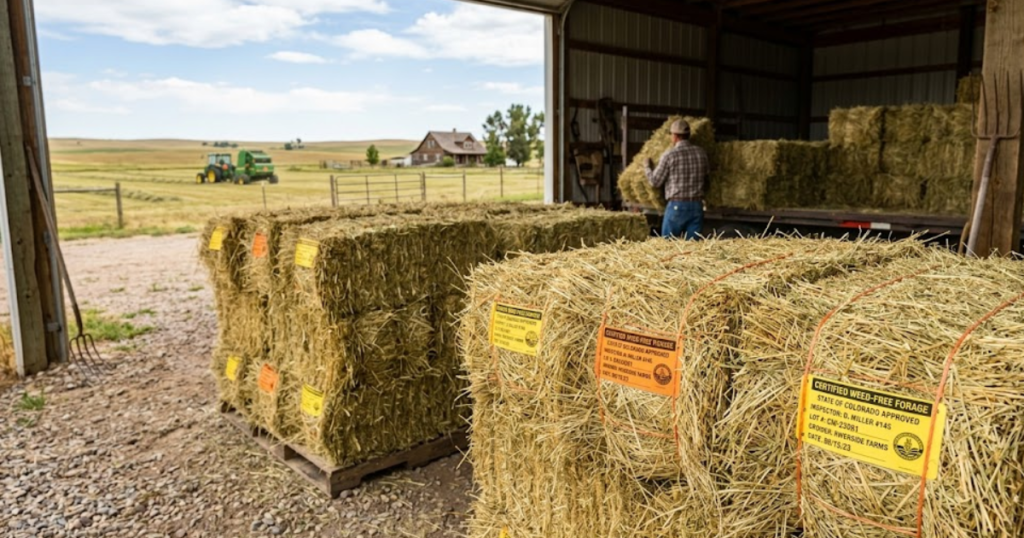
- The Field Inspection: To sell certified weed-free hay, a farmer must pay the Colorado Department of Agriculture to send an inspector to their fields before the hay is harvested. The inspector physically walks the acreage to verify there are zero noxious weeds growing among the grass or alfalfa.
- The Visual Proof: If the field passes, the farmer is allowed to bale the hay using highly specific, state-issued twine, often a distinct blue and orange woven twine, or attach specialized transit certificates to the bales.
- The Law Enforcement Check: Rangers are trained to look for this specific colored twine on your bales at the trailhead. If they do not see it, you are considered in violation of the law.
Certification is not about appearances. It is a traceable agricultural compliance process with visible proof that land managers and rangers are trained to verify.
3. The 48-Hour Digestive Protocol
You cannot just switch to the certified hay on the morning of your trail ride.
- The Transit Time: It takes roughly 48 to 72 hours for feed to completely pass through a horse's digestive tract.
- The Pre-Ride Flush: To legally enter public lands, you must start feeding your horse the certified weed-free hay at your home barn at least a full 48 hours prior to your departure. This ensures that any manure dropped on the trail contains only certified, seed-free waste.
- The Barn Logistics: This means you must have a dedicated, dry storage area in your barn specifically to keep a permanent stash of certified hay separate from your standard winter feed.
4. Sourcing and the Supply Chain Premium
If you buy an equestrian property near public lands, you must identify your feed supply chain immediately.
- The Scarcity: Growing certified hay requires meticulous field management and expensive herbicides. Many farmers simply do not want to deal with the bureaucratic hassle. In some counties, there may only be one or two certified producers.
- The Hauling Distance: If your property is an hour away from the nearest certified producer, you will burn entire weekends hauling a flatbed trailer back and forth just to maintain your legal trail-riding supply.
- The Price Premium: Because of the inspection fees and the high demand from outfitters and hunters, certified weed-free hay always commands a premium price over standard hay, drastically affecting your annual feed budget.
We Evaluate the Supply Chain Before You Buy
We do not just look at the trail access; we look at the logistics required to use those trails.
When Mark Eibner and Belinda Seville represent you in an equestrian purchase, we look at the complete operational picture. We help you identify local feed stores and agricultural producers in the county, ensuring you have reliable access to the specialized feed you need to enjoy the vast Western wilderness.
Contact Us Today to find premium horse properties Colorado buyers trust for incredible public land access and convenient agricultural supply chains.
Browse Active Colorado Horse Properties: Browse active Colorado horse ranches for sale or ask our team about finding a horse property for rent Colorado while you plan your permanent move to the West
Frequently Asked Questions (FAQ) About Weed-Free Hay
If I feed processed hay pellets or alfalfa cubes, do they need to be certified weed-free?
In most jurisdictions, yes, but the rules are slightly different. The intense heat and pressure used during the commercial milling process of pellets and cubes usually destroy the viability of any weed seeds. However, you must still keep the original commercial feed bag with the manufacturer's ingredient tag attached to prove to the ranger that it is a commercially processed, pelleted feed.
Can I use straw for bedding my horse trailer when going onto public lands?
No. The certified weed-free rule applies to all agricultural forage, including straw used for bedding. If you bed your trailer with uncertified straw and sweep it out at the trailhead, you are still spreading seeds and can be heavily fined. You must use certified weed-free straw or pine shavings for bedding.
Does Colorado certified hay work if I haul my horses to Wyoming or Utah to ride?
Generally, yes. Colorado participates in the North American Invasive Species Management Association weed-free forage program. If your hay has the official blue and orange NAISMA twine, it is legally recognized by federal agencies across most Western states and Canada.