
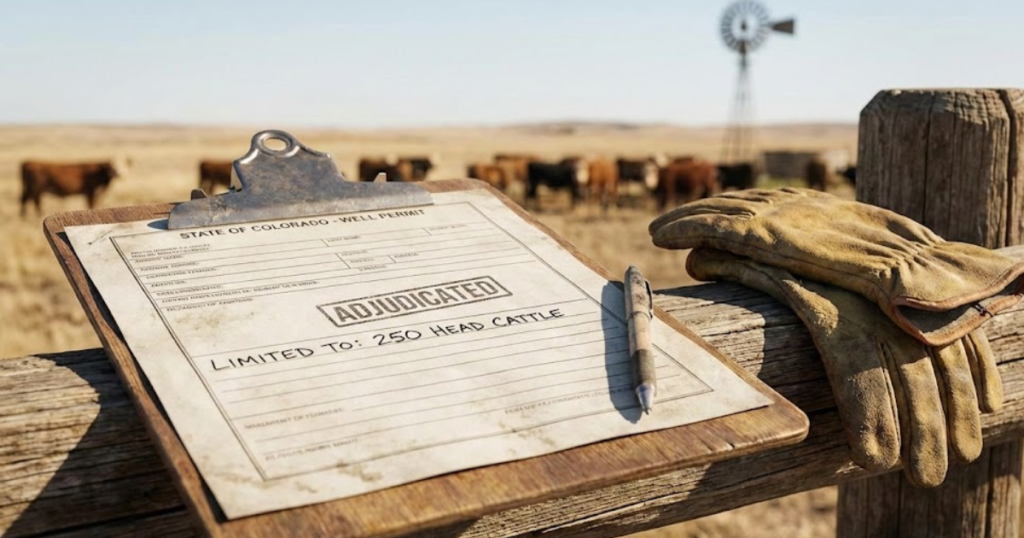
You look at a well permit and see “Livestock Watering” listed as an allowed use. You assume this means you can bring your herd of 20 horses.
Not so fast.
While the permit might not explicitly say “Max 4 Horses,” the underlying legal structure often does. In Colorado, water rights are based on “consumptive use.” A horse drinks about 10 to 15 gallons a day. If you have enough horses, you are no longer a “hobby farm”—you are a significant water user.
If you violate the implied or explicit limits of your well, the Division of Water Resources (DWR) can issue a cease-and-desist order, effectively shutting off your water.
Here is how to read the fine print before you close on a property.
Is the Well Permit “Adjudicated” for a Specific Number of Livestock Head?
Quick Summary: The Hidden “Head Count” Limit
- Exempt vs. decreed: A standard “Domestic” well (typically on 35+ acres) allows for the watering of livestock on farms and ranches. It rarely lists a specific number of animals on the permit itself.
- The commercial trap: A domestic well allows for your horses, but it strictly prohibits “commercial” use. If you board horses for money, you may have crossed the line into a commercial operation—often requiring a different, harder-to-obtain permit.
- Augmentation is where the count lives: On lots under 35 acres with an “Augmented” well, limits are often very specific. The engineering plan may restrict you to exactly 2 horses or 4 large animals based on replacement calculations.
- “Adjudicated” means court-approved: An adjudicated well has a decree from a water judge confirming priority and amount. The permit issued by the State Engineer dictates how you can use it day-to-day. You must read both.
On small lots, the headcount limit often hides in the augmentation decree—not on the face of the permit.
1. The “Exempt” Domestic Well (35+ Acres)
If you have a standard Domestic Exempt well on a larger tract of land, the rules are generally more generous.
The language
- The statute typically allows for “watering of poultry, domestic animals, and livestock on farms and ranches.”
The reality
- There is usually no hard number written on this permit.
- The state generally assumes that on 35+ acres, the land and use will be reasonable.
The limit is intent (commercial use)
- If you start operating a 40-stall boarding facility or a commercial feedlot, you are no longer a domestic user—you are commercial.
- Commercial wells may be limited to specific volumes unless you have the appropriate decrees and replacement water.
2. The Augmentation Plan (Small Lots)
This is where buyers get in trouble. On lots under 35 acres, your well is often part of a court-approved Augmentation Plan.
The math
- To approve the permit, an engineer calculated the expected use for the subdivision.
- That budget often includes household gallons/day, lawn irrigation, and a specific livestock allowance (example: “2 horses”).
The hard cap
- Your property can be legally restricted to the number of animals in that plan.
- If you exceed it, you may be using water that was never replaced back into the system.
Where to find the number
- You may not find it on the well permit itself.
- You often have to locate the Augmentation Decree and/or subdivision documents to see the livestock allowance.
If the listing says “horse property” but it’s under 35 acres, assume there is a headcount limit until proven otherwise.
3. Adjudicated vs. Permitted
Understanding the difference between a decree and a permit prevents expensive mistakes.
Adjudicated (decreed)
- A Water Court judge rules on the water right.
- A decree gives you a priority date and a maximum amount/flow rate.
- It is a property right.
Permitted
- The State Engineer issues the permission to drill and pump.
- The permit is the administrative rulebook for daily use.
The conflict
- Sometimes a decree suggests one kind of use, but the current permit language restricts another.
- In practice, you must follow the permit until the paperwork is corrected.
4. Why “Grandfathered” Wells Are Gold
If you find a well drilled before May 8, 1972, you may have found a rare advantage.
- Pre-1972 status: These wells were often drilled before strict modern augmentation rules took effect.
- The benefit: A pre-1972 well on smaller acreage may allow livestock watering without the strict “headcount caps” that appear in modern plans.
- The reality: You still need to verify the current permit, but these wells can offer more flexibility than new wells.
For buyers who want multiple horses on smaller acreage, pre-1972 wells can be a game changer.
We Dig Up the Augmentation Plan
We don’t just read the listing; we read the engineering report.
When Mark Eibner and Belinda Seville research a property, we look for hidden limits. We verify whether a 5-acre horse property is legally allowed to have horses, or if it is restricted to “1 large animal” by a court-approved plan. We help you confirm your herd is legal before you unload the trailer.
- Contact Us Today to verify livestock limits on your dream home.
- Browse Active Colorado Horse Properties with water rights that fit your herd size.
Browse Active Colorado Horse Properties: View All Available Listings
Frequently Asked Questions (FAQ) About Livestock Water Limits
Does “Domestic Animal” include horses?
Yes. In Colorado water law, horses, cows, chickens, and sheep are generally considered “domestic animals and livestock” for well permitting purposes.
If my permit says “Household Use Only,” can I use a bucket to water my horse?
Technically, no. “Household Use Only” means the water cannot be used outside the interior of the home. Watering animals would require a permit that allows livestock use or hauling water from an off-site source.
Can I upgrade my well permit to allow more horses?
Sometimes. If you can obtain replacement water (for example, through a district or credits), you might be able to amend your permit. In many over-appropriated basins, expanding use can be very difficult or prohibited.