
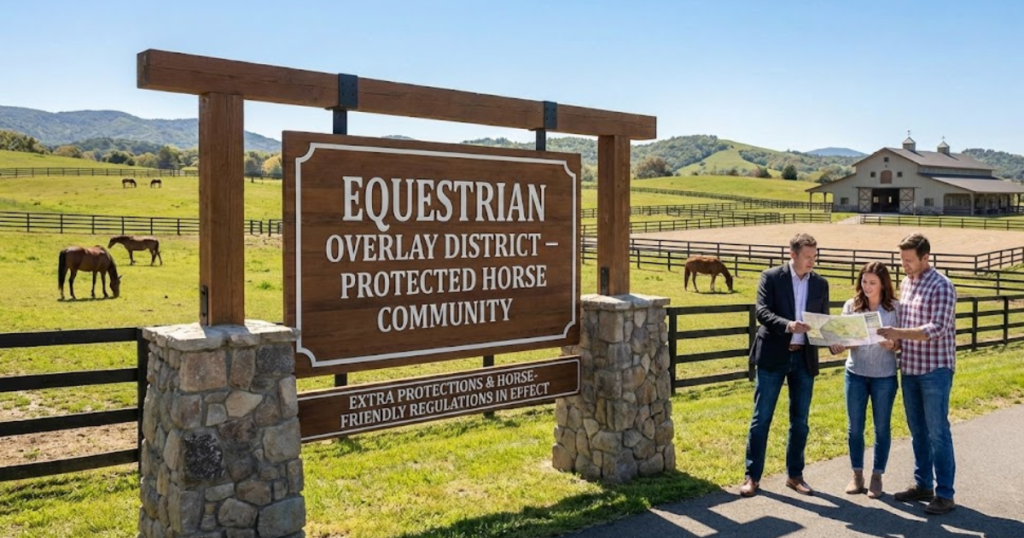
You find a beautiful 5-acre property. It is zoned for horses today, and the pastures are perfect.
But then you look down the road and see the bulldozers. A massive new high-density subdivision is going in just a mile away. What happens when 500 new families move in, and they do not like the smell of your barn or the dust from your arena?
As Colorado’s population booms, the friction between traditional rural landowners and new suburbanites is at an all-time high. Your standard “A-1” agricultural zoning might allow you to keep horses right now, but it does not always protect you from angry neighbors, changing local ordinances, or lost trail access.
This is where an Equestrian Overlay District becomes your strongest shield.
Here is why finding a property in one of these protected zones is the smartest investment you can make.
Is the Property Located in an “Equestrian Overlay District” With Extra Protections?
Quick Summary: The Ultimate Zoning Shield
- The second layer of law: An Equestrian Overlay District is a specialized zoning tool that sits on top of standard zoning. It’s designed to protect horse owners as suburban development expands.
- The right to ride: These districts often require developers to include, preserve, and maintain dedicated equestrian trails that connect private neighborhoods to public open spaces.
- Nuisance protection: Living in an overlay district strengthens legal protection and makes it harder for new neighbors to complain about normal horse smells, flies, noise, or arena dust.
- High demand: Because these zones are rare and desirable, properties within them often hold their value exceptionally well.
An overlay district is a long-term lifestyle protection—especially in fast-growing counties where sprawl is inevitable.
1. What Exactly is an Overlay District?
Zoning laws can shift over time, but an overlay district adds a layer of permanence to protect a community’s lifestyle.
The base zoning
- Your underlying zoning controls core rules: setbacks, building size, and permitted uses.
The overlay
- The overlay adds extra rules designed to preserve equestrian character.
- It’s essentially a legal declaration that horses belong there.
How they’re created
- Overlay districts often happen when a historic horse neighborhood is threatened by urban expansion.
- Residents band together and lobby the city/county for permanent protections.
2. Protecting the Trail Network
One of the most common casualties of suburban development is trail access.
The old way
- For decades you may have ridden across open private land to reach public trails.
- When that land sells, access disappears overnight.
The overlay solution
- Overlay districts can require new developments to preserve existing trails or create equestrian easements.
- This helps maintain safe off-property riding without hauling in a trailer.
Trail easements are a quality-of-life feature that you can’t “build later.” They’re either protected—or they’re gone.
3. The “Nuisance” Defense
New neighbors often love the “country” aesthetic—until summer arrives.
Common complaints
- Manure smell
- Flies
- Tractor noise at 6:00 AM
- Arena dust during dry months
How the overlay helps
- The district establishes horses as a priority use.
- It creates a legal precedent that normal equestrian activity is expected and protected.
- This reduces nuisance enforcement pressure and frivolous conflicts.
4. Preserving the Infrastructure
Overlay districts often protect the physical look and function of horse neighborhoods.
Fencing standards
- Some overlays require horse-safe perimeter fencing (wood rail or continuous pipe).
- They may discourage tall solid privacy fences that destroy the open rural feel.
Barn protections
- Many overlays have relaxed rules for barns and arenas, recognizing them as essential structures.
- They may reduce setbacks or streamline approvals compared to normal residential neighborhoods.
We Find the Protected Pockets
We don’t just look at the house—we look at the master plan for the entire county.
When Mark Eibner and Belinda Seville help you buy a horse property, we check zoning maps for Equestrian Overlay Districts and understand which communities are actively protecting equestrian lifestyles.
Contact Us Today to find a property in a protected equestrian community.
Browse Active Colorado Horse Properties: View All Available Listings
Frequently Asked Questions (FAQ) About Equestrian Zoning
Can an HOA override an Equestrian Overlay District?
Yes. An HOA is a private contract and can be more restrictive than county zoning. Even inside an overlay district, an HOA may ban horses. Always read the covenants.
Are property taxes higher in an overlay district?
The overlay itself does not directly raise taxes. However, properties in protected districts can have higher market values due to demand, which may raise the assessed value.
Do I still need a manure management plan?
Yes. The overlay protects you from unreasonable nuisance complaints, but it does not exempt you from health codes, environmental rules, or runoff laws.