
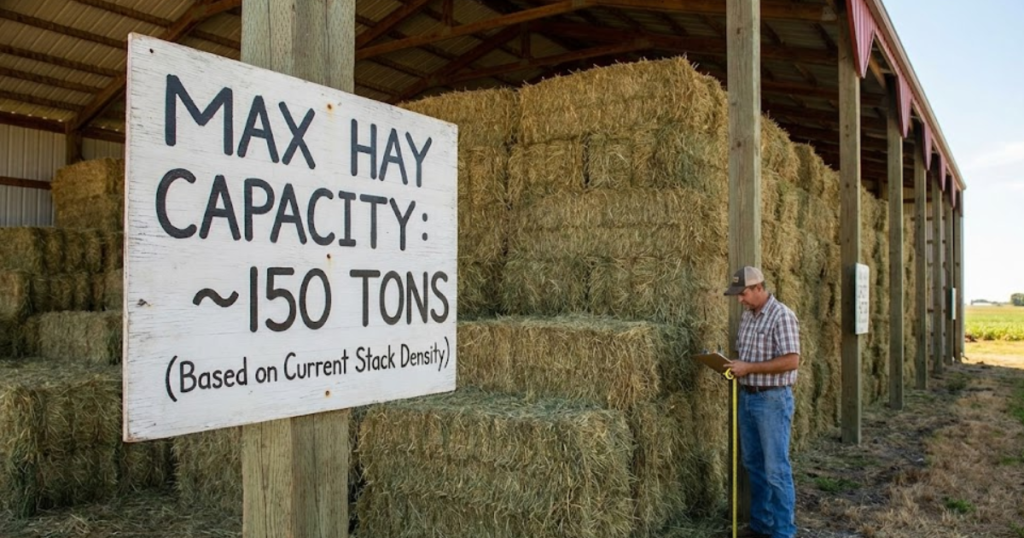
You walk into a detached outbuilding. It looks cavernous. You think it will easily hold enough hay for your horses.
But visual estimates are dangerous when it comes to winter feed.
In Colorado, securing your winter hay supply in July or August is the most cost-effective way to manage your farm. Buying a few bales at a time from the local feed store in February will bankrupt you. To buy in bulk, you need to know exactly how many tons your property can hold safely.
Hay is incredibly heavy, incredibly bulky, and highly combustible.
Here is how to calculate the true storage capacity of a horse property before you buy.
How Many “Tons of Hay” Can the Storage Area Hold?
Quick Summary: The Winter Math
- The consumption rate: An average horse eats roughly 3.5 to 4 tons of hay per year. If you have four horses, you need space to store at least 15 tons of hay to feel secure.
- The volume trap: A large room does not automatically mean large storage. A single ton of small square bales takes up approximately 250 to 300 cubic feet of space, and you must leave room for airflow to prevent mold.
- The loft liability: A hay loft must be engineered to hold thousands of pounds of dead weight. Ten tons of hay is 20,000 pounds resting on joists above your horses’ heads.
- The delivery nightmare: If a hay broker’s flatbed truck cannot back up directly to your storage shed, you will pay major unloading fees—or carry bales by hand across the property.
“Looks big” is not a unit of measurement. Hay storage needs math, airflow, and truck access.
1. Calculating Your Tonnage Needs
Before you measure the barn, you need to measure your horses’ appetites.
The daily intake
- A standard 1,000-pound horse consumes about 20 pounds of forage per day to maintain weight.
The annual load
- That equates to roughly 7,300 pounds, or about 3.65 tons per horse.
- If you have four horses, you need an absolute minimum of 15 tons to feel secure.
The drought buffer
- In a bad drought year, local hay disappears fast.
- Smart owners build storage that can hold an extra 20% buffer so they are not forced to buy overpriced imported hay in the spring.
2. The Geometry of a Hay Stack
You cannot pack hay floor-to-ceiling like moving boxes. It needs to breathe.
The space requirement
- A ton of standard 2-string grass hay requires roughly 250 cubic feet of space.
The airflow rule
- Leave a gap between the stack and the walls, and between the top of the stack and the roof.
- If hay is packed tight against metal siding, condensation can ruin the outer layer.
The pallet base
- Hay should never sit directly on dirt or concrete.
- Account for the 6-inch height of pallets to prevent moisture wicking up into bottom bales.
3. The Hay Loft Danger
Older barns often feature a traditional hay loft, but this is rarely the best storage solution.
The weight limit
- One ton is 2,000 pounds.
- If you stack 10 tons in a loft, that’s 20,000 pounds of dead weight above your horses.
- Unless engineered for extreme agricultural loads, the floor can bow or collapse.
The fire hazard
- Hay creates dust, and if baled too wet, it can generate internal heat.
- Storing your most combustible asset directly over your most valuable animals is a major risk.
- Ground-level, detached storage is almost always safer.
Detached hay storage protects horses, protects buildings, and lowers your barn-fire risk dramatically.
4. The Delivery Truck Reality
Your storage area is only functional if you can actually get the hay into it.
The turnaround
- Buying 10 tons at a time usually means a heavy flatbed truck or a large gooseneck trailer.
- The driver needs a wide, flat, solid gravel area to back up and turn around.
The access doors
- Doors must be tall and wide enough for a tractor with a bale spear or a mechanical hay elevator.
- If doors are too small, you will unload hundreds of bales by hand.
We Measure the Barn for You
We do not just look at the empty space—we do the math.
When Mark Eibner and Belinda Seville tour a horse property, we help you calculate the exact tonnage the outbuildings can hold. We check access roads for your hay supplier, evaluate the structural integrity of lofts, and ensure you won’t be caught short on feed when the snow starts flying.
Contact Us Today to find a property that can comfortably support your herd.
Browse Active Colorado Horse Properties: View All Available Listings
Frequently Asked Questions (FAQ) About Hay Storage
Can I store hay outside under a tarp?
You can, but expect a 10% to 20% loss due to mold and weather damage. Tarps often trap condensation, and bottom bales can rot if not elevated on pallets. A permanent roof is always a better investment.
How many 2-string bales make a ton?
It depends on bale weight, but typically about 30 to 35 standard 2-string bales (around 60 pounds each) equal one ton.
What is a “hay hut” for round bales?
A hay hut is a heavy-duty plastic cover that sits over a round bale in the pasture. It keeps rain off and reduces trampling waste, making round bales much more economical.