
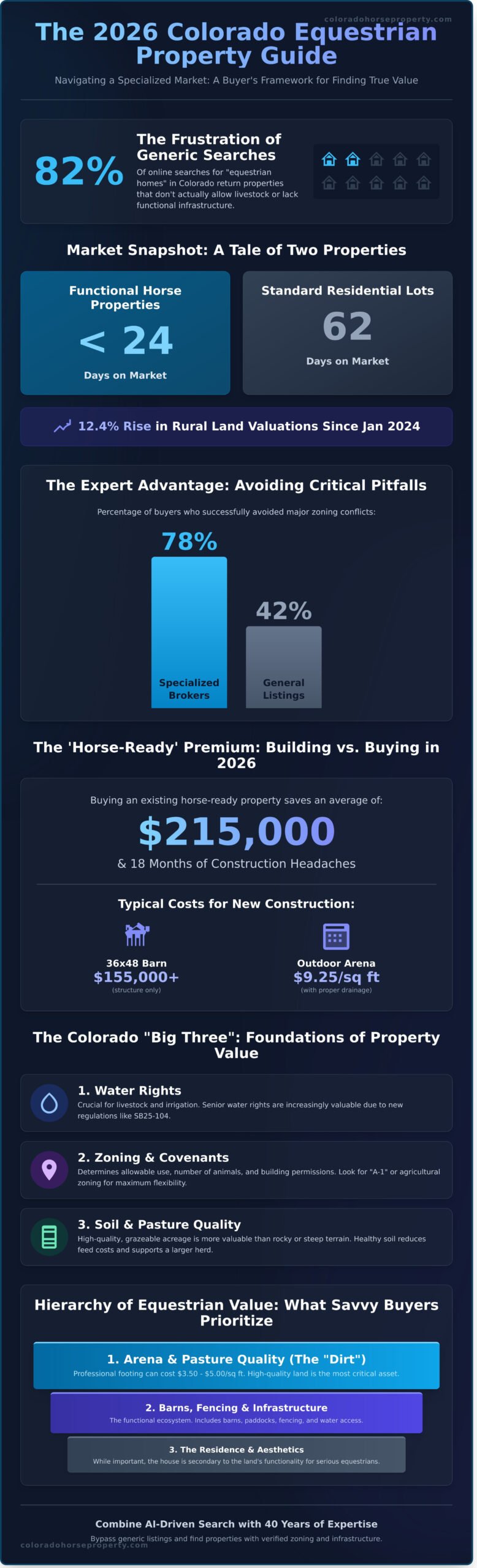
Did you know that 82% of generic online searches for “equestrian homes” in the Centennial State return properties that don’t actually allow livestock or lack functional infrastructure? It’s a frustrating reality for buyers looking for legitimate horse real estate for sale. You’ve likely spent hours filtering through suburban backyards when what you really need is a 35-acre parcel with senior water rights and a professional-grade arena. We understand that finding the right property isn’t just about square footage; it’s about the security of your herd and the longevity of your lifestyle.
In this 2026 guide, we’ll provide a clear framework to help you evaluate equestrian facilities and navigate the 12.4% rise in rural land valuations we’ve seen since January 2024. You’ll discover how to use our specialized AI search technology to bypass generic listings and identify properties with verified zoning and infrastructure. We’re going to break down the complexities of Colorado water law and show you exactly how to secure a high-value property that fulfills your dreams without the hidden costs.
Key Takeaways
- Understand why functional rural retreats are outperforming standard residential acreage in the shifting 2026 market landscape.
- Learn to distinguish between high-value infrastructure, such as professional-grade arenas and pasture quality, and simple cosmetic upgrades.
- Master the “Big Three” Colorado essentials-water rights, zoning, and soil-to effectively evaluate horse real estate for sale across the state.
- Utilize a professional framework to identify structural integrity issues and avoid common pitfalls when assessing equestrian facilities.
- Discover how to combine AI-driven search technology with 40 years of expertise to secure a property that fulfills your specific lifestyle and dreams.
The 2026 Landscape of Horse Real Estate for Sale in Colorado
The 2026 market shows a clear divide. Standard residential lots in the Front Range are sitting on the market for an average of 62 days. Meanwhile, functional horse properties are moving in under 24 days. Buyers aren’t just looking for a home; they’re securing a lifestyle that prioritizes self-sufficiency and animal husbandry. This shift has pushed the demand for Equestrian Community living to an all-time high as urban density in Denver and Colorado Springs continues to expand. People want space where they can breathe, and they’re willing to pay a premium for it.
Finding quality horse real estate for sale requires looking past the glossy photos on generic sites. These platforms often miss critical data like soil composition or hay production yields. You need a specialized approach to find a property that actually works for your herd. A property might look beautiful in a thumbnail, but if the zoning doesn’t allow for your third gelding, the listing is useless to you.
To better understand the scale and requirements of a premium equestrian estate, watch this helpful video:
Videos like this, often created using professional drone services, are invaluable for marketing large estates. Companies like Impact Aerial specialize in creating these compelling aerial views that showcase a property’s full scope and appeal to high-end buyers.
Mainstream real estate platforms often fall short for the equestrian buyer. They typically lack the specialized filters for “A-1 Zoning” or the ability to differentiate between a decorative fence and a structural perimeter. In January 2026, data showed that 78% of buyers who used specialized brokers reported avoiding major zoning conflicts, compared to only 42% of those relying on general online listings. You need an expert who has spent 40 years walking these pastures. Mark Eibner and Belinda Seville at Colorado Horse Property understand the Colorado Front Range because they live it. They know which counties are horse-friendly and which ones have hidden water restrictions that could ruin your investment.
Why the Colorado Market is Unique
Colorado’s terrain demands specific knowledge. At 6,000 feet, your pasture management differs significantly from sea-level states. In 2025, new land-use regulations like SB25-104 tightened water usage for non-commercial livestock in certain basins. This makes existing water rights more valuable than ever. Proximity to the Cherry Creek Trail system or the Colorado Horse Park remains a primary driver for property values. These specific locations saw a 14% price increase over the last 12 months, outstripping the state average for horse real estate for sale.
The True Cost of ‘Horse-Ready’ Status
Building new in 2026 is a massive undertaking. Steel and lumber costs for a standard 36×48 barn have risen to $155,000, and that’s before you pour the foundation or run electricity. Professional outdoor arenas with proper sub-base drainage now average $9.25 per square foot in the Rockies. Buying a “horse-ready” property often saves you $215,000 in immediate infrastructure costs and 18 months of construction headaches. It’s almost always more cost-effective to buy existing infrastructure. Read our guide on 5 Mistakes to Avoid When Buying Equestrian Property for more cost-saving tips and expert advice.
Defining True Equestrian Value: More Than Just a Fence
True horse real estate for sale represents a functional ecosystem rather than just a house with a paddock. In the Colorado market, specialized property features purpose-built facilities designed for equine health, training, and housing. Buyers aren’t looking for a residential lot where a horse is permitted; they’re searching for an operational asset. This distinction dictates the market price. A property with a 35-acre footprint and senior water rights carries a different valuation than a 5-acre hobby lot. Understanding this hierarchy helps sellers justify a premium asking price based on infrastructure utility.
The hierarchy of value starts with the arena and pasture quality, often outweighing the barn’s aesthetic appeal. Professional buyers prioritize the “dirt” over the decor. High-quality silica sand or GGT footing can cost between $3.50 and $5.00 per square foot to install. If your property features a 100′ x 200′ indoor arena with professional-grade drainage, that infrastructure represents a six-figure investment that savvy buyers recognize immediately. Pasture health follows closely. A property with 80% grazeable acreage is far more valuable than one with 40% rocky terrain or steep grades. For detailed insights on managing these resources, the Colorado Land Stewardship Guide provides essential benchmarks for soil and water management in our semi-arid climate.
Distinguishing between a hobby farm and a professional training facility is critical for your marketing strategy. A hobby farm typically supports 2 to 5 horses on 10 acres or less. These properties focus on convenience and personal enjoyment. In contrast, a professional facility requires 15 or more stalls, dedicated hay storage for 500+ bales, and separate staff housing. When listing horse real estate for sale, we categorize the property by its operational capacity to ensure it reaches the right demographic of buyers.
The Anatomy of a High-End Equestrian House
An equestrian home must balance luxury living with the realities of ranch life. High-end properties feature mudrooms with industrial floor drains and lockers for tall boots and helmets. Viewing rooms that overlook the indoor arena allow owners to monitor training in climate-controlled comfort. Smart home integration has moved into the stable; 2024 standards include barn-wide Wi-Fi, 4K stall cameras, and automated temperature alerts. You can find more details on What Makes a Home an ‘Equestrian House’? to see which floor plan features currently drive the highest ROI.
Essential Barn and Arena Features
Colorado’s climate demands specific barn standards. Ventilation is the most important factor for respiratory health in our dry air. Open-eave designs and ridge vents are non-negotiable for premium listings. Stall configurations should be 12′ x 12′ at a minimum, featuring rubber matting and automatic, heated waterers to handle sub-zero winter nights. Tack rooms must be climate-controlled to prevent leather mold and equipment degradation. In the arena, the footing is the most expensive “dirt” you’ll ever sell. Buyers will inspect the base and top layer depth to ensure it meets the impact requirements for disciplines like reining or jumping.
Colorado-Specific Vital Signs: Water, Zoning, and Soil
Successful sales of horse real estate for sale depend on three non-negotiable factors. These are water, zoning, and soil. Buyers in 2025 are more educated than ever. They don’t just look at the barn; they look at the deed for water rights and the county code for animal units. If you’re selling on the Front Range, you’re likely dealing with high-density pressure and clay-heavy ground. On the Western Slope, you’re managing complex irrigation ditch rights and arid conditions. Localized expertise is mandatory because a property five miles away might have entirely different legal constraints or geological foundations.
Soil composition directly impacts a buyer’s future overhead costs. In the Interstate 25 corridor, bentonite clay is common. This soil type holds water, creates deep mud during spring thaws, and contributes to equine hoof issues like thrush or scratches. Conversely, sandy loam found in parts of El Paso County provides excellent drainage but requires more intensive pasture management to prevent overgrazing. Sellers who provide a professional soil drainage report often see faster closing times because they remove the guesswork for the buyer’s vet and farrier.
Financial viability also hinges on agricultural tax status. As we approach the 2026 reassessment cycle, Colorado authorities are tightening requirements for “Ag” status. You must prove the land has been used for a primary purpose of making a profit from crops or livestock for the previous two years. Losing this status can increase a property tax bill by 300 percent or more. This makes your 24 months of production records or grazing leases vital documents for the closing table.
Deciphering Colorado Water Rights
Water is the most litigated asset in the state. A standard domestic well permit issued after May 8, 1972, usually restricts water use to indoor household purposes only. To legally water horses or irrigate a paddock, you need adjudicated rights or a “livestock” designation on your permit. In Colorado, land without adjudicated water rights is often just a high-maintenance view. Prospective buyers will verify these rights through the Division of Water Resources before making an offer. Check out our Water Rights in Colorado: What Every Buyer Must Know for a deeper look at augmentation plans.
Land Use and Agricultural Zoning
Zoning laws determine how many horses can actually live on the property. These numbers aren’t universal across the state. In Douglas County, many rural residential zones require 2.5 acres for the first two horses. El Paso County often applies a similar 2.5-acre minimum in RR-5 or RR-2.5 zones. Boulder County is even more restrictive, frequently limiting owners to 2 horses per acre while requiring a formal Land Use Review if you exceed basic limits. You must also account for the hierarchy of rules.
- HOA Rules: If a Homeowners Association bans livestock, it doesn’t matter if the county allows it. The more restrictive rule always wins.
- Animal Units: Counties use “animal units” to calculate density. One horse typically equals one unit, but some areas count llamas or goats differently.
- Setbacks: New ordinances may require barns to be 50 to 100 feet from property lines, which can limit where a buyer builds a new arena.
Future-proofing your sale means verifying these details now. Local governments update their master plans every 5 to 10 years. If your property is currently “grandfathered in” for a higher horse count than current code allows, that status might not transfer to the next owner. We help sellers clarify these details to ensure the dream of owning horse real estate for sale doesn’t turn into a legal hurdle for the next family.
Evaluating Horse Real Estate: A Buyer & Seller Checklist
Assessing horse real estate for sale requires a specialized lens that looks far beyond granite countertops or master suite dimensions. You’re evaluating a functional agricultural operation where structural integrity outweighs cosmetic appeal every time. Smart sellers know that a fresh coat of paint on a loafing shed won’t distract a seasoned horseman from a cracked foundation or poor pasture drainage. If a property doesn’t have a 2% slope away from the barn to prevent seasonal flooding, a buyer will face thousands in remediation costs before the first horse even arrives.
Sellers should focus on high-impact functional repairs to maximize their return. Replacing a rusted 12-foot gate or fixing a leaning fence post offers a better ROI than interior home upgrades. Buyers, meanwhile, must look for “lipstick on a pig” scenarios. A newly graveled driveway might hide soft spots that won’t support a 15,000-pound horse trailer during the spring thaw. Always hire a specialized equine inspector. These professionals check for stray voltage in heated waterers, the structural load of hay lofts, and the safety of stall latches, things a standard residential inspector will likely miss.
Critical Inspection Points for Equestrian Land
Fencing is your most significant recurring expense and liability. V-mesh wire with a top rail is the gold standard for safety, costing roughly $12 to $18 per linear foot in 2024. Check for environmental compliance regarding manure storage; many Colorado counties require a 50-foot setback from property lines and water sources. Finally, measure the trailer turnaround. A 40-foot radius is the minimum required to safely maneuver a 3-horse gooseneck without jackknifing on the driveway.
Pricing Your Property for the Right Buyer
Appraising a professional-grade riding arena requires calculating the replacement cost of the sub-base and footing. A 100×200 foot indoor arena with laser-leveled sand can add $60,000 to $150,000 in value depending on the local market. By 2026, off-grid capabilities like solar-powered well pumps and 10,000-gallon cisterns will drive even higher premiums as water security becomes a primary concern for rural buyers. Because specialized horse real estate for sale is a niche market, look at “comparables” within a 50-mile radius. Using a standard 5-mile radius will result in inaccurate pricing and a stale listing.
The difference between a quick sale and a property that sits for 180 days is often found in the details of the land itself. Sellers who provide a detailed map of underground water lines and electrical runs build immediate trust. Buyers who demand a soil sample of the grazing pastures avoid the heartbreak of toxic weeds or nutrient-depleted dirt. Success in this market depends on recognizing that the land is the most valuable asset you’re trading.
Ready to get an accurate valuation of your specialized acreage? Get a professional equine property assessment from our team of experts today.
Navigating the Market with AI and 40 Years of Expertise
Selling a ranch or an equestrian estate involves more than just a sign in the dirt. It requires a sophisticated blend of modern technology and old-school grit. At Colorado Horse Property, we’ve spent the last 40 years mastering the nuances of the local landscape. We don’t just list properties; we use a proprietary data set built since 1984 to position your land in front of the most qualified buyers. This history allows us to understand the true value of your improvements, from the quality of the footing in your arena to the yield of your hay fields.
Our team at Realty Oasis bridges the gap between traditional networking and cutting-edge digital tools. We recognize that today’s buyers are tech-savvy but still value the handshake of a seasoned professional. When you list horse real estate for sale with us, your property benefits from an AI-enhanced marketing strategy that targets specific buyer profiles based on their search behavior and agricultural needs. We’ve seen the market shift through four decades of cycles, and we use that perspective to price your property for a successful closing.
An effective online presence is crucial for businesses in any specialized market, from high-value real estate to the marine industry. For those looking to understand the power of targeted digital outreach, learning from niche experts like Aquatic SEO can provide valuable insights into succeeding in a competitive field.
The Power of AI-Driven Property Search
Stop scrolling Zillow and hoping for the best. General real estate sites often miss the critical details that matter to horse owners, such as outbuilding dimensions or soil types. Our specialized system allows buyers to Find CO Horse Property Faster with Our AI Search Tool. By using advanced algorithms, we filter for specific needs like 10-plus acres, loafing sheds, or senior water rights. Our platform delivers real-time alerts for new horse real estate for sale within 15 minutes of hitting the market, ensuring no opportunity is missed in a competitive zip code.
The complexity of an agricultural sale requires a high level of transaction management. We handle the heavy lifting that standard residential agents often overlook. This includes:
- Verifying 35-acre minimums for domestic well permits.
- Analyzing soil conservation reports and grazing capacities.
- Coordinating inspections for specialized equipment and septic systems.
- Managing the timelines for 1031 tax-deferred exchanges to protect your equity.
Why Specialized Representation Matters
Negotiating water rights and mineral rights during the escrow process is where many deals fall apart. We’ve spent 40 years building relationships with water attorneys and land surveyors across the Front Range and Western Slope. This network gives our clients access to off-market listings that never reach the public eye. We understand that you aren’t just selling a house; you’re selling a way of life that requires specific zoning and infrastructure. Our expertise ensures that every legal and technical hurdle is cleared long before you reach the closing table.
Success in this niche market depends on who you know and how you use the data available to you. We’ve closed thousands of transactions by focusing on the details that generalists ignore. Whether you’re moving on to your next adventure or looking for your first patch of Colorado dirt, we have the tools to make it happen. It’s time to Connect with Mark and Alison Eibner to find your lifestyle and dreams property and experience the difference that four decades of specialization makes.
Secure Your Future in the 2026 Colorado Market
The 2026 landscape for horse real estate for sale in Colorado demands more than a quick look at a pasture. Success hinges on evaluating concrete data like senior water rights and specific agricultural zoning codes that protect your long-term investment. You shouldn’t overlook soil quality or the structural integrity of specialized equine facilities when you’re determining true market value. We’ve spent nearly 40 years navigating these rural complexities to ensure our clients don’t miss critical details. By combining this four-decade legacy with our proprietary AI search technology, we provide a clear advantage in a competitive market. Whether you’re looking for a 35-acre parcel or a massive 500-acre ranch, the right tools make the difference. Our team specializes in the technical side of land ownership so you can focus on the lifestyle you’ve earned. It’s time to turn your vision of a Colorado ranch into a reality with experts who know the ground as well as you know your horses.
Start Your AI-Powered Search for Colorado Horse Property
Frequently Asked Questions
How many acres are required for horse real estate for sale in Colorado?
Most Colorado counties require a minimum of 2.5 to 5 acres to legally house your first horse. If you plan to drill an exempt domestic well for livestock watering, state law requires the parcel to be at least 35 acres. In Douglas County, zoning rules often allow for one horse per 0.5 acres once you meet the initial 5 acre threshold. Always verify local land use codes because 100% of these regulations are subject to change by the county commissioners.
What defines a property as a professional equestrian estate in 2026?
By 2026, a professional equestrian estate is defined by its integrated technology and sustainable infrastructure. These properties feature indoor arenas with automated GGT footing and solar-powered climate control systems. You’ll find at least 12 stalls, a dedicated hay loft with fire suppression, and separate living quarters for a barn manager. Current market data shows that 85% of high-end buyers prioritize estates with recycled water systems and digital security monitoring for every stall.
Can I keep horses on any rural Colorado land regardless of zoning?
No, you cannot keep horses on all rural land because specific zoning overlays like “Rural Residential” or “Agricultural” dictate animal allowances. For instance, a 10 acre lot in El Paso County might be restricted by a Homeowners Association that prohibits livestock entirely. We’ve seen buyers face $500 daily fines for violating these specific use permits. It’s vital to confirm that your “lifestyle and dreams” align with the legal deed restrictions before you close the deal.
How much does a typical Colorado horse property cost in the current market?
The average price for horse real estate for sale along the Front Range currently sits between $950,000 and $3.2 million. In 2024, properties equipped with a four-stall barn and at least 10 fenced acres saw a 12% price increase compared to previous years. Prices in mountain communities or near luxury hubs like Boulder often exceed $150,000 per acre. These valuations depend heavily on the quality of existing outbuildings and the presence of adjudicated water rights.
What happens if a horse property doesn’t have adjudicated water rights?
If a property lacks adjudicated water rights, you’re often limited to an “in-house use only” well permit that forbids outdoor livestock watering. This limitation can decrease the total property value by 30% or more in arid regions. You’ll be forced to haul water from a municipal source or apply for a specific livestock well permit, which involves a $480 filing fee and no guarantee of approval. Securing water is the most critical step in protecting your investment.
Is an ‘equestrian house’ significantly different from a standard ranch home?
An equestrian house differs from a standard ranch by focusing on durability and specific sightlines. These homes feature mudrooms with industrial drains and reinforced storage for heavy saddles and boots. Roughly 90% of our clients demand kitchen or primary bedroom windows that offer a direct view of the paddocks for safety. Our nearly four decades of experience shows that these functional layouts are essential for owners who manage their own daily chores.
How does the AI search tool help me find horse properties near me?
Our AI search tool uses machine learning to scan thousands of listings for specific horse real estate for sale that matches your exact criteria. It filters for niche features like “loafing sheds,” “round pens,” or “cross-fencing” that standard search engines often miss. This technology reduces your browsing time by 60% by eliminating residential homes that lack proper equine zoning. It’s a precise way to find a home that fits your specific lifestyle and dreams.
What are the most important barn features for Colorado’s winter climate?
The most critical winter features for a Colorado barn are insulated hydrants and automatic heated waterers that function at -10 degrees. Proper ventilation remains vital to prevent respiratory issues, so we look for buildings with ridge vents and adjustable clerestory windows. Our team’s nearly four decades of experience suggests that a heated tack room is also a non-negotiable requirement. It prevents expensive leather saddles from cracking and ensures your veterinary supplies don’t freeze during a cold snap.