
A stunning 10,000 square foot indoor arena adds zero value to your legacy if the soil beneath it cannot support a single head of livestock or if your well runs dry by mid-July. You’ve likely spent years dreaming of the perfect Colorado landscape, but you also know that the reality of operating horse ranches requires more than just a passion for the trail. It’s a complex balancing act of legal rights and physical infrastructure that can feel overwhelming even for seasoned owners.
We understand that you’re looking for a property that supports both your horses and your long-term financial goals. With nearly 40 years of specialized experience in the Colorado market, we’ve seen how the right technical evaluation can turn a risky purchase into a multi-generational asset. This 2026 guide provides the exact framework you need to value infrastructure, assess grazing quality, and secure senior water rights before you sign a contract.
You’ll discover the specific benchmarks for high-functioning working ranches and learn how to identify the red flags that often hide behind a fresh coat of paint. It’s time to move past the uncertainty and find the property that truly fits your lifestyle and dreams.
Key Takeaways
- Learn the critical distinctions between ranchettes and working horse ranches to ensure your land supports long-term grazing and sustainability in the Colorado climate.
- Identify the technical standards for professional barns and arenas, including essential insights on ventilation, stall safety, and high-performance footing.
- Understand how to navigate the “Colorado Hurdle” of senior versus junior water rights to accurately value and protect your equestrian investment.
- Compare the benefits of the Front Range and Western Slope to determine which region aligns with your specific lifestyle and ranching goals.
- Discover how to leverage AI-powered search tools to filter properties by specialized needs like stall count and water flow, moving beyond the limits of standard listings.
What Defines a True Horse Ranch in 2026?
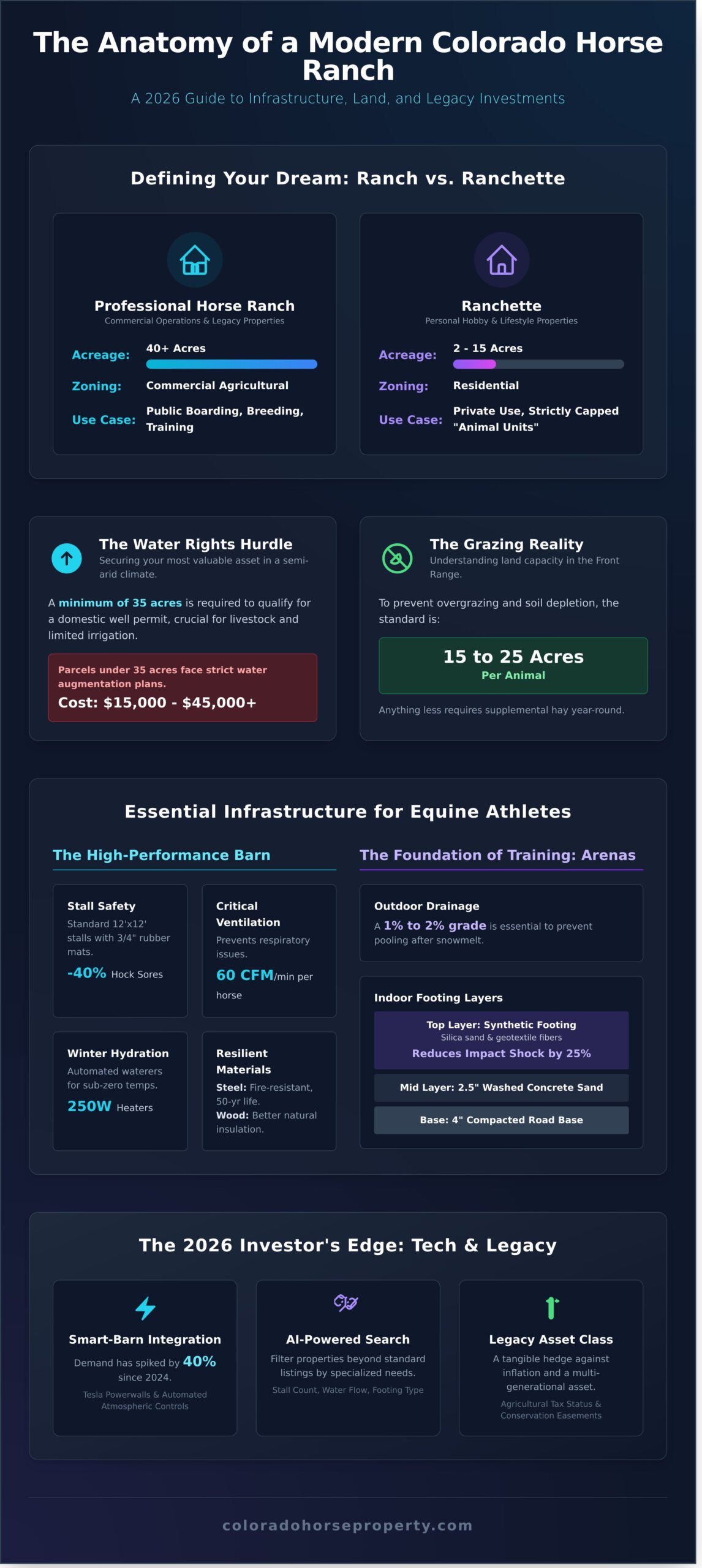
By 2026, the definition of a horse ranch has shifted from simple livestock production to a sophisticated blend of land stewardship and high-tech infrastructure. To understand the roots of these properties, one might ask What is a Ranch? historically, but today’s buyers look for more than just grazing land. Modern horse ranches now function as high-performance training centers and private sanctuaries. They require a specific balance of acreage, water rights, and technological integration to remain viable in a changing climate.
In Colorado’s semi-arid climate, sustainability requires a minimum of 35 acres to qualify for a domestic well permit. This permit is vital. It allows for livestock watering and limited irrigation without the heavy restrictions found on smaller parcels. Owners with less than 35 acres often face strict water augmentation plans that can cost between $15,000 and $45,000 depending on the specific county and water district. For grazing, the data is clear. In the Front Range, you need 15 to 25 acres per animal to avoid overgrazing and total soil depletion. Anything less requires supplemental hay year-round.
Modern investors see these properties as the ultimate legacy asset for 2026. Land is finite. With Colorado’s population projected to hit 6.5 million by 2030, large, contiguous parcels of horse ranches are becoming exceptionally rare. These properties act as a hedge against inflation. They offer tangible value through agricultural tax status and potential conservation easements. Since 2024, the demand for “smart-barn” integration has spiked by 40%. Investors now prioritize barns equipped with Tesla Powerwall 3 systems and automated atmospheric controls that maintain hay at a consistent 12% moisture level.
Ranch vs. Ranchette: Knowing the Difference
Scale defines the category. A ranchette typically covers 2 to 15 acres and serves personal equine hobbies. These properties fall under residential zoning where “animal units” are strictly capped by local ordinances. A professional horse ranch operates on 40 or more acres with commercial agricultural zoning. This allows for public boarding and breeding operations. It also supports professional-grade infrastructure, such as 150-foot by 300-foot indoor arenas and 12-stall barns with dedicated veterinary bays.
The 2026 Equestrian Lifestyle Evolution
The trend has moved toward lifestyle architecture. The barn is no longer a dusty, isolated shed. It’s an integrated space featuring glass-walled viewing lounges and direct access to private trail networks. Owners are increasingly utilizing conservation easements to protect their 100-plus acre spreads from future subdivision. This ensures the land remains pristine for future generations while providing significant tax relief. A horse ranch is a self-sustaining equestrian ecosystem. This evolution reflects a shift from purely functional spaces to properties that fulfill a lifelong dream of freedom and connection to the land.
Essential Infrastructure for Professional and Private Ranches
Building a functional facility requires looking beyond the aesthetic. High-quality horse ranches succeed or fail based on their underlying utility. You aren’t just buying land; you’re investing in a system that protects your equine athletes and simplifies daily chores. Every gate placement and stall dimension affects your efficiency and your horse’s health.
The Anatomy of a High-Performance Barn
Colorado’s climate demands resilience. Steel buildings offer 50-year lifespans and superior fire resistance, but wood provides better natural insulation during -10 degree winters. Professional designs prioritize 12’x12′ stalls with 3/4-inch rubber mats to reduce hock sores by 40%. Ventilation must move 60 cubic feet of air per minute per horse to prevent respiratory issues. Automated waterers with 250-watt heaters ensure hydration when temperatures plummet. Security shouldn’t be an afterthought. Installing 4K infrared cameras and smoke detectors linked to local fire departments provides peace of mind when you’re off-site. Ergonomic tack rooms with 36-inch wide revolving doors allow for easy movement while carrying heavy western saddles.
Arenas and Footing: The Foundation of Training
The most expensive mistake is ignoring what’s underneath. A 1% to 2% grade is necessary for outdoor drainage to prevent pooling after a heavy snowmelt. For indoor spaces, a 4-inch compacted road base topped with 2.5 inches of washed concrete sand is the standard. Synthetic footings, often a mix of silica sand and geotextile fibers, reduce impact shock by 25% compared to plain dirt. Size matters for your specific discipline. A 60’x120′ space works for basic schooling, but reining and jumping require at least 100’x200′ to allow for full-speed maneuvers and safe approach distances. Specialized disciplines like dressage require exactly 20×60 meters to maintain proper training geometry.
Proper land use keeps your soil healthy and your feed costs low. Implementing Best Management Practices for rotational grazing ensures pastures aren’t overgrazed to the point of erosion. On Colorado horse ranches, you need at least 2 acres of managed pasture per horse to sustain forage without heavy supplemental feeding. Fencing should utilize 4-rail wood or high-visibility polymer coated wire to prevent injuries. Don’t forget storage. A 1,200-pound hay bale takes up 64 cubic feet of space, and you’ll need room for tractors, spreaders, and trailers. Design your driveway with a 100-foot turnaround radius to accommodate 4-horse gooseneck trailers without the need for complex backing maneuvers. Dedicated equipment sheds keep your $50,000 tractors out of the elements, extending their mechanical life by years.
If you’re ready to see how these features look in person, you can browse current ranch listings that meet these professional standards. Finding a property that already has this infrastructure in place can save you 18 months of construction time and significant capital investment.
The Economics of Ownership: Valuation and Water Rights
Investing in horse ranches requires a sharp eye for the bottom line. It’s not just about the aesthetic of a riding arena; it’s about the tangible assets that sustain value. The valuation of equestrian improvements often deviates from raw land prices. While a professional-grade indoor arena adds immense utility, appraisers frequently categorize these structures as “special purpose” buildings. In a typical 2024 market analysis, owners might only recoup 60% to 75% of construction costs during a resale. Understanding The Economics of Horse Ranching is vital for anyone looking to balance a passion for riding with sound financial planning.
Operating a 40-acre property involves specific maintenance realities that many first-time buyers overlook. You should budget approximately $12,000 to $18,000 annually for routine upkeep. This includes pasture weed control, fence line repairs, and specialized arena footing replenishment. To offset these costs, many owners leverage Colorado’s agricultural tax status. If your land is used for grazing or hay production, your property tax burden could drop by as much as 90% compared to standard residential rates. Conservation easements also offer a path to protect the landscape while receiving significant state tax credits, sometimes valued at over $1 million for larger parcels.
Water Rights: The Lifeblood of the Colorado Ranch
In Colorado, water law follows the “prior appropriation” doctrine. This means senior rights established in the 1860s take precedence over junior rights during dry seasons. When evaluating horse ranches, you must verify if the property includes “ditch rights” for irrigation or just a well permit. A standard exempt domestic well permit might only allow for in-house use, whereas a livestock permit is necessary to water a full stable. Water rights are frequently more valuable than the primary residence because, without them, the land’s utility for livestock vanishes. Internal link opportunity: [Water Rights in Colorado: What Every Buyer Must Know]
Valuation Myths and Market Realities
Over-improving a property is a common pitfall in the equestrian world. Building a $500,000 stable in a region where the median home price is $450,000 rarely yields a full return. Location remains the primary driver of value. Properties within a 30-minute drive of major show grounds, like the Colorado Horse Park in Parker or the events in Estes Park, command a 20% to 30% price premium. Market data from 2023 shows that proximity to these hubs ensures higher occupancy for boarding operations and faster resale times. Modern AI search tools help buyers identify undervalued ranch assets by cross-referencing soil quality, historical water flow data, and zoning changes that human analysis might miss. Stick to improvements that match the local market demand to protect your equity.
- Senior Water Rights: Established priority dates that ensure water delivery during droughts.
- Ag-Status: Requires proof of profit-seeking activity, such as livestock sales or haying.
- Maintenance Reserve: A recommended 1.5% of the total property value set aside for annual repairs.
Navigating Colorado’s Best Regions for Ranching
Choosing the right location for horse ranches requires balancing lifestyle goals with the practical realities of land management. Colorado offers several distinct micro-climates and economic zones. Each region presents unique advantages for horse owners, from the proximity of the Front Range to the secluded valleys of the Western Slope. Property values and operating costs vary significantly across these zones, making it vital to understand the data before you buy.
Front Range Favorites: Douglas and Elbert Counties
The Front Range remains the most popular choice for those who need to balance professional careers with equestrian life. Douglas County saw a population increase of 19.3% between 2010 and 2020, which has increased the pressure on available land. Buyers here often look for properties with A-1 agricultural zoning to ensure their right to keep livestock is protected. While privacy is harder to find near the urban corridor, areas like Parker and Castle Rock offer elite boarding facilities and veterinary specialists within a 15-minute drive. Elbert County serves as a primary alternative for those seeking larger parcels. Here, the 35-acre minimum for domestic well permits is a standard benchmark, providing enough space for private trails while staying within a 45-minute commute of Denver. Find CO Horse Property Faster with Our AI Search Tool.
The Western Slope and Mountain Valleys
The Western Slope offers the vast acreage and rugged beauty often associated with traditional horse ranches. In the Yampa Valley, the ranching heritage is a core part of the local economy, with some operations dating back to the late 1800s. Steamboat Springs attracts buyers who want a mix of luxury and utility. However, high-altitude ranching requires specific infrastructure. Properties in this region must handle extreme snow loads. It’s common to see roofs engineered for a 40-pound per square foot snow load or higher. Winter grazing is non-existent for five months of the year, so owners must account for the cost of high-quality alfalfa and grass hay hauled in from lower elevations. For those seeking total seclusion, the San Juan Mountains offer off-grid opportunities where water rights are the most critical asset for long-term sustainability.
Southern Colorado counties like Huerfano and Las Animas provide the best value for buyers on a budget. Land prices in these southern regions are frequently 40% to 60% lower than those in the northern Front Range. The terrain is incredibly diverse, ranging from the flat, arid grasslands near Pueblo to the dense pine forests of the Sangre de Cristo foothills. This region is ideal for riders who prioritize long-distance trail riding and want to escape the traffic of the I-25 corridor. You’ll find that your dollar goes much further here, allowing for larger barn builds or professional-grade arena installations that might be cost-prohibitive in Boulder or Larimer Counties.
Managing horses at high altitudes requires a specialized approach to animal husbandry. Above 8,000 feet, oxygen levels are significantly lower. Horses moving from sea level typically need 14 to 21 days to acclimate before they can handle heavy work in a riding arena. The ultraviolet rays are also more intense at these elevations, which can lead to coat bleaching and skin issues in certain breeds. Pasture management is another hurdle. The growing season in the Rockies can be as short as 90 days. Overgrazing a high-altitude pasture can cause permanent damage to the native grasses, meaning a strict rotational grazing schedule is mandatory for anyone operating successful horse ranches in the Rockies.
Finding Your Legacy Property with AI-Powered Search
Traditional real estate searches often fail the equestrian buyer because they aren’t built for the complexities of rural land. Most Multiple Listing Service (MLS) platforms prioritize residential data like kitchen finishes or bedroom counts; they leave critical ranching infrastructure as an afterthought. For those seeking high-quality horse ranches, a standard search filter won’t distinguish between a decorative paddock and a functional 100-stall training facility. You need data that speaks the language of a horseman. Searching for a home is simple, but searching for a legacy requires a specialized lens.
Finding the right property means looking past the surface of a listing. You’re searching for specific arena dimensions, sustainable water flow rates, and zoning that permits your intended equine activities. Relying on generalist platforms leads to wasted weekends touring properties that lack the fundamental requirements for a professional-grade riding environment. Our approach changes that by focusing on the specific utility of the land and the structures upon it. We prioritize the elements that matter to your horses first.
The AI Advantage in Real Estate
We’ve integrated niche-specific algorithms that identify horse-ready land before it reaches the mainstream market. This technology analyzes property data to match features with specific disciplines, whether you need heavy sand for reining or groomed turf for jumping. This targeted approach reduces the average search time by 60%, allowing you to focus only on properties that meet 100% of your criteria. We use data to bridge the gap between a listing’s description and its actual ranching potential, ensuring you don’t miss hidden gems in the Colorado landscape.
Your Partnership with Colorado Horse Property
Technology is only half the equation in a successful land acquisition. Mark and Alison Eibner bring nearly four decades of Colorado ranching expertise to every transaction. Since the 1980s, we’ve helped buyers understand the nuances of water rights, soil composition, and rural title issues. We provide full-cycle support, managing everything from the initial valuation to the final coordination of title and escrow. This ensures your investment is protected and your transition to ranch ownership is seamless. We’ve seen every market shift over the last 38 years, and we use that history to your advantage.
Your journey from dreamer to owner begins with a search that understands your lifestyle. Don’t settle for generic results when you can access a database built specifically for the equestrian life. You can start your AI-powered ranch search today and find a property that supports your passion for horse ranches. We’re here to turn your vision of a legacy property into a functional, lasting reality. Whether you’re looking for ten acres or a thousand, our tools and experience will lead you home.
Secure Your Colorado Legacy in 2026 and Beyond
Owning a ranch in 2026 requires more than just a passion for the trail. It demands a sharp focus on essential infrastructure and the complex water rights that define a property’s true valuation. You’re not just buying land; you’re investing in a legacy that needs professional-grade arenas and sustainable grazing plans to thrive. Finding the right horse ranches in today’s market involves balancing these traditional ranching needs with the efficiency of modern search technology. It’s a high-stakes process where specific regional knowledge of Colorado’s zoning laws becomes your greatest asset.
Our team brings nearly 40 years of specialized experience to your search. We’ve built a full-service brokerage that handles every detail, including the critical title and escrow coordination that ensures a smooth closing. We don’t believe in generic listings. Instead, we use our proprietary AI-powered search tool to filter properties by exact acreage and equine features. This data-driven approach saves you time and connects you directly with the lifestyle you’ve been dreaming of. Find your next Colorado Horse Property with AI today. Your perfect piece of the Colorado landscape is waiting for you to take the first step.
Frequently Asked Questions
How many acres do I really need for a horse ranch in Colorado?
You typically need at least 35 acres to bypass most local county zoning restrictions and ensure you have enough land for sustainable grazing. While some smaller parcels allow horses, a standard rule of thumb for Colorado land is 2 to 3 acres of usable pasture per horse to prevent overgrazing. If you plan to build a professional facility, aiming for 40 acres or more provides the space required for multiple turnouts and large riding arenas.
What is the difference between a farm and a horse ranch?
A farm primarily focuses on crop production and soil cultivation for food or fiber, while horse ranches prioritize the breeding, training, and boarding of livestock. While a farm might have 80 percent of its land under a plow for corn or wheat, a ranch maintains native grasses and specialized infrastructure like round pens and hay sheds. The management of a ranch centers on animal husbandry and the maintenance of large tracts of grazing land rather than seasonal harvesting.
Are water rights always included when I buy a ranch?
Water rights are not automatically included in a property sale and must be explicitly detailed in the deed. Colorado follows the 1876 doctrine of prior appropriation, which means senior rights take precedence over junior ones during a drought. You must verify the specific cubic feet per second or acre-feet allocated to the land during your 30 day due diligence period to ensure you can legally water your horses and irrigate your pastures.
What are the most important features to look for in a horse barn?
Look for a barn with 12 by 12 foot stalls and a minimum 14 foot center aisle to ensure safety and easy equipment movement. Proper ventilation is critical; a high quality barn should have ridge vents or cupolas that circulate air at a rate of 4 to 6 air changes per hour. Ensure the flooring consists of crushed stone or heavy duty rubber mats to prevent hock sores and joint strain on your animals during the winter months.
Can I get a tax break for owning a horse ranch in Colorado?
You can qualify for significantly lower property taxes if your land meets the Colorado Revised Statutes requirements for agricultural classification. To qualify, you must demonstrate the land was used for the primary purpose of deriving a profit from livestock or hay for 2 consecutive years. This status can reduce your tax assessment from 29 percent down to 7 percent for the portion of the land dedicated to ranching operations.
What is the average cost of a horse ranch in the Front Range?
The average price for a 35 acre horse ranch in the Front Range currently ranges from $1.2 million to $2.5 million depending on the county and existing infrastructure. In high demand areas like Douglas or Boulder County, prices often exceed $3 million for properties with indoor arenas and luxury residences. You’ll find more competitive pricing in Weld or El Paso counties, where 10 to 20 acre parcels often list between $850,000 and $1.1 million.
How does the altitude in Colorado affect horse care on a ranch?
Altitude affects hydration and respiratory health because Colorado air is 20 percent to 30 percent drier than sea level environments. Horses moving to elevations above 7,000 feet need a 14 day acclimation period to adjust their red blood cell counts and lung capacity. You must provide 10 to 15 gallons of fresh water daily per horse and monitor for signs of High Mountain Disease, which can impact the heart and lungs in rare cases.
Why should I use a specialized equestrian realtor instead of a general one?
A specialized realtor understands complex issues like ditch rights, soil composition for arenas, and specific zoning codes that a general agent might miss. At Colorado Horse Property, we bring nearly 4 decades of experience to every transaction to protect your lifestyle and investment. We know how to evaluate if a property’s 5 acres can actually support 3 horses based on local health department regulations and specific grazing capacity for our semi-arid climate.