
What if the five-acre ranch you just found online is legally prohibited from watering the very horses you plan to bring home? In Colorado, a beautiful barn and a lush pasture are often secondary to the invisible complexities of senior water rights and strict county zoning laws. You’ve likely spent hours scrolling through listings for horse property for sale colorado, only to realize that horse-friendly doesn’t always mean horse-legal. It’s frustrating to find a perfect arena only to discover the well permit doesn’t allow for livestock. Zoning might even limit you to just two animals when you own four.
We understand that you’re looking for more than just land; you’re looking for a lifestyle that matches your passion. This 2026 guide simplifies the search by showing you how to audit infrastructure costs and secure a property that fits your specific riding discipline. We’ve spent nearly 40 years helping buyers identify hidden expenses before they sign a contract. You’ll learn to use AI-powered search tools to filter by acreage and water priority, ensuring your investment holds its value for years to come.
Key Takeaways
- Learn how to leverage modern AI-powered tools to streamline your search for the perfect horse property for sale colorado in today’s competitive market.
- Identify the non-negotiable features for barns and arenas that ensure your facility is both functional for your horses and a sound long-term investment.
- Navigate the complexities of Colorado water rights and zoning restrictions to determine the true “animal unit” capacity of any potential ranch or estate.
- Explore the distinct advantages of Colorado’s diverse regions, from elite Front Range facilities to the expansive grazing lands and BLM access of the Western Slope.
- Understand how partnering with a specialized equestrian expert can help you secure your lifestyle and dreams while avoiding the critical details generalist agents often miss.
The State of Colorado Horse Properties in 2026
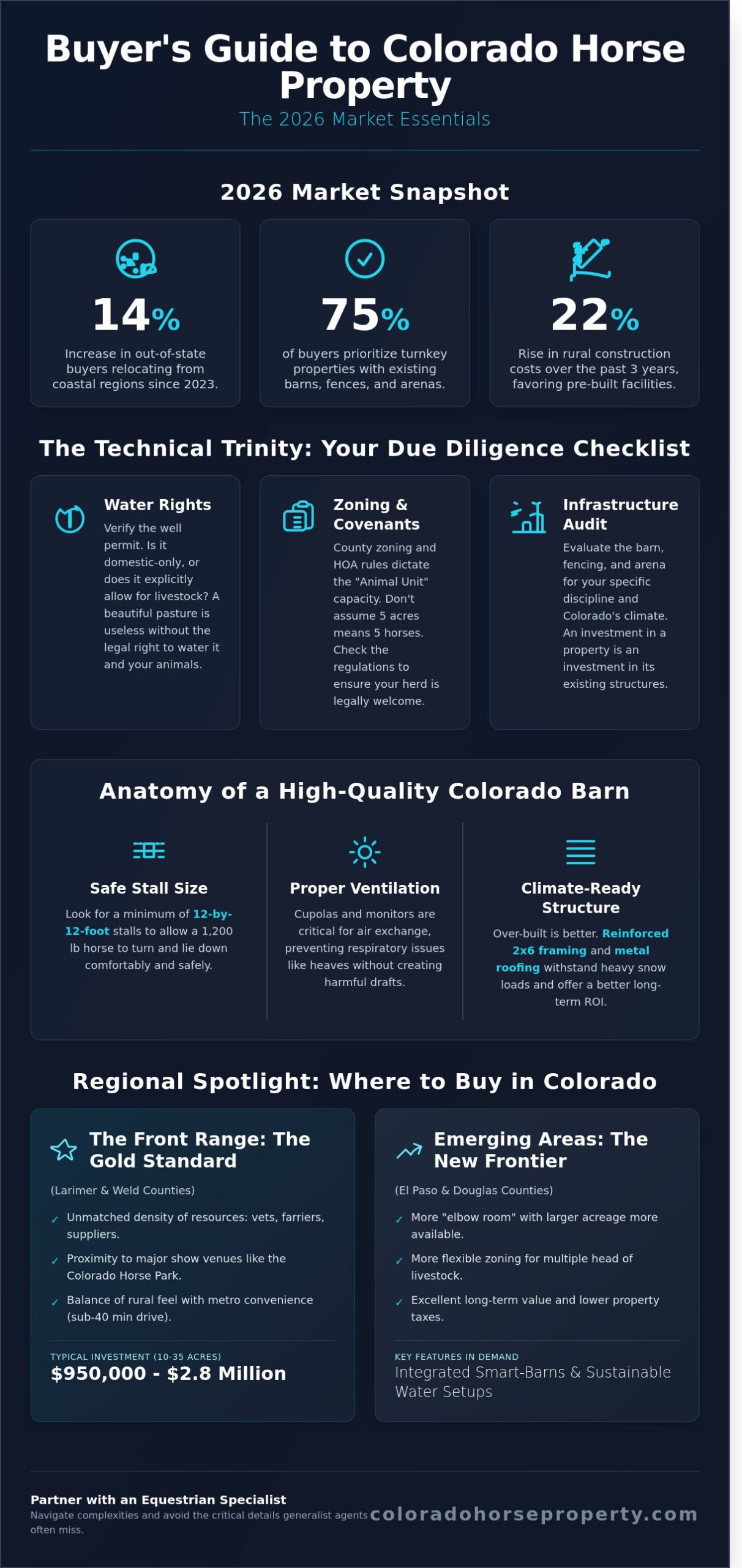
Colorado’s equestrian market has reached a new peak in 2026. Demand for specialized land remains high, driven by a 14% increase in out-of-state buyers relocating from coastal regions since 2023. These buyers aren’t just looking for a home; they’re pursuing a specific lifestyle that only the Rocky Mountains can provide. The state’s deep-rooted ranching culture, anchored by the historic National Western Stock Show, ensures that the infrastructure for horse owners, from hay suppliers to elite farriers, is among the best in the country.
Finding the right horse property for sale colorado requires a clear understanding of current inventory. We’ve seen a decisive shift toward turnkey properties. In 2026, roughly 75% of our clients prioritize estates with existing barns, fenced pastures, and functional arenas. This trend stems from a 22% rise in rural construction costs over the last three years, making pre-built facilities much more attractive than raw land development. Buyers want to unload their trailers and start riding on day one without waiting for permits or contractors.
To better understand what to look for in a local equestrian estate, watch this helpful video:
Your search strategy must be dictated by your specific equine goals. A professional trainer focusing on reining or dressage will have vastly different requirements than a recreational rider who wants direct access to public trail systems. We categorize properties based on their primary utility, whether it’s high-density training facilities with indoor arenas or expansive acreage designed for sustainable grazing and trail proximity. Understanding these distinctions is the first step toward fulfilling your lifestyle and dreams in the high country.
Why the Colorado Front Range is Still the Top Choice
The Front Range corridor remains the gold standard for equestrian living due to its unmatched density of resources. Owners here enjoy proximity to world-class veterinary specialists and major show venues like the Colorado Horse Park. As of early 2026, pricing for 10 to 35 acre parcels in Larimer and Weld counties typically ranges from $950,000 to $2.8 million. This investment secures a balance between a private rural atmosphere and the convenience of being within a 40 minute drive of major metro hubs. It’s the ideal location for those who need to commute but refuse to compromise on their equine passions.
Emerging Equestrian Communities Outside the Metro Areas
Expansion is moving south and east into El Paso and Douglas Counties, where larger acreage is more readily available. The High Plains offer a different appeal, featuring wide-open vistas and more flexible zoning for multiple head of livestock. Modern ranch houses in these areas now feature specific amenities tailored to the 2026 buyer. We’re seeing a high demand for “mudroom-to-barn” transitions, integrated smart-barn monitoring systems, and sustainable water catchment setups. If you are searching for a horse property for sale colorado that offers more “elbow room” and lower property taxes, these emerging markets provide excellent long-term value for serious horsemen.
Must-Have Features for a Functional Equestrian Property
Evaluating a potential horse property for sale colorado requires looking past the mountain views and focusing on structural integrity. You need a setup that handles the Front Range’s 300 days of sun and sudden blizzard conditions. A property that looks beautiful in July might become a logistical nightmare in January if the infrastructure isn’t designed for the local climate.
The Anatomy of a High-Quality Horse Barn
A functional barn starts with 12-by-12-foot stalls. This size provides enough room for a 1,200-pound horse to turn and lie down safely. Ventilation is your biggest defense against respiratory issues like heaves. Look for monitors or cupolas that allow consistent air exchange without creating direct drafts on the animals.
Over-built structures often feature reinforced 2-by-6 framing and metal roofing. These choices offer a 25% better return on investment over thirty years compared to lighter pole barns. You’ve got to ensure the electrical system uses conduit to prevent rodents from chewing wires; this remains a leading cause of barn fires. Every barn needs at least two frost-free hydrants. These units utilize a shut-off valve buried below the 36-inch frost line, ensuring you have water when temperatures drop to -10 degrees. Keeping hay storage in a separate building at least 50 feet away significantly reduces fire risk and keeps dust away from the main stabling area.
Riding Arenas: More Than Just Dirt
Colorado’s semi-arid climate makes dust management a priority. A year-round arena needs a 4-to-6-inch compacted sub-base of road base or crushed limestone. This prevents the top layer from mixing with the native soil. For drainage, a 1% to 2% grade from the center to the edges keeps the surface usable after a heavy spring rain. Professional footing is a high-performance blend of washed sand and synthetic fibers designed to provide consistent impact absorption and maximize property value.
Footing choice depends on your specific discipline. Reining horses need a sliding top, while jumpers require more “grab” and cushioning. If you plan to ride through the winter, an indoor arena is essential. Outdoor arenas are more affordable, but they often become unusable for 60 days of the year due to frozen ground or mud. You can browse current equestrian listings to compare different arena configurations across the state.
Fencing and Pasture Management
Fencing in Colorado must withstand 60 mph wind gusts and intense UV exposure. Pressure-treated wood or 4-rail PVC are popular, but “no-climb” wire fencing with a top rail offers the highest safety rating for foals. Avoid T-posts without safety caps. In our environment, one horse typically requires 2 to 5 acres of grazing land to prevent overgrazing. Effective management involves:
- Rotational Grazing: Divide land into smaller paddocks to allow grass 30 days of recovery.
- Weed Control: Implement a plan for noxious weeds like Canada Thistle and Diffuse Knapweed.
- Sacrifice Lots: Use a dry lot during wet months to protect pasture roots.
Water is the most critical asset for any horse property for sale colorado. Understanding Colorado water rights and the Prior Appropriation System is vital before you close on any land. Without legal access to water, a 35-acre parcel is just expensive dirt. Make sure the well permit specifically allows for livestock watering, as some residential permits are strictly limited to household use inside the home.
The Technical Trinity: Water Rights, Zoning, and Soil
Buying a horse property for sale colorado involves more than checking the fence lines and barn stalls. You’re investing in a complex ecosystem where three technical factors determine your property’s long-term value and utility. We call these the Technical Trinity. If you ignore water, zoning, or soil during the inspection period, your dream ranch could become a legal and financial burden. These elements aren’t just details; they’re the foundation of your equestrian lifestyle.
Navigating Colorado Water Rights and Wells
Water is the most valuable asset on any Western property. You’ll likely encounter two main types of wells: household-use-only and domestic/augmented. A household-use-only well, common on parcels under 35 acres, typically restricts water use to inside the home. It won’t legally allow you to fill a trough or water a pasture. You must verify the well permit number with the State Engineer’s office to see if it allows for “livestock watering.” Colorado operates under Colorado’s Prior Appropriation System for water rights, which means “first in time, first in right.” If the property includes senior water rights, you’re in a much stronger position during drought years. (Internal Link: See our pillar article on Water Rights in Colorado for a deeper dive into ditch rights and shares).
Zoning Laws: Can You Actually Keep 5 Horses?
Zoning varies wildly across the Front Range. Weld County is generally horse-friendly, often allowing two animal units per acre. Conversely, Boulder County has strict Land Use Codes that might limit your herd size regardless of your total acreage. An “Animal Unit” is a specific metric; one horse typically equals one unit, while smaller livestock might count as 0.25 units. Always look beyond the county level. Homeowners Associations (HOAs) and Covenants, Conditions, and Restrictions (CC&Rs) often impose stricter rules than the county. If you plan to run a commercial boarding or training facility, you’ll likely need a Special Use Permit. This process can take six months and requires neighborhood notification and public hearings. We’ve seen buyers lose their earnest money because they didn’t realize their 10-acre lot was restricted to just two horses by a 1985 covenant.
Soil health dictates your daily workload. High clay content leads to poor drainage and “mucking” in the spring; it also creates “heave” that can ruin barn foundations. Sandy loam provides the best natural footing for arenas and healthy grazing. During your due diligence, we recommend a professional soil test. It’s a small $800 investment that prevents a $60,000 foundation repair later. Beyond the structures, soil quality impacts your carrying capacity. Overgrazing on poor soil leads to weed infestations like Bindweed or Cheatgrass, which can cost thousands to remediate. Avoid the common pitfall of skipping the environmental and land surveys. A standard residential contract doesn’t always protect you against these rural-specific risks. You need specific contingencies for well production, water potability, and zoning verification to ensure your horse property for sale colorado is a sound investment. Don’t rely on a seller’s word that the water is “fine.” Get the data to prove it.
Regional Breakdown: Where to Buy in Colorado
Colorado spans over 66 million acres, each region offering distinct advantages for equestrian life. Finding the right horse property for sale colorado requires balancing your riding discipline with the local climate and geography. Buyers often prioritize different factors based on whether they need a professional training facility or a private mountain retreat. Our team identifies properties based on these regional nuances to ensure your land supports your specific goals.
The Front Range remains the most competitive market. In counties like Douglas, Larimer, and Weld, premium facilities often include heated indoor arenas and professional-grade barns with rubberized flooring. Prices here frequently exceed $1.5 million for a 10-acre parcel because of the proximity to Denver and major show circuits. For those who value convenience, elite veterinary care, and accessibility to the Colorado Horse Park, this corridor is the gold standard.
Eastern Colorado’s High Plains offer a different value proposition. In counties like Elbert or Morgan, you’ll find deep ranching roots and expansive acreage. It’s common to see price-per-acre figures significantly lower than the mountain regions. You might secure a 40-acre parcel here for the price of a 5-acre lot near Boulder. This area suits owners who need space for large herds, cattle operations, or private cross-country courses where land mass is the priority.
Mountain Valleys provide unmatched beauty but present unique logistical challenges. In places like the Roaring Fork Valley or near Gunnison, growing seasons are short, often limited to a 90-day window between frosts. You’ll trade lush hay production for direct access to national forest trails and cooler summer riding temperatures. It’s a lifestyle choice for those who prioritize trail riding and scenery over commercial hay production or year-round outdoor training.
Western Colorado: BLM Land and Irrigation
The Western Slope is a haven for trail riders because of its proximity to Bureau of Land Management (BLM) land. Many properties in Mesa and Delta counties border these public lands, providing thousands of acres of riding territory right from your back gate. You’ll also encounter complex water systems here. Understanding senior ditch rights and flood irrigation is vital; these water assets often dictate the property’s long-term value more than the house itself. Compared to the Front Range, Western Slope values offer more “bang for your buck,” with many 20-acre irrigated parcels priced 30% lower than comparable Front Range listings.
Using AI to Narrow Your Regional Search
Sifting through thousands of listings is inefficient. Our proprietary search technology changes the process. Instead of filtering by bedrooms or bathrooms, you can prioritize what actually matters: acreage, barn types, and water rights. You’ll save hours by searching for a horse property for sale colorado based on “20+ acres” or “indoor arena” directly. This data-driven approach ensures you only tour properties that meet your specific equine requirements and regional preferences. Find CO Horse Property Faster with Our AI Search Tool
Partnering with a Specialist: The Colorado Horse Property Advantage
Generalist realtors often overlook the critical technical details that define a functional equine facility. They might focus on granite countertops or open floor plans while missing restrictive zoning ordinances or inadequate well permits. In the horse property for sale colorado market, these oversights can lead to thousands of dollars in unexpected costs. We’ve spent 40 years mastering the nuances of the Colorado Front Range landscape. Since 1984, our team has evaluated soil types, water rights, and grazing capacities to ensure our clients don’t just buy a house, but a sustainable home for their animals.
Our “Ecosystem” approach provides a level of security that a solo agent simply can’t match. We’ve built a dedicated network of title officers, escrow experts, and transaction managers who specialize exclusively in rural and agricultural land. This team tracks over 150 individual dates and deadlines for every deal. We handle the complex paperwork involving augmented wells and agricultural tax status so you don’t have to. It’s a comprehensive support system designed to protect your investment from the first showing to the final signature at the closing table.
We represent your lifestyle and dreams rather than just square footage. A house is a building, but a ranch is a daily rhythm. Whether you need a professional-grade arena for training or a simple three-stall barn for retirement, we prioritize the property’s utility. We analyze how the wind moves across the pasture and where the snow drifts will accumulate during a Front Range winter. This practical, boots-on-the-ground knowledge ensures the property you choose actually works for your specific discipline and herd size.
The Realty Oasis and Colorado Horse Property Connection
Mark and Alison Eibner lead our team with a sharp focus on the equestrian niche. They understand that ranch transactions require a different set of skills than suburban sales. They regularly coordinate specialized inspections for well production, septic leach fields, and outbuilding structural integrity. For out-of-state buyers relocating to Colorado, this expertise is invaluable. We provide detailed video walkthroughs and local environmental data, acting as your eyes and ears on the ground to make your relocation seamless and stress-free.
Ready to Find Your Next Ranch?
The search for the perfect acreage starts with the right tools. You can set up a custom AI search alert on our platform to receive real-time updates when new listings match your specific criteria. If you’re currently living in a residential neighborhood, we can help you prepare your home for sale while simultaneously hunting for your new land. We coordinate these timelines carefully so you won’t have to worry about temporary boarding for your horses. Start your journey today and Search current Colorado horse properties for sale to see what’s available in your preferred county.
Secure Your Colorado Equestrian Future
Navigating the 2026 market requires a sharp focus on the “Technical Trinity” of water rights, zoning, and soil quality. These factors determine if a ranch remains functional for decades or becomes a liability. You need more than just a scenic view; you need a property with the right infrastructure, from professional-grade arenas to sustainable grazing acreage. Finding the perfect horse property for sale colorado involves balancing these technical needs with your personal lifestyle and dreams. We’ve spent nearly 40 years mastering the nuances of rural real estate to ensure our clients make informed, secure investments.
We simplify this complex process by combining our deep experience with specialized AI search technology. This tool filters listings by specific equestrian features that general platforms miss. Our team also provides comprehensive title and transaction management services to protect your interests from contract to closing. Don’t settle for a generalist when you can partner with a seasoned expert who understands the land. Start your AI-powered Colorado horse property search today and take the first step toward the ranch life you’ve worked for. Your ideal Colorado landscape is waiting for you.
Frequently Asked Questions
How many acres do I need for two horses in Colorado?
You typically need at least 2.5 to 5 acres to keep two horses in most Colorado counties. While a single horse can technically survive on one acre with supplemental feed, local zoning codes in places like Douglas County often mandate a 35 acre minimum for certain land protections or smaller 5 acre parcels for residential equine use. Always check the specific Land Use Code for your parcel to ensure compliance with animal unit densities.
What is the difference between a domestic well and a stock well?
A domestic well allows for indoor household use and the watering of non-commercial livestock, while a stock well is strictly limited to watering animals. Under Colorado Division of Water Resources rules, a standard residential well permit on a 35 acre tract usually permits the irrigation of 1 acre of garden or lawn. Stock wells don’t allow for any indoor plumbing or human consumption. Understanding these permits is vital when evaluating a horse property for sale colorado.
Are there specific taxes for agricultural or horse properties in Colorado?
Colorado offers a significantly lower property tax rate for land classified as agricultural, which is currently assessed at 26.4 percent of its actual value compared to the 6.7 percent residential rate. To qualify, you must show a primary purpose of profit through grazing or hay production for at least 2 consecutive years. Simply keeping 2 personal pleasure horses doesn’t automatically grant this status. You must submit an application to the county assessor by January 1st to seek reclassification.
What should I look for when inspecting a horse barn in the Rockies?
You should prioritize checking the roof’s snow load rating and the depth of the frost protected water lines when inspecting a Rocky Mountain barn. Look for at least 4 feet of burial depth on external hydrants to prevent winter freezing. Ensure the structure has proper ventilation to mitigate respiratory issues caused by trapped ammonia. Check that the foundation remains stable against the 30 percent average slope found in many mountain foothills.
How do I know if a property has irrigation rights?
You can determine if a property has irrigation rights by reviewing the deed for specific water shares or checking the Colorado Decision Support Systems (CDSS) database. Look for “absolute” rather than “conditional” decrees. Water rights are separate from land ownership. If the listing includes 5 shares of a specific ditch company, verify the current annual assessment fees, which often range from 50 to 200 dollars per share.
Can I run a commercial boarding stable on any horse property?
You cannot run a commercial boarding stable on every horse property; most jurisdictions require specific “A-1” agricultural zoning or a Special Use Permit. In Jefferson County, for example, a stable with more than 5 boarded horses requires a formal public hearing process. Operating without these permits can lead to 1,000 dollar daily fines. We help you navigate these local regulations to protect your business investment and your lifestyle and dreams.
What are the best counties for horse properties near Denver?
Douglas, Elbert, and Jefferson counties are the premier locations for finding a horse property for sale colorado near the Denver metro area. Douglas County offers 1,000 miles of multi-use trails, while Elbert County provides lower land costs and larger 35 acre tracts. These areas maintain a 20 to 45 minute commute to Denver while preserving the rural character necessary for serious equestrian activities.
How does the AI search tool help me find specific equestrian features?
Our AI search tool filters listings by specific equine infrastructure like indoor arenas, loafing sheds, or perimeter fencing. Instead of scrolling through 500 general residential listings, you can isolate the 12 properties that actually meet your stall requirements. This technology analyzes thousands of data points in 2 seconds. It ensures your search stays focused on your specific needs, making the complex process of finding a ranch much simpler.