
The dream of looking out your window to see your horses in their own pasture is a powerful one. But as you navigate the market for horse barns for sale in Colorado, a critical question emerges: is it better to find a turnkey property with an existing structure, or secure the perfect piece of land and build from the ground up? This decision goes beyond simple preference. It’s a choice that impacts your budget, your timeline, and the long-term functionality of your equestrian lifestyle, especially when navigating the complexities of Colorado zoning and land suitability.
We understand the weight of this decision. Choosing incorrectly can lead to unforeseen costs and delays, turning your ranch dream into a frustrating challenge. This guide is designed to provide clarity. We will break down the essential pros and cons of both buying and building, helping you analyze everything from construction costs to customization options. Our goal is to empower you to choose the path that best suits your horses, protects your investment, and ensures a seamless transition to your new Colorado life.
Key Takeaways
- Uncover the critical land-related deal-breakers, such as water rights and soil stability, that can make or break a Colorado horse property investment.
- Weigh the total financial picture by comparing turnkey properties to the hidden costs of building, including permits, site prep, and utility extensions.
- Learn which barn materials and ventilation systems are essential for protecting your horses’ health and your investment in Colorado’s unique climate.
- Streamline your search for horse barns for sale by using targeted filters to identify properties with specific features like stall count, arenas, and the right acreage.
The Horse Barn Dilemma: Why the Structure is Only Half the Story
When you search for horse barns for sale in Colorado, you are looking for two things at once: the right architecture for your horses and the right acreage for your lifestyle. The process is a careful balance between emotion and finance. Bringing your horses home to your own land is a powerful dream, one that involves early morning feedings and sunset rides. But it is also a significant investment that requires practical, clear-headed planning. At Colorado Horse Property, we specialize in uniting these two sides of the equation, helping you find a property that fulfills your specific lifestyle and dreams.
To see what’s possible, this tour provides an excellent look inside a finished post-frame horse barn:
With a vision in mind, the next step is navigating the 2026 Colorado market. The fundamental choice is between purchasing a turnkey equestrian property with facilities already in place or acquiring build-ready land to create your vision from the ground up. Each path has profound implications for your timeline, budget, and final outcome.
The “Build vs. Buy” Decision Matrix
Navigating the choice between a move-in ready property and a custom build requires a clear-eyed assessment of your resources. Consider these key factors:
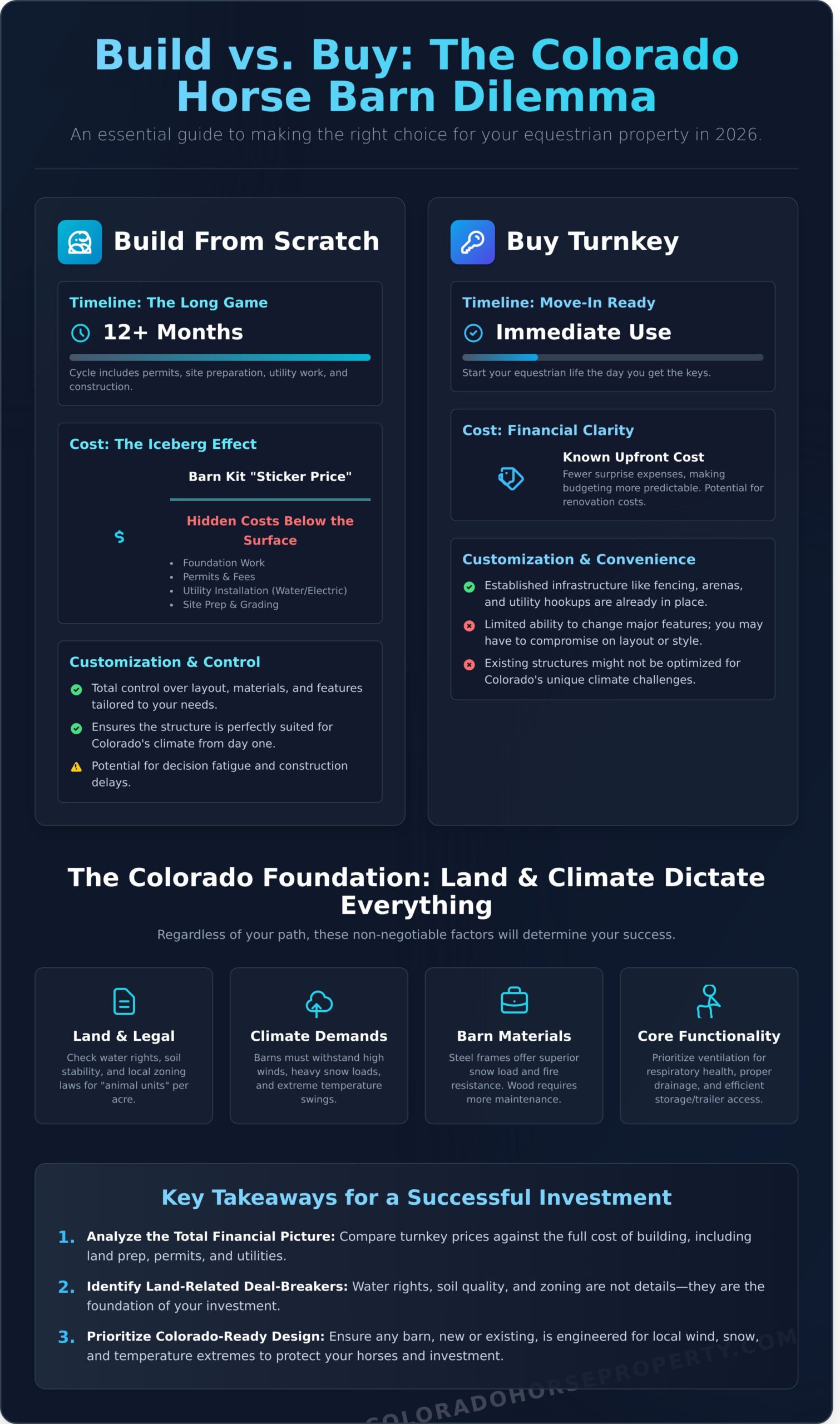
- Timeline: A turnkey property allows for immediate use, whereas a custom build often involves a 12-month or longer cycle for permits, site prep, and construction.
- Cost: The “sticker price” of a barn kit is misleading. It rarely includes essential expenses like foundation work, utility installation, and grading, which can dramatically increase the total investment.
- Potential: Identifying a property’s true potential-or its hidden pitfalls-is a skill. Our team’s nearly four decades of experience helps clients see beyond the surface to make a confident decision.
Why Colorado Geography Dictates Your Barn Choice
In Colorado, the land dictates the barn. Along the Front Range, powerful winds demand careful consideration of barn orientation and door placement to protect both animals and structures. At high altitudes, temperature swings can be extreme, making proper insulation and ventilation non-negotiable for managing moisture and ensuring equine respiratory health. These factors are central to successful modern horse stable design and functionality in our unique climate. A true Colorado-ready barn is engineered with a high snow-load rating to withstand the weight of heavy winter storms without compromise.
Essential Features of Colorado Horse Barns for Sale
An effective horse barn in Colorado is far more than a simple shelter; it’s a piece of critical infrastructure engineered for the state’s demanding climate and topography. When you evaluate properties with existing equestrian facilities or plan a new build, it’s essential to look beyond aesthetics to the core functional elements that ensure safety, efficiency, and the well-being of your horses.
Structural integrity is paramount. Steel-frame construction is often favored for its superior snow load capacity and fire resistance-two non-negotiable factors in the Rocky Mountains. While wood barns offer a classic aesthetic, they require diligent maintenance to withstand the elements. Inside, a well-designed ventilation system is crucial for managing dust and promoting respiratory health in our dry air. This attention to detail extends to the ground level, where thoughtfully designed flooring and drainage systems, from interlocking rubber mats to crowned concrete aisles, prevent moisture buildup and protect hooves.
Beyond the stalls, a functional property accounts for logistics. This means ample, accessible hay storage, secure tack rooms, and enough clearance for easy trailer maneuverability. Just as important is what lies outside the barn walls. Zoning regulations, which often define the number of “animal units” allowed per acre, vary significantly by county. Successful horse ownership is directly tied to land stewardship; understanding the principles of Colorado pasture management is essential for ensuring your acreage can sustainably support your herd and comply with local ordinances. When you search for horse barns for sale, the quality of the land is as crucial as the structure itself.
Popular Barn Styles for the West
From hobby farms to professional training centers, Colorado equestrian properties typically feature one of three primary barn designs:
- Center Aisle Barns: The gold standard for professional operations, offering protected, dual-sided stall access and excellent airflow.
- Shed Row Barns: A cost-effective and flexible option ideal for smaller ranchettes, where each stall opens directly to a paddock or pasture.
- Modular Barns: Prefabricated for quick installation, these are an efficient way to add immediate equestrian value to a property.
The “Must-Have” Interior Amenities
Modern buyers expect amenities that enhance both horse health and owner convenience. Key features to look for include:
- Wash Stalls with Heated Water: A near-necessity for year-round grooming, injury care, and managing Colorado’s mud season.
- Climate-Controlled Tack Rooms: Essential for preserving expensive leather saddles and equipment from extreme temperature swings and dry air.
- Integrated LED Lighting & Smart Monitoring: Bright, energy-efficient lighting and camera systems provide safety and 24/7 peace of mind.
Build vs. Buy: The Financials of Equestrian Real Estate in 2026
Deciding between building a custom barn and purchasing a property with existing equestrian facilities is one of the most significant financial choices a buyer will make. In the 2026 market, a quality, well-maintained barn substantially increases a property’s resale value and appeal, making turnkey horse properties a compelling investment. While the dream of a custom build is powerful, it comes with a complex budget. The hidden costs of new construction go far beyond the structure itself and include county permits, extensive site prep, and extending utilities like water and electricity, which can add tens of thousands to your final bill. The process requires careful planning and adherence to expert guidance on barn construction to ensure a safe, functional, and valuable asset.
Financing also differs greatly. Securing a land loan for a raw parcel typically requires a larger down payment and carries a higher interest rate than a traditional mortgage for an established property. Furthermore, if you plan to operate a boarding or training business, your barn improvements may be tax-deductible for agricultural use, but navigating these regulations requires professional tax advice.
For those planning to run a boarding or training business, managing the operational side—from scheduling farriers to invoicing clients—is just as important. Digitizing these tasks with field service software like repair-crm.com can help streamline the entire process.
Appraisal Realities for Horse Properties
Understanding how your investment will be valued is critical. In Colorado, appraisers typically assign a lower value per square foot to outbuildings like barns than to the primary residence. This means “over-building” a state-of-the-art barn in a neighborhood of modest homes can negatively impact your return on investment. A turnkey 5-acre property with existing infrastructure often appraises higher and sells faster than the combined cost of raw land plus new construction, offering immediate usability without the financial risks of building delays.
Budgeting for the “Total Equestrian Package”
When looking at horse barns for sale, remember the barn is just the centerpiece. A complete equestrian setup requires several other significant investments that must be factored into your total budget.
- Fencing Costs: A barn is useless without safe containment. Professional fencing for pastures and paddocks is a non-negotiable expense that can run from $5 to $15 per foot or more depending on the material.
- Arena Construction: An all-weather riding arena is frequently the single most expensive addition. Proper excavation, base layers, drainage, and footing can easily exceed $100,000 for a standard dressage court.
In Colorado, the cost for high-end custom horse barns can easily range from $60,000 to over $100,000 per stall, factoring in premium materials, climate control, and integrated amenities.
Critical Infrastructure: Evaluating Land Beyond the Barn Walls
When you’re searching for horse barns for sale, it’s easy to get captivated by the structure itself-the number of stalls, the size of the tack room, or the quality of the footing in the arena. However, seasoned equestrians know that the land is the true foundation of any successful horse property. The infrastructure beyond the barn walls can make or break your investment and your ability to live out your equestrian dreams.
Before you fall in love with a barn, you must perform due diligence on the land. Key factors like water availability, soil stability, zoning laws, and physical access are not just details; they are the essential components that determine a property’s viability and long-term value.
The Colorado Water Rights Deep Dive
In Colorado, water is everything. A property without adequate, legal water for livestock is not a horse property. It’s critical to understand the difference between a domestic well (often limited to in-home use and watering a few animals) and a true livestock well. Getting this wrong is a costly, and often irreversible, mistake. For a complete breakdown, see our guide on Water Rights in Colorado. In many cases, owning “shares” in a local ditch or irrigation company can be more valuable than the barn itself, ensuring your pastures stay green year after year.
Acreage and Pasture Management
The question “how many acres do you really need?” is one we hear constantly. The answer for a four-stall barn depends heavily on pasture quality, irrigation, and your management style. We cover this in-depth in our guide: How Many Acres Do You Need for a Horse Property? Beyond sheer size, consider the impact of over-grazing on Colorado’s fragile prairie grasses. A sustainable plan for rotational grazing, manure management, and controlling environmental runoff isn’t just good stewardship-it’s often required by local regulations.
Finally, consider the unseen forces that govern your land.
- Soil Quality: Much of Colorado has “heaving soils” rich in bentonite clay. These soils expand and contract dramatically with moisture, which can crack and destroy even the most robust barn foundations over time. A geotechnical report is essential.
- Zoning and Easements: Can you actually build that indoor arena you’ve been dreaming of, or add on to the existing barn? Local zoning regulations, conservation easements, and utility right-of-ways can severely limit your plans.
- Access and Egress: Your property must have reliable, year-round access for large vehicles. If a fully loaded hay truck, your veterinarian’s rig, or an emergency horse trailer can’t get to your barn in a March snowstorm or a muddy April, you have a critical failure point.
Evaluating these factors ensures the properties and horse barns for sale you consider can truly support your lifestyle. Navigating these complexities is what we do best. Contact an expert at Colorado Horse Property to help you find land that works as hard as you do.
Finding Your Dream Equestrian Estate with AI-Powered Search
Identifying the perfect equestrian property involves more than just a house and land. It requires a deep understanding of the features that support your lifestyle, from functional outbuildings to the right zoning. While the search for properties with existing horse barns for sale can be daunting, the combination of advanced technology and specialized expertise transforms this complex process into a clear path toward your goal.
Why Our AI Tool Outperforms Standard Property Searches
Generic real estate websites are designed for residential homes, not functional ranches. Our proprietary AI-powered search tool was built specifically for the needs of the equestrian community. It goes beyond standard filters to analyze listing descriptions for keywords that truly matter, saving you countless hours by eliminating unsuitable properties from the start.
- Niche-Specific Data: The tool actively scrapes listings for critical terms like “outbuildings,” “loafing sheds,” “tack rooms,” “arenas,” and crucial “water rights.”
- Intelligent Filtering: It automatically identifies and filters out properties with restrictive HOAs or zoning regulations that would prevent equine activities.
- Precision Search: You can filter with unparalleled accuracy, searching by a specific stall count, the presence of an arena, or the precise acreage needed for pastures and turnout.
Stop wasting time on listings that don’t fit. Find your next Colorado Horse Property with AI and see only the properties that match your vision.
Expert Representation for Buyer Success
Finding the right property is only the first step. The journey from search to closing is where expert representation becomes invaluable. With decades of focused experience, agents like Mark and Alison Eibner navigate the unique complexities of rural and ranch sales. Their expertise ensures that every detail is managed correctly, protecting your investment and your dream.
From coordinating soil and water tests to vetting title insurance and negotiating terms on an established ranch with horse barns for sale, our team provides comprehensive transaction management. We handle the technicalities so you can focus on the future. The final step isn’t just signing papers; it’s joining a vibrant community of Colorado horse owners who successfully realized their lifestyle and dreams with a trusted partner by their side.
Your Colorado Equestrian Dream Awaits
The path to owning the perfect equestrian property in Colorado involves more than just a structure; it’s about finding a place where your lifestyle and dreams can take root. The decision to buy versus build hinges on a careful evaluation of financials, timelines, and the critical land infrastructure that supports your vision. Whether you are searching for turnkey horse barns for sale or the ideal acreage to create your own, navigating this niche market requires specialized expertise.
With nearly four decades of dedicated experience in equestrian real estate, we provide the clarity you need. Our proprietary AI search technology allows you to pinpoint properties with the specific features that matter most, from water rights to arena footing. We manage every aspect of the transaction, from title to escrow, ensuring a seamless journey to your new home.
Your ideal property is out there. Let us help you find it. Start your AI-powered search for Colorado horse properties with barns today and take the first step toward making your equestrian dream a reality.
Frequently Asked Questions About Horse Barns and Facilities
Does a horse barn increase the property value in Colorado?
Yes, a well-built horse barn significantly increases property value for the right buyer. It enhances functionality and appeal for the equestrian market, making your property more attractive than those without equine facilities. When searching for horse barns for sale, buyers see a well-designed structure as a major asset, reflecting a turn-key property that saves them time and construction costs. The return on investment depends on the quality, size, and amenities.
How many horses can I keep on 5 acres in Colorado?
Zoning regulations vary by county, but a common guideline is 1-2 horses per acre. On 5 acres, you could typically keep between two to five horses, assuming adequate pasture for grazing and turnout. It is crucial to check specific county zoning laws and consider factors like pasture management, water availability, and manure disposal plans to ensure you are compliant and maintaining a healthy environment for your animals.
What is the cheapest type of horse barn to build?
A pole barn is generally the most cost-effective type of horse barn to build. This construction method uses large posts buried in the ground to support the roof, requiring a simpler foundation and less structural material than traditional stick-built barns. While the initial cost is lower, it’s important to ensure the design still meets the specific needs for safety, ventilation, and durability required for housing horses in Colorado’s climate.
Do I need a permit to put a modular horse barn on my property?
Yes, in almost all cases you will need a permit for a modular horse barn in Colorado. Even though parts are pre-fabricated, it is considered a permanent structure that must meet local building codes for safety, zoning, and land use. The permitting process involves submitting plans to your county’s planning department for approval. It is essential to complete this step before site preparation or delivery to avoid costly fines and delays.
What are the specific water requirements for a horse barn in CO?
A horse requires 5-15 gallons of fresh water daily, and your barn must have a reliable source. In Colorado, this often means having a well with adequate production rates and proper water rights. Your barn design should include frost-free hydrants and, ideally, heated automatic waterers to prevent freezing during cold winters. Ensuring your water source is legally sufficient and physically reliable is a critical step when planning any new equestrian facility.
Is it better to have a wood or steel horse barn for Colorado weather?
Both wood and steel have advantages for Colorado’s weather; the choice depends on budget and priorities. Steel barns offer excellent durability against heavy snow loads and are fire-resistant, but they can be noisy and require good insulation. Wood barns provide natural insulation and a traditional aesthetic but demand more maintenance to protect against moisture and pests. Many builders recommend a hybrid approach, such as a steel frame with wood-lined interiors.
How much does it cost to clear land for a barn and arena?
The cost to clear land for a barn and arena in Colorado can range from $3,000 to $10,000 per acre. This price varies widely based on the density of trees, the presence of large rocks, and the steepness of the terrain. A heavily wooded or rocky parcel will be on the higher end of that estimate. This cost typically covers excavation, grading, and debris removal to create a level, stable foundation for your structures.
Can I build a barn with living quarters on my land?
Yes, building a barn with living quarters, often called a “barndominium,” is possible on many Colorado properties. However, it is subject to strict county zoning and building codes that regulate residential structures. You will need permits for both the agricultural and residential components, including septic and utility hookups. It’s crucial to verify that local regulations allow for this type of dual-use structure before you begin planning your build.