
What if the 40-acre pasture you fell in love with is actually a legal liability because you don’t own the water flowing through it? In the High Plains and Rocky Mountain foothills, a stunning view doesn’t always come with the right to irrigate your crops or water your horses. You likely already know that finding the right farms for sale in colorado requires more than a quick drive through the countryside. It’s a high-stakes investment where a single missed detail in a century-old water decree can cost you thousands in future utility fees.
We’ve designed this 2026 guide to help you master the complexities of land acquisition, from securing senior water rights to managing specialized equestrian zoning. You’ll learn how to identify properties that offer the perfect balance of pasture and infrastructure while maximizing agricultural tax exemptions. We will also show you how our AI-driven search tools pinpoint the exact acreage you need. This comprehensive walkthrough covers everything from prior appropriation laws to the latest property search technology to ensure your investment remains protected for decades.
Key Takeaways
- Understand the 2026 market dynamics across the Front Range and Western Slope to distinguish between production agriculture and luxury equestrian estates.
- Master the “Golden Rule” of Colorado real estate by learning how senior water rights and prior appropriation determine the long-term viability of your land.
- Navigate the specialized buying process for farms for sale in colorado, including critical financial pre-qualification steps and unique down payment requirements for land loans.
- Learn to evaluate essential infrastructure for your specific goals, from indoor arenas and loafing sheds for horses to irrigated acreage for high-yield crops.
- Discover how to leverage AI-powered search tools and four decades of local expertise to identify premium properties that align with your lifestyle and dreams.
Understanding the Colorado Farm Market in 2026
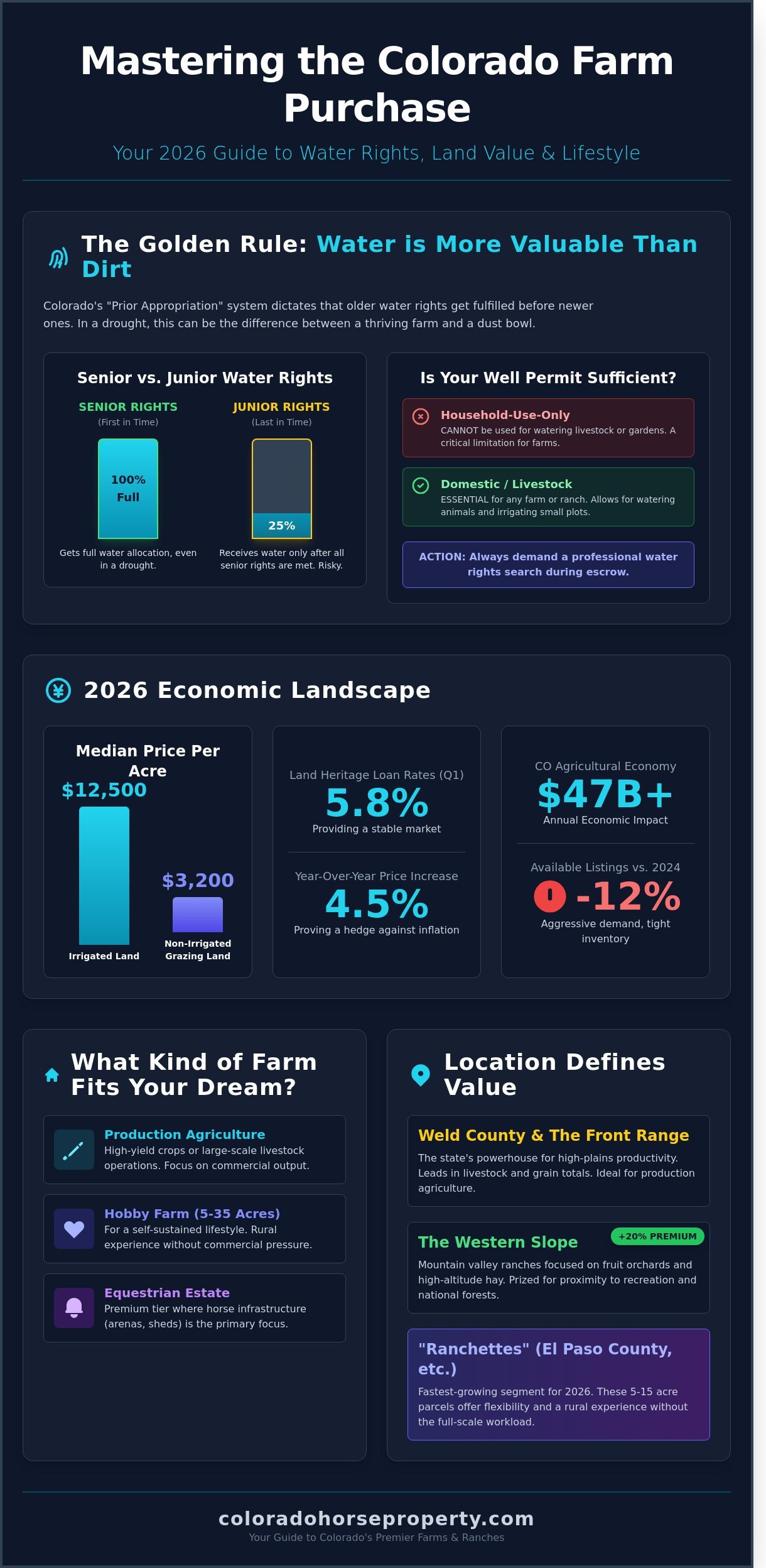
The landscape for agricultural real estate has shifted significantly as we move through 2026. Buyers looking for farms for sale in colorado today aren’t just looking for dirt and fences; they’re investing in a specific vertical of the rural economy. We categorize these properties into three distinct buckets. Production agriculture focuses on high-yield crop output or large-scale livestock operations. Hobby farms typically occupy 5 to 35 acres, serving owners who want a self-sustained lifestyle without the pressure of a commercial bottom line. Equestrian estates represent the premium tier, where the infrastructure for horses often outvalues the residential square footage.
Market demand remains aggressive across the Front Range and the Western Slope. This inventory squeeze stems from a 12% decrease in available listings compared to 2024. Buyers are prioritizing water security and senior water rights more than ever before. Colorado’s agricultural economy now generates over $47 billion in annual impact, which keeps land values resilient even during broader economic fluctuations. We see a consistent trend where professionals from Denver and Colorado Springs transition to the “Lifestyle and Dreams” model, seeking 10 to 40 acre parcels that allow for private arenas and hay production.
Regional differences define your daily life and your return on investment. Weld County remains the powerhouse for high-plains productivity, leading the state in livestock and grain totals. In contrast, the Western Slope offers mountain valley ranches where the focus shifts to fruit orchards and high-altitude timothy hay. These mountain properties often fetch a 20% premium due to their proximity to recreational hubs and national forest boundaries.
Farms vs. Ranches: What’s the Difference in Colorado?
The distinction is technical but vital for your tax bill. A farm focuses on cultivated crop production, while a ranch centers on livestock grazing on native or improved pasture. Zoning impacts your ability to build. In Larimer County, specific “Agricultural” designations might require a minimum of 35 acres to secure a domestic well permit that allows for livestock watering. El Paso County offers more flexibility for smaller “Ranchettes.” These 5 to 15 acre parcels are the fastest-growing segment for 2026 buyers who want the rural experience without the 60-hour work week of a full-scale operation.
The 2026 Economic Outlook for Agricultural Land
Interest rates for land heritage loans have stabilized at 5.8% as of Q1 2026, providing a predictable environment for high-value transactions. Conservation easements are playing a massive role in the current market, with 2.5 million acres now protected statewide, offering significant tax credits to landowners who limit future development. This preservation ensures that the “open space” feel of the state remains intact for future generations. In 2026, the median price for irrigated land holds steady at $12,500 per acre, while non-irrigated grazing land averages $3,200 per acre. These figures represent a 4.5% year-over-year increase, proving that farms for sale in colorado remain a premier hedge against inflation.
Critical Due Diligence: Water Rights, Soil, and Zoning
In Colorado real estate, the land is often secondary to the water. You’ll hear veterans say water is more valuable than the dirt it sits on. This isn’t hyperbole. Without secured rights, a 40-acre pasture quickly becomes a dust bowl. When you’re evaluating farms for sale in colorado, the first thing you look at isn’t the farmhouse kitchen or the fence lines. You look at the decree dates and the priority of the water rights attached to the deed. Securing one of the premier farms for sale in colorado requires more than a handshake; it requires a deep dive into historical records and state databases.
Navigating Colorado Water Law
Colorado follows a strict legal framework known as Colorado’s Prior Appropriation System. This doctrine dictates that the person who first put the water to beneficial use holds the senior right. If a drought hits, senior rights holders get their full allocation before a junior holder gets a single drop. You’ve got to know if the property includes “shares” in a ditch company or if it relies on a well. A “household-use-only” well permit won’t let you water a single horse or a small garden. You need a “domestic” or “livestock” permit for those activities. During the escrow process, always demand a professional water rights search to confirm you’re actually buying what the seller claims to own.
Beyond the water, you must analyze the ground itself. Don’t guess at productivity based on how green the grass looks in July. Use the NRCS Web Soil Survey to pull a report for the specific parcel. You’re looking for “Prime Farmland” or “Farmland of Statewide Importance” designations. For example, a Class II soil might support 2.5 animal units per acre, while a Class VI soil in a semi-arid zone might require 15 acres to support one horse without destroying the pasture. Testing for salinity and pH levels is a $50 investment that saves thousands in failed harvests or expensive reseeding efforts down the road.
Zoning and Land Use Regulations
Zoning dictates your daily life and your long-term investment. Most counties use “Animal Units” (AU) to cap livestock numbers. In Weld County, for instance, a horse is often counted as 1.0 AU. If your 5-acre lot is zoned for 1 AU per acre, you’re capped at five horses regardless of how many stalls you build. If you’re feeling overwhelmed by these technicalities, our team at Colorado Horse Property can help you verify these details before you sign a contract.
- Animal Units: Check the specific county code for density limits. Some areas allow 2 horses per acre, while others require 3 acres for the first horse.
- Ag-Exempt Buildings: Building a 60-by-120-foot indoor arena often qualifies for an “Ag-exempt” permit. This simplifies the process, but you’ll still need to meet specific setbacks and drainage requirements.
- Special Use Permits: If you plan to board ten outside horses or run a commercial training facility, you’ll likely need a Special Use Permit. This process can take 6 months and cost upwards of $2,500 in application fees and public hearings.
Specifics matter when you’re moving from a residential mindset to a rural one. You don’t want to find out after closing that your dreams of a 20-stall boarding stable are illegal under current county land-use maps. Confirming the zoning and the health of the soil today ensures your farm remains a viable asset for decades to come.
Evaluating Farm Types: From Hobby Farms to Equestrian Estates
Colorado’s diverse terrain means that farms for sale in colorado aren’t a one-size-fits-all investment. Buyers typically choose between four distinct categories based on their lifestyle goals and financial objectives. Production farms focus on high-yield output, often requiring 160 acres or more to remain competitive. In regions like the Arkansas River Valley, these properties rely on senior water rights to produce 6 to 8 tons of alfalfa per acre or over 200 bushels of corn. Without secured water, the land’s value drops significantly, making irrigation the primary metric for any production-focused buyer.
Working ranches represent the largest scale of land ownership. These operations often span thousands of acres and require Bureau of Land Management (BLM) or U.S. Forest Service grazing permits to be viable. Managing a herd of 200 head of cattle involves complex logistics, including maintaining miles of perimeter fencing and managing seasonal migrations to higher elevations. For those seeking a smaller footprint, hobby farms and ranchettes offer 5 to 35 acre parcels. These properties are ideal for sustainable living, allowing for a large garden, a small orchard, and a handful of livestock without the overhead of a commercial enterprise.
The Anatomy of a High-Quality Horse Property
A true equestrian estate requires specialized infrastructure that prioritizes animal safety and training efficiency. High-quality fencing is the first priority; experts recommend no-climb wire with a top rail or traditional four-rail PVC over dangerous barbed wire. Indoor arenas should feature at least 60 by 120 feet of space with 3 inches of washed sand footing to protect a horse’s joints. Barns need cross-ventilation and 12 by 12 foot stalls to ensure respiratory health. Since Colorado averages only 15 inches of annual precipitation, horse owners must implement rotational grazing across at least 2 acres per horse to prevent pasture degradation. The home itself should bridge the gap between luxury and utility, featuring a mudroom with direct access to the barn and unobstructed views of the paddocks.
Investment Potential: Ag-Exemptions and Taxes
Securing an agricultural tax classification is the most effective way to manage the carrying costs of large acreage. This status can reduce property tax liabilities by 70% to 90% compared to residential rates. Landowners often achieve this by leasing grazing rights to local ranchers or harvesting hay for sale. Boarding horses also provides steady income; a 10-stall barn charging $650 per month generates $78,000 in gross annual revenue. To maintain an agricultural tax classification for the 2026 assessment cycle, Colorado owners must provide documented evidence of a profit motive and consistent agricultural use during the 2024 and 2025 calendar years. It’s a strict requirement that rewards those who actively manage their land as a business. When looking for farms for sale in colorado, verifying the current tax status and water decree is a non-negotiable step in the due diligence process.
The 2026 Buying Process: A Strategic Roadmap
Buying a farm in 2026 requires more than a standard mortgage approval. You need a lender who understands the dirt. The first step involves securing financial pre-qualification through specialized agricultural lenders. Unlike residential loans, agricultural land loans typically require a down payment between 20% and 35%. Institutions like Farm Credit or regional banks such as High Plains Bank evaluate the land’s production potential alongside your credit score. They look at the soil’s capability and the historical yield of the acreage.
Once your budget is set, you must define your “must-haves” versus “nice-to-haves.” Searching for farms for sale in colorado requires specific parameters. You aren’t just looking at bedroom counts. You’re looking at “A-1” zoning, senior water rights, and existing irrigation infrastructure. A property might have a beautiful house, but if the 40 acres of pasture don’t have decreed water rights, your lifestyle goals will remain out of reach. We help you filter by these critical agricultural variables from day one.
Financing Your Colorado Farm
Lenders treat raw land and improved farms differently. A raw land loan often carries a higher interest rate and a shorter repayment term, sometimes only 10 to 15 years. If the property includes a residence and outbuildings, you can often secure a 30-year fixed rate. It’s vital to recognize that water rights can account for 40% or more of the total appraisal value in the Colorado Front Range. Without documented water shares, your financing could collapse during the appraisal phase.
The inspection period for a farm is a rigorous, multi-layered process. You aren’t just checking for leaky faucets. You’re testing the viability of the entire operation. This phase usually lasts 30 to 45 days to allow for specialized reports. If the property relies on a well, a four-hour drawdown test is essential to ensure the flow rate meets the needs of your livestock and household. Soil quality tests are equally important to check for salinity or heavy metal concentrations that could hinder crop growth or grazing.
The Inspection Phase: Beyond the Home
Standard home inspectors don’t have the tools to evaluate a 10,000-square-foot equipment shed or a 100-year-old timber-frame barn. You need a structural engineer familiar with rural outbuildings. Additionally, septic systems on large farms often handle higher capacities or specialized waste; these require a full pumping and camera inspection. Don’t rely on old fence lines. A professional boundary survey is the only way to verify you’re actually buying the 80 acres described in the listing. Encroachments from neighbors are common in rural areas and must be resolved before the title transfers.
The final step is coordinating title and escrow for complex agricultural deeds. These documents often contain conservation easements, grazing leases, or mineral rights reservations that date back to the 1800s. A specialized title company will ensure that ditch rights and water shares are correctly transferred through the appropriate water conservancy districts. This meticulous attention to detail protects your investment and ensures your Colorado dream doesn’t turn into a legal nightmare.
Ready to begin your search? Our team has spent nearly four decades helping buyers secure the perfect farms for sale in colorado that match their specific agricultural needs.
Find Your Lifestyle and Dreams with Colorado Horse Property
Finding the right agricultural land requires more than a general real estate license. It demands a deep understanding of soil quality, water law, and specific equine needs. At Colorado Horse Property, we’ve spent 38 years specializing in this unique niche. We don’t just show houses; we evaluate the long-term viability of the land for your specific goals. Buying a ranch isn’t like purchasing a suburban home. It’s a complex acquisition of assets that requires a seasoned eye to spot potential issues with zoning or infrastructure before you sign a contract.
Why Our AI Search is a Game Changer
Traditional search engines often fail to filter for the details that matter most to horse owners and ranchers. Our proprietary AI-powered system changes that by scanning thousands of data points to identify farms for sale in colorado that meet strict criteria. Instead of scrolling through irrelevant listings, you can filter by specific features that save you an average of 40 hours of manual research. Our system prioritizes:
- Specific Barn Features: Search for properties with indoor arenas, heated tack rooms, or specific stall counts.
- Water Rights: We identify properties with senior water rights or domestic well permits, which are critical for 35-plus acre parcels.
- Acreage and Grazing: Filter by pasture quality and fencing types to ensure the land supports your livestock count.
Our technology doesn’t just look at what’s on the market today. It taps into our deep-rooted Colorado network to surface off-market opportunities. These “pocket listings” often represent the highest quality farms for sale in colorado, allowing our clients to view properties before they hit the mass market. You can start your AI-powered farm search today to receive personalized alerts the moment a matching property is identified.
Negotiations for rural property involve variables that standard realtors often overlook. You need a “horse person” in your corner who understands the difference between a decorative fence and a functional one. We analyze grazing leases, mineral rights, and access easements to protect your investment. If a property lacks the proper irrigation for hay production or has restrictive zoning that prevents building a second dwelling, we’ll tell you immediately. We provide full-cycle support, managing everything from the initial property identification to complex title coordination and the final closing.
Meet Mark and Alison Eibner
Colorado Horse Property is a family-led operation built on a foundation of trust and specialized knowledge. Mark and Alison Eibner bring nearly four decades of experience to the table, helping hundreds of families transition from city living to high-country ranching. They understand that you aren’t just buying dirt; you’re investing in a way of life. Their approach focuses on building long-term partnerships rather than quick transactions.
One recent success story involved securing a 50-acre equestrian estate in Douglas County for a client who had been searching for two years. By using our network and AI tools, we found an unlisted property that met 100% of their requirements, including a pre-existing 10,000-square-foot indoor arena. This legacy of service ensures that your dream of owning a Colorado ranch is handled with the precision and care it deserves. We’re ready to help you find the space, freedom, and connection to the land you’ve been looking for.
Secure Your Colorado Agricultural Legacy
Navigating the 2026 land market requires a sharp focus on the technical details that determine a property’s long term value. Success hinges on your ability to verify senior water rights and understand the specific agricultural zoning laws that impact your operations. From testing soil viability to evaluating existing irrigation infrastructure, every step of your due diligence protects your investment. Finding the right farms for sale in colorado doesn’t have to be an overwhelming process when you have the right tools and expertise at your side.
Our team brings nearly 40 years of specialized real estate experience to your search, ensuring you never miss a critical detail regarding Colorado water law or equine facility requirements. We’ve integrated proprietary AI search technology to help you pinpoint niche features like indoor arenas or specific pasture types with precision. It’s our mission to bridge the gap between complex data and your personal goals. Find your next Colorado Farm with our AI-Powered Search and start building the lifestyle and dreams you’ve always envisioned. The right acreage is out there, and we’re ready to help you claim it.
Frequently Asked Questions
How many acres do I need for a horse property in Colorado?
You typically need 2.5 to 5 acres for your first horse to comply with most county zoning laws. For instance, Douglas County requires a minimum of 35 acres for certain agricultural designations, while Weld County allows animals on smaller plots. It’s best to plan for 2 acres of managed pasture per horse to prevent overgrazing and soil erosion.
What is the average cost of farm land for sale in Colorado in 2026?
Projections for 2026 suggest average prices for irrigated farms for sale in Colorado will reach $6,800 per acre. This estimate follows a 4% annual growth trend from 2023 USDA data that valued state cropland at $5,500. Dryland prices remain lower, often averaging $1,800 per acre in eastern counties like Kit Carson or Yuma.
How do water rights work when buying a farm in Colorado?
Water rights are separate real estate interests and don’t automatically transfer with a land deed. You must specifically include ditch company shares or decreed well rights in your purchase contract. The Colorado Division of Water Resources manages these through a priority system where “senior” rights from the 1860s receive water before “junior” rights during dry seasons.
Can I get an agricultural tax exemption on a small hobby farm?
You can qualify for agricultural status if you prove a profit motive and use the land for grazing or crops for at least two consecutive years. Most county assessors require a minimum of 2 to 40 acres depending on the specific use. This designation can slash your property tax bill by 50% or more compared to standard residential rates.
What are the best counties in Colorado for equestrian properties?
Douglas, Boulder, and Weld counties are the top choices for equestrian infrastructure and trail access. Douglas County offers over 300 miles of public trails, while Weld County provides the most affordable large acreage farms for sale in Colorado. Larimer County is also a favorite because it’s close to world-class veterinary care at Colorado State University.
Is it possible to find farms for sale in Colorado with owner financing?
Owner financing appears in roughly 5% to 8% of rural land transactions when traditional bank lending is tight. Sellers usually demand a 20% to 30% down payment and a balloon payment within 5 to 10 years. This path helps buyers who don’t fit the strict debt-to-income ratios required by commercial agricultural lenders.
What is a Ranchette and is it right for me?
A ranchette is a small rural property ranging from 2 to 15 acres that combines a home with space for livestock. It’s the right choice if you want to achieve your lifestyle and dreams without the 24/7 labor of a 1,000-acre ranch. These properties let you keep a few horses or a garden while staying close to city amenities.
How does the Colorado Right to Farm law protect property owners?
Colorado Revised Statute 35-3.5-102 protects established agricultural operations from nuisance lawsuits filed by new neighbors. If your farm was active first, a neighbor can’t sue you over smells, dust, or noise from normal farming practices. This law has protected the state’s agricultural heritage for over 40 years as urban areas expand into rural spaces.