
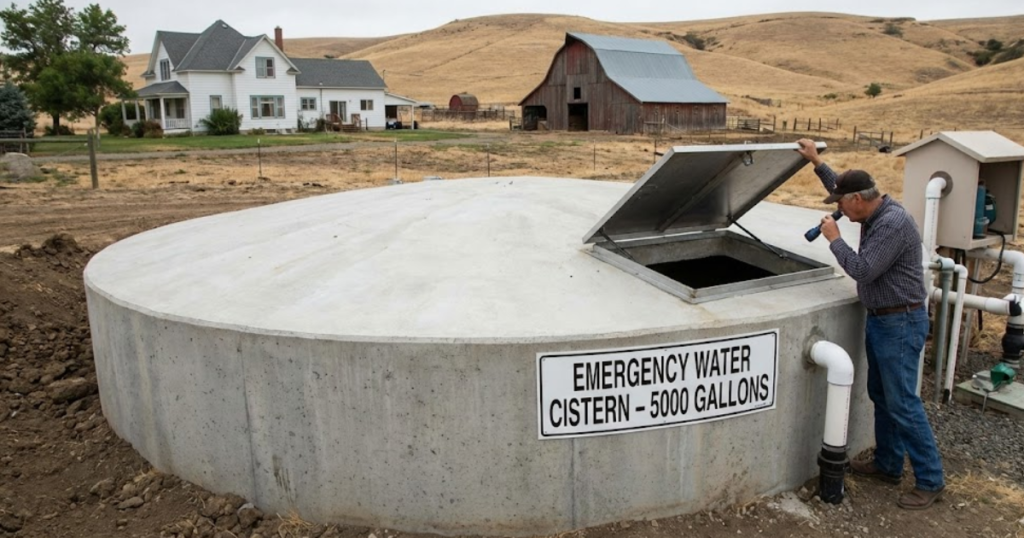
You turn on the faucet in your rural Colorado home, and nothing happens.
In the city, this means a water main broke down the street. On a horse property, it usually means your well pump just died, or a winter blizzard has knocked out the power grid. Without a backup plan, you now have a herd of 1,200-pound animals with nothing to drink.
This is why a cistern is one of the most valuable, and often overlooked, pieces of infrastructure on a ranch. It acts as your emergency water battery.
Here is what you need to know about underground water storage before you buy a rural property.
Does the Property Have “Cistern” Storage for Emergency Water Outages?
Quick Summary: The Lifeline in a Crisis
- The emergency battery: A cistern is a massive holding tank for your well water. When the power goes out or the well pump fails, a cistern helps ensure your horses will not go thirsty while you wait for repairs.
- Fixing low-yield wells: If a well only produces 1–2 gallons per minute, it can’t keep up with peak demand. A cistern solves this by filling slowly 24 hours a day, allowing high-pressure use when you need it.
- The fire mitigation mandate: Many mountain and foothills communities require a dedicated fire cistern reserved for firefighters to draft from during a wildfire.
- Maintenance is required: Cisterns must be cleaned, sanitized, and inspected for leaks to prevent bacteria growth and water loss.
A cistern is not a luxury. It’s redundancy—one extra layer between your horses and a “no water” emergency.
1. What Is a Cistern and How Does It Work?
A cistern is a large storage tank—usually concrete or heavy-duty plastic—buried underground.
The dual-pump system
- The well pump pulls water from the aquifer and fills the cistern slowly.
- A separate booster pump pulls from the cistern and supplies the house/barn at normal pressure.
The buffer zone
- Because the cistern supplies “peak demand,” the deep well pump cycles less, which can extend pump life.
Where is the cistern lid, what size is it, and when were the booster pump and pressure tank last replaced?
2. The Cure for Low Flow Wells
A cistern is the ultimate equalizer for a property with poor water production.
The math of low yield
- A well producing just 1 gallon per minute still generates 1,440 gallons in 24 hours.
Why a cistern changes everything
- Without a cistern, a shower + trough fill can drain pressure instantly.
- With a 2,000-gallon cistern, the well fills the tank slowly overnight, and you can use water normally in the morning.
3. The Fire Department Requirement
In high-risk wildfire zones, a cistern may be required before you can even build new structures.
Domestic vs. fire tank
- Domestic cistern: Supplies your household and livestock water.
- Fire cistern: Often 10,000 gallons or more, with a dry hydrant hookup so firefighters can draft from your property.
The insurance factor
- Fire trucks carry limited water. A dedicated fire cistern can materially improve defensibility and may help with insurance premiums in forested areas.
4. The Hidden Maintenance Costs
A cistern is security—but it is also an extra system that requires active management.
Routine cleaning
- Sediment and minerals settle at the bottom over time.
- Many owners clean and sanitize every 3 to 5 years.
Sanitization
- To prevent algae and bacteria, some systems use UV filtration or automatic chlorination.
- Water quality should be monitored periodically.
Structural integrity
- Older concrete tanks can develop hairline cracks.
- A slow leak can cause the pump to run constantly and burn out—turning a cistern into a liability.
Ask for maintenance logs and receipts. A cistern with no service history should be treated like a system you’ll service immediately after closing.
We Check the Water Security Before You Buy
We do not just turn on the tap—we trace the pipes.
When Mark Eibner and Belinda Seville help you evaluate a horse property, we look for cistern covers, request maintenance history, and test the booster pump system so you know you’re buying resilience—not surprises.
Contact Us Today to find a resilient and water-secure horse property.
Browse Active Colorado Horse Properties: View All Available Listings
Frequently Asked Questions (FAQ) About Cisterns
How big should a domestic cistern be?
Do cisterns freeze in the winter?
Not if installed correctly. Cisterns are buried below the frost line (usually 3 to 4 feet deep in Colorado) which naturally insulates the water from freezing temperatures.
Can I haul water to fill my cistern if the well breaks?
Yes. If the pump fails or the well goes dry, a commercial water hauling truck can fill the cistern. This is a crucial backup plan that helps you stay on-site while waiting for repairs.