
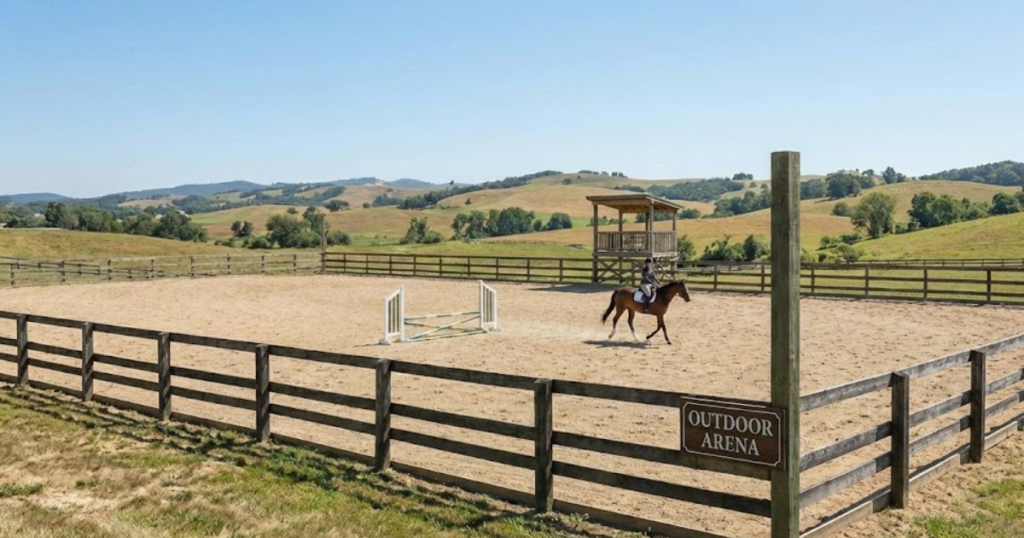
You look at the listing photos. You see a flat patch of dirt
with a few fence panels. The description says “Riding Arena.”
Is it? Or is it just a scraped spot in the weeds?
For a serious rider, the arena is the office. It is where
the work gets done. If the footing is too deep, the drainage is poor, or the
size is awkward, your training suffers. And in Colorado, the difference between
an indoor and an outdoor arena changes your entire lifestyle.
Here is how to evaluate the riding facilities on a potential
property.
Does the Property Have an Indoor or Outdoor Riding Arena?
Quick Summary: The Training Reality Check
- The outdoor reality: An outdoor arena is the standard for most private properties. It is cost-effective and beautiful in June. However, in Colorado, an outdoor arena is often unusable from December through March due to snow, ice, and freeze-thaw mud cycles.
- The indoor premium: An indoor arena is the “Holy Grail” for Colorado equestrians. It guarantees you can ride 365 days a year regardless of the blizzard outside. Consequently, properties with existing indoors command a massive price premium.
- The “room to build” trap: Buyers often say, “It doesn’t have an arena, but there is room to build one.” Be careful. “Room” does not mean “legal ability.” Slopes, drainage easements, and HOA height restrictions can make building your dream arena impossible.
- Size matters: A “round pen” is not an arena. For safe training, you generally need a flat, graded surface of at least 70' x 140'. Anything smaller is just a turnout paddock.
How to Spot a Real Arena
You look at the listing photos. You see a flat patch of dirt with a few fence panels. The description says “Riding Arena.”
Is it? Or is it just a scraped spot in the weeds?
For a serious rider, the arena is the office. It is where the work gets done. If the footing is too deep, the drainage is poor, or the size is awkward, your training suffers. And in Colorado, the difference between an indoor and an outdoor arena changes your entire lifestyle.
Here is how to evaluate the riding facilities on a potential property.
If the “arena” is missing fencing, missing base, or can’t drain, treat it like a future project—not a finished amenity.
1. The Outdoor Arena: Fair Weather Friend
Most horse properties in the $800k to $1.5M range will have an outdoor arena.
The pros
- Riding outside in the Colorado sunshine is unbeatable.
- It is less dusty than an indoor.
- The construction cost is a fraction of a building.
The cons
- Winter: Once the ground freezes, the footing becomes like concrete. Unless you use expensive additives (like magnesium chloride) and drag it daily, you likely won’t ride much in January.
- Spring: When the snow melts, a poorly drained outdoor arena turns into a bog.
- Wind: On the plains (Elizabeth/Kiowa), the wind can be relentless, making schooling young horses difficult.
2. The Indoor Arena: The Ultimate Asset
If you find a property with a permitted, well-built indoor arena, you have found gold.
The value
- Building a new indoor arena today costs $200,000 to $500,000+.
- Buying a property that already has one is almost always cheaper than building it yourself.
The lifestyle
- It allows you to keep horses in shape year-round.
- You don’t have to take the winter off or haul to a trainer’s barn just to trot.
Lighting
- Check the lights. Older arenas have dim, buzzing yellow bulbs.
- Newer ones have bright LEDs. Good lighting is essential for those 5:00 PM rides in December when it is pitch black outside.
3. The “Build It Later” Myth
We hear this all the time: “I’ll just buy the land and put up a steel building next year.”
It is never that simple.
Common reality checks
- Excavation costs: To build a 15,000-square-foot building, you need a perfectly flat pad. In the foothills, “making it flat” can cost $50,000 to $100,000 in earthmoving and retaining walls before you even buy the steel.
- HOA restrictions: Many covenants restrict the size of outbuildings. Your HOA might say, “No structure larger than 2,000 square feet.” An indoor arena is typically 12,000 square feet. If you buy in that neighborhood, you will never have an indoor.
- Height limits: Some counties have height restrictions to preserve views. An indoor arena needs high trusses (16–18 feet clearance). If the zoning limits height to 15 feet, you can’t build it.
Confirm slope, drainage, easements, HOA covenants, and county height rules. “Space” on a map is not the same as “permission” on paper.
4. The Footing and Fencing Factor
Whether indoor or outdoor, the “finish” matters.
The fence
- An arena needs a visual barrier.
- A simple wire fence is dangerous for riding (knees get caught).
- Look for continuous pipe, wood rail, or at least a solid kick-wall in an indoor.
The footing
- Check the sand. Is it deep and boggy? Is it hard as a rock?
- Replacing the sand in a standard arena can cost $10,000.
The dust
- Indoors require water.
- If there is no hydrant inside the arena to water the footing, you will be choking on dust within minutes.
We Know What Riders Need
We don’t just count the bedrooms; we measure the arena.
When Mark Eibner and Belinda Seville tour a property, we look at the riding potential. We check the orientation of the outdoor arena (does it get afternoon shade?). We check the truss height of the indoor. We verify that the zoning allows for the expansion you are planning.
Contact Us Today to find a property where you can train year-round.
Browse Active Colorado Horse Properties: View All Available Listings
Frequently Asked Questions (FAQ) About Arenas
What is the standard size for an arena?
A small dressage arena is 20m x 40m (66' x 132'). A standard dressage arena is 20m x 60m (66' x 198'). For jumping or reining, you typically want at least 80' x 150' or larger. Anything narrower than 60 feet feels claustrophobic for a large horse.
Does an indoor arena increase property taxes?
Yes. It is a large, valuable improvement. However, if the property has Agricultural Status, the tax impact might be minimized compared to a commercial warehouse.
Can I cover an existing outdoor arena?
Sometimes. You can buy “cover-all” fabric structures or steel roofs to place over an existing pad. However, these still require building permits and must meet Colorado’s strict wind and snow load ratings. You cannot just put up a tent and hope it holds.