
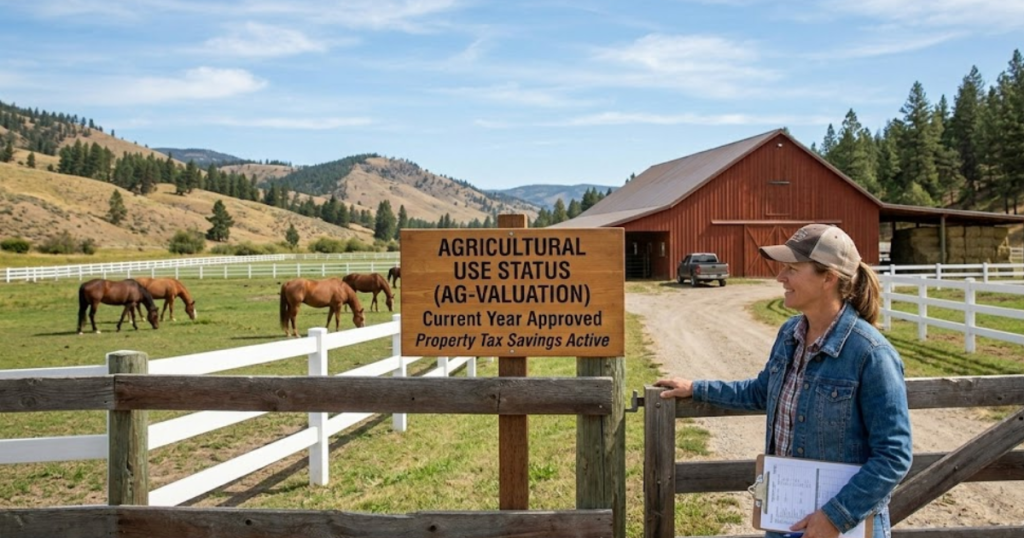
You are looking at two identical 40-acre properties on the market. One has a property tax bill of $4,000 a year. The other has a tax bill of $40 a year.
You might think it is a typo, but it is actually the most powerful financial advantage available to rural landowners.
In Colorado, land classified as “Agricultural” is taxed at a fraction of the rate of vacant or residential land. However, maintaining that status requires strict compliance with county rules. Buying a property under the assumption that it has Ag-Status, only to find out the seller lost it, can completely derail your monthly budget.
Here is what you need to know about navigating property taxes on a farm or ranch.
Does the Property Currently Have “Ag-Status” for Property Tax Savings?
Quick Summary: The Tax Loophole
- The massive savings: Ag-Status can lower property taxes by thousands of dollars a year. The land is taxed on its productive agricultural capacity rather than its high market value.
- Zoning vs. status: Do not confuse agricultural zoning with agricultural tax status. You can be zoned to have horses but still pay residential taxes if you are not actively farming for profit.
- The pleasure horse trap: Personal pleasure horses do not qualify for Ag-Status in Colorado. The land must be used with the primary intent of obtaining a monetary profit from agricultural products or livestock.
- The reinstatement wait: If a property loses its Ag-Status, you generally have to prove continuous agricultural use for two to ten years before the county will grant the tax break again.
Never assume the MLS tax status is correct. Verify the assessor classification code before you make an offer.
1. The Financial Impact of Ag-Status
To understand the value of Ag-Status, you have to look at how the county assessor calculates your bill.
The residential rate
- Residential land is assessed based on its market value.
- If the land is worth $500,000, your taxes are calculated on a percentage of that high number.
The agricultural rate
- Ag land is valued based on its income potential.
- Because dryland grass is not very lucrative, 40 acres might be valued by the county at $1,000 total.
The result
- The savings from this tax break can often cover your entire winter hay bill or your annual property insurance.
2. The “Pleasure Horse” Misconception
This is the most painful realization for new buyers. Just owning horses does not automatically grant you a tax break.
The rule
- Under state law, the breeding, boarding, or training of horses can be considered agricultural.
- Keeping horses for personal use is not.
The burden of proof
- If you apply for Ag-Status based on horses, the county assessor may audit you.
- They may ask for business tax forms, profit and loss statements, and proof of a commercial operation.
The reality
- Having four horses in the backyard for trail riding does not qualify the land.
- To the tax assessor, those are large pets.
If you cannot show a documented profit motive, expect the county to deny the tax break.
3. The Grazing Lease Strategy
If your personal horses do not count, how do you qualify for the tax break? Most small ranches do it by leasing the grass.
Leasing the grass
- You sign a grazing lease with a local cattle rancher.
- They run a small herd on your land for the summer and pay you a nominal fee.
Why it works
- The land is now supporting a commercial livestock operation, which satisfies the assessor’s requirement.
Hay production option
- Alternatively, you can lease the land to a farmer who cuts and bales hay for commercial sale.
4. The Danger of Losing the Status
Ag-Status is not permanent. It must be earned and maintained year after year.
The vacant land penalty
- If the previous owner sold their cows and let the land sit idle, the county can reclassify it as vacant land.
- Vacant land is taxed at a very high rate (commonly cited as 27.9% of market value in Colorado).
Earning it back
- If a property has lost its Ag-Status, you must prove actual agricultural use for two consecutive years before the tax status changes.
- If the land is part of a recorded subdivision, you may need to prove ten years of use depending on county rules.
If the property lost Ag-Status, your first years of ownership might carry the full residential/vacant tax bill before you can re-qualify.
We Verify the Tax Records Before You Buy
We do not just trust the MLS description. We check the county assessor data.
When Mark Eibner and Belinda Seville help you buy a horse property, we verify the current tax classification and the actual assessor codes. We make sure you know exactly what it will take to maintain that low tax bill so you are not hit with a massive surprise in January.
Contact Us Today to find a tax-efficient equestrian property.
Browse Active Colorado Horse Properties: View All Available Listings
Frequently Asked Questions (FAQ) About Ag-Status
Can I get Ag-Status on just 5 acres?
Technically there is no minimum acreage, but it is practically very difficult. Assessors look at economic viability, and it is hard to prove a 5-acre parcel supports a commercial agricultural operation large enough to generate a profit.
Does the house itself get the Ag-Status discount?
No. The house and the footprint of land immediately under it (often 1 to 2 acres) will typically be taxed at the higher residential rate. The remaining acreage may qualify for the agricultural rate (split classification).
Can keeping chickens qualify me for Ag-Status?
Usually not on a small backyard scale. You would need to prove a commercial egg or poultry operation with a documented profit motive to satisfy the assessor.