
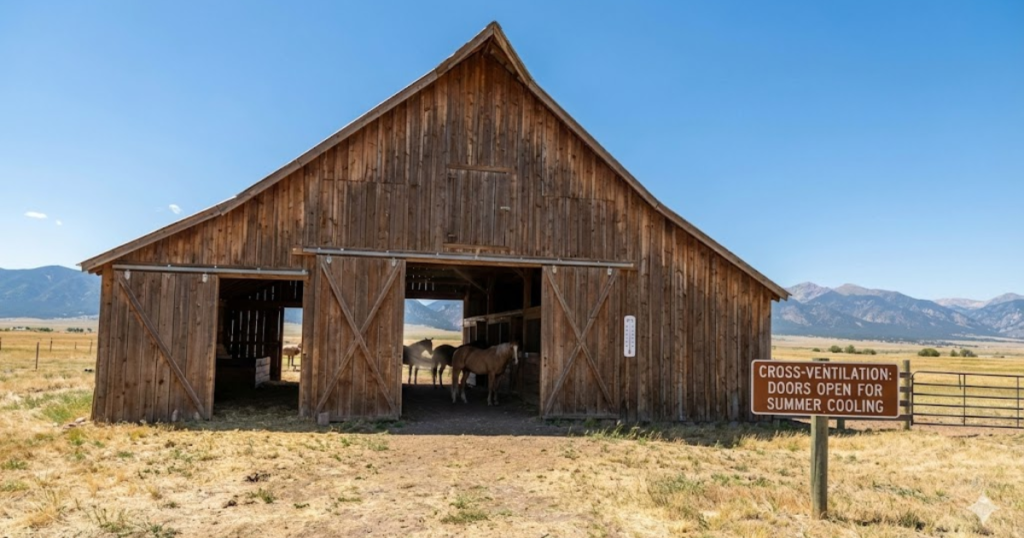
You step into a beautiful center-aisle barn in the middle of a July afternoon. Instead of a cool, shady oasis, you are hit with a wall of suffocating heat and the sharp smell of ammonia. In Colorado, buyers often obsess over keeping horses warm in the winter.
However, surviving the baking heat of a dry summer is just as critical for your herd’s health. Horses generate a massive amount of body heat. When you put them inside a sealed metal or wood box, that heat has nowhere to go. A barn without proper cross-ventilation is not a safe shelter. It is an oven. Here is how to tell if a barn will keep your horses cool and breathing easy when the summer temperatures spike.
Does the Barn Have “Cross-Ventilation” for Hot Colorado Summers?
Quick Summary: The Oven Effect
- The stagnant trap: A poorly ventilated barn in July can easily reach 10 degrees hotter than the outside air. Without continuous airflow, a barn becomes a dangerous heat trap for a large animal.
- The chimney principle: Hot air naturally rises. Good barns use ridge vents or cupolas on the roof to pull hot air up and out. This creates a vacuum that draws fresh, cool air in through lower windows.
- The ammonia risk: Ventilation is not just about temperature control. Stagnant air traps ammonia from urine and dust from hay, which can contribute to severe respiratory issues like equine asthma.
- Agricultural fans only: If natural wind is not enough, use mechanical ventilation—but only sealed-motor agricultural fans. Cheap box fans are a leading cause of barn fires.
If the barn smells like ammonia on a normal day, that’s a ventilation failure—not a cleaning issue.
1. The Mechanics of Horizontal Airflow
You cannot simply open the main aisle doors and expect the whole barn to cool down. You need air to move across every individual stall.
Dutch doors
- The gold standard for stall ventilation is an exterior Dutch door.
- Leaving the top half open gives the horse a direct breeze from outside.
Permeable stall fronts
- The interior stall wall facing the aisle cannot be solid wood to the ceiling.
- It should have heavy wire mesh or vertical bars so air entering from the exterior side can flow through the stall and flush out into the aisle.
The wind tunnel
- When you have open windows on exterior walls and open main doors at both ends of the aisle, you create a natural wind tunnel.
- This constantly sweeps stale air out and brings fresh air in.
Stand in a stall with doors open. If you don’t feel air moving, the stall isn’t truly ventilated.
2. The Roof Release: Thermal Buoyancy
Cross-ventilation handles horizontal airflow, but you also need vertical airflow to remove heat.
Trapped heat
- Hot air rises and accumulates at the ceiling.
- If the roof is sealed, that heat radiates back down onto the horses.
Ridge vents
- A continuous ridge vent runs along the peak of the roof and allows the hottest air to escape passively.
Cupolas
- They may look decorative, but functional cupolas have louvered sides that pull hot air up from the aisle and vent it outside.
Open soffits
- To make the chimney effect work, air must enter at the bottom of the roof line.
- Open, wire-meshed soffits under the eaves allow fresh air to enter and push hot air up toward the ridge vent.
3. The Invisible Hazard of Stagnant Air
A stuffy barn is more than uncomfortable. It is a veterinary hazard.
Ammonia buildup
- Urine breaks down into ammonia gas, which is heavier than air.
- It pools near the floor where horses lay down. Without airflow, it burns their respiratory lining.
Dust and mold
- Every time you sweep or throw hay, you release particulates.
- In a sealed barn, they can hang in the air for hours.
Equine asthma risk
- Chronic exposure to poor barn air is a leading contributor to Recurrent Airway Obstruction (heaves).
- Good ventilation is one of the best lung-protection tools you can buy.
If you cough in the aisle when someone sweeps, your horses are breathing that dust all day.
4. Mechanical Helpers and Fire Risks
Sometimes the Colorado air is dead calm and natural ventilation fails. That’s when you add safe mechanical movement.
Overhead fans
- Large ceiling fans over the main aisle can keep air moving and help flush heat out the ends.
Stall fans
- Many owners mount individual fans in stalls to lower temperature and reduce flies.
The fire warning
- Never use cheap residential box fans in a barn. Their motors are open and unsealed.
- Barn dust and horse hair get sucked into the motor and can ignite.
- Use only heavy-duty, sealed-motor agricultural fans.
If the fan doesn’t explicitly say it’s rated for agricultural or dusty environments, it doesn’t go in a barn.
We Check the Airflow Before You Buy
We do not just look at barn aesthetics—we look at the engineering.
When Mark Eibner and Belinda Seville tour an equestrian facility, we look up at the roofline for ridge vents. We check if the stalls have exterior windows or Dutch doors. We point out if the barn is positioned poorly to catch prevailing summer winds. We help you ensure the barn you buy is a healthy environment year-round.
Contact Us Today to find a property where your horses can breathe easy.
Browse Active Colorado Horse Properties: View All Available Listings
Frequently Asked Questions (FAQ) About Barn Ventilation
Should I insulate my barn for the summer?
Yes. Insulation does not just keep the barn warm in winter. A well-insulated roof acts as a barrier against the sun’s radiant heat in summer, keeping the interior significantly cooler than an uninsulated metal roof.
Are skylights a good idea in a barn?
They provide great natural light, but they can act like magnifying glasses in summer. If a barn has skylights, ensure ventilation is strong enough to offset solar heat gain, or choose frosted panels rather than clear ones.
Can I just leave my horses outside in the summer?
In Colorado, the sun is intense at high altitudes. Horses need shade during the hottest parts of the day to reduce heat stress and sunburn. If they don’t have access to a cool, ventilated barn, they need a well-positioned loafing shed in the pasture.