
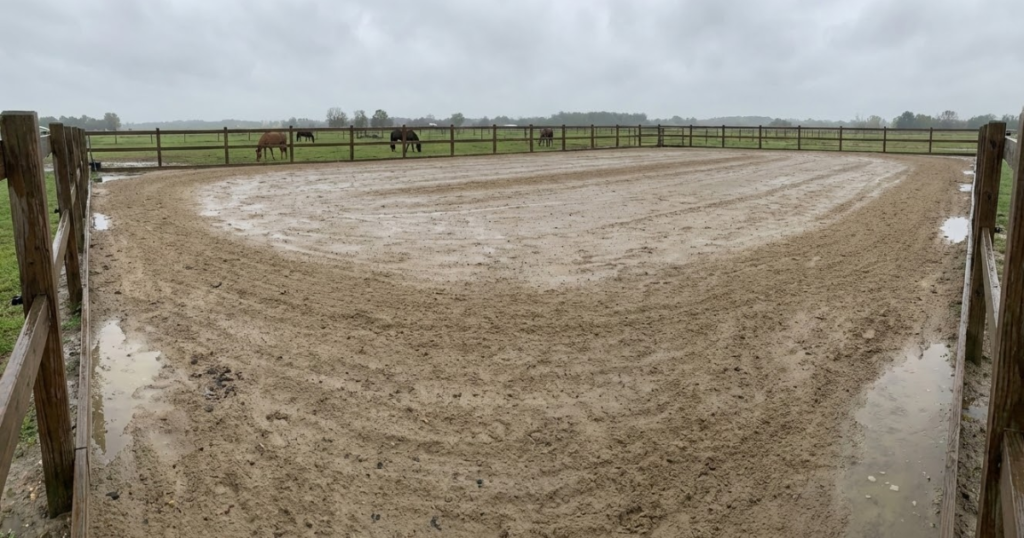
You look at a property on a sunny day. The arena is dry, the sand is fluffy, and it looks like a dream. You assume it is always rideable.
But in Colorado, we get sudden, heavy thunderstorms. If that arena was built perfectly flat, it will turn into a swimming pool for three days every time it rains.
Drainage is the difference between riding the day after a storm and waiting a week for the mud to dry. An arena without a crown is basically a bathtub. It holds water, ruins the base, and eventually causes soft tissue injuries to your horses.
Here is how to check the grade of an arena before you make an offer.
Does the Arena Have “Crown Drainage” to Prevent Puddling After Rain?
Quick Summary: The Invisible Slope
- The highway principle: A good outdoor arena looks flat to the naked eye, but it is actually built like a road. The center line is the highest point, allowing water to shed off to the sides rather than pooling in the middle.
- The 1% rule: Professional excavators grade the sub-base with a 1% to 2% slope. This is steep enough to move water quickly during a storm, but subtle enough that the horse and rider do not feel off-balance.
- The base destroyer: Standing water is the enemy of your footing. If puddles sit on the surface for days, the water softens the compacted base layer. This causes horses to punch through the base, mixing rocks with the sand and ruining the arena.
- The sheet flow option: Not all arenas have a crown. Some use a single-slope or sheet-flow design, where one side of the arena is high and the other is low. This is also effective, provided the low side has a place for the water to escape.
Arena drainage is invisible on a sunny day. The slope is what determines whether you ride tomorrow or wait a week.
1. The Crown vs. The Bathtub
Most people think “level” means “flat.” In arena construction, a flat surface is a failure.
The crown design
- Imagine a turtle’s back. The spine is the center of the arena. The ground slopes gently away from that spine toward the kickboards.
- This ensures the water has the shortest possible distance to travel to get off the riding surface.
The bathtub effect
- If an arena is built without a slope, or if the center has been worn down by years of riding, the water pools in the middle.
- It has nowhere to go. It sits there until it evaporates, which leaves behind hard, crusty spots and deep mud.
2. Why Puddles Are Dangerous
You might think you can just ride around the wet spots, but the damage goes deeper than the surface.
Soft spots
- When water sits on the footing, it saturates the compacted base layer underneath.
- This turns the hard base into mush.
- When a horse lands on that spot, their hoof punches through the base.
The injury risk
- Sudden changes in footing depth are one of the biggest causes of suspensory and tendon injuries.
- If your horse goes from firm footing to a deep bog in one stride, the soft tissue takes the hit.
The migration
- Water carries sand.
- If the drainage is too steep or uneven, a heavy rain will wash all your expensive footing out the back gate, leaving you with bare rock in the corners and a sand dune in the pasture.
Water does not just make the surface wet. It changes the structure underneath the surface.
3. Inspecting the Grade Without a Laser
You do not need surveyor equipment to spot a drainage problem. You just need to look for the clues left behind by the water.
The water lines
- Look at the wooden kickboards or the fence posts surrounding the arena.
- If you see water stains or rot a few inches up the wood, it means the arena floods regularly.
The vegetation
- Look at the edges of the arena.
- If the grass is dead or muddy on the low side, it means the water is exiting properly.
- If you see lush weeds growing in the middle of the riding track, it means water is pooling there long enough to support plant life.
The footing depth
- Walk the center line and then walk the rail.
- If the footing feels significantly deeper in the middle, it might mean the base has sunk, inverting the crown.
4. The Cost of Fixing a Flat Arena
If you buy a property with a flat arena, you cannot just add more sand to fix it.
The process
- You have to strip all the existing footing off to the side.
- Then you have to bring in heavy equipment to re-grade and re-compact the base material to create the proper slope.
- Finally, you redistribute the sand.
The expense
- This is a major construction project.
- It often costs nearly as much as building a new arena from scratch because of the labor involved in moving the material twice.
We Check the Slope Before You Buy
We do not just kick the dirt, we look at the engineering.
When Mark Eibner and Belinda Seville evaluate an equestrian facility, we look for the subtle signs of drainage failure. We check the topography to see where the water flows when it leaves the arena. We make sure you are not buying a mud pit disguised as a dressage court.
Contact Us Today to find a property where you can ride year-round.
Browse Active Colorado Horse Properties: View All Available Listings
Frequently Asked Questions (FAQ) About Arena Drainage
Can I use a French drain inside the arena?
Yes, but it is risky. Some builders install perforated pipes under the base to help drain the water. However, these pipes can easily be crushed by the weight of a tractor or a horse, and they often clog with sand over time. Surface drainage through slope is always more reliable than sub-surface drainage.
Does an indoor arena need a crown?
No. Because an indoor arena has a roof, it does not need to shed rain. The base of an indoor arena should be laser-leveled to be perfectly flat. If an indoor arena has a slope, it is usually because the site was not prepped correctly.
How much slope is too much?
Generally, anything over 2.5% becomes noticeable to the horse. If the slope is too steep, the footing will migrate to the low side every time you ride, and the horse will feel like they are working on a hill, which can cause uneven muscle development.