
A 40 acre parcel with a beautiful barn is worth exactly zero for ranching if you don’t own the senior water rights to sustain it. Buying a ranch in Colorado isn’t just about the view; it’s a high-stakes investment where the technical details matter more than the total acreage. You likely already know that finding the right ranches for sale requires more than scrolling through a generic listing site that hasn’t been updated in 45 days. It’s about finding a property that stands up to the rigors of rural life and protects your long-term interests.
For those who need to sell an existing property to facilitate their purchase, exploring streamlined options can be a game-changer. For example, you can discover more about Instant Cash Offer Program to see how you might simplify the selling side of your transaction.
We’ve spent nearly 40 years helping buyers secure properties that actually fulfill their lifestyle and dreams, whether that’s a working cattle operation or a private equestrian estate. You’ll learn how to identify senior water rights, bypass hidden zoning traps, and use our 2026 AI search tools to filter for specific equestrian amenities that traditional aggregators miss. This guide provides a clear path to managing a seamless transaction for your next legacy property, ensuring your investment is protected for decades to come.
Key Takeaways
- Master the 2026 market by learning how to use AI-powered tools to identify specific “horse-ready” features that traditional search platforms often overlook.
- Gain essential insights into Colorado water law to ensure your property includes the “Senior Rights” necessary to sustain your agricultural or equestrian goals.
- Differentiate between specialized property types by understanding technical metrics like Animal Unit Months (AUM) for cattle or specific arena requirements for elite equestrian estates.
- Uncover the hidden complexities of the “Split Estate” to protect your investment when browsing the most desirable ranches for sale across the state.
- Leverage nearly four decades of specialized brokerage experience to move confidently from your initial search to a seamless close on your ideal rural property.
Understanding the Landscape of Colorado Ranches for Sale in 2026
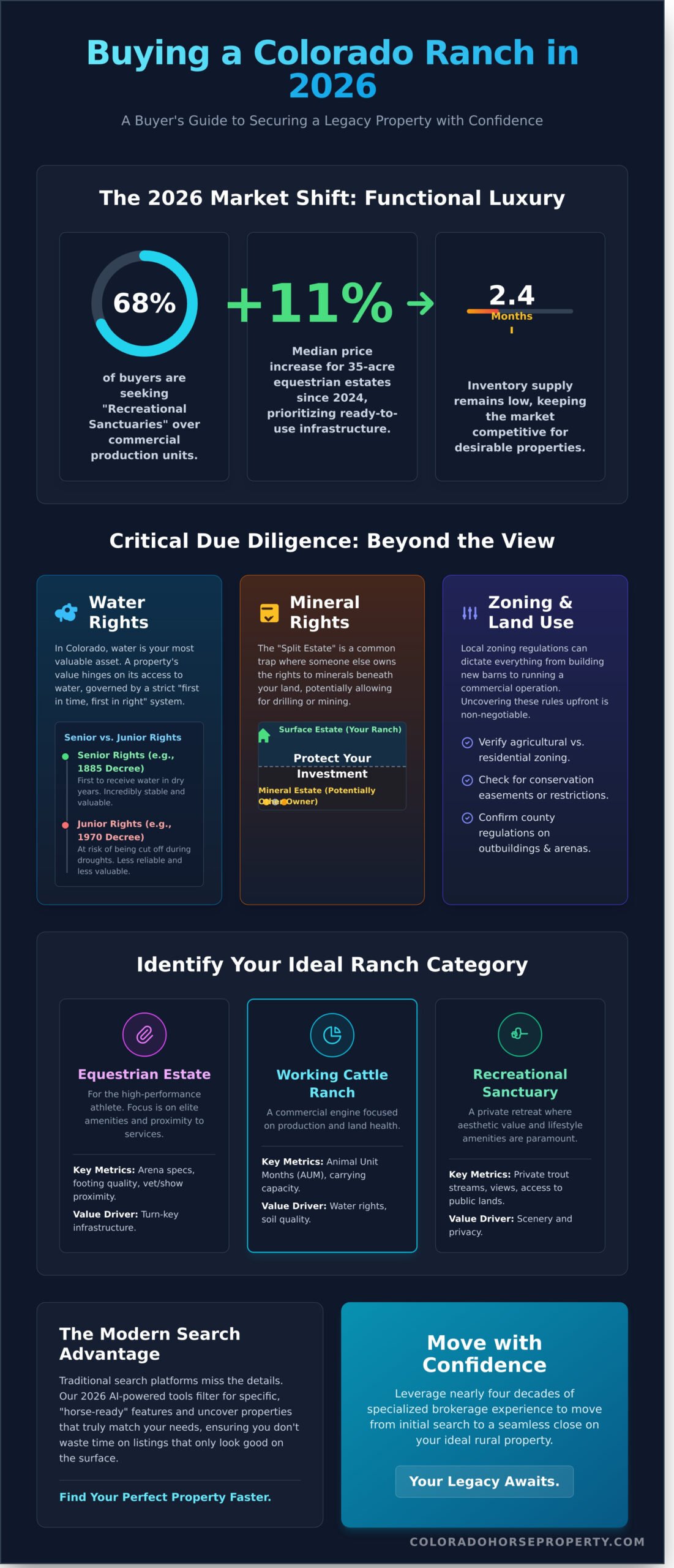
In 2026, the market for ranches for sale in Colorado is defined by a specific appetite for “functional luxury.” Buyers aren’t settling for dilapidated barns or unmanaged pastures. They want properties where the irrigation is automated and the living quarters are refined. Since 2024, the median price for a 35-acre equestrian estate has risen by 11% because people are prioritizing ready-to-use infrastructure. Colorado stays at the top of the list for agricultural investment because of its unique combination of climate, soil quality, and a culture that respects land ownership.
The diverse geography of Colorado creates distinct micro-markets that sellers must understand to price effectively. You’ll see a shift where lifestyle ranches now outperform traditional working cattle operations in terms of price per acre. Buyers in 2026 are looking for a connection to the land that doesn’t require a 60-hour work week. Statistics from the first quarter of 2026 indicate that 68% of ranch buyers are seeking “recreational sanctuaries” rather than commercial production units. This shift means that aesthetic value and recreational amenities often carry more weight than the carrying capacity of the soil.
Defining Your ‘Lifestyle and Dreams’ on the Range
Success in the 2026 market starts with identifying the core purpose of your land. Is it a commercial engine, a professional equestrian hub, or a private retreat? Buyers are currently paying a 15% premium for properties that offer “future-proofed” features. This includes senior water rights, solar-integrated outbuildings, and fire-mitigated perimeters. Inventory levels for ranches for sale remain at a 2.4-month supply, keeping the market competitive. Sellers who can prove the long-term viability of their water and land health are closing deals 18 days faster than the state average.
Regional Breakdown: Where to Look
Colorado’s regions offer vastly different value propositions for buyers and sellers alike. Understanding these nuances is critical for accurate valuation:
- The Front Range: Properties within 45 miles of Denver or Colorado Springs are the most valuable. These estates cater to the high-performance equestrian athlete. Proximity to major show venues and veterinary specialists drives prices here to record highs in 2026.
- The Western Slope: This region is the capital of diversity. From the fruit orchards of Palisade to the rugged hunting acreage near Meeker, it offers a slower pace. Valuation here depends heavily on specific land use and private access to public lands.
- Central Mountains: These are the premier recreational estates. High-altitude grazing is secondary to private trout stream access and views of the Continental Divide. Properties near resort towns like Steamboat Springs or Aspen are currently fetching top dollar from out-of-state investors.
Pricing your estate requires a seasoned perspective that goes beyond basic square footage. We’ve spent nearly four decades analyzing these trends to help clients realize their lifestyle and dreams. In 2026, the value of a ranch isn’t just in its dirt; it’s in the freedom and the specific lifestyle the property enables. Whether you’re managing a legacy cattle operation or a boutique horse property, the current landscape rewards those who present a clear, functional vision to the market.
Critical Technical Considerations: Water, Minerals, and Zoning
Pricing an equestrian estate requires looking far beyond the aesthetic appeal of the pastures or the square footage of the residence. In the Colorado market, the legal framework governing the land often dictates its ultimate market value. Buyers looking at ranches for sale prioritize the security of their investment, which means the technical documentation of your property’s rights is your strongest selling point. If these elements are not clearly defined and documented, you risk losing a sale during the due diligence period or being forced to accept a significantly lower offer.
The Complexity of Colorado Water Rights
Water is the most valuable asset on any western ranch. Colorado operates under Colorado’s Prior Appropriation System, which establishes a strict hierarchy where “senior” rights take precedence over “junior” ones during dry years. A property with an 1885 decree is inherently more stable and valuable than one with a 1970 decree. You must clearly differentiate between tributary water, which is connected to surface streams, and non-tributary water found in deep aquifers. The Colorado Division of Water Resources oversees these allocations, and any buyer will scrutinize the well permits and diversion records before signing a contract.
Adjudicated water rights represent a court-decreed legal entitlement to divert a specific volume of water from a defined source for a designated beneficial use with a set priority date. Without this legal certainty, a 40-acre parcel may only be able to support a single household rather than a full boarding operation or irrigated hay field.
Mineral Rights and Surface Ownership
Colorado is a “split estate” state. This means the person who owns the surface of your horse property might not own the oil, gas, or minerals beneath it. If you do not own 100 percent of the mineral rights, a third party could potentially access the property to extract resources. This uncertainty can be a major deterrent for buyers. Before listing, you should conduct a mineral rights search, which typically costs between $600 and $2,500 depending on the complexity of the chain of title. If you own the minerals, including them in the sale can justify a 10 to 15 percent premium on your asking price. If you don’t, you must be prepared to show surface use agreements that protect your arenas and barns from future drilling rigs.
Agricultural Zoning and Tax Benefits
The difference in property tax between residential and agricultural zoning is substantial. For a typical 35-acre equestrian estate, agricultural status can reduce annual tax burdens by as much as 80 percent. To qualify for this status in Colorado, the land must be used for the primary purpose of obtaining a monetary profit from agricultural products, including livestock or hay production, for at least two years. Owners are also protected by “Right to Farm” laws, which prevent neighbors from filing nuisance lawsuits over standard ranching smells and noises. If you’re unsure how your current zoning status affects your listing price, the experts at Colorado Horse Property can provide a comparative market analysis that accounts for these tax advantages.
Access and Easements
Physical access does not always equate to legal access. You must verify that your ranch isn’t landlocked or dependent on a “handshake agreement” with a neighbor. Common issues that impact the value of ranches for sale include:
- Public Trail Easements: If a local municipality has a 20-foot wide easement for hikers through your back pasture, your privacy and security are compromised.
- Utility Easements: Large transmission lines can limit where you build new structures like indoor arenas.
- Prescriptive Easements: Long-term use of a path by neighbors can create a permanent legal right that you cannot easily revoke.
Ensuring your title is clean and your boundaries are surveyed will prevent 11th-hour price negotiations that could cost you thousands of dollars in equity.
Identifying Your Ranch Category: Equestrian vs. Cattle vs. Recreation
Pricing your property accurately requires a clinical look at its primary utility. Buyers searching for ranches for sale rarely cross categories; a professional cutter isn’t looking for a hunting cabin, and a commercial cattleman won’t pay a premium for a heated tack room. You’ve got to define your property’s “highest and best use” to avoid leaving money on the table or overpricing it into stagnation. In Colorado, this classification often hinges on water rights and infrastructure age.
Equestrian estates demand a focus on “horse-safe” details. This means no barbed wire, 12 by 12 foot stalls, and specialized arena footing. Buyers in this niche prioritize the health and performance of their animals over the acreage’s raw grazing capacity. They’re looking for turnkey facilities where they can offload a trailer and start training on day one. If your property features a 100 by 200 foot indoor arena, your price point moves into a different bracket entirely compared to a property with just a perimeter fence.
Working cattle ranches are valued as a business asset. Here, the math centers on Animal Unit Months (AUM) and the quality of the forage. A ranch that can support 200 head year-round commands a higher price than one requiring supplemental hay for six months of the year. Investors look at the efficiency of the “working” parts. This includes the layout of the sorting pens, the condition of the squeeze chutes, and the reliability of the stock tanks. It’s about production, not aesthetics.
Recreational ranches trade on “the experience.” These properties often command a premium if they share a border with National Forest or BLM land, effectively expanding the owner’s playground by thousands of acres. Value is driven by private trout stream access, elk migration patterns, and the “view shed.” For these buyers, 40 acres with a 180-degree view of the Sangre de Cristo Mountains is often more valuable than 100 acres of flat scrubland.
The “Ranchette” serves the modern professional seeking a hobby farm. These are typically 5 to 35-acre parcels located within a 45-minute commute of urban centers like Denver or Colorado Springs. They offer the dream of two horses and a garden without the soul-crushing labor of a 1,000-acre operation. Pricing for these depends heavily on domestic well permits and proximity to paved roads.
Key Features of a High-End Equestrian Ranch
Colorado’s climate makes an indoor arena a 365-day necessity rather than a luxury. Professional buyers look for 20-foot eave heights and 60-pound snow load ratings to ensure year-round safety. Barns must prioritize ventilation to prevent respiratory issues; look for 12-foot wide aisles and Dutch doors. Sustainable grazing depends on irrigation. A property with 2.0 acre-feet of water rights per acre will always outsell a dry-lot facility because it slashes annual hay costs by 40%.
Evaluating Working Ranch Productivity
Productivity is measured in the dirt and the deed. High-quality loam soil that supports orchard grass or alfalfa can yield 3 to 4 tons of hay per acre in a good season. When evaluating ranches for sale, savvy buyers check if BLM or USFS grazing permits are attached to the deed. These permits, which cost $2.11 per AUM in 2024, allow for massive herd expansion without the cost of buying additional private land. Infrastructure like 4-strand high-tensile fencing and solar-powered wells adds immediate tangible value to the appraisal.
The Modern Search: Leveraging AI to Find Ranches for Sale
Most general real estate platforms are built for suburban homebuyers; they prioritize granite countertops and bedroom counts over soil quality and grazing capacity. For a serious equestrian, these filters are a waste of time. You don’t care about a finished basement if the property lacks the 35 acres required for your agricultural tax status. Our proprietary AI search tool flips the script by using acreage-first parameters. It allows you to bypass the noise of small residential listings and focus exclusively on land that supports your lifestyle and dreams. Since 85% of ranch buyers report frustration with residential-centric search filters, we’ve optimized our system to prioritize the dirt first.
This technology doesn’t just look at the text in a listing. It analyzes metadata and image recognition to verify “Horse-Ready” status. While a human might miss a mention of a 60-foot round pen buried in a three-page description, our AI identifies it instantly. Locating premium ranches for sale requires more than a zip code filter. It requires a system that understands the nuances of Colorado land, from the high plains of Pueblo to the mountain meadows of Steamboat Springs. By setting up automated alerts through our platform, you receive notifications for the latest ranches for sale across the Front Range up to 24 hours before they populate on national aggregate sites.
How Our AI Search Tool Changes the Game
Traditional search engines struggle with non-standard data. Our AI tool bridges this gap by filtering for 5+ specific equestrian amenities like heated tack rooms, indoor arenas, and specialized fencing types. It integrates topographical data and water rights information directly from state databases. You can identify high-match properties in under 15 seconds, significantly reducing the search fatigue that comes with manual browsing. We leverage nearly four decades of expertise to train these algorithms, ensuring they recognize the difference between a decorative barn and a functional 12-stall stable.
Steps to Finding Your Ranch with Colorado Horse Property
Start by defining your non-negotiables. Do you need a 100×200 foot indoor arena or senior water rights for 40 acres of hay production? Once you input these “must-have” land features, our AI scans 100% of the Colorado MLS data simultaneously. This isn’t a passive search; it’s an active hunt for value. After the system narrows the field to the top 5% of matches, you consult with our specialists. Mark Eibner or Belinda Seville personally vet these results, applying 38 years of local knowledge to verify zoning and land use before you ever schedule a tour.
The efficiency of this modern search process means you spend less time behind a screen and more time on the ground. We’ve found that clients using our AI-driven parameters view 60% fewer properties before making an offer compared to those using traditional search methods. It’s about precision, not volume. You’re looking for a specific legacy property, and our technology is designed to find it without the usual rural real estate headaches.
Ready to see how the right technology finds the right land? Search Colorado ranches with our AI tool today and find your perfect match.
Partnering with Colorado Horse Property for a Seamless Close
Selling an equestrian estate involves technical complexities that standard residential agents often overlook. Colorado Horse Property brings nearly four decades of specialized experience to your side of the table. Since 1984, founders Mark Eibner and Belinda Seville have focused exclusively on the niche requirements of acreage and equine facilities. We’ve managed the transition of over 1,500 properties, seeing the market through every cycle from the high-interest rates of the 1980s to the recent shifts in rural land demand. Our full-cycle brokerage model ensures you aren’t left managing the details alone. We provide a continuous thread of support that begins with the initial property search and carries through to the final coordination of title and escrow.
Finding the right ranches for sale is only the first step in a long journey. The path from an initial offer to a successful close requires a steady, authoritative hand. Many buyers don’t realize that our specialized buyer representation is free for the purchaser. Because the seller typically covers the commission, you gain access to 40 years of market data and negotiation leverage without an out-of-pocket fee. This allows you to move from the search phase to the closing table with total confidence, knowing your interests are protected by experts who understand the dirt, the water, and the zoning laws unique to the Centennial State.
Our approach is functional and direct. We don’t just show properties; we analyze them for long-term viability. We look at the structural integrity of barns, the quality of the fencing, and the health of the pasture. This deep-level analysis prevents surprises during the inspection period. By the time you reach the closing date, every question regarding the property’s utility and value has been answered with concrete data.
Expert Transaction Management
Ranch contracts require specific language regarding well permits, augmentation plans, and mineral rights. We manage these specialized contingencies with precision. Our team coordinates directly with Meridian Title & Escrow to ensure every easement and deed restriction is verified for a clean title transfer. To protect your financial data, we utilize Club Realm. This tech-backed platform provides a secure environment for document management and transaction tracking, giving you a transparent view of the closing timeline from any device.
Beyond the Sale: Joining the Colorado Rural Community
Your journey doesn’t end when the keys are handed over. Transitioning to a large acreage property requires a reliable support system. We provide immediate access to our vetted network of professional ranch managers, custom barn builders, and specialized equine veterinarians. Owning a piece of the West is a significant responsibility. We help you embrace your role as a steward of the Colorado landscape, ensuring you have the resources to maintain the land for generations. Start your AI-powered ranch search today to find a property that fits your lifestyle and your long-term dreams. Whether you are looking for ranches for sale near the Front Range or a secluded mountain retreat, we have the expertise to get you home.
Secure Your Colorado Legacy in 2026
Buying a ranch in 2026 requires a sharp focus on technical details like senior water rights and specific agricultural zoning laws. Whether you’re looking for a dedicated equestrian facility or a sprawling cattle operation, choosing the right category defines your long-term success. The market for ranches for sale is evolving quickly, and navigating these complexities requires a partner who understands the rural landscape inside and out. Colorado Horse Property offers nearly 40 years of specialized real estate experience to guide your journey. We’ve built proprietary AI search technology specifically for horse and ranch properties to ensure you don’t miss a single hidden gem. Our team handles every detail from the first property tour through the final escrow signature, providing a seamless transition into your new lifestyle. You’ve done the research and identified your goals. Now it’s time to put our four decades of expertise to work for you. Your dream of owning a piece of the Colorado wilderness is within reach.
Start Your AI-Powered Colorado Ranch Search Now
Frequently Asked Questions
How many acres do I need for a horse ranch in Colorado?
You generally need at least 2.5 acres for the first horse in most Colorado counties, with an additional acre required for every animal after that. If you want a domestic well permit that allows for livestock watering and garden irrigation, state law usually requires a minimum of 35 acres. Always verify specific Douglas or Elbert County zoning codes before buying; local regulations dictate exact stocking densities and manure management rules.
What is the difference between a ranch and a farm in Colorado?
A ranch focuses on livestock production and grazing on native pasture, while a farm primarily produces crops for harvest. In Colorado, this distinction impacts your tax status under Article X, Section 3 of the state constitution. Ranches for sale typically feature perimeter fencing and barns, whereas farms prioritize high-yield soil and complex irrigation systems for hay or corn production.
How much does a typical ranch in Colorado cost in 2026?
Market projections for 2026 suggest that ranches for sale in the Front Range corridor will average $1.2 million for a 40-acre parcel. Prices vary based on water rights and infrastructure, with premium equestrian estates often exceeding $2.5 million. Expect a 4% annual appreciation rate from 2024 levels, driven by limited inventory and steady demand for rural lifestyles.
Can I build on land that has a conservation easement?
You can build on land with a conservation easement only within designated “building envelopes” defined in the original deed. These envelopes typically restrict development to 2% or 5% of the total acreage to protect the property’s conservation values. You must review the specific terms held by organizations like the Colorado Cattlemen’s Agricultural Land Trust before you plan any new structures or arenas.
What are ‘Senior Water Rights’ and why do they matter for ranches?
Senior water rights are claims established in the 1860s or 1870s that take priority over “junior” rights during drought years. Under Colorado’s Prior Appropriation System, the oldest dates get their full water allocation first. This matters because a ranch with 1880 rights will have green pastures while a neighbor with 1950 rights might see their irrigation ditches run dry during a hot July.
Is it possible to buy a ranch with BLM grazing permits?
You can buy ranches that include Bureau of Land Management (BLM) grazing permits, which are transferred via the Taylor Grazing Act of 1934. These permits allow you to graze cattle on public land for a set fee, currently $1.35 per Animal Unit Month (AUM). The permit stays with the “base property,” meaning the grazing preference moves to the new owner upon closing the sale.
How do I check if mineral rights are included in a ranch sale?
You must conduct a specialized mineral title search because surface rights were frequently severed from mineral rights in Colorado during the 1920s. A standard title commitment won’t always show ownership of oil, gas, or coal deep underground. It’s best to hire a professional landman to trace the chain of title back to the original homestead patent to ensure you own what’s beneath your feet.
What is a ‘Ranchette’ and is it right for me?
A ranchette is a small-scale horse property typically ranging from 5 to 15 acres. It’s right for you if you want the rural lifestyle without the 24/7 labor of a 500-acre operation. These properties offer enough space for a 4-stall barn and a small outdoor arena while remaining close enough to town for a 30-minute commute to work or school.