
What if the most valuable asset on your 2026 colorado ranch isn’t the sweeping mountain views or the custom timber-frame home, but a paper document dating back to 1865? While 90% of buyers start their search focused on the horizon, they quickly realize that owning rural land involves navigating a maze of senior water rights and complex agricultural zoning. It’s natural to feel overwhelmed by the potential maintenance costs and the steep learning curve of land management; you want a property that fulfills your dreams without becoming a financial burden.
This guide provides the specialized knowledge you need to turn a rural land search into a sustainable legacy investment that protects your capital for generations. Experience matters. Drawing on nearly four decades of expertise in the rural market, we’ll help you distinguish between a hobby property and a true legacy asset. We’ll break down the specific ranch types available this year, the critical red flags that can sink a deal, and the management strategies used by seasoned experts to achieve their lifestyle and dreams.
Key Takeaways
- Learn the fundamental differences between small ranchettes and large-scale working operations to define your ideal scale of land ownership.
- Identify whether a revenue-generating working ranch or an adventure-focused recreational property best supports your long-term goals.
- Master the critical complexities of water rights and rural land laws to ensure your investment in a colorado ranch is secure and sustainable.
- Explore the financial strategies and tax advantages, including Agricultural Tax Status, that help transform rural acreage into a high-value legacy asset.
- Utilize cutting-edge AI search tools and seasoned expert guidance to efficiently locate a property that aligns with your unique lifestyle and dreams.
What Defines a Colorado Ranch in 2026?
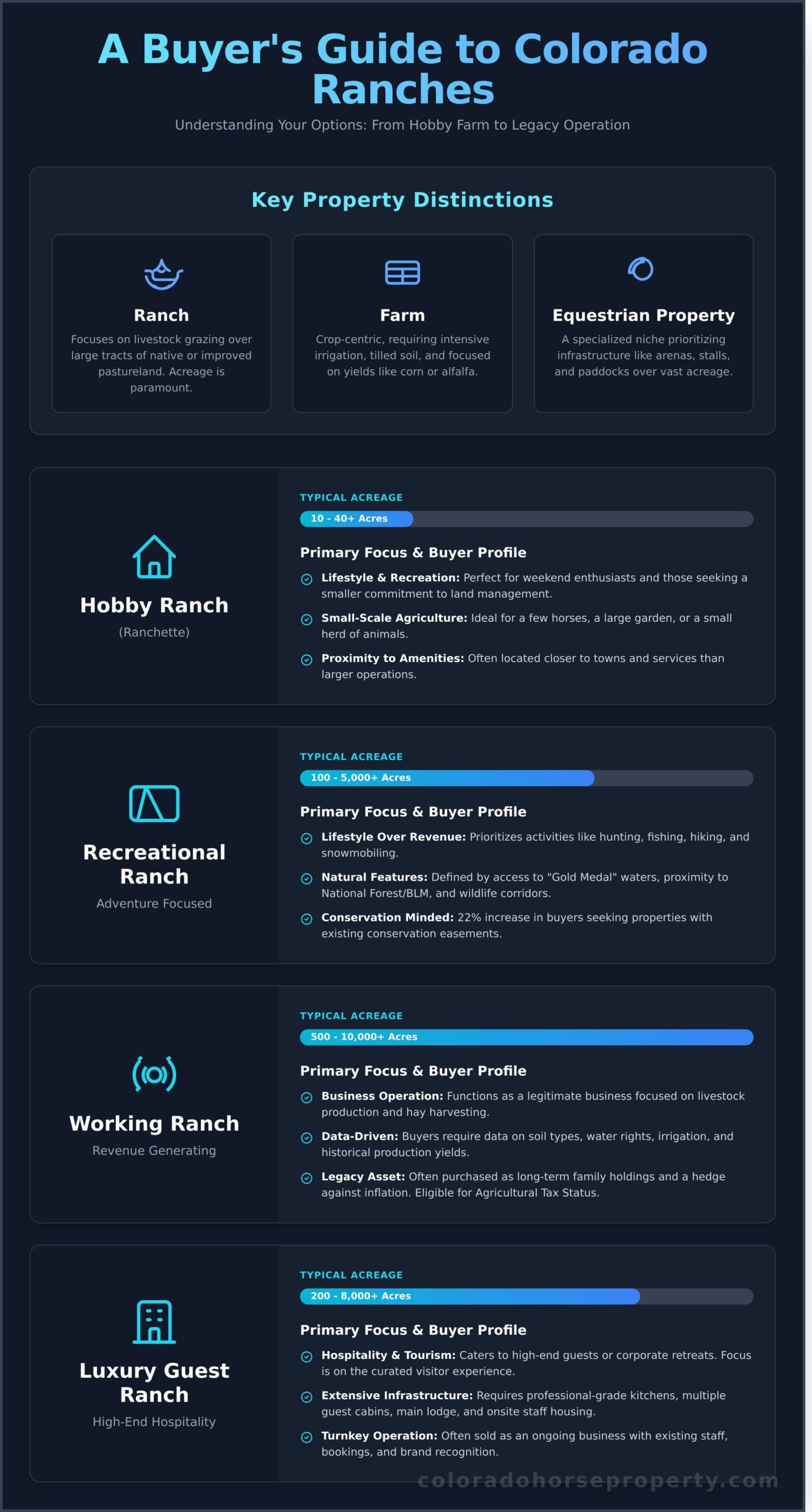
In 2026, the definition of a colorado ranch has expanded far beyond simple livestock production. It encompasses a diverse land category that starts at 35-acre “ranchettes” and scales up to massive 10,000-acre working cattle operations. While the technical answer to What is a Ranch? involves the grazing of livestock on large tracts of land, the modern Colorado version is as much about land stewardship as it is about beef production.
These properties represent a deep-seated cultural connection to the American West, offering owners a sense of autonomy that’s hard to find in urban centers. Owning land here isn’t just about a deed; it’s about participating in a legacy of rugged independence. This emotional pull remains the primary driver for high-net-worth individuals entering the market today.
To better understand this concept, watch this helpful video:
Owning a private ranch is a different reality than the curated “guest ranch” experience many travelers enjoy. A guest ranch focuses on hospitality and tourism, while a private ranch requires active management of water rights, fences, and soil health. By 2026, more buyers are viewing these properties as “legacy assets.” These aren’t just real estate flips. They are long-term family holdings intended to stay in the family for three or four generations, serving as a hedge against inflation and a sanctuary for future descendants.
The Evolution of the Colorado Ranch Lifestyle
Ranching has shifted from purely agricultural goals to multi-use recreational estates. Data from 2024 land sales showed a 22% increase in buyers seeking properties with existing conservation easements. This rise in “conservation ranching” focuses on restoring native grasses and protecting wildlife corridors while maintaining a small cattle herd. Colorado remains a top destination because of its diverse topography, ranging from high-alpine meadows to rolling plains. It’s a place where you can manage a business and hunt or fish on your own acreage the same afternoon.
Ranch vs. Farm vs. Equestrian Property
It’s vital to distinguish between these categories to find the right fit for your goals. A colorado ranch focuses on livestock grazing on native or improved pasture. A farm is typically crop-centric, requiring intensive irrigation and tilled soil for yields like corn or alfalfa. Equestrian properties are a specialized niche. They prioritize infrastructure like indoor arenas, 12×12 stalls, and turnout paddocks over total acreage. If your goal is a 10-head cattle operation, a ranch with 100+ acres is the target. If you’re training performance horses, a 40-acre property with a professional-grade barn is likely a better match for your lifestyle.
Types of Ranches for Sale in Colorado
The Colorado land market isn’t a monolith. A 35-acre parcel in the Front Range foothills serves a completely different buyer than a 10,000-acre operation in the San Luis Valley. To market a colorado ranch effectively, you must first categorize the property based on its highest and best use. Buyers in this niche are highly educated; they don’t just look at acreage, they look at utility, water rights, and historical production data.
Working ranches function as legitimate business entities. These properties focus on livestock production and hay harvesting. According to the latest Colorado agricultural statistics, the state supports over 31 million acres of farmland, with cattle and calves representing the largest segment of agricultural commodity cash receipts. When selling a working ranch, data regarding soil types, irrigation ditch rights, and historical yield per acre is mandatory for a successful closing.
Recreational ranches prioritize lifestyle over revenue. These properties are often defined by their proximity to public lands, such as National Forest or BLM boundaries. Buyers seek these out for private hunting tags, fly-fishing access on “Gold Medal” waters, and snowmobiling. Meanwhile, luxury guest ranches cater to the high-end hospitality or corporate retreat market. These include professional-grade kitchens, multiple guest cabins, and onsite staff housing. For those seeking a smaller commitment, hobby ranches or “ranchettes” offer 10 to 40 acres of land. These are perfect for the weekend enthusiast who wants enough room for a few horses and a vegetable garden without the overhead of a full-scale operation.
The Working Cattle Ranch
Success in selling a working cattle ranch hinges on the “Animal Unit” (AU). This metric defines the amount of forage required by one 1,000-pound cow and her calf for one month. A property’s value is directly tied to its carrying capacity. If a colorado ranch can support 250 AU year-round without overgrazing, it holds a specific price floor in the market. Sellers should clarify if the operation is owner-operated or if the grass is currently leased to local neighbors. Leasing is a common strategy for owners who want to maintain their agricultural tax status while offloading the daily labor of herd management.
The Luxury Equestrian Estate
Luxury equine properties require a different set of “must-have” features. Buyers at this level expect more than a simple pole barn. They look for indoor arenas with specialized GGT or shredded rubber footing to protect a horse’s joints. Climate-controlled barns with 12×12 stalls, automatic waterers, and integrated wash racks are standard expectations. The resale value of these estates is heavily influenced by “ride-out” potential. A property that backs directly into a trail system or is located within 15 miles of a major equestrian competition venue will see a 20% higher demand than an isolated lot. If you are evaluating properties for their horse-friendly amenities, you can search our specialized listings to see how professional infrastructure impacts market pricing. High-end amenities, like a 100-foot by 200-foot indoor arena, can cost upwards of $250,000 to build today; having this infrastructure already in place is a massive incentive for modern buyers.
Critical Considerations Before Buying a Colorado Ranch
Purchasing a colorado ranch isn’t a standard real estate transaction. It’s an acquisition of a complex business asset and a specific lifestyle. Many buyers feel overwhelmed by the technicalities of rural land management. This fear is valid. Residential agents who thrive in Denver suburbs often lack the specialized knowledge required for large acreage. They don’t understand soil composition, grazing capacities, or the legal weight of a ditch decree. You need a partner who recognizes the difference between a decorative pond and a functional stock tank. A generalist might miss a missing mineral deed or an expired grazing lease, mistakes that cost hundreds of thousands of dollars.
Success starts with a rigorous due diligence period. This isn’t a 10 day inspection window for a leaky faucet. It’s a 30 to 60 day deep dive into the property’s history and legal standing. You must evaluate the land’s productivity and its limitations before the earnest money becomes non-refundable. Understanding Colorado’s Agriculture Economy is essential, as the state’s 38,900 farms and ranches contribute over $47 billion annually to the local market. This economic engine relies on specific legal protections and tax structures that every buyer must master before signing a contract. You’ll need to review title commitments, survey plats, and environmental assessments to ensure the dirt matches the dream.
Water Rights: The Lifeblood of the Ranch
Colorado operates under the “Prior Appropriation” system. This doctrine, established in 1876, dictates that the first person to take water and put it to beneficial use has the first right to it. Senior rights are those established early, often dating back to the 1860s. During a drought, junior rights holders might be “called out,” meaning they must stop pumping so senior holders get their full share. You must verify well permits through the Division of Water Resources and examine ditch company bylaws to ensure your water is secure. A colorado ranch without senior water is often just an expensive piece of desert. Check for augmentation plans that replace out-of-priority stream depletions to keep your wells legal year-round.
Zoning, Easements, and Access
Agricultural zoning, such as A-1, provides flexibility for livestock and outbuildings, but it isn’t a free pass. Every county has unique setbacks and density requirements. You should also scrutinize conservation easements. These legal agreements can offer significant tax credits, sometimes exceeding $5 million in state credits for large parcels, but they permanently restrict development. If your plan involves a future subdivision, an easement could be a deal breaker. Finally, confirm physical and legal access. A gravel road might look public, but without a recorded easement, you could lose the ability to move heavy equipment or 40 foot livestock trailers during a neighbor dispute. Ensure your title insurance specifically covers ingress and egress for commercial agricultural use.
Expertise in the Front Range and Eastern Plains is vital. Local knowledge prevents costly mistakes regarding mineral rights and public land grazing permits. Don’t settle for a generalist when your legacy and financial security are on the line. Working with a specialist ensures you’re protected from the hidden complexities of the rural landscape.
The Financials: Cost of Ownership and Investment Potential
Buying a colorado ranch requires a shift from a residential mindset to a commercial one. Your initial purchase price is just the entry fee. A standard 35-acre parcel might list for $450,000; however, the operational budget determines the property’s true viability. You should set aside 1.5% of the property value annually for general maintenance and infrastructure upkeep. One of the most significant financial levers is the Agricultural Tax Status. In Colorado, qualifying land is taxed based on its productive capacity rather than its market value. This often reduces property taxes by more than 85% compared to residential rates. To qualify, you must prove the land was used for primary agricultural purposes, such as livestock or hay production, for the two prior years.
Ranching also serves as a hard-asset hedge against inflation and market volatility. While paper assets fluctuate with interest rate cycles, land remains a tangible resource with intrinsic value. You can diversify income through these specific revenue streams:
- Leasing grazing rights to local cattlemen for a seasonal fee per head.
- Participating in the Colorado Landowner Preference Program to obtain and sell big game hunting tags.
- Selective timber harvesting on forested tracts to improve forest health and generate immediate cash flow.
Calculating the Real Cost of Ranching
Fixed costs include your mortgage, specialized ranch insurance, and property taxes. Even with Ag status, these are constant financial obligations. Variable costs are where many new owners find themselves over budget. Professional weed control for invasive species like knapweed can cost $65 per acre. Replacing a four-strand barbed wire fence currently averages $4.25 per linear foot. Carrying capacity acts as the economic baseline for land productivity, representing the maximum number of livestock an acre can support without degrading the soil.
Ranch Land as a Legacy Investment
Colorado land values have shown remarkable resilience over the last 40 years. Data from the USDA indicates that mountain state farm real estate values increased by 215% between 2000 and 2023. This growth is driven by a finite supply of private land; approximately 43% of Colorado is publicly owned. This scarcity ensures that a well-managed colorado ranch remains a high-demand asset for buyers looking for privacy and utility. Succession planning is the final piece of the puzzle. By utilizing conservation easements, families can often reduce estate taxes by 50% or more while ensuring the land remains undeveloped. This protects both your financial legacy and the rural character of the landscape for future generations.
Finding Your Ideal Ranch with AI and Expert Guidance
Securing a legacy property requires a blend of advanced technology and boots-on-the-ground expertise. The process isn’t just about finding land; it’s about finding the right land for your specific needs. Follow these five essential steps to ensure your purchase is a success.
- Step 1: Define your primary goal. You must decide if your purchase is for lifestyle, investment, or agriculture. A 35-acre hobby farm in Douglas County requires different zoning than a 1,000-acre cattle operation in Weld County. Defining this goal early prevents wasted time on properties that don’t match your long-term vision.
- Step 2: Utilize AI-powered search tools. Technology now bridges the gap between a broad search and a specific match. Use data-driven tools to filter for senior water rights or specific outbuildings like a 60×120 indoor arena.
- Step 3: Conduct a field tour. Once the data narrows the field, you need a physical inspection. A specialized ranch broker identifies issues like soil quality or fence line encroaching that a standard residential agent might miss.
- Step 4: Engage a specialized title and escrow team. Rural transactions involve complex legalities. You need a team that understands easements and mineral rights. In 2023, roughly 15% of rural closings faced delays due to poorly documented access rights.
- Step 5: Finalize the purchase and begin stewardship. Closing the deal marks the beginning of your journey. This involves managing the land’s health, from weed control to grazing rotations.
The Power of AI in Ranch Real Estate
Our proprietary AI tool changes how buyers locate a colorado ranch. Instead of scrolling through thousands of irrelevant listings, you can filter by specific water rights or barn types. Searching by ‘Acres’ and ‘County’ uncovers hidden gems that general real estate sites often bury. This data-driven approach saves an average of 45 hours of physical travel and prevents the frustration of visiting properties that look good in photos but lack the necessary infrastructure. We use algorithms to cross-reference listing data with public records, ensuring you see the full picture before you drive to the property. This technology handles the heavy lifting, allowing you to focus on the properties that truly meet your criteria.
Why Partner with Colorado Horse Property?
Experience matters in the Colorado Front Range. We bring nearly 40 years of specialized knowledge to every transaction. Our ‘Lifestyle and Dreams’ approach ensures we match you with a property that supports your specific equine or agricultural goals. We understand the nuances of the local terrain and zoning laws that generalists often overlook. Whether you’re looking for a productive colorado ranch or a private equestrian estate, we provide the guidance needed to navigate this complex market. Start your AI-powered Colorado ranch search today to find your perfect fit.
Secure Your Legacy on the Colorado Frontier
Owning a colorado ranch in 2026 requires a blend of traditional land wisdom and modern data tools. Successful buyers focus on how water rights and zoning laws dictate long-term property value. Smart investors balance lifestyle dreams with clear financial projections to ensure their land remains an asset for generations. Finding a property that meets these standards is the first step toward a lasting rural legacy. The landscape is changing, but the value of well-managed acreage remains a constant in the Rocky Mountain region.
Navigating this complex market doesn’t have to be a solo journey. We bring nearly 40 years of specialized Colorado real estate expertise to your search. Our team uses a proprietary AI search tool specifically designed to filter for essential equestrian and ranch features like barn configurations and pasture quality. We handle every detail of your transaction management from the initial contract to the final closing day. It’s time to turn your vision of wide-open spaces into a tangible reality. Your future on the range is waiting for you.
Start your AI-powered Colorado ranch search today and find the land that fits your future.
Frequently Asked Questions
How many acres do I need for a ranch in Colorado?
You typically need at least 35 acres to qualify for a domestic well permit and avoid strict subdivision regulations in most counties. While a 5 acre parcel might support a few horses; 35 to 40 acres is the standard for a functional colorado ranch. This size ensures enough pasture for rotational grazing and meets the minimum requirements for many agricultural zoning benefits. Smaller parcels often face more restrictive land use codes.
What are water rights and why are they so important for ranches?
Water rights are legal entitlements to use specific amounts of water from a source, and they’re vital because Colorado follows the Prior Appropriation Doctrine. This means the oldest rights get water first during a drought. A ranch without senior water rights may lose its irrigation supply in July or August. You must verify if the rights are absolute or conditional to ensure your livestock and hay fields stay productive.
Is a ranch a good investment in 2026?
A colorado ranch remains a strong investment in 2026 as demand for tangible assets and rural retreats continues to climb. Market data from the last five years shows rural land values in the Front Range and Western Slope appreciating by an average of 6% annually. Investors value these properties for their finite supply and potential for conservation easements. Owning land provides a hedge against inflation that traditional stocks can’t match.
What is the difference between a dude ranch and a private ranch?
A dude ranch is a commercial enterprise focused on guest hospitality, whereas a private ranch is used for personal recreation or agricultural production. Dude ranches require specific commercial zoning and liability insurance to host 20 or more visitors for paid stays. Private properties focus on the owner’s lifestyle and dreams of solitude. You won’t need public lodging permits or staff housing for a standard private operation.
How do I qualify for agricultural tax status in Colorado?
You qualify for agricultural tax status by proving the land has been used for primary purpose farming or ranching for the previous two years. This status can lower your property tax bill by 50% or more compared to residential rates. You must provide records showing livestock grazing or hay production to the county assessor. It’s a strict process that requires consistent documentation of your agricultural intent and actual production.
Can I build a second home or ADU on my Colorado ranch land?
Building a second home or Accessory Dwelling Unit (ADU) depends on your specific county zoning and the total acreage of your property. In Douglas County, you generally need a minimum of 35 acres to add a secondary residence without a complex rezoning process. Some counties limit ADUs to 1,000 square feet or 30% of the main home’s size. Always check the local land use code before you start pouring a foundation.
What are the most common mistakes when buying ranch land?
The most common mistake is failing to conduct a thorough title search for senior water rights and mineral ownership. Buyers often assume they own the rights under their feet, but in Colorado, mineral and surface rights are frequently severed. Another error is overlooking legal access; 15% of rural land disputes involve shared easements or landlocked parcels. Don’t skip the professional inspection of fences, wells, and soil quality before closing.
How does the AI search tool help find horse-ready properties?
Our AI search tool uses advanced algorithms to scan thousands of listings for specific keywords like indoor arena, loafing shed, or cross fenced pasture. It filters properties based on your exact needs, such as a minimum of 10 acres with existing equine infrastructure. This technology saves you 20 hours of manual searching by highlighting properties that fit your horse centric lifestyle. It’s the most efficient way to find your ideal home.