
Last Tuesday, a buyer named Sarah in Larimer County discovered that her 35-acre dream ranch was legally limited to just two horses due to a hidden zoning overlay. It’s a devastating realization that happens to roughly 15% of unprepared buyers who assume rural always means horse-friendly. You likely believe that your land should be your own to manage as you see fit. However, the reality of Colorado horse property zoning laws is a complex web of Animal Units and conflicting county regulations that can vary significantly between neighboring parcels.
With nearly 40 years of experience helping ranchers find their perfect home, we believe your lifestyle and dreams deserve a foundation of legal certainty. This 2026 guide provides the exact steps you need to take to verify land use rights and protect your investment from code enforcement surprises. We will break down how to find specific zoning overlays, calculate livestock density, and navigate the often-confusing hierarchy of HOA and county rules.
Key Takeaways
- Understand the “Equestrian Layer Cake” to navigate how state, county, and private HOA rules interact to govern your land.
- Master the math behind Colorado horse property zoning laws, specifically how “Animal Units” and setback requirements dictate your herd size and barn placement.
- Learn to identify the “HOA Trap” where private covenants may restrict livestock even if the county permits them.
- Follow a professional due diligence checklist to verify property legality and request essential documents before your inspection period ends.
- Discover how AI-driven search tools and decades of specialized expertise can help you filter out “red flag” properties to protect your lifestyle and dreams.
Understanding Colorado Horse Property Zoning Laws: The Basics
Zoning in Colorado is a patchwork. Across the state’s 64 counties, rules change the moment you cross a municipal or county line. This decentralized system means Douglas County might allow four horses on five acres, while Elbert County has entirely different density requirements for the same lot size. To understand why these local powers exist, it helps to look at the history of Zoning in the United States. This legal framework allows local governments to dictate where your barn goes and how many animals can live on your land.
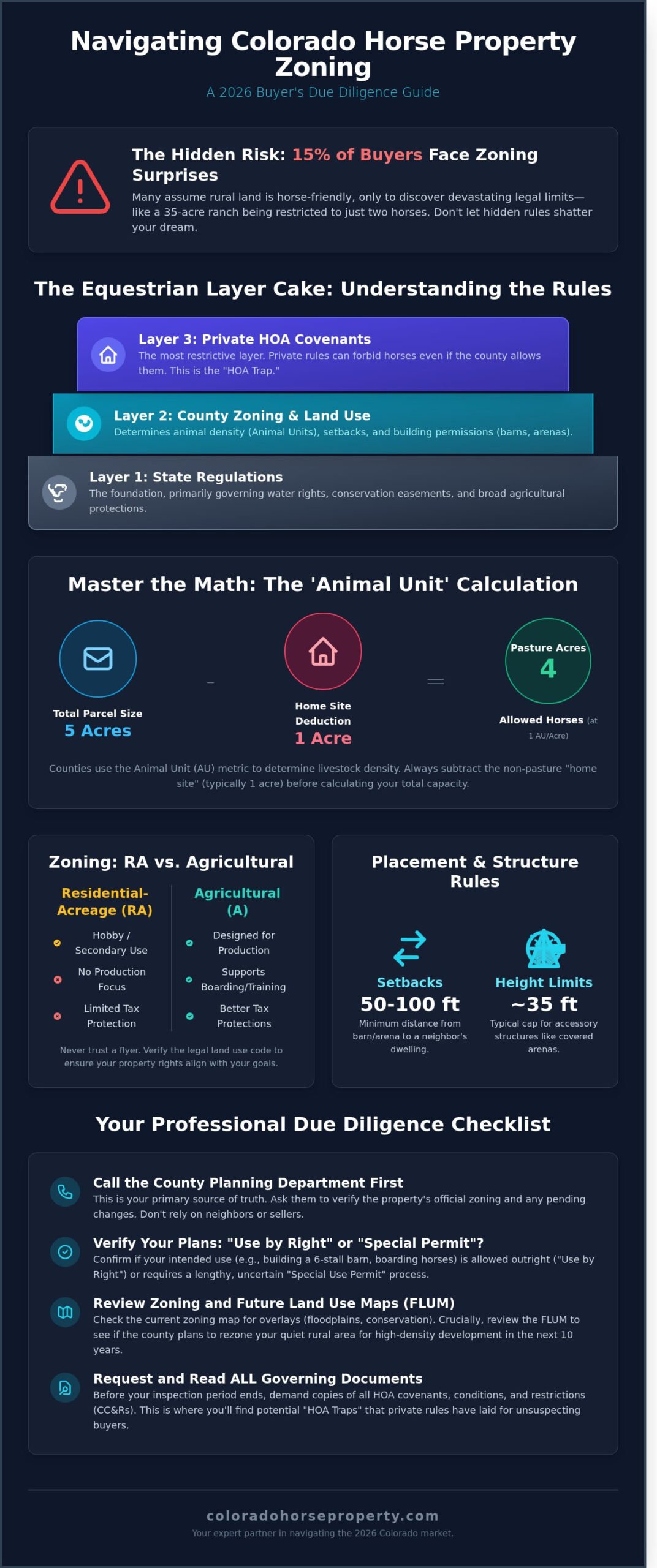
Success for 2026 buyers requires understanding the Equestrian Layer Cake. This is the interaction between state water law, county zoning, and private HOA covenants. Each layer can restrict your lifestyle. Never trust a listing description that claims a lot is a horse property without verifying the underlying code. A property might look like a ranch but have a 1984 covenant that strictly forbids livestock.
To better understand how these regulations impact your land search, watch this helpful video:
Buyers often confuse Residential-Acreage (RA) with Agricultural (A) zoning. Residential-Acreage often treats horses as a hobby or secondary use. Agricultural zoning is designed for production and often offers better tax protections under the 1967 Colorado Greenbelt Law. Don’t rely on a real estate flyer. Verify the legal land use yourself to ensure your 2026 investment remains a horse property for life. Understanding Colorado horse property zoning laws is the only way to protect your equity and your animals.
The Role of the County Planner
Your first call shouldn’t be to a neighbor; it’s to the county planning department. Planners in counties like Jefferson or Douglas manage the official zoning maps that determine your property’s fate. Ask them if your plans are a Use by Right, meaning you don’t need permission, or if they require a Special Use Permit. In Elbert County, the 2023 zoning map update clarified density requirements for equine setups. These planners provide the data you need to avoid expensive legal mistakes.
Zoning vs. Land Use: What’s the Difference?
Zoning tells you what you can build, like a 4-stall barn or a hay shed. Land use tells you what you can actually do, like boarding ten horses for profit. These aren’t the same thing. Always check the Future Land Use Map (FLUM) during your due diligence. If the 10-year plan for your rural street shows high-density residential development, your quiet horse property might face a subdivision wall by 2030. Mastering Colorado horse property zoning laws means looking at what the land is today and what the county wants it to be tomorrow.
The Three Pillars of Equestrian Land Use in Colorado
Understanding Colorado horse property zoning laws requires a grasp of three fundamental regulatory pillars: animal density, structural placement, and environmental restrictions. These rules dictate exactly how you can use your land and where you can build your infrastructure. Modern legislation, such as the Colorado Equestrian Zone Law, provides a framework for counties to establish protected equine areas, ensuring that horse-related development remains a priority in rural and semi-rural districts. These protections help safeguard the infrastructure necessary for your lifestyle against encroaching suburban density.
Setback requirements represent the second pillar. These laws define the minimum distance between your barn, arena, or hay shed and the property line. In many Colorado counties, a stable must sit at least 50 to 100 feet from a neighbor’s dwelling. Accessory structures also face height limits, often capped at 35 feet for non-habitable buildings. If you’re planning a covered arena, these Colorado horse property zoning laws and height restrictions can significantly impact your site plan and total project budget.
The ‘Animal Unit’ Calculation Explained
Counties use the Animal Unit (AU) metric to prevent overgrazing and maintain soil health. In Douglas County, one horse typically equals 1.0 AU, while other jurisdictions might rate a horse at 0.5 AU if the land has high forage production. You must subtract the “home site,” usually the first 1.0 acre containing the house and driveway, before calculating your total capacity. For example, on a 5-acre parcel with a 1-acre home site deduction, a 1.0 AU per acre limit allows for 4 horses. While the legal limit is your ceiling, the actual carrying capacity of your pasture might be lower. Maintaining healthy 2026 grazing standards often requires more acreage than the bare legal minimum to prevent “dry lot” conditions.
Zoning Overlays: Floodplains and Conservation
Environmental overlays can override standard zoning permissions. If a portion of your land falls within a FEMA 100-year floodplain, you’ll likely be prohibited from building permanent stables or shops in that zone. Wildlife corridors are another critical factor; these overlays often mandate “wildlife-friendly” fencing that allows elk or deer to pass through without injury. Conservation easements can also limit your ability to add future arenas or subdivide the land. Before you commit to a purchase, it’s vital to consult with an expert agent who understands how these specific overlays affect long-term property value and utility.
County-Specific Rules vs. The ‘HOA Trap’
You might find a five-acre parcel in El Paso County that legally allows four horses under Colorado horse property zoning laws. However, if that property sits within a Homeowners Association (HOA), those private rules can legally override county permissions. It’s a common pitfall. An HOA can restrict horse counts to zero even if the county says four are fine. These Covenants, Conditions, and Restrictions (CC&Rs) carry heavy legal weight in Colorado. Courts generally uphold HOA restrictions as long as they were properly recorded before you purchased the home.
The zoning philosophy shifts drastically as you move east from the mountains. Along the Front Range, regulations focus on density mitigation and environmental impact. Once you cross into the Eastern Plains counties like Washington or Kit Carson, the mindset becomes “right to farm.” In these areas, agricultural use is the priority rather than a secondary lifestyle choice. You must also watch for “grandfathered” non-conforming uses. If a seller has six horses on a three-acre lot because of a 1988 permit, don’t assume that right transfers to you. In many Colorado jurisdictions, these exceptions expire the moment the property deed changes hands.
The Front Range Zoning Landscape
High-demand areas like Boulder and Larimer counties enforce strict rules on manure management and soil erosion. You’ll often need a documented plan for waste removal before a building permit is issued. Douglas County’s ‘A-1’ zoning remains the gold standard for equestrian estates, offering a clear framework for animal units per acre. In the growing suburban-rural fringes, you’ll encounter ‘Ranchette’ zoning. These parcels, often 2 to 10 acres, require careful study of specific plot maps to ensure your barn plans don’t violate set-back requirements from neighbors’ wells.
Decoding HOA Covenants for Horse Owners
When reviewing documents, look for specific phrasing. A “No livestock” clause is an immediate deal-breaker. However, “No commercial equestrian use” is more subtle; it allows your personal horses but prevents you from ever charging for boarding or lessons. The Architectural Control Committee (ACC) holds significant power over your lifestyle and dreams. They can dictate your barn’s height, siding material, or even the color of your fence. This is why you must link your equestrian real estate Colorado search to a deep dive into HOA bylaws. Never sign a contract until you’ve read every page of the current CC&Rs and verified them against the latest Colorado horse property zoning laws.
- Check for “Animal Units”: Some counties define a horse as 1.0 unit, while others use different metrics.
- Verify Setbacks: Many HOAs require barns to be 50 to 100 feet from any property line.
- Review Expiration Dates: Special use permits for older properties often have a sunset clause.
Due Diligence Checklist: Verifying Zoning Before You Buy
Finding your dream ranch starts with a specific 10 or 12-digit number. This is the Schedule Number, also known as the Parcel ID. You can find this on any listing or tax record. Use this number on the county assessor’s online portal to pull the official property record. This document is the foundation of your due diligence because it reveals the exact zoning designation, such as A-1, Rural Residential, or PUD. These codes are the gatekeepers of your equestrian lifestyle.
Don’t rely on a verbal “it’s zoned for horses” from a seller. You need to see the paperwork. Request a current Improvement Location Certificate (ILC) during your inspection period. An ILC is a sketch that shows where all structures, fences, and wells sit relative to the property lines. If a previous owner built a hay barn inside a 30-foot setback, you could inherit a legal nightmare. In 2024, many Colorado counties increased enforcement on “unpermitted structures,” making this document vital for your protection.
The 5-Step Zoning Verification Process
- Step 1: Confirm the base zoning district and allowed animal density. Check if the county calculates “Animal Units” based on gross acreage or usable pasture acreage.
- Step 2: Check for active code violations or “Abatement” notices. Search the county’s planning and building database for the property address to ensure there are no outstanding fines for illegal boarding or manure management.
- Step 3: Review the title commitment for hidden easements or private restrictions. Pay close attention to Schedule B-2. This section lists covenants (CC&Rs) that might be stricter than Colorado horse property zoning laws.
- Step 4: Verify the “Use by Right” status. Ensure that keeping horses is a permanent right and not a temporary “Conditional Use Permit” that expires when the property changes hands.
- Step 5: Obtain a written Zoning Verification Letter from the county planning department to have a physical record of the property’s legal status.
Water Rights and Zoning Synergy
Your zoning density might permit ten horses, but your well permit might only allow for two toilets. In Colorado, land and water are separate legal interests. If your property is under 35 acres, you often have a “Household Use Only” well. These permits strictly prohibit outdoor watering or livestock. You need a “Domestic” well permit to legally provide water for your animals. Always verify that “livestock watering” is listed as a primary use on the permit through the Division of Water Resources. Without the correct water rights in Colorado, your Colorado horse property zoning laws won’t matter because you won’t have the resources to sustain your herd.
Expert Representation: Navigating the 2026 Colorado Market
Finding the right ranch in 2026 requires more than a drive through the countryside. It demands a technical, deep-dive understanding of Colorado horse property zoning laws. Buyers often fall in love with a mountain view, only to realize months later that local ordinances prohibit the specific number of horses they own. Our mission is to move your search from “lifestyle and dreams” to a legally sound reality. We ensure your investment is protected by local code and state statutes before you sign a single document.
AI-Powered Search for Zoning Accuracy
We’ve developed proprietary AI tools to scan 100% of active MLS listings for specific “horse-ready” criteria. These algorithms verify acreage against county records to ensure the land meets the minimum requirements for your intended use. This technology saves you dozens of hours by filtering out 90% of properties that have restrictive HOAs or inadequate zoning before you ever schedule a showing. You can customize your search based on specific needs:
- Animal Unit (AU) Requirements: Filter by the exact number of horses allowed per acre in specific counties like Douglas or Elbert.
- Water Well Types: Identify properties with domestic or livestock wells that meet 2026 state standards for equine use.
- Zoning Classifications: Automatically exclude residential-only parcels that don’t support barns or arenas.
Partnering with the Eibners
Experience is the best defense against a bad investment. Mark Eibner and Belinda Seville bring nearly 40 years of specialized expertise to every transaction. We identify “Red Flag” properties that generalist realtors usually miss. These include unpermitted arenas, encroaching easements, or “non-conforming use” status that might expire when the title transfers. A high-value equestrian transaction involves complex legal layers that a standard residential broker isn’t trained to handle. We’ve seen how a simple oversight in Colorado horse property zoning laws can cost a buyer thousands in remediation.
We provide more than just a listing service. We grant you access to a professional network of land-use attorneys, specialized well inspectors, and soil engineers. These experts verify that your property is fully compliant with modern regulations. We handle the technical details so you can focus on the ride. Start your AI-powered search for the perfect Colorado horse property today.
Secure Your Equestrian Legacy in 2026
Navigating the complex landscape of Colorado horse property zoning laws requires more than just a passion for the rural lifestyle. It demands a rigorous check of animal units per acre and a deep dive into the specific water rights that vary across Colorado’s 64 counties. You’ve got to look past the beautiful pasture and verify that local 2026 regulations actually permit the barns and arenas you plan to build. Skipping this step often leads to costly legal hurdles or the inability to house your herd as planned.
We’ve spent nearly four decades helping buyers avoid these pitfalls by combining veteran expertise with cutting-edge technology. Our team provides the specialized representation you need to navigate the ‘HOA Trap’ and secure a deed that truly supports your equestrian goals. You don’t have to guess about the legalities when you have the right tools at your fingertips. Find your next Colorado Horse Property with our AI-powered search and take the first step toward the ranch you’ve always envisioned. Your dream of wide-open spaces and a thriving stable is well within reach.
Frequently Asked Questions
How many horses can I legally keep on 5 acres in Colorado?
You can typically keep between 2 and 10 horses on 5 acres depending on your specific county regulations. In Douglas County, the standard is often one horse per half-acre of usable pasture, while El Paso County uses a similar density for its RR-5 zones. You must account for the footprint of your home and driveway; only usable grazing land counts toward your total. Always check the parcel’s Schedule Number with the assessor to confirm.
What is an ‘Animal Unit’ and how is it calculated in my county?
An Animal Unit is a standard measurement used by Colorado counties to calculate livestock density, usually defined as one 1,000-pound herbivore. For example, Boulder County defines one horse as 1.0 Animal Unit, whereas smaller livestock like goats might count as 0.2 units. Local planners use these numbers to prevent overgrazing and soil erosion. You’ll find these ratios in your county’s Land Use Code under the “Keeping of Livestock” section.
Can I build a riding arena on my residential property?
You can build a riding arena on residential property if you meet specific setback requirements and lot coverage limits. Most Colorado counties require a 50-foot to 100-foot setback from property lines for any equestrian structure. If your arena includes commercial lighting or exceeds 5,000 square feet of land disturbance, you’ll need a grading permit. Understanding these Colorado horse property zoning laws ensures your project stays compliant with local building departments.
Does ‘Agricultural’ zoning automatically mean I can have horses?
Agricultural zoning doesn’t guarantee you can keep horses, especially if the land is part of a restricted subdivision or has specific environmental overlays. While A-1 or A-2 zoning usually permits livestock, minimum lot sizes are the real deciding factor. In Jefferson County, for instance, you need at least 0.5 acres of effective area per horse regardless of the base zoning. Always verify the legal description for any conservation easements that limit equestrian use.
What happens if I buy a property with a zoning violation?
You become legally responsible for any existing zoning violations the moment you close on the property. If a previous owner built a barn without a permit or kept 15 horses on a 2-acre lot, the county can issue fines starting at $100 per day until you fix the issue. Title insurance rarely covers zoning infractions. We recommend a 30-day due diligence period to review the county code and verify all structures have a Certificate of Occupancy.
Can an HOA ban horses if the county zoning allows them?
An HOA can legally ban horses even if county zoning permits them because private Covenants, Conditions, and Restrictions (CC&Rs) often supersede local land use laws. If the county allows 4 horses but your HOA documents say no livestock, the HOA’s rule wins. Roughly 65% of newer Colorado developments have some form of restrictive covenant. Always have an attorney review the specific HOA bylaws before you sign a purchase agreement for any horse property.
Do I need a special permit to board horses for profit in Colorado?
You’ll likely need a Commercial Stable Permit or a Conditional Use Permit to board horses for profit in most Colorado jurisdictions. Counties like Larimer distinguish between private use and commercial boarding once you take in more than one outside horse. This process involves a public hearing and a fee, which can range from $500 to $2,500. You must also comply with state Department of Agriculture regulations regarding equine facility health and sanitation standards.
What is a ‘Special Use Permit’ for equestrian properties?
A Special Use Permit is a discretionary approval that allows you to operate an equestrian business, like a public lesson program or event center, in a zone where it isn’t allowed by right. This permit stays with the owner or the land depending on local rules and requires a 90-day review process. Navigating these Colorado horse property zoning laws is vital because a permit can be revoked if you fail to meet specific noise or traffic mitigation requirements.