
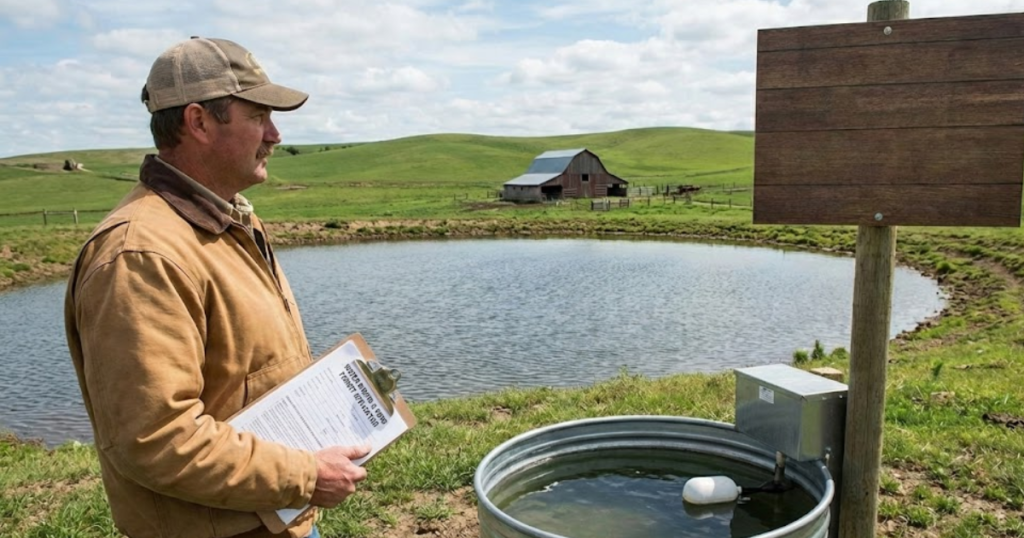
You see a property with a dried-up depression in the pasture. You think, “I’ll just turn the hose on and fill that up for the horses to splash in.”
Stop.
In Colorado, “exposed groundwater” is a major legal issue. The State Engineer strictly regulates anything that increases evaporation. While you have a right to let your horse drink, you do not necessarily have a right to create a swimming hole.
Understanding the difference between a legal stock tank and an illegal pond can save you thousands of dollars in fines and the heartbreak of being ordered to backfill your dream oasis.
Here is the reality of water storage on private land.
Can I Legally Fill a Pond or Have an Automatic Waterer in My Pasture?
Quick Summary: The War on Evaporation
- Ponds are “water theft”: In the eyes of Colorado water law, an open pond is a water thief. The sun evaporates the water, which is considered “consumptive use.” Unless you have a specific decree allowing for a pond, you generally cannot fill an earthen pond with well water.
- Stock tanks vs. ponds: You are allowed to water your horses. Filling a standard 100-gallon stock tank or using an automatic waterer is considered “livestock watering.” Filling a 1-acre decorative lake is considered “storage” and requires a totally different (and expensive) water right.
- Automatic waterers are preferred: Because they have tiny surface areas and insulated covers, automatic waterers minimize evaporation. The state generally prefers these over giant open troughs.
- The augmentation requirement: If you are on less than 35 acres without a grandfathered well, you may be restricted to “Household Use Only.” In that case, filling any outside waterer—even a small automatic one—might be illegal without an augmentation plan.
You can usually water horses. You usually cannot “store” water in an open pond without a specific decree.
1. The Problem With Ponds: The Evaporation Tax
Why is the state so strict about ponds? Because once water is exposed to sun and wind, it disappears.
The science
- Water in an aquifer is protected from the sun.
- Once pumped into an open pond, Colorado’s dry air pulls it into the sky.
- That lost water never returns to the river system to satisfy downstream senior water rights.
The rule
- A standard Domestic Well permit allows for “watering of livestock.”
- It typically does not allow for “filling of ponds for aesthetic or recreational purposes.”
The exception
- If the property has a water right decreed for “storage” or “piscatorial” (fish) use, you may be able to legally maintain a pond.
- These rights are rare and valuable.
2. Automatic Waterers: The Efficiency Solution
If you want water 24/7 without the legal headache of a pond, automatic waterers are the answer.
How they work
- These units connect to a buried water line.
- A float valve keeps a small bowl (typically 1 to 5 gallons) full.
- When the horse drinks, it refills instantly.
The legal safety
- The surface area is tiny (often less than 1 square foot), so evaporation is negligible.
- This falls squarely under “livestock watering” and is widely accepted as responsible use.
The winter benefit
- Quality units are insulated and heated, so you aren’t chopping ice in a tank at -10°F.
3. The “Stock Tank” Loophole
What about a standard metal trough? This is where things get gray.
The accepted use
- A standard 100-gallon or 300-gallon tank is generally accepted as a watering vessel.
The danger zone
- If you bury a 20-foot diameter tank and call it a “stock tank,” you may invite scrutiny.
- The key is intent. Is it for drinking, or is it effectively storage/aesthetics?
The leak problem
- A slow leak creates a wetland and can waste massive amounts of water.
- Maintain float valves diligently so you aren’t accidentally irrigating the surrounding dirt.
4. The “Household Use Only” Trap
We mention this in every water post because it is the number one way buyers get blindsided.
The restriction
- If your well permit says “Household Use Only,” you cannot have any outside water.
The reality
- No automatic waterers.
- No stock tanks.
- No hose bibs for trough filling.
- You would have to haul water in from an off-site source to legally water horses.
Always verify the exact permit language and whether the property is covered by an augmentation plan.
We Check the Decrees
We don’t just look at the water; we look at the rights.
When Mark Eibner and Belinda Seville evaluate a property with a pond or water system, we pull the records. We check if that pond is a legal decreed reservoir or an illegal hole in the ground. We verify your well permit allows you to hook up an automatic waterer so your horses can drink legally.
- Contact Us Today to find a property where your horses can drink legally.
- Browse Active Colorado Horse Properties with verified water infrastructure.
Browse Active Colorado Horse Properties: View All Available Listings
Frequently Asked Questions (FAQ) About Ponds and Waterers
Can I catch rainwater to fill a pond?
No. Colorado law allows two rain barrels (110 gallons total) for outdoor irrigation. You cannot divert roof runoff into a large pond without a specific water right. The rain belongs to the river.
What if the pond is fed by a natural spring?
“Spring rights” are their own category. Just because it bubbles up on your land doesn’t mean you can keep it. If you detain spring water in a pond, you may be preventing it from flowing to senior water right holders downstream. You usually need a decree to store spring water.
How much electricity does an automatic waterer use?
In summer, essentially none. In winter, the heating element (typically 250–500 watts) runs when temperatures drop. Expect about $15 to $30/month in the coldest months—still cheaper than the time and effort of chopping ice daily.