
You look out the window of your new Colorado home. The thermometer reads a bitter 15 degrees, and the wind is howling across the plains at 40 miles per hour. Your horses are turned out in a sprawling 10-acre pasture, but the land is completely flat and barren.
There are no trees, no hills, and no shelters. Your horses are standing with their tails clamped down, their backs hunched against the biting wind, shivering violently. You are now forced to bring them inside or desperately try to blanket a panicked herd in the middle of a blizzard.
When buyers look at sprawling rural acreage, they often just see beautiful, open space. But in the winter, that open space becomes a frozen wind tunnel. If you intend to manage a herd with 24/7 outdoor turnout, evaluating a property’s windbreaks is just as important as checking the water supply.
Here is how to evaluate the topography and shelter of a horse property to survive the winter winds.
Are There "Windbreaks" (trees or hills) for Horses Kept Out 24/7?
Quick Summary: The Winter Chill Factor
- The Wind Chill Threat: Horses are incredibly resilient to cold temperatures, but wind is their ultimate enemy. Severe winds destroy the insulating properties of a horse's winter coat, causing their core temperature to plummet.
- The Caloric Drain: A horse left out in driving wind without a break will burn thousands of extra calories just shivering to stay warm, resulting in rapid, dangerous weight loss mid-winter.
- Natural vs. Man-Made: A premier property leverages natural topography, like deep draws, hills, and dense evergreen tree lines, to block the prevailing winds, rather than forcing you to build expensive wooden shelter walls in every pasture.
- The 24/7 Turnout Requirement: If you plan to leave your horses out 24/7 without stalling them inside a barn, a three-sided run-in shed or a massive, impenetrable windbreak is an absolute, non-negotiable necessity for their survival in the West.
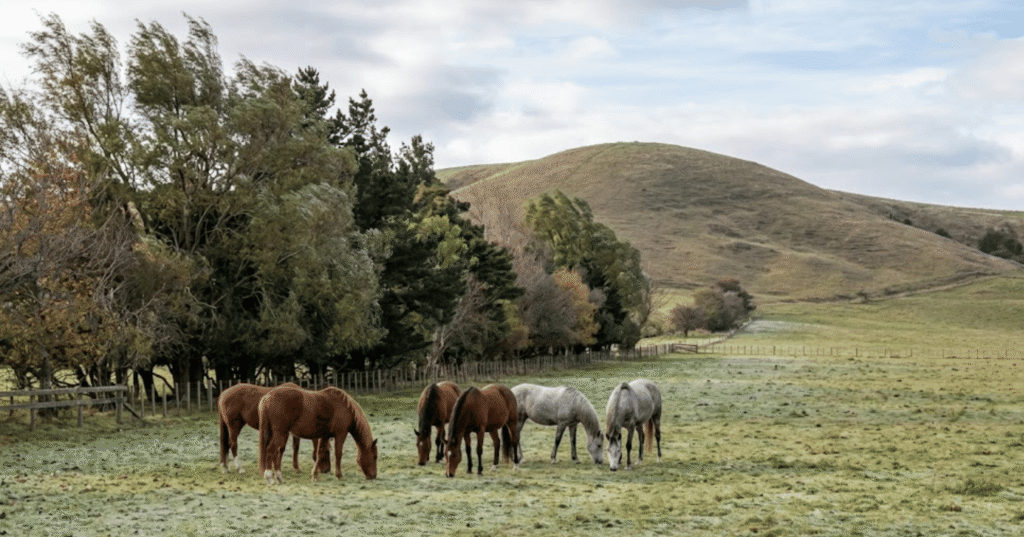
Wide open pasture can look beautiful in summer, but in winter the real question is whether the land gives horses a reliable place to get out of the wind.
1. The Biology of the Wind Chill
To understand why a property needs a windbreak, you must understand how a horse stays warm.
- The Piloerection Defense: When a horse gets cold, the hairs of their thick winter coat stand straight up, a process called piloerection. This creates a thick, trapped layer of warm air right next to their skin, acting exactly like a premium down jacket.
- The Wind Thief: Cold temperatures alone rarely bother a healthy, unclipped horse. However, high winds actively blow apart that trapped layer of warm air. The wind slices right to the skin, instantly stripping the horse of its natural insulation.
- The Caloric Cost: For every degree the wind chill drops below a horse's lower critical temperature, they require a massive increase in forage, hay, just to fuel the internal furnace that keeps them from freezing. If they cannot escape the wind, you will spend a fortune on extra hay, and they will still likely lose weight.
2. Evaluating Natural Topography
The best windbreaks are the ones you do not have to build. You must look at the land's natural defenses.
- The Prevailing Winds: In Colorado, the most brutal winter storms and prevailing winds typically blast in from the north and the northwest. You must mentally map the pastures to see if they offer any natural shield from these specific directions.
- Hills and Draws: Flat, eastern-plains properties are the most vulnerable. Properties nestled in the foothills often feature deep draws, small valleys, or steep hillsides. Horses will naturally migrate down into these low spots to escape the cutting wind passing overhead.
- The Timber Line: Dense rows of mature evergreen trees, like ponderosa pines or junipers, are exceptional natural windbreaks. Deciduous trees, like cottonwoods or aspens, lose their leaves in the winter and become essentially useless for blocking the wind when the horses need it most.
Not all acreage is equally usable in winter. Natural landform protection can make a major difference in whether outdoor turnout is practical or stressful.
3. Man-Made Windbreaks and Shelterbelts
If the property is flat and treeless, you must evaluate the existing man-made infrastructure or budget to build it.
- The Run-In Shed: The ultimate windbreak is a deep, three-sided run-in shed with its solid back wall facing directly into the prevailing north and northwest winds. This gives the horses a dry, wind-free microclimate.
- Wooden Windbreak Walls: If a run-in shed is too expensive, large pastures should at least feature heavy-duty wooden windbreak walls. These are typically massive, V-shaped or straight walls built from heavy timber, often 8 to 10 feet tall, that the horses can huddle behind during a squall.
- The Shelterbelt: A shelterbelt is a purposely planted row of fast-growing, drought-resistant trees and shrubs designed to block wind and control snow drifting. If a property has a young shelterbelt, it is a massive value-add, but you must ensure the trees are fenced off so the horses do not eat the bark and kill them.
4. The Snowdrift Danger
A windbreak solves one problem but can easily create another.
- The Drop Zone: When a heavy wind hits a solid object, like a tree line or a wooden wall, it slows down. When the wind slows down, it drops whatever snow it is carrying.
- Strategic Placement: A poorly placed windbreak will cause massive, 6-foot snowdrifts to form exactly where you do not want them. If a windbreak wall is built too close to the pasture gate or the automatic waterer, the resulting snowdrift will completely bury your access, trapping the horses and forcing you to dig out the infrastructure by hand.
We Evaluate the Topography Before You Buy
We do not just look at the summer grass; we look at the winter survival dynamics.
When Mark Eibner and Belinda Seville represent you in buying a rural estate, we evaluate the land exactly how a horse does. We look for the natural draws, assess the direction of the prevailing winds, and calculate the cost of adding necessary run-in sheds if the land is entirely exposed. We want to ensure your herd can live outside safely and comfortably year-round.
Contact Us Today to find premium horse properties Colorado buyers trust for safe, year-round turnout.
Browse Active Colorado Horse Properties: Browse active Colorado horse ranches for sale or ask our team about finding a horse property for rent Colorado while you search for a permanent farm with the perfect natural layout
Frequently Asked Questions (FAQ) About Windbreaks
If my horses have blankets, do they still need a windbreak?
Yes, absolutely. While a heavy turnout blanket protects their core barrel, their neck, face, and legs are still completely exposed to the wind chill. Furthermore, horses need a wind-free zone to comfortably sleep and rest. A blanket is a supplement to shelter, not a complete replacement for it.
How tall does a wooden windbreak wall need to be?
To be effective for full-sized horses, a wooden windbreak should be a minimum of 8 feet tall, though 10 feet is preferred in areas with severe drifting. It must also be built with heavy-duty posts set deep in concrete, as a solid wall catches a massive amount of wind force and can easily blow over if under-engineered.
Can I use round bales of hay as a temporary winter windbreak?
Yes, placing a row of large, 1,000-pound round bales along a fence line can act as a highly effective temporary wind barrier for horses turned out on the plains. However, the horses will eventually eat their own windbreak, so it must be actively managed and replaced throughout the winter.