
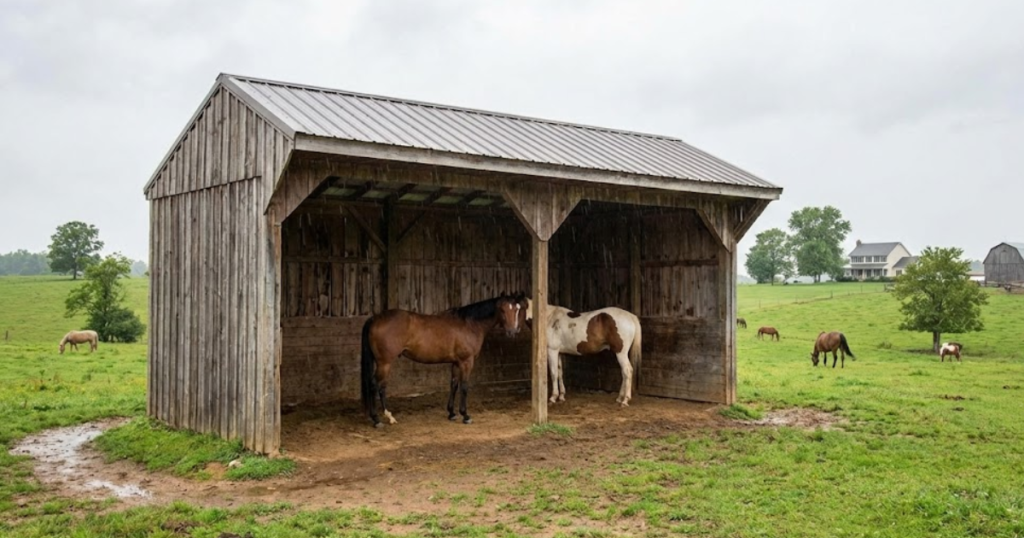
You see a pasture with a shed in the corner. You check the box: “Has shelter.”
But is it a safe haven or a trap?
In the Rockies, a loafing shed (or run-in shed) is a critical piece of infrastructure. It allows your horses to live outside naturally—moving and socializing—while giving them a place to escape the biting wind.
However, a poorly built shed can be a hazard. We have seen sheds blow over in windstorms, sheds that act as snow-catchers because they face north, and sheds with metal edges that slice skin like a razor.
Here is how to inspect the pasture shelters on your potential property.
Are There Existing Run-In Sheds or Loafing Sheds in the Pastures?
Quick Summary: The Wind Block Factor
- Wind vs. cold: Horses are incredibly tough animals. They can handle 10-degree weather easily, but they cannot handle freezing wind and wet snow combined. A 3-sided shelter is often more important for their health than a warm stall.
- Orientation is everything: In Colorado, the prevailing winter storms come from the North and West. A properly sited shed should generally open to the South or East.
- The “mud pit” problem: Without gutters or a raised pad, roof runoff creates a knee-deep swamp at the entrance. This leads to thrush, scratches (mud fever), and lost shoes.
- Portable vs. permanent: Many shelters are built on skids to be classified as portable equipment rather than permanent structures—sometimes avoiding strict building permits.
A good shed blocks wind, stays dry, and won’t hurt a horse if they kick a wall.
1. The Compass Test: Which Way Does It Face?
In Colorado, the direction the shed faces is the difference between a dry shelter and a snow cave.
- The golden rule: The open side should face South or East. This captures winter sun and blocks North/West winds.
- The “scoop” effect: If it opens to the North or West, it can act like a giant scoop during a blizzard. Snow drifts all the way to the back wall.
- Sunlight sanitization: South-facing sheds get UV light inside, helping dry out urine/manure and reduce bacteria.
2. Construction: Metal vs. Wood
What is it made of? The answer affects safety.
All-metal skins
- Cheap and durable, but risky if a horse kicks through thin sheet metal.
- Check for plywood lining (kick walls) on the inside to at least 4 feet high.
Wood post-frame
- Warmer, quieter, and often safer.
- Check for “beavering” (chewing damage) on posts that could compromise structure.
Anchoring
- Colorado winds can exceed 80 mph.
- Portable sheds should be anchored with screw-in augers or rebar stakes.
Look for sharp edges, exposed fasteners, and any sheet metal that can flex when pushed.
3. The Foundation: Avoiding the Swamp
Horses will stand in the shed for hours during storms. What are they standing on?
The dirt floor trap
- If the shed sits on native dirt, it quickly becomes a manure-filled mud pit.
The solution
- Look for a raised pad of road base or gravel higher than the surrounding pasture.
- Gutters are a game-changer: they move roof runoff away from the entrance to prevent ice slicks and bogs.
If you see deep ruts or standing water at the entrance, plan on a pad rebuild and drainage work.
4. The “Portable” Loophole
You might ask, “Why are all the sheds on skids?” There’s a reason.
- Tax and zoning: A structure on a concrete foundation can increase taxes and requires permits. A shed on skids is often treated as equipment or chattel.
- Flexibility: You can drag it to fresh ground when mud builds up or rotate between pastures.
We Check the Anchors
We don’t just look at the view; we kick the tires on the sheds.
When Mark Eibner and Belinda Seville walk a pasture, we look for safety hazards. We check anchoring. We check for sharp metal edges. We evaluate the location for winter feeding and water access—because a perfect shed in the wrong spot still fails in a blizzard.
Contact Us Today to find a property where your horses will be safe and warm.
Browse Active Colorado Horse Properties: View All Available Listings
Frequently Asked Questions (FAQ) About Loafing Sheds
How big does a shed need to be?
The rule of thumb is 12' x 12' (144 sq ft) for the first horse, plus an additional 60 sq ft for each additional horse. If it is too small, the dominant horse can block access and kick others out into the storm.
Can I use a shipping container as a shelter?
Use caution. Containers are narrow (8 feet wide). A dominant horse can trap a submissive horse in the back with no escape route. Also, steel roofs can create heavy condensation “rain” unless insulated. They’re generally not recommended without major modification.
Do sheds count towards my lot coverage limits?
In many residential zones, yes. Even if portable, the county may count the square footage against accessory structure limits. Always verify zoning and HOA rules before adding more sheds.