
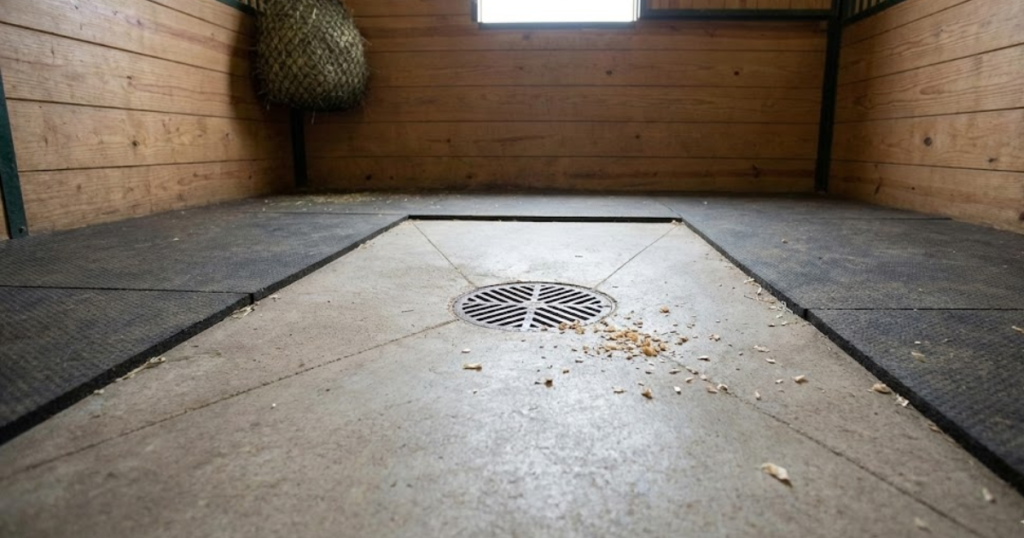
You walk into a barn and the aisle is swept clean. The stalls look tidy with fresh shavings. But as you stand there, your eyes start to water and you smell the sharp, biting scent of ammonia.
This is the tell-tale sign of a floor drainage failure.
A horse produces gallons of urine every day. If the stall floor is perfectly level, that liquid has nowhere to go. It seeps through the cracks in the rubber mats and sits there, fermenting. Many buyers assume that “level” means “good,” but when it comes to livestock housing, you actually want a calculated imperfection.
Here is how to check if a barn’s foundation was engineered for hygiene.
Are the Stall Floors “Level” or Do They Have Built-In Drainage?
Quick Summary: The Liquid Logic
- The flat floor fallacy: A perfectly level stall floor sounds good in theory, but in practice it creates a bathtub effect. Urine pools under the mats, creates a swamp, and generates harmful ammonia fumes.
- The 2% slope rule: Professional barn builders grade the sub-floor with a slight slope, usually 1% to 2%, toward a drain or a back wall. This allows fluids to run off via gravity rather than stagnating under the bedding.
- The sub-floor material: Concrete is durable but impermeable, which means it requires a plumbed drain system. Packed road base or clay allows for some natural absorption, but it requires more maintenance to keep it level over time.
- The ammonia health risk: If urine is trapped under rubber mats on a level floor, it decomposes into ammonia gas. This damages the horse’s respiratory system and softens their hooves, leading to persistent cases of thrush.
When it comes to stall floors, “perfectly level” is often the wrong answer. Controlled drainage is what keeps a barn healthy.
1. The Engineering of the Slope
You cannot rely on bedding alone to absorb all stall moisture. Gravity needs to do most of the work.
The gradient
- Ideally, a stall floor slopes about one-quarter inch per foot.
- That is subtle enough that the horse does not feel like it is standing on a hill, but steep enough to encourage liquid movement.
The direction
- The slope usually runs toward the back of the stall to an exterior drain, or toward a center aisle channel.
The test
- If you pull up a corner of a stall mat and the material underneath is black, wet, and foul-smelling, the floor is likely too flat.
- That means the urine is trapped instead of draining away.
Fresh shavings can hide a drainage problem. The smell under the mats tells the real story.
2. Concrete vs. Leeching Floors
The material under the mats determines how drainage has to work.
Concrete floors
- These are sanitary and impossible for horses to dig up.
- But they are also non-absorbent.
- A concrete stall must have a built-in slope and a proper floor drain connection.
- If you have a flat concrete floor with no drain, you are basically keeping your horse over a trapped urine reservoir.
Leeching bases (road base / stone dust)
- This is the most common floor type in Colorado barns.
- It consists of compacted crushed rock or stone dust.
- It allows urine to trickle slowly downward into the earth below.
- It drains more naturally, but it also requires periodic regrading because horses can dig depressions into the center.
3. The “French Drain” Solution
High-end barns often use hidden drainage systems to move liquids away from the stall surface quickly.
How it works
- Builders dig a trench under the center of the stall or along the back wall.
- The trench is filled with large gravel and a perforated pipe, then covered by the stall base.
The benefit
- This acts like a super-highway for urine and moisture.
- It keeps bedding drier and can reduce how many shavings you need to buy.
The long-term risk
- These systems are excellent, but over time they can clog with fine sediment or shavings dust.
- After 10 to 15 years, they may require significant renovation.
If the barn has a drainage system, ask when it was installed and whether it has ever been serviced or flushed.
4. Mattress Systems and One-Piece Mats
Newer flooring systems can improve comfort, but they change how moisture needs to be managed.
Interlocking mats
- Standard 4x6 rubber mats have seams.
- Liquid will always find those seams.
- On a flat floor, that becomes a hygiene disaster.
- On a sloped floor, the liquid can travel under the mat to the low point and drain away.
Sealed systems
- Some modern barns use seamless, pour-in-place rubber or wall-to-wall mattress systems.
- These are essentially waterproof.
- That means the stall floor underneath must be designed to move liquid out the front or back, or you must use enough absorbent bedding to capture nearly all moisture.
We Check the Floors Before You Buy
We do not mind getting our hands dirty.
When Mark Eibner and Belinda Seville inspect a barn, we check the corners of the stalls, look for heaving mats, and identify wet spots or ammonia clues that indicate drainage failure. We verify whether the sub-floor is concrete or soft base and help you estimate the cost of correcting a flat-floor problem.
Contact Us Today to find a barn that is healthy from the ground up.
Browse Active Colorado Horse Properties: View All Available Listings
Frequently Asked Questions (FAQ) About Stall Drainage
Can I fix a stall that holds urine without tearing out the concrete?
It is difficult. If you have a flat concrete floor, your best option is often to install a mattress system on top that manages drainage better, or to use deep-litter bedding techniques. Pouring new concrete on top to create a slope usually raises the floor too high.
Does a dirt floor need a drain?
A true dirt floor usually turns into mud. But a proper road base floor acts as its own drain and typically does not need a pipe, provided the water table is low enough and the material below can absorb the liquid.
How often should I lift the mats to clean underneath?
If the floor is perfectly level, you might need to do this annually to wash out ammonia buildup. If the floor has a proper slope and drainage system, you may only need to do it every 5 to 10 years for maintenance.