
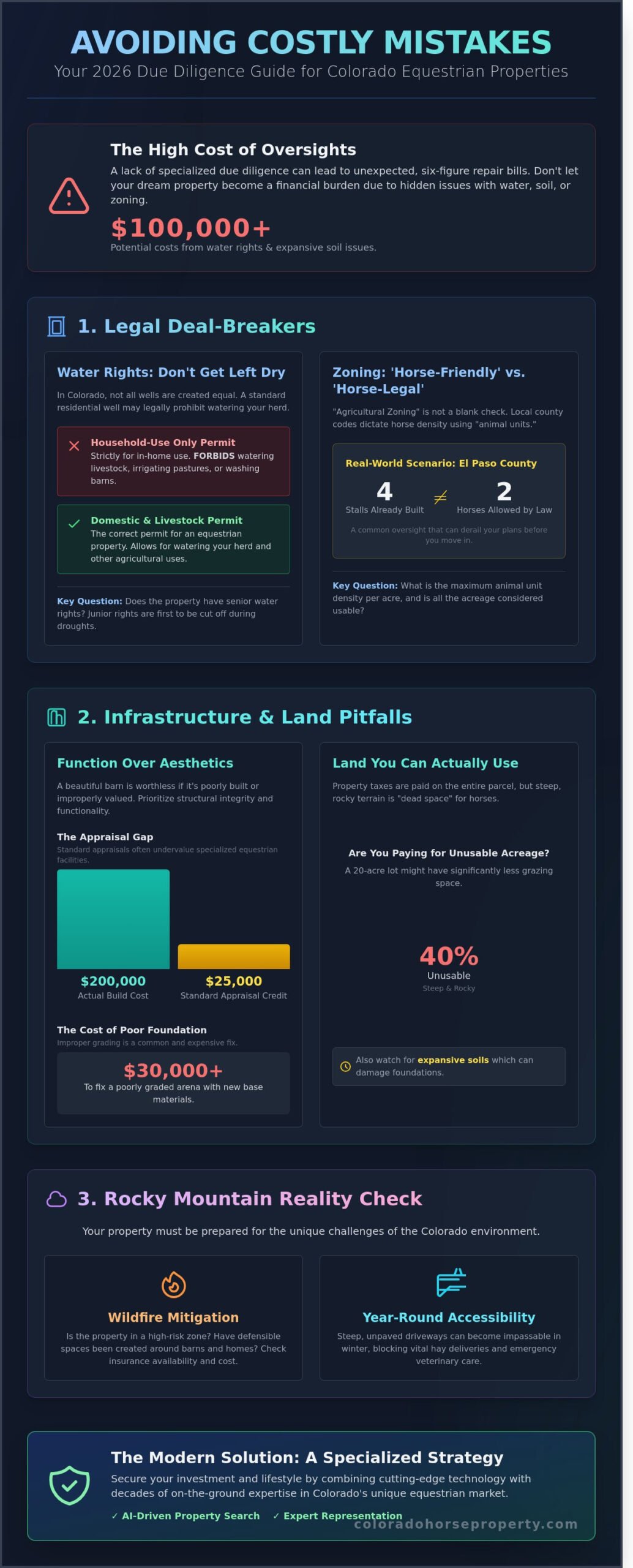
Imagine signing the final closing documents on a 35-acre ranch in El Paso County, only to discover three weeks later that local zoning laws cap your horse count at two, despite having four stalls already built. This oversight is just one of the costly mistakes to avoid buying equestrian property CO that can derail your lifestyle and dreams before the first trailer even arrives. You’ve worked hard to reach a point where you can invest in the rural Colorado landscape, and you deserve a property that’s legally and physically capable of supporting your equine partners without hidden restrictions.
We understand that the search for the perfect barn and pasture is about more than just square footage; it’s about securing your future. With nearly four decades of experience in the specialized equine market, we’ve seen how easily a lack of due diligence regarding senior water rights or expansive soils can lead to $100,000 repair bills. This 2026 guide provides the professional clarity you need to move forward with confidence. We’ll walk you through a comprehensive due-diligence checklist covering everything from legal land use to infrastructure pitfalls, ensuring your investment remains a source of freedom rather than a financial burden.
Key Takeaways
- Understand why a standard residential well may not support your herd and how to verify critical water rights before you commit to a purchase.
- Learn the most common mistakes to avoid buying equestrian property CO, specifically regarding misinterpreted agricultural zoning and horse density limits.
- Discover why prioritizing structural barn functionality over aesthetics can save your investment from costly infrastructure and arena soil corrections.
- Evaluate essential Rocky Mountain environmental factors, including wildfire mitigation zones and winter accessibility for vital hay deliveries and emergency veterinary care.
- Master a specialized strategy that uses AI-driven search and decades of expert representation to secure a property that fulfills your lifestyle and dreams.
Why Colorado Equestrian Real Estate Requires a Specialized Strategy
In Colorado, an equestrian property isn’t defined by a white picket fence or a hobby shed. It’s a complex agricultural asset where soil composition, water law, and zoning regulations dictate your daily life. One of the biggest mistakes to avoid buying equestrian property CO is treating the search like a standard suburban home hunt. General residential agents often overlook critical details like manure management setbacks or the legality of a second dwelling for a ranch hand. They see a beautiful barn; we see a structure that might violate a specific county utility easement.
By 2026, the Colorado market for ranches and acreage has shifted toward high-tech, sustainable infrastructure. Buyers are currently competing for limited 35-plus acre parcels that offer domestic well permits, which allow for livestock watering. Falling in love with a panoramic view of the Front Range is a common emotional trap. That view won’t help you when a $50,000 drainage issue turns your primary turnout into an unusable swamp during the spring thaw. You need a strategy that prioritizes the horse’s needs as much as the humans’ comfort.
Equestrian Property vs. Standard Residential
Appraisals for specialized properties operate differently than typical neighborhood comps. A standard appraiser might only give a $25,000 credit for a professional-grade indoor arena that cost $200,000 to build. We utilize nearly four decades of experience to bridge this gap, identifying where the true value lies in specialized improvements. You’ll often see listings labeled “horse-friendly,” yet local county codes might restrict you to only two horses on a five-acre lot when your plan requires four. Verifying “horse-legal” status is the only way to protect your long-term investment.
The Cost of a ‘Bad’ Purchase
Poor land selection creates a permanent financial drain that’s difficult to reverse. If 40% of your 20-acre lot consists of steep, rocky terrain, you’re paying property taxes on land your horses can’t safely graze. Specialized representation ensures your lifestyle and dreams aren’t sidelined by these physical or legal hurdles. Fixing a poorly graded arena can cost upwards of $30,000 in dirt work and base materials alone. Equestrian due diligence is the process of verifying legal land use and physical safety for livestock.
- Zoning: Confirming the maximum animal unit density per acre.
- Water Rights: Ensuring your well permit actually allows for outdoor trough filling.
- Topography: Identifying “dead space” that can’t be used for hay storage or riding.
Avoiding the common mistakes to avoid buying equestrian property CO starts with recognizing that your agent must be a land specialist. This isn’t just about square footage; it’s about the health of your herd and the security of your rural legacy.
The Legal Deal-Breakers: Water Rights and Zoning Mistakes
Buying land for horses isn’t like buying a standard residential lot. The legal nuances can turn a dream pasture into a liability overnight. One of the most critical mistakes to avoid buying equestrian property CO involves misunderstanding the ground beneath your feet and the water flowing under it. Colorado operates on the “Prior Appropriation System,” meaning the first person to take water and put it to beneficial use has the first right to it. If you buy a property with junior water rights established in 1985, you’ll be the first to lose access during a drought while the neighbor with 1890 senior rights keeps their hay fields green.
Colorado Water Rights 101
Don’t assume a well provides unlimited water for your herd. Most wells on parcels smaller than 35 acres are “household-use-only” permits. These strictly forbid watering livestock or washing out a barn. You must verify if the permit is specifically “domestic and livestock.” In restricted basins, you might need a court-approved augmentation plan. This often requires paying a fee to a water conservancy district to replace the water your horses consume. For a detailed breakdown of these legalities, see our guide on Understanding Water Rights in Colorado.
Zoning and ‘Animal Units’
The term “Agricultural Zoning” is a broad umbrella that doesn’t guarantee you can keep as many horses as you want. Counties use “animal units” to dictate density. In Douglas County, regulations often allow for 1 animal unit per 0.5 acres of usable land, while Weld County may have entirely different thresholds based on specific zone districts like A-Agricultural. You might see a current owner keeping 10 horses on 5 acres, but this could be a non-conforming use. When ownership transfers, that “grandfathered” status often expires, leaving you with a code violation on day one.
- Verify animal density: Check the specific county code for your exact parcel number.
- Check surrounding parcels: Review the 5-year or 10-year master plans for nearby vacant land to ensure a new subdivision won’t land on your fence line.
- Scrutinize easements: A 30-foot utility easement or a neighbor’s historic right-of-way can prevent you from building that dream indoor arena where you planned.
It’s vital to remember that a title commitment won’t always highlight these restrictions clearly. You need a team that understands the rural landscape. If you’re feeling overwhelmed by these technicalities, search our listings to find properties where we’ve already done the heavy lifting on zoning research. Ignoring these legal hurdles is a gamble that rarely pays off in the high plains or the mountains.
Infrastructure Oversights: Barns, Arenas, and Soil Quality
A beautiful facade often masks expensive structural flaws. Mistake #5 is valuing aesthetics over functionality. A barn might look like a postcard, but if it lacks cross-ventilation or uses 14-gauge wire instead of commercial-grade conduit, it’s a liability. You’re looking for a facility that protects your investment, not just one that looks good in photos. High-end finishes don’t matter if the stall latches are flimsy or the aisle way is too narrow for a tractor.
Evaluating Existing Horse Barns
Check for stall safety standards first. Stalls smaller than 12×12 feet restrict movement for larger breeds and increase the risk of a horse getting cast. Proper ventilation is non-negotiable to prevent respiratory issues like heaves. Older barns require specialized inspections for electrical and plumbing systems. Look for frost-free hydrants and wiring protected from rodents. If the existing structure is failing, you’ll need to decide between Buying vs. Building Your Colorado Horse Barn to ensure the safety of your herd.
The Hidden Cost of Riding Arenas
Mistake #6 is assuming a flat piece of dirt is a ready-to-use arena. Colorado’s climate requires specific base layers and footing materials to prevent soft tissue injuries. Without a four-inch compacted sub-base and proper drainage, your arena will become a mud pit or a hard-packed hazard. Professional arena remediation can cost between $20,000 and $50,000 depending on drainage requirements. Don’t let a “turn-key” claim fool you without testing the depth and composition of the footing first.
Soil and Pasture Health
One of the critical mistakes to avoid buying equestrian property CO is ignoring soil composition. The Front Range is notorious for bentonite, a heaving clay that expands when wet. This soil can crack foundations and buckle arena walls within five years of construction. You also need to calculate grazing sustainability. In Colorado’s arid climate, you often need 3 to 5 acres per horse for year-round grazing without destroying the land. Check for noxious weeds like leafy spurge or knapweed before closing. These invasive species can cost thousands to eradicate and are toxic to livestock.
Mistake #8 involves logistics. Ensure the property has a 50-foot trailer turnaround radius and dedicated hay storage. A 1,200-pound horse eats about 2% of its body weight daily; you’ll need dry, ventilated space for at least 300 small square bales to survive a Colorado winter. If you can’t fit a delivery semi on the driveway, your feed costs will skyrocket.
Environmental and Access Pitfalls in the Rockies
Colorado’s rugged terrain offers breathtaking views, but it also creates logistical hurdles that catch many buyers off guard. One of the most common mistakes to avoid buying equestrian property CO involves underestimating the power of the environment. Buyers often fall in love with a secluded ridge top in June without considering the reality of a January blizzard or the rising costs of wildfire protection. If you don’t account for these factors during the due diligence period, your dream ranch can quickly become a financial and operational burden.
Property owners must now manage three distinct Home Ignition Zones (HIZ) to satisfy underwriters. By 2026, new Colorado wildfire zoning regulations will make it nearly impossible to secure traditional insurance without documented fire-wise land management. You’ll need to maintain a 5-foot non-combustible zone around all structures and thin trees within 100 feet of your barn. Failing to plan for these clearings can lead to immediate policy cancellations after your first inspection.
Wildfire Risk and Insurance
Insurance carriers now use high-resolution satellite imagery to assess your property’s risk before issuing a quote. If your arena or hay shed is surrounded by dense gamble oak or unmanaged timber, expect a denial or a 300% premium hike. Effective mitigation isn’t just about safety; it’s a financial necessity. You must clear ladder fuels and ensure your roof materials meet Class A fire ratings to maintain coverage in high-risk zones like the Front Range foothills.
A mile-long private driveway looks beautiful until it requires four hours of tractor work after every 6-inch snowfall. If a vet can’t reach your colicking horse in February because your road is impassable, the location becomes a liability. You must verify that the road width and turn radius can accommodate a 53-foot semi-truck carrying 20 tons of hay during the winter months.
Seasonal Access and Terrain
Slope and aspect dictate your daily workload and the health of your herd. A north-facing slope might stay iced over until April, while a south-facing pasture sees “green-up” three weeks earlier. Most heavy equipment requires a maximum 10% grade to operate safely on packed snow. If your pasture is too steep, you’ll deal with increased erosion and limited grazing capacity. Off-grid features like solar arrays or cisterns also complicate financing, as many traditional lenders require a 25% larger down payment for properties without municipal power connections.
Avoid these costly oversights by working with experts who understand rural land; contact us to find your next Colorado horse property with confidence and local expertise.
The Modern Solution: AI Search and Expert Representation
Traditional real estate platforms often fail to distinguish between a dusty 35-acre lot and a turnkey training facility with functional infrastructure. Avoiding the most common mistakes to avoid buying equestrian property CO starts with using tools built specifically for the rural market. You shouldn’t waste time scrolling through listings that lack the basic requirements for your herd. Our system bridges the gap between digital convenience and the complex realities of Colorado land ownership.
Leveraging Proprietary AI Tools
Our proprietary AI search engine processes thousands of data points to filter properties by specific equine criteria like “outbuildings,” “loafing sheds,” or “indoor arenas.” Searching by “Acres” and “Features” saves buyers an average of 60 hours of manual filtering over a three-month search period. This technology identifies properties with equestrian potential before they are fully indexed on national sites, giving you a head start on competitive listings. For a deeper dive into what makes a property viable, check out our Equestrian Real Estate Colorado: A Complete Buyer’s Guide. It’s about finding the hidden gems that the general public misses because they aren’t looking at the land through a rancher’s eyes.
This trend of using data to make smarter real estate decisions isn’t limited to the buying process. For homeowners looking to sell, data-driven frameworks from services like Homeselling AI provide a scientific approach to optimizing a property’s sale.
Partnering for Success
The “Founder-Forward” approach with Mark and Alison Eibner ensures you work with brokers who have spent nearly 40 years in the saddle and in the local real estate market. Agricultural transactions are roughly 40% more complex than standard residential deals. Issues like water rights transfers, grazing leases, and conservation easements require a specialist’s touch. We partner with Meridian Title & Escrow to verify these intricate titles, ensuring there are no hidden encumbrances after you close. You need a broker who is a horse person first. They’ll spot a drainage issue in a paddock or a poorly ventilated barn roof that a city-based realtor would overlook. This expertise protects your investment and the safety of your animals.
- Days 1-7: Conduct well permit searches and water quality/quantity testing.
- Days 8-14: Verify county zoning for specific livestock counts and manure management rules.
- Days 15-21: Complete structural inspections of barns, arenas, and fencing systems.
- Days 22-30: Finalize title review of all easements, access rights, and mineral interests.
Finding the right Colorado ranch is about more than just square footage; it’s about securing a lifestyle. Don’t let a lack of specialized data lead to a costly error in judgment. Use technology and experience to your advantage to ensure your dream property doesn’t become a logistical nightmare.
Start your AI-powered search for Colorado horse property today!
Secure Your Colorado Equestrian Legacy
Owning a ranch in the Rockies is a major milestone that requires more than just a love for the land. Success depends on navigating complex water rights and verifying that local zoning permits your specific equine activities. Overlooking soil drainage or barn infrastructure can lead to expensive repairs that derail your budget. By understanding the common mistakes to avoid buying equestrian property CO, you protect your investment and your animals before the first fence post is even set.
Mark and Alison Eibner bring nearly four decades of specialized real estate experience to your search. Their team combines this deep local knowledge with advanced technology to simplify a complex market. You can now use AI-powered filtering to instantly sort listings by exact acreage and verified water rights. This ensures you only see properties that meet your high standards for safety and utility. Don’t leave your lifestyle and dreams to chance when professional expertise is just a click away.
Find your dream equestrian property with our AI-powered search tool!
Your ideal Colorado landscape is waiting for you; it’s time to start your next chapter with confidence.
Frequently Asked Questions
How many acres do I really need for two horses in Colorado?
You generally need at least 2 to 5 acres for two horses, depending on the specific county zoning and the quality of the land. For example, Douglas County regulations typically require a minimum of 2.5 acres for the first horse and additional acreage for more animals. In drier regions like Pueblo, you’ll need closer to 10 acres to prevent overgrazing. Always check the specific parcel’s animal unit density before you buy.
What is the most common legal mistake when buying a ranch in CO?
One of the biggest mistakes to avoid buying equestrian property CO is assuming water rights automatically transfer with the land title. In Colorado, water is a separate real estate interest. You must verify the adjudication date and flow rate, often measured in cubic feet per second, during your due diligence. Failing to secure these rights can leave you without enough water to irrigate pastures or sustain a 10 stall barn.
Do I need a special inspection for a horse barn?
You should hire a specialized inspector to evaluate the barn’s structural integrity, ventilation, and electrical safety. Standard home inspections usually exclude agricultural buildings. A professional will look for 12 by 12 foot stall dimensions, proper drainage in wash racks, and fire hazards in hay lofts. Spending $500 on a specialized report now prevents thousands in repairs to a failing foundation or poor stall design later.
Can I use a standard residential realtor to buy equestrian property?
You can, but working with a specialist is safer because generalists often miss critical details like mineral rights or septic capacity for manure runoff. An equestrian expert understands the difference between sandy loam and clay soil for arena footing. Our team has nearly 40 years of experience navigating these specific rural transactions. This expertise ensures you don’t end up with a property where you can’t legally build your dream arena.
How do water rights affect the price of Colorado horse property?
Water rights can increase a property’s market value by 25% or more, especially in arid regions. A parcel with a permitted domestic well that allows for livestock watering is significantly more valuable than one restricted to household use only. You’ll pay more upfront for a property with 2 shares of ditch water, but it’s essential for maintaining green pastures through August. Without it, your land’s resale value could drop.
What are the zoning requirements for keeping horses in Douglas County?
Douglas County zoning laws usually require a minimum of 2.5 acres for the first horse in Large Rural Residential (LRR) zones. You’re allowed one horse per 0.5 acres after that initial threshold is met. Manure management plans are often required for properties with more than 4 horses to protect local watersheds. Always verify the specific zoning code for your parcel’s 10 digit schedule number before closing.
Is it better to buy a property with an existing arena or build my own?
Buying a property with a 100 by 200 foot arena is usually more cost effective because construction costs for a professional outdoor arena currently average $5 to $10 per square foot. Building your own requires permits, grading, and expensive base materials. If you find a property with an existing arena, you’re saving six months of construction time. Just ensure the sub-base is properly compacted and level before you commit.
What happens if the property I want is in a high-risk wildfire zone?
Purchasing in a high-risk zone means you must prioritize fire mitigation to secure insurance coverage. This is one of the common mistakes to avoid buying equestrian property CO because some carriers won’t issue policies for homes with heavy timber within 30 feet of the barn. Expect to spend $2,000 to $5,000 annually on brush clearing and defensible space maintenance. You’ll also need a clear evacuation plan for your trailer and livestock.