
What if the sprawling mountain acreage you just purchased lacks the legal right to water a single horse? In 2026, the true value of a property is defined by its underground infrastructure rather than its surface beauty. When you’re searching for Colorado land with well and septic for sale, it’s natural to feel overwhelmed by complex water laws and the fear of a dry well. You want a turn-key parcel that supports your lifestyle without the threat of environmental fines or depleted aquifers.
We understand that securing a rural investment requires more than a handshake; it requires technical due diligence. This guide provides the expertise you need to master the legal essentials of existing systems. We’ll examine the impact of the June 2026 Regulation 43 updates on septic systems and explain why Front Range well drilling costs can now exceed $25,000. You’ll learn how to verify well permit classes to ensure your water rights allow for livestock and irrigation. By the end of this guide, you’ll have a clear roadmap to navigate Colorado’s strict water doctrines and settle into your new land with total confidence.
Key Takeaways
- Identify how purchasing a property with pre-installed utilities can provide immediate equity and save up to $70,000 in development expenses.
- Learn to decipher Colorado’s complex water rights to ensure your well permit allows for livestock watering and outdoor irrigation rather than just indoor use.
- Discover why 2026 updates to Regulation 43 mean that soil composition and “perc” tests will dictate the feasibility and cost of your septic system.
- Navigate the specific infrastructure challenges of the Front Range and Eastern Plains using specialized AI search filters for Colorado land with well and septic for sale.
- Leverage 40 years of local expertise to verify well permit classes and avoid the legal pitfalls associated with the Prior Appropriation doctrine.
The Value of Colorado Land with Well and Septic Already in Place
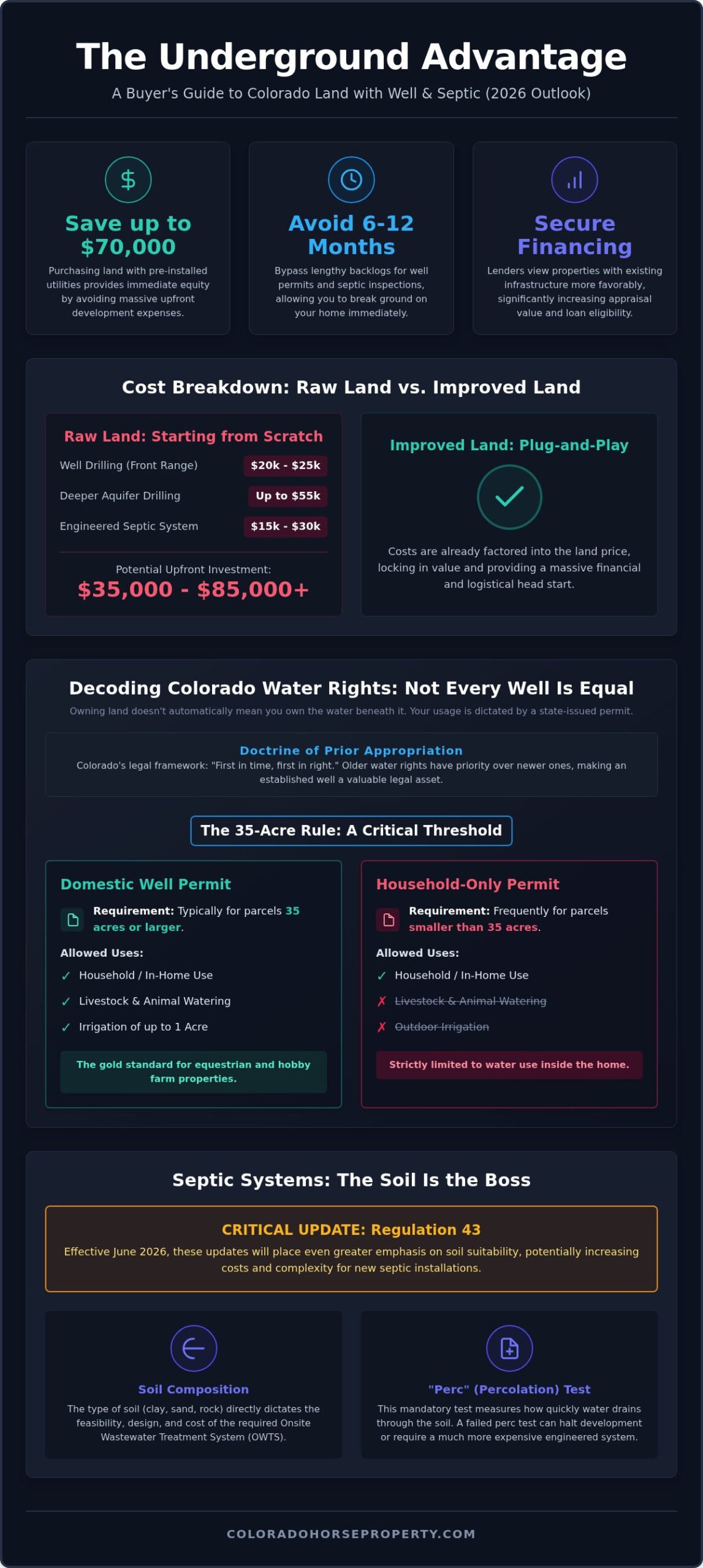
In the 2026 Colorado real estate market, “improved land” isn’t just a label; it’s a massive financial head start. Raw land might look cheaper on paper, but it requires a grueling permitting process and significant capital layout. When you find Colorado land with well and septic for sale, you aren’t just buying dirt. You’re purchasing a property that has already cleared the highest hurdles of rural development. Pre-installed utilities can save a buyer between $30,000 and $70,000 in immediate costs, depending on the depth of the aquifer and the complexity of the soil.
To better understand this concept, watch this helpful video showing a large parcel with existing infrastructure:
Beyond the cash savings, time is your most valuable asset. Current backlogs for well permits and septic inspections often stretch from 6 to 12 months in popular counties like Douglas or El Paso. Buying a lot with these systems already in place allows you to break ground on your home immediately. Additionally, lenders view these properties with much higher favor. Existing infrastructure significantly increases the appraisal value, making it easier to secure land loans compared to raw, unserviced acreage.
The 2026 Market for Self-Sufficient Acreage
The demand for “plug-and-play” lots has surged as remote work becomes the standard for Front Range professionals. Buyers are no longer looking for multi-year projects; they’re looking for freedom. Finding land for sale in colorado that includes high-speed utility access and functioning water systems is the gold standard. These properties offer the independence of rural living without the administrative headaches associated with developing from scratch.
Infrastructure as a Hedge Against Inflation
Drilling costs in the Rocky Mountain region have climbed steadily. Drilling a well into the Dawson Aquifer on the Front Range now typically costs between $20,000 and $25,000, while deeper aquifers can reach $55,000. Septic systems add another $15,000 to $30,000 for engineered designs. In an arid climate, a verified water source is the ultimate security. Because of Colorado’s prior appropriation doctrine, which operates on a “first in time, first in right” basis, having an established well permit is a legal safeguard. It ensures your investment remains viable even as water scarcity increases across the West. Searching for Colorado land with well and septic for sale is a strategic move to lock in your infrastructure costs at today’s value.
Navigating Colorado Water Rights and Well Permits
In Colorado, water is not just a utility; it’s a legal property right. The state operates under the Doctrine of Prior Appropriation, a “first in time, first in right” system. This means that older water rights have priority over newer ones during times of scarcity. When looking for Colorado land with well and septic for sale, you must understand that owning the land doesn’t automatically mean you own the water beneath it. Every drop is legally accounted for by the state, and your ability to use it depends entirely on your specific permit.
The size of your parcel often dictates your water destiny. The “35-acre rule” is a critical threshold in rural transactions. Generally, if your property is 35 acres or larger, you’re eligible for a “Domestic” well permit. This permit is versatile; it allows for indoor use, watering livestock, and irrigating up to one acre of garden or lawn. For parcels smaller than 35 acres, the state frequently issues “Household-Only” permits, which strictly forbid any outdoor water use. You can research specific property histories and permit statuses through the official portal for Colorado Well Permits.
Decoding Well Permit Types
Distinguishing between permit types is a legal necessity that many generalist real estate sites ignore. A Domestic permit is the gold standard for equestrian enthusiasts because it legally covers your animals’ hydration needs. Conversely, a Household-Only permit means you cannot legally fill a trough or water a single blade of grass outside. If a smaller lot has outdoor water rights, it’s often through an augmentation plan. These plans involve the developer “replacing” the water used with senior rights from elsewhere. It’s a complex legal structure, but it’s often the only way to get outdoor water on modern Front Range lots. If you’re unsure about a listing’s status, our specialized search tools can help you filter for properties with the correct permit class.
Due Diligence for Water Sources
Never take a seller’s word for well production. A well recovery test is a non-negotiable part of your inspection period. This test measures the Gallons Per Minute (GPM) and how quickly the well refills after heavy use. For a household with horses, a flow of 5 GPM is a common benchmark, though storage tanks can mitigate lower yields. You should also request the original well log from the Division of Water Resources (DWR). This document reveals the well’s depth, the geological layers encountered, and the initial production levels. Finally, invest in a comprehensive water quality test. In 2026, testing for minerals, bacteria, and potential chemical runoff is the only way to ensure your water is safe for both your family and your livestock; just as you prioritize your family’s safety at home, you can learn more about Temecula Valley Injury Attorneys to see how legal professionals advocate for personal well-being in other areas.
An On-site Wastewater Treatment System (OWTS) is the heart of a rural property’s functionality. Unlike municipal sewers, an OWTS processes waste entirely on your lot through a combination of a septic tank and a soil treatment area, or leach field. As of June 15, 2026, Colorado Regulation 43 mandates rigorous soil testing for all new systems. This makes the “perc” test the ultimate gatekeeper for your build. If the soil doesn’t absorb water at the correct rate, you’ll be forced into a complex engineered system rather than a standard gravity-fed one.
When browsing Colorado land with well and septic for sale, the existing system’s design is just as important as its age. Engineered systems, often required in rocky or clay-heavy terrain, can cost between $15,000 and $50,000. Standard gravity systems are significantly more affordable but require specific geological conditions to function. In 2026, most counties require a transfer of title inspection. This ensures the system is functioning and sized correctly before the deed changes hands, protecting your investment from immediate failure.
Equestrian-Specific Septic Considerations
Horse owners face unique challenges with septic health. You must never build arenas, paddocks, or heavy structures over a leach field. Soil compaction from hooves or heavy equipment will crush pipes and suffocate the system’s ability to treat effluent. Managing drainage is equally vital. Ensure that runoff from manure piles or wash racks doesn’t saturate the septic area. If you plan on adding a guest house for ranch hands, your system must be sized for that additional load from the start. For more on managing these complex assets, see our guide on equestrian real estate Colorado.
County Regulations and Compliance
Septic permit costs vary wildly across the Front Range. In Douglas and El Paso counties, permits and inspections typically range from $250 to $1,800. Each jurisdiction has its own specific fee structures and setback requirements, often mandating that tanks be at least 50 to 100 feet from property lines and water sources. Most Colorado counties now mandate a “Use Permit” for any property transfer. This requires a licensed inspector to verify the tank’s integrity and the leach field’s performance. Failing to secure this before closing can result in immediate environmental fines and a “no-occupancy” order from the health department.
Regional Guide: Where to Find Land with Utilities
Finding Colorado land with well and septic for sale requires a regional strategy. Colorado’s diverse geography means that a system that works in the sandy soils of the Eastern Plains will fail in the granite bedrock of the High Country. Your infrastructure budget must account for these geological shifts. While the Front Range offers the most developed “plug-and-play” lots, the Eastern Plains provide value for those willing to invest in deeper wells. In these eastern regions, drilling into deep aquifers can cost between $40,000 and $55,000, but the lower land prices often offset this initial capital layout.
On the Western Slope, the focus shifts toward irrigation rights. Properties here often combine a domestic well for the home with senior surface rights for agricultural use. This region is ideal for buyers looking to produce their own hay or maintain large orchards. However, you must verify that the septic system is placed far enough from irrigation ditches to meet modern environmental setbacks. Each region has specific soil profiles that dictate whether you can install a standard system or if you’ll need a more expensive engineered solution.
Douglas and Elbert County: The Equestrian Gold Standard
Douglas and Elbert counties remain the top choice for horse owners who need to stay close to Denver or Colorado Springs. These areas offer a “lifestyle” feel with zoning that specifically supports livestock. Many parcels in this corridor come with adjudicated water rights, providing a level of legal certainty that is rare in other parts of the state. If you are looking for established colorado ranches for sale, this region provides the best balance of infrastructure and accessibility. The soil here often supports traditional leach fields, though some areas near the Pikes Peak region require specialized designs due to clay content.
High Altitude Land Challenges
Building in the mountains brings a unique set of technical hurdles. Septic excavation in the High Country often involves blasting or specialized drilling through bedrock, which can double your installation costs. Well production also varies seasonally; a well that flows at 5 GPM in the spring might drop during a dry winter. Furthermore, drilling costs in mountainous rocky terrain can range from $60 to $80 per foot. You must also consider the accessibility of your utility lines. In heavy snow zones, ensuring that your well head and septic risers are protected and accessible for maintenance is a critical part of winter property management.
Use our AI-powered property search to filter listings by specific regional infrastructure and water permit types.
Leveraging AI Search and Expert Brokerage for Land Acquisition
Finding Colorado land with well and septic for sale involves more than just browsing photos. Most generic real estate platforms use basic keyword filters that can’t distinguish between a domestic well and a household-only permit. Our AI-powered search tool bridges this gap. It analyzes listing data to identify specific infrastructure features, allowing you to filter for properties that already have the “wet” utilities you need. This technology saves you dozens of hours of manual research by highlighting parcels that meet technical requirements from day one.
While technology provides the data, the Eibners provide the context. With a 40-year legacy in Front Range real estate, Mark and Alison Eibner understand the nuances of rural transactions that algorithms miss. They know which aquifers are under pressure and which counties have the strictest septic regulations. This expertise is critical during the contract phase. We ensure your offer includes robust contingencies for well production and potability testing, as well as a mandatory OWTS inspection. If a system doesn’t meet 2026 standards, we manage the negotiations to ensure the seller addresses the issues before you close.
Why a Specialized Broker is Essential
Managing a land sale requires coordinating with a network of professionals. We work directly with engineers to facilitate soil “perc” tests and water quality evaluations. If you’re looking for horse property for sale in colorado, we also verify water shares and ditch company rights. These legal elements are often separate from the land deed and require specialized title and escrow services to transfer correctly. We handle these complexities so your investment remains secure and your water rights are fully protected.
Your 2026 Colorado Land Search Starts Here
The best “improved land” listings move quickly in the current market. By setting up custom alerts through our platform, you’ll receive immediate notifications when new inventory hits the market. You should also prepare your financing early; rural land loans often require higher down payments than standard residential mortgages. Once you’re ready, you can find your perfect Colorado land with well and septic using our AI tool and leverage our 40 years of experience to cross the finish line with confidence.
Secure Your Future on the Front Range
Purchasing rural acreage is a significant investment that requires technical precision and local insight. As we’ve explored, the value of finding Colorado land with well and septic for sale lies in the immediate cost savings and the legal security of established water rights. Navigating the 2026 updates to Regulation 43 for septic systems and understanding the nuances of the 35-acre rule are essential steps to protecting your equity. You don’t have to manage these complexities alone.
With over 40 years of Front Range real estate experience, we specialize in the unique requirements of equestrian and agricultural land. Our proprietary AI search for rural infrastructure allows you to filter listings with surgical accuracy; this ensures you only see properties that meet your specific utility needs. Whether you’re looking for a mountain retreat or an expansive ranch on the Eastern Plains, we provide the seasoned expertise to guide you home. Search Colorado land with well and septic using our AI tool today and take the first step toward your rural lifestyle goals. Your dream property is within reach.
Frequently Asked Questions
Does a well permit in Colorado automatically mean I have water rights?
No, a well permit is not the same as a water right. In Colorado, a permit is essentially a license to build a well and pump water according to specific rules, while water rights are governed by the prior appropriation doctrine. You must verify if the property includes adjudicated water rights or shares. Our team helps buyers navigate these title complexities to ensure your investment is legally protected through the closing process.
How much does it cost to drill a new well in Colorado in 2026?
Drilling costs depend on your location and the depth of the aquifer. For 2026, drilling on the Front Range into the Dawson Aquifer typically costs between $20,000 and $25,000. If you need to reach deeper aquifers, prices can climb to $55,000. In mountainous terrain, drilling through hard rock can cost up to $80 per foot. These figures exclude the $10,000 to $50,000 needed for a complete system with pumps and tanks.
Can I have horses on a property with a “household-only” well permit?
Legally, you cannot use a household-only well permit to water horses or livestock. These permits strictly limit water use to indoor domestic purposes. If you plan to keep animals, you need a “Domestic” permit, which is usually granted for parcels 35 acres or larger. When searching for Colorado land with well and septic for sale, it’s vital to check the permit’s use class to avoid future legal issues or dry troughs.
What is a “perc” test and why is it required for land for sale in Colorado?
A “perc” test measures how quickly soil absorbs water, which determines the type of septic system you can install. Colorado Regulation 43 now mandates soil testing for all new On-Site Wastewater Treatment Systems (OWTS). If the soil fails to drain properly, you might need an expensive engineered system instead of a standard gravity-fed one. We recommend completing this evaluation during your due diligence period to understand your total development costs before committing to a purchase.
How often do septic systems need to be inspected on Colorado ranches?
Most Colorado counties now require a “Use Permit” or transfer of title inspection every time a property is sold. For ongoing maintenance, ranch owners should have their septic tanks pumped and inspected every three to five years. If you have an advanced treatment system, you might face annual maintenance requirements. Keeping detailed records is essential for a smooth transaction when you eventually decide to list your acreage for sale in the future.
Are there grants available for improving rural land infrastructure in CO?
While direct grants for private residential wells are rare, agricultural and equestrian landowners may qualify for federal programs like the Environmental Quality Incentives Program (EQIP). These funds often support water conservation and infrastructure improvements that benefit soil health. We recommend checking with the local Natural Resources Conservation Service (NRCS) office to see if your specific acreage qualifies for any current land management cost-sharing initiatives or conservation easements.
What happens if a well fails its production test during the inspection period?
If a well fails to meet the Gallons Per Minute (GPM) requirements specified in your contract, you typically have three options. You can request that the seller repairs the system, negotiate a price reduction to cover a new well, or terminate the contract entirely. Our transaction management team ensures these specific well and septic contingencies are included in your offer to protect your earnest money and prevent you from buying a property without reliable water.
Can I buy land without water rights and drill a well later?
You can buy raw land, but drilling a well later is never a guarantee. Whether you can get a permit depends on the parcel size, the local aquifer status, and existing water court decrees. Because Colorado follows the prior appropriation doctrine, new wells are often restricted in over-appropriated basins. It’s much safer to look for Colorado land with well and septic for sale that already has a verified, permitted water source in place to protect your investment.