
What if your backyard didn’t end at a neighbor’s fence line, but instead opened directly into millions of acres of protected wilderness? For many equestrians, owning a Colorado horse property bordering national forest is the ultimate goal; it offers a level of freedom that simply cannot be found in a standard subdivision. You want the ability to saddle up at your own barn and hit the trails without ever seeing a horse trailer or a paved road. It’s a lifestyle defined by expansive views and the certainty that no one will ever build a roofline behind yours.
Finding these parcels requires more than just a map. It requires a deep understanding of federal boundaries and local stewardship. You likely already know that sharing a border with the U.S. Forest Service (USFS) brings unique responsibilities, from managing public hikers who might wander off-trail to navigating strict fencing regulations. This guide provides the expert strategies you need to acquire and manage these elite estates in 2026. We’ll explore the latest USFS gate permit protocols, the impact of the new $1.69 federal grazing fee, and the essential legal due diligence required to protect your private land while enjoying public access.
Key Takeaways
- Understand why national forest adjacency provides the “permanent neighbor” advantage, ensuring your views and privacy are protected from future residential development.
- Learn to identify the “survey gap” and navigate the legal requirements for USFS special use permits when installing private trail access gates.
- Discover how to manage a Colorado horse property bordering national forest through effective fire mitigation strategies and a clear understanding of 2026 grazing regulations.
- Explore the best geographic regions for equestrian ranching, including high-demand areas near the Pike, Roosevelt, and White River National Forests.
- Master the use of AI-powered search filters to bypass generic listings and find properties that feature both direct forest access and necessary horse infrastructure.
The Allure of the Boundary: Why National Forest Adjacency is the Gold Standard
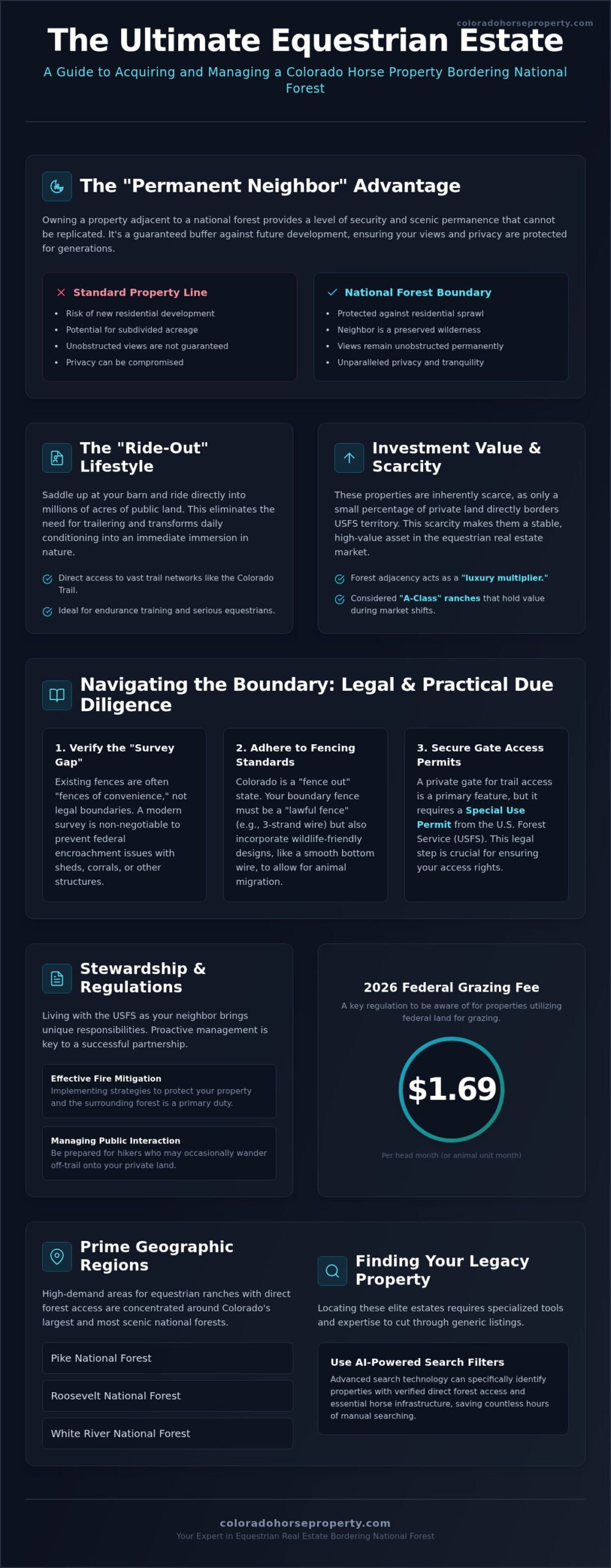
A boundary property is defined as deeded private land that shares at least one property line with the U.S. National Forest system. For a Colorado horse property bordering national forest, this adjacency represents a “permanent neighbor” agreement. Unlike private neighbors who might sell to developers or subdivide their acreage, the Forest Service preserves the land behind you. This provides a guaranteed buffer against residential sprawl. It ensures your views remain unobstructed by future rooflines or asphalt for generations. Finding a Colorado horse property bordering national forest requires local expertise to verify that the boundary lines are accurate and that the access is as promised.
The Freedom of Trail Riding from Your Barn
Direct access eliminates the logistical burden of loading a trailer for every afternoon ride. You can simply saddle up and ride through your back gate into millions of acres of public land. This “ride-in, ride-out” functionality is essential for serious equestrians, particularly those focused on endurance training or daily conditioning. Many of these elite properties connect directly to massive networks like the Colorado Trail or the Continental Divide Trail. It transforms your daily routine from a commute into an immediate immersion in the high-country ecosystem. You’re riding in active wildlife corridors where elk, mule deer, and bighorn sheep are your primary companions. This level of freedom is the primary driver for buyers seeking a true western lifestyle.
Investment Value and Scarcity in 2026
Market dynamics in 2026 continue to favor land with public borders. Only a small percentage of Colorado’s deeded acreage physically touches USFS boundaries, making these properties inherently scarce. They hold their value better during market shifts because their primary asset, unrestricted wilderness access, cannot be replicated. As the real estate market in areas like Douglas County sees steady price growth, these “A-Class” ranches remain the top tier of the market. National Forest adjacency acts as a luxury multiplier in equestrian real estate Colorado. Buyers are increasingly focused on these quality assets because they offer a lifestyle that even the most exclusive gated communities cannot match. Owning this land is more than a transaction; it’s a strategic partnership in land stewardship that pays dividends in both equity and quality of life.
Navigating the Boundary: Fencing, Gates, and Legal Access Rights
The technical reality of owning a Colorado horse property bordering national forest often centers on the “Survey Gap.” Many buyers assume that an existing fence line represents the legal boundary. In rural Colorado, fences are frequently “fences of convenience” built where the terrain allowed rather than where the deed dictates. The U.S. Forest Service (USFS) is strict about encroachments. If a previous owner accidentally built a loafing shed or corral inches over the line, the federal government can mandate its removal. Verifying these markers with a modern survey before closing is a non-negotiable step in protecting your investment.
Fencing Standards for Forest Neighbors
Colorado remains a “fence out” state. This means landowners are responsible for fencing neighboring livestock out of their property rather than the livestock owner being liable for trespass. When your land touches federal territory, you must maintain a “lawful fence,” typically a three-strand barbed wire structure. However, you must also balance this with wildlife-friendly guidelines. Colorado Parks and Wildlife (CPW) and the USFS prefer fencing that allows elk and mule deer to migrate without entanglement. Using a smooth bottom wire and specific height requirements helps maintain the local ecosystem while keeping your horses securely on your side of the line. Our team of Colorado horse property experts can help you review existing boundary infrastructure during your due diligence period.
Securing Your Private Access Point
Direct trail access is the primary draw for these estates, but a private gate into the forest is not an inherent right of land ownership. To legally install or maintain a gate, you must obtain a Special Use Authorization from the local District Ranger. These permits are often “permissive use” rather than “deeded access,” meaning they are granted at the discretion of the USFS and may not automatically transfer to a new buyer. Understanding Federal regulations on landowner access is critical when evaluating a property with an existing gate. Inherited gates that lack proper documentation can lead to surprise closures, so you must verify the permit status as part of the transaction management process.
Liability and public management are the final pieces of the boundary puzzle. While you enjoy access to the forest, public trail users may mistakenly believe your private gate is a public trailhead. Clear signage is your best defense. Marking your boundary with “Private Property” signs at the gate prevents hikers from wandering into your pastures or interacting with your horses. This protects your privacy and reduces the risk of liability issues involving the public on your equestrian estate.
Stewardship & Regulations: Living with the US Forest Service
When you purchase a Colorado horse property bordering national forest, your most influential neighbor isn’t the rancher down the road. It’s the District Ranger. This official manages the federal land that dictates your views, trail access, and safety protocols. Successful ownership requires active stewardship rather than passive enjoyment. You’re living in the Wildland-Urban Interface (WUI), where private assets meet public wilderness. This proximity demands a collaborative approach to land management, especially regarding water runoff and forest health. Establishing a professional rapport with the local ranger station allows you to stay informed about upcoming timber sales, trail closures, or watershed projects that could impact your equestrian lifestyle.
Fire Mitigation and Defensible Space
Fire safety is a shared burden. The USFS frequently conducts thinning and prescribed burns to reduce fuel loads on federal acreage. As a neighbor, you should coordinate your own defensible space efforts with these federal projects. Maintaining a buffer around your barn and arena isn’t just about safety; it’s about insurability. Many providers now require proof of mitigation for properties bordering dense timber. You can find resources through the Forest Stewardship Program to help plan these efforts. Colorado landowners often qualify for grants to offset the cost of forest health work, turning a regulatory necessity into a subsidized improvement that protects your livestock and infrastructure.
Understanding Grazing Allotments
Equestrians must distinguish between their deeded acreage and federal grazing permits. Owning a Colorado horse property bordering national forest doesn’t grant you the right to turn your horses out onto public grass. As of March 1, 2026, the federal grazing fee is $1.69 per animal unit month (AUM). This fee applies to permit holders, but even if you don’t hold a permit, you’re impacted by those who do. You must research existing allotments to see if cattle or sheep will be moved near your boundary during the summer months. Because Colorado is a “fence out” state, you’re responsible for keeping these animals off your private pastures. Environmental restrictions on federal land, such as riparian protections, may also limit where you can ride or how you manage runoff from your property.
Federal land management directly influences your private resources. Runoff from national forest slopes feeds the aquifers that your domestic and livestock wells rely on. If the USFS changes its management of a nearby watershed, your water capacity could be affected. This is why the “steward” mindset is so critical. By participating in local forest planning meetings and maintaining your boundary fences, you ensure your property remains a functional part of the high-country ecosystem while protecting your private property rights.
Prime Regions for Colorado Horse Properties Bordering National Forest
Colorado’s diverse topography means that a Colorado horse property bordering national forest in the Front Range offers a completely different lifestyle than one in the San Juan Mountains. Your choice of region dictates your climate, trail terrain, and the specific federal agency you’ll interact with most. While the Pike and Roosevelt National Forests provide immediate access to the Denver and Colorado Springs metro areas, the high-country forests like the White River offer elite, high-altitude ranching opportunities. Each region carries its own set of zoning challenges and market values that you must evaluate before making an offer.
The Front Range Corridor
Communities like Evergreen, Conifer, and Monument are the primary targets for riders who need to balance a professional career with wilderness access. These areas offer the seclusion of the forest without sacrificing proximity to city amenities. When searching for horse property for sale in colorado, buyers often look at the transition zones where private land meets the Pike National Forest. Zoning in these areas varies significantly; for instance, Douglas County maintains stricter residential equestrian standards, while Park County often provides more flexibility for agricultural use and larger livestock counts. The 2026 market shows Douglas County remains highly competitive, with steady price growth for parcels featuring direct forest gates.
Western Slope and Central Mountains
Steamboat Springs and the surrounding Routt National Forest represent the pinnacle of mountain equestrian living. The Uncompahgre Plateau is another favorite for long-distance trail riders who value expansive, rolling terrain over steep alpine climbs. It’s vital to recognize that price-per-acre values are significantly higher in regions with world-class ski resort proximity, such as those bordering the White River National Forest near Aspen or Vail. These properties are often considered legacy assets due to their rare combination of recreation and luxury infrastructure. Buyers in these regions are typically looking for “A-Class” ranches with established water rights and professional grade barns.
For those seeking expansive acreage and fewer neighbors, the San Juan and Rio Grande National Forests in Southern Colorado are ideal. These regions often feature larger deeded parcels that allow for more extensive grazing and private trail development. Regardless of the region, your success depends on understanding local county zoning. A property that physically touches the forest is only as valuable as its legal right to house your horses and support your infrastructure. To find your ideal match, use our AI-powered search for Colorado horse properties to filter by specific forest adjacency and county zoning requirements.
Finding Your Legacy Property: AI-Powered Search and Expert Representation
Generic real estate platforms often fail when identifying a true Colorado horse property bordering national forest. These sites rely on broad zip codes or proximity keywords that don’t account for the physical reality of a boundary line. A listing might claim “forest access” while actually requiring a two-mile trailer ride to a public trailhead. True adjacency means your deeded acreage physically touches federal land, a distinction that generic algorithms often miss. Identifying these legacy assets requires a specialized approach that combines advanced data filtering with decades of boots-on-the-ground experience.
AI-Powered Precision Search
Our proprietary AI tool solves the accuracy problem by identifying properties that “touch” the green on the map. This search engine doesn’t just look for keywords; it analyzes spatial data to ensure the property line is the forest line. You can filter for specific equestrian infrastructure like barns, indoor arenas, tack rooms, and hay lofts simultaneously with USFS adjacency. This level of granularity saves months of manual searching through irrelevant listings. In the fast-moving 2026 market, setting up real-time alerts through this system ensures you’re the first to see new forest-border listings as they hit the market.
The Realty Oasis Advantage
Finding the land is only the first step. Mark and Alison Eibner provide expert buyer representation backed by 40 years of experience with ranches for sale colorado. This tenure is vital when evaluating complex water rights, zoning restrictions, and the “Survey Gap” discussed in previous sections. We take a no-nonsense approach to property valuation. We ensure you don’t overpay for a “view” that lacks the legal infrastructure to support your horses. Our expertise in resource management allows us to spot potential issues with well permits or grazing allotments before you sign a contract.
Our team handles the entire transaction management process, including title coordination and escrow services. We verify that every gate permit and access right is documented so your legacy property is secure from day one. We act as your partners in land stewardship, helping you transition from a buyer to a responsible forest neighbor. To find your place on the boundary, Start your AI-powered search for forest-border properties today.
Securing Your Place on the Colorado Frontier
Owning a Colorado horse property bordering national forest is more than a real estate investment; it’s the fulfillment of a lifestyle dream that prioritizes freedom and stewardship. You now understand that while these boundaries provide permanent privacy, they also require a professional approach to survey gaps and USFS gate permits. Balancing your private property rights with the responsibilities of the Wildland-Urban Interface ensures your ranch remains a functional sanctuary for years to come.
Led by Mark and Alison Eibner, our team brings 40 years of Colorado real estate experience to your search. We use specialized AI equestrian search technology to identify properties that generic sites miss. Whether you’re looking for a Front Range retreat or a high-country legacy ranch, we provide the seasoned, no-nonsense guidance you need to navigate federal boundaries and land laws. Find your dream horse property bordering National Forest with our AI search tool. Your ideal trail starts right at your barn door. We’re ready to help you find it.
Frequently Asked Questions
Do I automatically get a gate into the National Forest if my property borders it?
You don’t automatically receive a private access gate just because your land touches the boundary. To install or maintain a gate, you must apply for a Special Use Authorization from your local District Ranger. These permits are discretionary and often temporary. If you’re buying a Colorado horse property bordering national forest with an existing gate, verify that the permit is documented and transferable during your due diligence period.
Can hikers from the National Forest legally cross onto my private horse property?
Hikers and public trail users don’t have a legal right to cross your private boundary. While the forest is public, your deeded acreage is not. To prevent accidental encroachment, you should clearly mark your property line with “Private Property” or “No Trespassing” signs. This is especially important near trailheads or popular recreation areas where the distinction between public wilderness and your private equestrian estate might be unclear to visitors.
Who is responsible for maintaining the fence between my land and the National Forest?
The private landowner is typically responsible for maintaining the boundary fence. Colorado operates under “fence out” laws, meaning you must protect your land from trespassing livestock. The Forest Service generally doesn’t contribute funds or labor to maintain fences for the benefit of private neighbors. Keeping your fence in good repair is essential to prevent your horses from drifting onto federal land and to keep neighboring cattle out of your pastures.
Are there restrictions on what I can build near the National Forest boundary?
Local county zoning and building codes dictate how close you can build to the property line. Most Colorado counties require specific setbacks for barns, arenas, and dwellings. Additionally, the Forest Service may hold easements for utilities or access that restrict permanent structures. You should always consult with the county planning department and review your title commitment to identify any federal restrictions that might impact your planned equestrian infrastructure near the boundary.
Can I ride my horses anywhere in the National Forest from my property?
Horseback riding is generally permitted on most national forest lands, but you must stick to designated trails and open areas. Some sensitive regions or wilderness areas have seasonal restrictions to protect wildlife or prevent trail erosion. It’s your responsibility to check current USFS travel management maps for your specific forest district. Always follow “Leave No Trace” principles to ensure continued access and maintain a positive relationship with federal land managers.
How does bordering a National Forest affect my property taxes in Colorado?
Bordering federal land doesn’t change your assessment rate, but it can increase your property’s actual value due to scarcity. For the 2026 tax year, agricultural property in Colorado is assessed at 25% of its actual value. To maintain this favorable rate on your Colorado horse property bordering national forest, you must prove the land is used for a primary agricultural purpose, such as grazing or hay production, rather than just residential recreation.
What are the fire mitigation requirements for properties bordering federal land?
There isn’t a federal law requiring private owners to mitigate fire risk, but local ordinances and insurance providers often mandate it. Properties in the Wildland-Urban Interface face higher risks from wildfire. You should create a defensible space by thinning timber and clearing brush within 100 feet of your structures. Coordinating these efforts with USFS forest health projects can improve your property’s safety and help you maintain essential insurance coverage for your ranch.
Can I use the National Forest for grazing my horses if I border it?
You cannot graze horses on federal land without a valid grazing permit or allotment. As of March 1, 2026, the federal grazing fee is $1.69 per animal unit month (AUM). These permits are highly regulated and often tied to specific legacy allotments. If your property doesn’t come with an existing permit, you must keep your horses within your fenced private acreage to avoid federal fines and legal action for unauthorized use.