
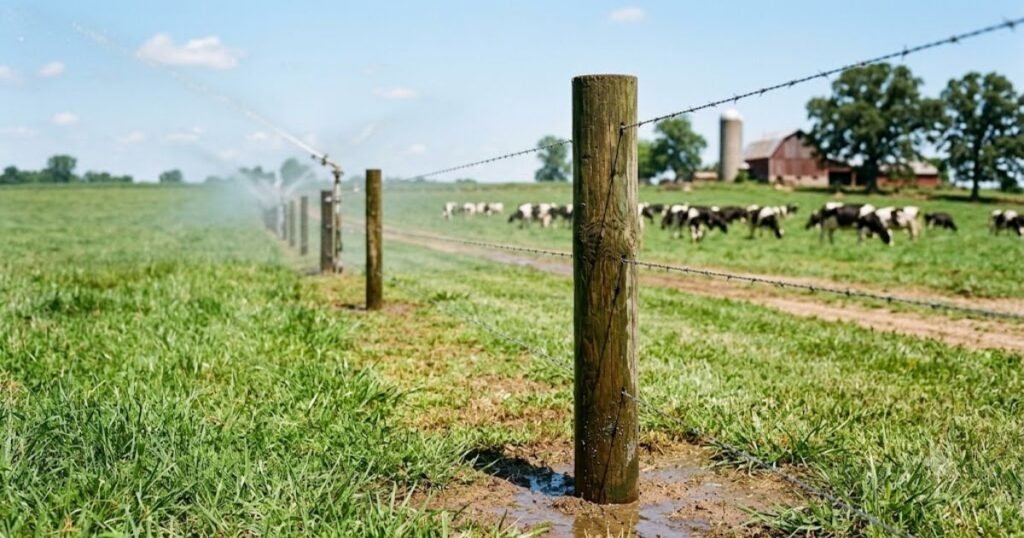
You purchase a spectacular 10-acre equestrian estate with lush, irrigated pastures. Surrounding the emerald green grass is a stunning, freshly painted, white three-rail wooden fence. It looks like a picture-perfect Kentucky horse farm.
Throughout June and July, you run your heavy agricultural sprinklers every other day to keep the grass alive. In late August, your 1,200-pound Warmblood leans his chest against the top rail to reach a patch of clover on the other side. You hear a loud crack, and suddenly, a 40-foot section of the fence completely collapses.
When you go to inspect the damage, you find that the beautiful white posts snapped cleanly right at the dirt line. The wood above ground was pristine, but the wood below ground had the consistency of wet cardboard.
When buyers look at colorado horse ranches for sale, they almost always judge a fence by how straight and pretty it looks from a distance. But in an irrigated Western pasture, the real value of a fence is buried six inches underground.
Here is how to evaluate the structural integrity and treatment quality of wooden fence posts before you buy the farm.
Can the Well Pump Maintain Consistent Pressure During Peak June Irrigation Demands From Neighboring Properties?
Quick Summary: The Summer Drawdown
- The Cone of Depression: When a well pump activates, it pulls water from the surrounding dirt, creating an invisible, funnel-shaped dip in the water table called a "cone of depression."
- Well Interference: In dense rural subdivisions, when all the neighbors turn on their heavy agricultural sprinklers in June, those individual cones overlap. This massive, simultaneous draw temporarily pulls the local water table down, starving shallower wells of pressure and volume.
- The Submersible Burnout: If the water level drops below your pump’s intake screen, the pump will suck air. Without water to cool its internal motor, a $2,000 submersible pump can overheat and burn out in a matter of hours.
- The Cistern Buffer: You cannot control your neighbors' water usage, but you can isolate your property from the fluctuation. Installing a large holding cistern with a dedicated pressure booster pump guarantees 60 psi to your barn and house, regardless of what the aquifer is doing.
A spring well test only shows how the system behaves when the aquifer is relatively relaxed. The real stress test happens during peak summer irrigation when the whole neighborhood is drawing hard.
1. The Invisible Shared Aquifer and "Well Interference"
Groundwater is not an isolated underground lake directly beneath your property; it is water trapped in layers of rock and sand that flows across property lines.
- The Overlapping Cones: When your neighbor pumps water to irrigate their pasture, it pulls the surrounding water table down. If your well is located too close to their well, you are both pulling from the same immediate underground pocket. This is known as "well interference."
- The Summer Surge: During the winter, domestic household use is incredibly low, and the aquifer easily keeps up. But in June and July, agricultural irrigation demands spike by hundreds of percentage points. The combined draw of an entire valley pumping simultaneously can temporarily drop the static water level by tens of feet.
- The Pressure Drop: If your pump was sitting in 40 feet of standing water in March, but the neighbors' June irrigation drops the water table by 35 feet, your pump is suddenly starving for water. It can no longer build the pressure required to push water up the pipe to your house, resulting in sputtering faucets and failed sprinklers.
2. Pump Placement: Depth vs. Set Level
A deep well does not automatically protect you from pressure loss; it depends entirely on where the pump is hanging.
- The Borehole vs. The Pump: A well driller might have drilled an 800-foot hole, but if they found good water at 300 feet, they likely hung the submersible pump at 350 feet to save money on wire and pipe.
- The Drawdown Buffer: If the well log shows the hole is significantly deeper than the pump setting, you have a safety net. When the summer drawdown hits, a licensed well technician can pull your pump and physically lower it another 100 feet down the existing borehole, dropping it below the zone of summer well interference.
- The Shallow Well Trap: If the borehole itself is only 150 feet deep, and the pump is sitting at the very bottom at 145 feet, you have nowhere to go. When the neighbors irrigate and the water table drops below 145 feet, you are out of water until the aquifer recovers in the fall.
The total drilled depth alone is not enough. You want to know the pump setting, the historical static water level, and how much unused depth remains if seasonal drawdown becomes a problem.
3. The Cistern and Booster Pump Solution
If you share a sensitive aquifer with heavy-irrigating neighbors, you cannot change the geology. You must engineer your way out of the problem.
- The Decoupled System: The ultimate defense against well interference is decoupling your home's water pressure from the well's real-time performance. This is done by installing a massive storage cistern, typically 1,500 to 3,000 gallons, either buried underground or inside a heated outbuilding.
- The Overnight Trickle: Instead of demanding 10 gallons per minute during the peak afternoon heat when the neighbors are watering, you set your well pump on a timer to slowly trickle-fill the massive cistern at 2 gallons per minute during the middle of the night when the aquifer has recovered.
- The Constant Pressure: The cistern acts as your private, on-site lake. A separate, high-horsepower booster pump sits next to the cistern and pushes water to your house and barn. Because the booster pump pulls from the full tank rather than the struggling aquifer, you will experience flawless, municipal-grade 60-psi water pressure 24/7, even during the worst July droughts.
4. Evaluating the Pressure Tank Health
Sometimes the pressure drop is not the aquifer; it is a failure of the mechanical equipment already inside the house.
- The Water-Logged Tank: Every well system has a blue or grey steel pressure tank sitting in the utility room. Inside is a heavy rubber bladder pre-charged with air. When the pump pushes water in, it compresses the air, creating the pressure that blasts out of your shower head.
- The Short-Cycling Warning: Over time, the rubber bladder can tear, or the air charge can leak out. The tank becomes "water-logged." When this happens, the pump turns on, instantly hits 60 psi, turns off, and then instantly drops to zero the second you open a faucet. This rapid on/off "short cycling" destroys water pressure and will burn out the submersible pump in a matter of weeks.
We Evaluate the Well Logs Before You Buy
We do not just turn on the kitchen sink; we investigate the hydrology of the valley.
When Mark Eibner and Belinda Seville represent you in buying an equestrian property, we pull the historical well logs. We look at the depth of the borehole, the static water level, and the set depth of the pump. We analyze the density of surrounding agricultural pivots and help you identify if a property requires the immediate addition of a cistern system so your horses never go thirsty during the heat of a Colorado summer.
Contact Us Today to find a property with secure, resilient water infrastructure.
Browse Active Colorado Horse Properties: Browse Active Colorado Horse Properties fully equipped to handle peak summer demands
Frequently Asked Questions (FAQ) About Well Pressure and Drawdown
Can I legally force my neighbors to stop irrigating if my well loses pressure?
Generally, no. Under Colorado water law, unless you can legally prove in Water Court that a specific junior water-rights holder is maliciously or illegally over-pumping beyond their decreed limits and directly injuring your senior water right, you have very little recourse. It is an expensive and difficult legal battle. Upgrading your own storage infrastructure is almost always cheaper and faster.
Will a larger horsepower submersible pump fix my summer pressure drop?
No. If the water table has physically dropped below the pump intake due to well interference, putting a bigger, faster pump in the hole will only suck the hole dry faster. You cannot pump water that is not there.
How much does it cost to install a 2,000-gallon cistern and booster pump system?
Depending on whether the tank is buried, which requires heavy excavation to get below the frost line, or placed in an existing heated shop, a complete commercial-grade cistern and constant-pressure booster pump system typically ranges from $8,000 to $15,000 fully installed.