
What if the 40-acre ranch you’re dreaming of today becomes the heavy burden that forces you out of the saddle in just ten years? It’s a common fear for equestrians searching for retirement horse properties for sale Colorado offers. You want the freedom of the Front Range and a deep connection to your animals, but you don’t want to spend your retirement years fixing miles of fence or worrying about complex water litigation. Finding that balance requires more than just a beautiful view; it requires a strategic approach to land management and infrastructure.
We believe your legacy ranch should be a place of joy rather than a source of exhaustion. This guide will help you discover the perfect, manageable Colorado equestrian estate that balances world-class facilities with long-term accessibility. You’ll learn how to navigate the 2026 property tax assessment rates and the new water rights regulations under House Bill 26-1340. We’ll also preview the best regions for “right-sized” acreage, where modern, low-maintenance barns and proximity to specialized medical services ensure you can keep riding for decades to come.
Key Takeaways
- Understand why the 2026 market favors buyers seeking established equestrian estates on the Front Range and Western Slope.
- Identify the specific “ranch style” home layouts and low-maintenance barn features that ensure your property remains manageable as you age.
- Discover the top regions for retirement horse properties for sale Colorado offers, from the vet-rich Douglas County to the milder climates of the Western Slope.
- Learn how to evaluate “Senior” vs. “Junior” water rights and why well permit verification is the most critical step in your due diligence process.
- See how AI-powered search tools can simultaneously filter for single-level living and high-quality equestrian facilities to streamline your search.
Why Colorado is the Premier Destination for Equestrian Retirement in 2026
Colorado offers a rare combination of rugged freedom and sophisticated infrastructure. For senior riders, the appeal lies in the state’s diverse geography. You can choose the high desert plains of the Western Slope for milder winters or the lush alpine meadows of the Front Range. This variety makes finding retirement horse properties for sale Colorado has to offer a highly personalized experience. Beyond the scenery, the mental and physical health benefits of daily barn chores and trail riding provide a sense of purpose that keeps retirees active and engaged with the landscape.
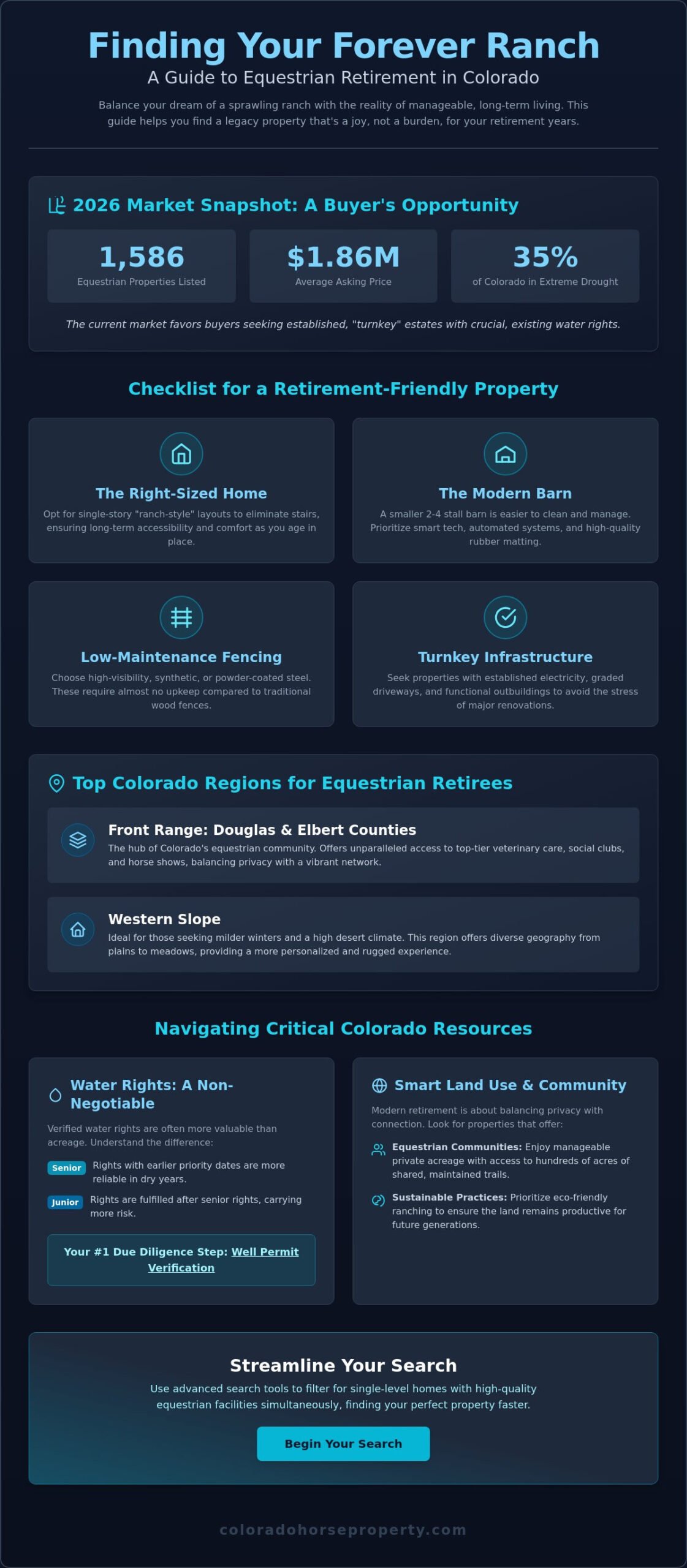
The 2026 real estate market is currently seeing a shift toward established estates. With 1,586 equestrian properties listed statewide at an average price of $1,859,286, buyers are finding more “turnkey” opportunities than in previous years. These properties often feature mature pastures and existing water rights, which are vital as 35% of the state currently faces extreme drought conditions. Investing in an established ranch allows you to bypass the complexities of new construction while securing your place in Colorado’s equestrian heritage.
To better understand the potential of a legacy property, watch this walkthrough of a premier 175-acre ranch with private forest access:
The 2026 Equestrian Lifestyle in the Rockies
Colorado’s dry climate is a significant advantage for equine joint health. Low humidity helps manage inflammation in older horses, keeping your companions comfortable for longer. We’re also seeing a rise in “equestrian communities” that offer shared trail access and sustainable land management. These developments allow you to own manageable acreage while enjoying hundreds of acres of communal riding space. Modern retirees are prioritizing these eco-friendly ranching practices to ensure the land remains productive for future generations.
Balancing Privacy with Community
Retirement shouldn’t mean isolation. The best properties offer total seclusion on-site but remain within a short drive of local horse shows and social clubs. Proximity to top-tier veterinary care in Douglas and Elbert Counties is a priority for most of our clients. By selecting a property near these hubs, you ensure your ranch remains a functional legacy for your family without sacrificing the social connection of a vibrant horse community. It’s about finding a “forever” home that balances the peace of the Rockies with the practical needs of a lifelong equestrian.
Essential Features of a Retirement-Friendly Horse Property
Transitioning to a legacy ranch shouldn’t mean increasing your daily workload. When browsing retirement horse properties for sale Colorado offers, the goal is right-sizing your infrastructure. You want a property that works for you, rather than the other way around. This starts with a single-story home. A ranch-style layout eliminates stairs, allowing you to age in place while staying just steps away from your horses. It ensures your home remains accessible and comfortable for decades without the need for future modifications.
Look for turn-key properties to avoid the physical and financial stress of major renovations. A retirement-friendly estate should already have established electricity, graded driveways, and functional outbuildings. Safety-first fencing is another non-negotiable. Opt for high-visibility, synthetic, or powder-coated steel options. These materials require almost no painting or repair compared to traditional wood, which can become a constant maintenance chore. Choosing low-maintenance materials now prevents expensive and exhausting repairs later in life.
The Evolution of the Retirement Barn
Modern equestrian retirement is moving away from massive, 10-stall complexes. A smaller, 2-4 stall barn is often superior. It’s easier to clean and keeps your daily routine efficient. Incorporate smart barn technology like remote temperature monitoring and automated lighting systems. High-quality rubber matting and automatic waterers are essential for reducing heavy lifting and manual labor. Adding a covered or indoor round pen ensures you can stay in the saddle during unpredictable spring weather without battling the wind or snow.
Land Management for the Senior Owner
The sweet spot for many retirees is between 10 and 35 acres. This provides enough space for privacy and grazing without requiring industrial-sized equipment to maintain. Focus on flat or gently rolling terrain to ensure ease of movement for both you and your senior horses. You can find more details on specific regional requirements in our guide to equestrian real estate Colorado features. Terrain that is easy to navigate helps prevent injuries and makes daily checks on your livestock much simpler.
Remember that land utility depends heavily on resource access. Navigating Water Rights is a fundamental part of evaluating any Colorado property. Ensure your well permit allows for livestock use, as some residential permits are restricted to indoor use only. If you’re ready to see how these features look in person, you can explore current Colorado listings that meet these specific retirement criteria.
Top Colorado Regions for Retired Horse Owners
Selecting a region for your legacy ranch is a decision that balances lifestyle goals with logistical realities. When you’re evaluating retirement horse properties for sale Colorado has available, the geography dictates the ease of your daily routine. Douglas and Elbert Counties are the primary hubs for equestrian activity. Douglas County currently sees an average listing price of $2,153,254, reflecting its status as a premier location. The value here isn’t just in the land; it’s in the density of specialized equine surgeons and 24-hour emergency clinics that provide peace of mind as your horses age.
Northern Colorado, encompassing Larimer and Weld Counties, offers a robust agricultural environment with expansive trail systems. These areas are ideal for those who want a community deeply rooted in ranching traditions. Conversely, if you’re seeking a more arid climate with high sun exposure, Pueblo and Fremont Counties provide more affordable entry points. While these southern regions are budget-friendly, you must be diligent about water rights. With 35% of the state facing extreme drought, a property’s well permit and its “presumed non-injury” status on 35-plus acres become critical assets for long-term sustainability.
The Front Range Advantage
The Front Range provides unparalleled access to specialized equine care, specifically the CSU Veterinary Teaching Hospital in Fort Collins. This facility is a cornerstone for senior horse owners who may need advanced diagnostics or long-term health management for their animals. Proximity to major transportation hubs like Denver International Airport is another practical benefit. It ensures that family can visit your ranch without the stress of long mountain drives. Check our Colorado ranches for sale for specific regional breakdowns that help you weigh these logistical advantages against your retirement budget.
Western Slope: The “Banana Belt” for Equestrians
The Western Slope, particularly the Uncompahgre Valley near Montrose and Grand Junction, offers a milder climate often referred to as the “Banana Belt.” At these lower elevations, the physical toll of high-altitude living is significantly reduced. This is easier on your lungs and your horse’s joints. You’ll find longer growing seasons and abundant irrigated pastures, which are essential for maintaining quality forage. This region provides access to year-round riding in nearby canyonlands, allowing you to stay in the saddle through the winter months without the heavy snowpack found in the high Rockies.
Navigating Water Rights and Land Use for Colorado Retirees
Securing a legacy ranch requires a deep understanding of Colorado’s “first in time, first in right” water doctrine. When searching for retirement horse properties for sale Colorado offers, you must distinguish between senior and junior water rights. Senior rights were established earliest and have priority during drought cycles. With 35% of the state currently facing extreme drought conditions as of June 2026, owning junior rights could mean your water supply is curtailed when you need it most. This legal hierarchy is the most critical factor in ensuring your pastures remain viable and your livestock stay hydrated through the summer months.
Zoning laws are equally important for retirees who plan to keep multiple horses. Most counties use an “Animal Unit” (AU) system to determine carrying capacity. A standard 1,000-pound horse typically counts as one AU. You must also account for setback requirements, which often mandate that barns or manure storage be 50 to 100 feet from property lines or wells. Ensuring your intended use is a “Use by Right” rather than requiring a “Special Use Permit” will save you from bureaucratic headaches and potential conflicts with local statutes.
Securing Your Water Future
Well permits are the lifeblood of a rural property. A property of at least 35 acres typically holds a “presumed non-injury” status, making it easier to obtain a domestic well permit for watering livestock. For smaller parcels, you might encounter “Household Use Only” permits, which strictly prohibit outdoor watering. When evaluating high-value horse real estate for sale, we recommend hiring a water attorney to verify ditch rights and historical usage. If you are looking in Water Division 2 (the Arkansas River Basin), be aware of House Bill 26-1340. This law requires revegetation or erosion management if you ever transfer agricultural irrigation rights to other uses.
Managing Property Taxes through Land Use
For the 2026 tax year, residential property is assessed at 7.05% for schools and 6.8% for local governments. While agricultural property is assessed at a higher rate of 25%, the actual valuation is based on the land’s productive capacity rather than its market value. This often results in significantly lower annual taxes. You can maintain this “Ag status” through grazing leases or hay production, even if you aren’t running a commercial operation. Conservation easements are another tool for legacy planning, offering tax relief while protecting your ranch from future development. Our team provides comprehensive Transaction Management and Title Services to verify these land rights and tax statuses before you close on your new home.
Using AI to Secure Your Retirement Horse Property in Colorado
Generic search engines often force you to choose between a comfortable home and a functional ranch. You might find a great house with no barn, or a world-class arena attached to a multi-story home that won’t suit your physical needs in a decade. Our AI-Powered Horse Property Search solves this by allowing you to filter for “single-level living” and “equestrian facilities” simultaneously. This ensures that every listing for retirement horse properties for sale Colorado has on our platform meets your specific longevity requirements from the first click.
The technology doesn’t just look at bedroom counts. It scans listing data for specific infrastructure we’ve identified as essential, such as automatic waterers, rubber matting, and easy-clean stalls. You can also set up precise alerts for properties with specific water right designations, such as “domestic” well permits or senior ditch rights. This is vital given that 35% of Colorado is currently facing extreme drought. Instead of manual searching, our technology identifies properties based on the quality of the pasture and the maturity of the facilities, saving you months of due diligence.
Beyond the Standard MLS Search
Generic real estate sites often miss “hidden gems” because they rely on broad categories. Our proprietary AI identifies listings near Colorado Horse Parks & Riding Trails by analyzing proximity data that standard filters ignore. You can customize your parameters with keywords like “low-maintenance” or “turn-key” to find estates that are ready for immediate move-in. This specialized approach uncovers properties that meet the “right-sizing” criteria, focusing on manageable acreage rather than overwhelming land mass that requires constant labor.
Starting Your 2026 Property Search
Before you schedule your first viewing, secure financial pre-approval specifically for ranch land. Lenders often view agricultural properties differently than standard residential homes, so having your documentation ready is essential for a smooth transaction. Working with Mark and Alison Eibner’s specialized team provides you with a seasoned partner who understands the nuances of animal units and zoning setbacks. We offer expert Buyer Representation and Transaction Management to ensure your legacy ranch is a sound investment. You can start your AI-powered search for retirement horse properties today and let our technology find the estate that fits your future.
Secure Your Future in the Colorado Saddle
Your retirement should be defined by the time spent with your horses, not the time spent maintaining a property that has outgrown your needs. By focusing on “right-sized” acreage and low-maintenance infrastructure, you ensure your legacy ranch remains a source of joy for decades. Navigating the 2026 water rights regulations and property tax assessments requires specialized knowledge that only comes with decades of local experience. Finding the ideal retirement horse properties for sale Colorado has available is a strategic process that balances your current passion with your future physical comfort.
Led by industry veterans Mark and Alison Eibner, our team brings 40 years of service to the Colorado Front Range. We combine this deep historical expertise with specialized AI search technology to identify estates with the exact equestrian features you need. From verifying senior water rights to finding single-level homes near top-tier veterinary care, we’re here to simplify your transition. Find Your Legacy Horse Property with Our AI Search Tool today. The Rocky Mountain lifestyle you’ve worked for is within reach, and we’re ready to help you secure it.
Frequently Asked Questions
What is the best county in Colorado for retired horse owners?
Douglas and Elbert Counties are the premier choices due to their high density of specialized equine veterinarians and proximity to top-tier medical services. Douglas County currently sees an average listing price of $2,153,254, reflecting its status as a high-demand hub. For those prioritizing milder winters and lower elevations, Montrose and Grand Junction on the Western Slope provide a “Banana Belt” climate that is significantly easier on both human and equine joints.
How many acres do I really need for two horses in retirement?
A property between 10 and 35 acres is the ideal “sweet spot” for most retirees managing two horses. This size provides sufficient grazing and privacy without requiring industrial-grade maintenance equipment or a full-time ranch hand. You must check county-specific “Animal Unit” regulations, as some areas require specific acreage minimums to maintain healthy pastures. This range also helps secure “presumed non-injury” status for well permits in many Colorado water basins.
Are there specific tax breaks for senior horse property owners in Colorado?
The primary tax benefit comes from maintaining Agricultural status, where land is valued based on its productive capacity rather than its market value. For the 2026 tax year, residential property is assessed at 7.05% for schools, while agricultural property is assessed at 25%. However, the significantly lower valuation of Ag land often results in a smaller total tax bill. You can achieve this by leasing land for hay production or grazing, even on smaller retirement estates.
Is it better to buy a turn-key horse property or build new in retirement?
Buying a turn-key property is generally the superior choice for retirees to avoid the physical and financial stress of new construction. Building in Colorado involves complex well permitting, utility trenching, and strict setback requirements that can take years to navigate. Established retirement horse properties for sale Colorado buyers prefer often feature mature pastures and existing water rights, allowing you to enjoy the lifestyle immediately rather than managing a construction site.
How do I check the water rights on a Colorado horse property before buying?
You should verify water rights during the contract’s Water Rights Due Diligence period by reviewing records from the Colorado Division of Water Resources. It is vital to confirm whether your well permit is “Domestic,” allowing for livestock, or “Household Use Only,” which strictly prohibits outdoor use. On properties under 35 acres, obtaining a new permit for outdoor watering is complex, making it essential to verify senior water rights before your closing date.
What are the most important “aging-in-place” features for an equestrian home?
The most critical features include single-story ranch layouts to eliminate stairs and wide doorways for future accessibility. In the barn, look for automatic waterers to eliminate heavy hose dragging and high-quality rubber matting to reduce the impact on your joints during chores. Low-maintenance fencing, such as powder-coated steel or synthetic materials, is also essential because it removes the need for repetitive painting and structural repairs as you age.
Can I maintain a horse property alone in my 70s?
It is entirely possible to maintain a horse property alone in your 70s if the infrastructure is designed for efficiency. Smaller, 2-4 stall barns with “smart” monitoring and automated systems significantly reduce the daily physical workload. Utilizing local services for heavy tasks like hay delivery and manure removal allows you to focus on riding. Selecting a property with flat terrain also makes daily perimeter checks and feeding much safer and physically manageable.
How does the AI search tool help find manageable horse properties?
Our AI search tool identifies properties by cross-referencing residential features like “single-level living” with technical equestrian requirements like “indoor arena” or “irrigated pasture.” Most generic search engines cannot filter for these specific combinations, often forcing you to sift through multi-story homes that aren’t retirement-friendly. This technology helps you find retirement horse properties for sale Colorado offers that are specifically “right-sized” for longevity, saving you time and preventing a future relocation.