
What if the most breathtaking sunset on your new 40 acre spread is actually masking a six figure infrastructure failure or a senior water right that doesn’t legally belong to you? You’ve likely spent years dreaming of Colorado’s expansive horizons and the freedom of land ownership. It’s natural to feel anxious about the “lifestyle versus reality” gap, especially when your legacy is on the line. The fear of hidden costs or legal entanglements can turn an aspirational purchase into a source of constant stress, making the process of avoiding buyer’s remorse on a ranch purchase feel like a high-stakes gamble.
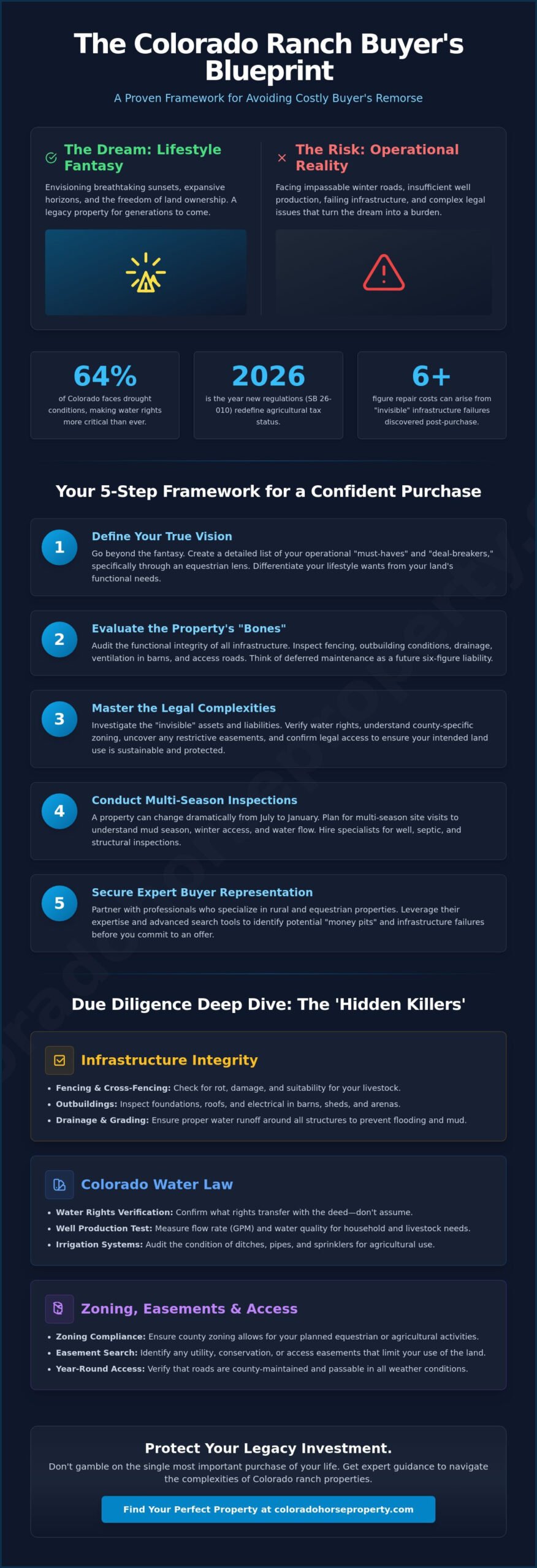
This guide provides a proven framework to help you navigate these complexities by bridging the gap between your vision and the land’s operational reality. With over 64% of the state currently facing drought conditions and new 2026 regulations like SB 26-010 redefining agricultural tax status, the stakes for due diligence have never been higher. We will walk you through the complexities of Colorado water law, the impact of the 25% agricultural assessment rate, and the essential “invisible” assets that ensure your property remains a dream instead of a burden. You’ll gain the legal certainty and operational clarity needed to move forward with confidence.
Key Takeaways
- Learn how to distinguish between lifestyle fantasies and operational realities by defining your property “must-haves” through an equestrian-specific lens.
- Discover how to evaluate the “bones” of a property, including fencing integrity and outbuilding conditions, to prevent hidden maintenance costs from becoming a financial burden.
- Master the complexities of Colorado water rights and county-specific zoning to ensure your intended land use is legally sustainable and protected.
- Implement a proven 5-step framework for avoiding buyer’s remorse on a ranch purchase by conducting multi-season site visits and specialized professional inspections.
- Understand how expert buyer representation and AI-powered search tools identify potential “money pits” and infrastructure failures before you commit to an offer.
Understanding the Psychology of Ranch Buyer’s Remorse in 2026
Ranch buyer’s remorse is more than a simple case of post-purchase anxiety. It’s the technical realization that a property’s utility fails to meet your intended operational use. In Colorado’s 2026 market, where high demand and limited inventory create a “buy now or lose out” environment, many buyers bypass critical due diligence. You might fall in love with a panoramic view of the Sangre de Cristo Mountains in July, only to discover in January that the access road is impassable or the well production is insufficient for your livestock. This mismatch between the aspirational dream and the daily labor of land management is the core of avoiding buyer’s remorse on a ranch purchase.
To better understand how these feelings manifest and how to stay objective during your search, watch this helpful video:
Cognitive Dissonance in Legacy Purchases
Buying a ranch is often a legacy move, which adds immense emotional weight to the transaction. This pressure can trigger a specific psychology of ranch buyer’s remorse where the brain works overtime to justify a massive investment. You might notice a cracked foundation in a barn or poor soil quality but dismiss them as minor issues to maintain the narrative of the perfect find. True structural regret happens when these ignored red flags turn into systemic failures. It’s different from standard “buyer’s jitters,” which are usually temporary. Genuine remorse stems from the discovery of permanent limitations, such as restricted easements or senior water rights held by a neighbor. These aren’t just inconveniences; they’re fundamental flaws in the property’s utility.
Fantasy vs. Operational Reality
The “Yellowstone Effect” has painted a cinematic picture of ranching that often skips the less glamorous details. Daily life on a Colorado ranch involves managing mud, fixing frozen fence lines, and maintaining complex irrigation systems. If a property lacks proper drainage in its equestrian facilities, your dream of a world-class training center can quickly turn into a literal swamp. Buyers often overestimate their capacity for land management. Before you sign, you must assess if you have the time, equipment, or budget to handle 100+ acres. If the property requires three hours of tractor work every weekend just to keep the driveway clear, will you still love it in five years? Reality hits hard in winter. Understanding your true operational limits is the best way to ensure your legacy purchase remains a dream.
The Operational Reality Check: Infrastructure and Land Management
Evaluating the “bones” of a Colorado ranch requires a shift in perspective. You aren’t just buying a home; you’re acquiring a complex operational system. Successfully avoiding buyer’s remorse on a ranch purchase often hinges on seeing past the aesthetic charm of a property to audit its functional integrity. While the median price per acre in Colorado is approximately $12,427, rural agricultural land can range from $600 to $5,000. This price gap usually reflects the quality of existing infrastructure and the state of the land itself. Performing thorough due diligence for a large land purchase means looking at fencing and outbuildings as line items on a future balance sheet. Deferred maintenance on a 100 acre spread can quickly escalate into a six figure liability.
Equestrian Infrastructure Audit
Barns and arenas are the heart of a horse property, but they are also common sources of regret. Inspect every structure for proper ventilation and drainage. A barn with poor airflow leads to respiratory issues for your horses, while a lack of drainage can compromise the foundation. Arena footing is another critical factor. Replacing low quality footing in a large indoor arena is a massive expense that many buyers fail to calculate. You should also verify the functionality of automatic waterers. In the Rockies, these systems must be properly insulated and heated to survive sub-zero temperatures. If you’re unsure where to start, using an AI-powered property search can help you filter listings by specific infrastructure needs, ensuring you only view properties that meet your operational standards.
Accessibility and Seasonal Challenges
Colorado’s geography presents unique logistical hurdles. Year-round access is not guaranteed on remote parcels. You must assess the difficulty of snow removal and the impact of “mud season” on your primary roads. If the property is miles from the nearest paved road, your costs for fuel and vehicle maintenance will rise. Proximity to essential services like equine veterinarians and farriers is a frequently overlooked stressor. A two hour wait for an emergency vet call is a high price to pay for isolation. Additionally, check the reliability of the local power grid. Remote ranches often require robust backup generator systems to keep well pumps and heaters running during winter storms. Pasture health is also tied to climate. With over 64% of the state currently abnormally dry to severely dry, your livestock capacity is dictated by soil composition and water availability rather than just total acreage.
Navigating the ‘Hidden Killers’: Water Rights, Zoning, and Easements
While the physical condition of a barn is visible to the naked eye, the legal constraints of the land are often invisible until after the closing. These “hidden killers” are the primary drivers of long-term legal regret. In Colorado, the most critical factor in avoiding buyer’s remorse on a ranch purchase is understanding that owning the surface land does not guarantee control over the water or minerals beneath it. Discovering that a third party has the right to extract oil from your backyard or that your stream belongs to a downstream municipality can shatter the dream of a private legacy ranch.
Mineral rights often involve “split estates.” In these scenarios, the mineral interest has been severed from the surface land. This means a mineral owner may have the legal right to use a reasonable portion of your surface to access their resources. Additionally, conservation easements can severely limit your ability to build new structures or subdivide the property. While these easements offer tax benefits, they can be a source of remorse if you later decide to expand your equestrian facilities or add guest housing. Thoroughly vetting the title commitment for these encumbrances is a non-negotiable step in the due diligence process.
Colorado Water Law 101 for Ranch Buyers
Colorado operates under the doctrine of “prior appropriation,” which essentially means “first in time, first in right.” Senior water rights are the most valuable asset a ranch can possess. If you hold junior rights during a drought, like the conditions currently affecting over 64% of the state, you may be legally prohibited from drawing water until senior holders are satisfied. You must also verify your well permits. Under the 35 acre rule, parcels of at least 35 acres generally qualify for a domestic well permit that allows for watering livestock. Smaller parcels may be restricted to “household use only,” which prohibits outside watering. Adjudicated water rights are the gold standard for Colorado land because they have been formally decreed by a water court, providing a clear legal priority and quantity.
Zoning and Land Use Restrictions
Local zoning laws dictate the number of “animal units” allowed per acre, which varies significantly by county. You must confirm that your intended use, whether it’s a commercial boarding stable or a private breeding operation, aligns with local “right-to-farm” protections. If you plan to house ranch hands, check for regulations regarding Accessory Dwelling Units (ADUs). Some counties have strict limits on secondary residences. You should also identify utility or public access easements. A hidden easement that allows a utility company to run heavy machinery through your prime grazing pasture can quickly turn a peaceful property into a source of constant frustration.
A 5-Step Framework for a Regret-Free Ranch Purchase
Moving from the “dream phase” to successful ownership requires a disciplined approach. You can’t rely on a standard residential checklist when millions of dollars and a family legacy are at stake. A structured framework is the most effective tool for avoiding buyer’s remorse on a ranch purchase. This process ensures that every decision is backed by data rather than just emotion. By following these five steps, you’ll identify potential failures before they become your financial responsibility.
- Step 1: Define ‘Must-Haves’ vs. ‘Nice-to-Haves’. Prioritize land utility and water rights over the interior finishes of the main house.
- Step 2: Conduct Multi-Season Site Visits. View the property during mud season or after a heavy snow to understand true accessibility and drainage.
- Step 3: Perform a Deep-Dive Legal Audit. Hire specialists to verify title, adjudicated water rights, and any severed mineral interests.
- Step 4: Create a 5-Year Operational Budget. Include property taxes, labor, and the specialized equipment needed for land management.
- Step 5: Partner with a Niche-Specialized Brokerage. Work with experts like Colorado Horse Property who understand the technical requirements of equestrian and agricultural land.
Building Your Ranch ‘Must-Have’ List
Successful ranch owners prioritize land quality over house aesthetics. While a kitchen can be remodeled, you can’t easily fix poor soil composition or a lack of natural shelter for livestock. Your list should reflect the specific requirements of your discipline. If you focus on cattle work, grazing capacity and fencing integrity are paramount. For those in reining or jumping, the potential for high-quality arena footing and drainage is the priority. You can use our equestrian real estate Colorado guide to refine your search parameters and ensure you aren’t overlooking critical regional factors.
The Financial Reality of Ranch Ownership
The 2026 tax year brings significant changes for Colorado landowners. The assessment rate for agricultural property is now 25% of its actual value. Maintaining this Ag status is vital for long-term affordability. Under new law S.B. 26-010, your land must be used for a “pasture-based operation” for profit to qualify. Beyond taxes, you must factor in the cost of specialized equipment like tractors and hay storage. We recommend allocating a “remorse fund” of at least 10% of the purchase price for unexpected infrastructure repairs in the first year. To start your search with a clear understanding of these operational realities, browse our verified horse property listings today.
Why Expert Representation is Your Best Insurance Against Remorse
Navigating the acquisition of a Colorado ranch is a technical challenge that requires more than a standard real estate license. A generalist agent often lacks the specialized vocabulary to audit senior water rights or evaluate the structural safety of a 20 stall barn. Successfully avoiding buyer’s remorse on a ranch purchase comes down to having a representative who can identify a “money pit” before you ever sign an offer. Mark and Alison Eibner bring over 40 years of Front Range experience to the table. This longevity provides you with a seasoned, no-nonsense perspective on property utility and long-term value.
Our team understands that a legacy purchase is about more than just acreage. It’s about the intersection of your personal goals and the land’s actual capacity. We provide comprehensive buyer representation and transaction management to ensure that every legal and operational detail is verified. With the mandatory 2026 Colorado contract changes, having an expert who understands restricted assignability and “as-is” language is critical for protecting your earnest money. We act as your peer and partner, making the complex search process as simple as possible through categorized navigation and expert oversight.
AI-Powered Search: Beyond the Surface
Traditional search engines fail to categorize properties by the metrics that matter to horse and land owners. Our proprietary AI-powered horse property search bridges this gap. It filters listings by specific equestrian utility, such as the presence of indoor arenas, professional-grade footing, and adjudicated water rights. This technology reduces search fatigue by ensuring you only view properties that meet your strict criteria. You won’t waste time on parcels with “household use only” wells if your goal is to maintain a 10 acre pasture for livestock. For a more curated look at the current market, explore our guide to horse property for sale in colorado.
The Realty Oasis Advantage
Choosing the right representation is your best insurance policy. A generalist agent might overlook the nuances of a grazing lease or the impact of a split estate, but our specialized focus ensures these details are scrutinized. We provide an integrated approach through our title and escrow services and a network of land management partners. If a property has a conservation easement or complex mineral rights, we know exactly which specialists to call to verify your future development rights. This level of expertise is essential when evaluating complex ranches for sale colorado. Don’t leave your legacy to chance. Schedule a consultation with the Eibners to start your regret-free search today.
Securing Your Colorado Legacy with Confidence
You don’t have to navigate these complexities alone. Mark and Alison Eibner bring 40 years of Colorado Front Range experience to your search, providing the seasoned expertise needed to identify potential money pits and legal hurdles. Our proprietary AI-powered search technology is specifically designed to filter properties by equestrian and agricultural utility, ensuring you only spend time on parcels that fit your specific goals. Secure your Colorado legacy with an expert-led ranch search and move forward with the certainty that your new land is a dream you can actually live. Your Colorado future is waiting for you.
Frequently Asked Questions
What is the most common cause of buyer’s remorse on a ranch?
The primary cause of regret is the gap between a lifestyle fantasy and operational reality. Buyers often fall in love with the scenery but fail to account for the labor required to manage the land. This includes fixing fences, managing mud, and maintaining irrigation systems. When the property’s utility doesn’t match the intended use, the dream becomes a burden. This mismatch is the most frequent hurdle in avoiding buyer’s remorse on a ranch purchase.
How do I verify water rights on a Colorado ranch before buying?
You must verify water rights by conducting a specialized title search through the Colorado Division of Water Resources. Don’t rely on the seller’s word; instead, hire a water attorney to audit the decrees. They’ll confirm if the rights are senior or junior and if they’re adjudicated. This legal certainty is essential because owning the surface land doesn’t automatically mean you own the water beneath it or have the right to use it.
Is it better to buy a turnkey ranch or one that needs work?
Turnkey properties are currently outperforming others in the 2026 market because they eliminate the uncertainty of construction costs and labor shortages. While a fixer-upper might seem cheaper initially, the hidden costs of deferred maintenance on large acreage can be staggering. Turnkey ranches provide immediate utility, which is a major factor in avoiding buyer’s remorse on a ranch purchase. You’ll avoid the stress of finding reliable contractors in remote rural areas.
How many acres do I actually need for three horses in Colorado?
In Colorado, the 35 acre rule is the gold standard for equestrian property. Parcels of at least 35 acres generally qualify for a domestic well permit, which allows you to water livestock without legal restriction. While some counties allow three horses on smaller parcels, you might be restricted to a “household use only” well. This means you can’t legally water your animals from your own well, forcing you to haul water in at a high cost.
What are the hidden costs of ranch ownership I should budget for?
Beyond the mortgage, you must budget for the 25% agricultural property tax assessment rate. You’ll also need specialized equipment like tractors, trailers, and hay storage. If you’re buying water rights, the 2026 law HB 1340 makes you responsible for land revegetation. These costs, along with professional land management, veterinary travel fees, and snow removal, can add thousands of dollars to your annual operating budget.
Can I change the zoning of a ranch property after I buy it?
Changing zoning is a complex, county-specific process with no guarantee of success. You’ll need to petition the local planning commission and likely attend public hearings. Most Colorado counties are hesitant to change agricultural zoning to residential or commercial uses. It’s always safer to buy a property that’s already zoned for your intended use, whether that’s a commercial boarding stable or a private breeding operation.
What should I look for in a ranch home inspection that is different from a standard home?
A ranch inspection must go beyond the house to include the “bones” of the operation. You need to test the well’s flow rate and water quality specifically for livestock use. Inspect the structural safety of barns, the integrity of perimeter fencing, and the condition of access roads for heavy equipment. A standard home inspector often lacks the expertise to evaluate these critical agricultural and equestrian components.
How does agricultural tax status work in Colorado?
Colorado’s agricultural tax status provides a lower assessment rate, but the requirements are strict. For the 2026 tax year, the rate is 25% of the actual value. Under new law SB 26-010, the land must be used for a “pasture-based operation” for monetary profit to qualify. This often involves a grazing lease. If you fail to prove an agricultural profit motive, your property could be reclassified at a significantly higher residential rate.