
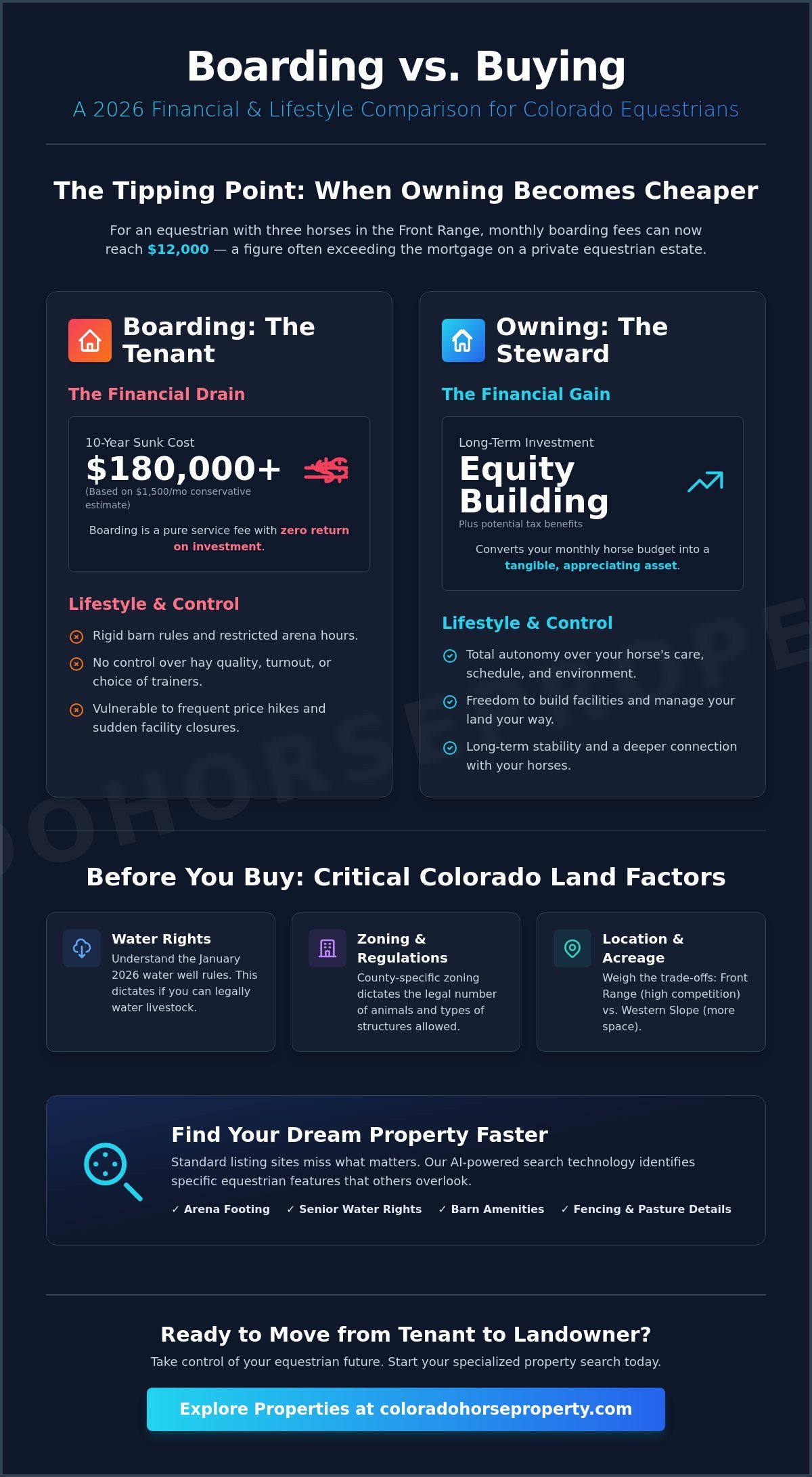
For an equestrian with three horses in the Front Range, monthly boarding fees can now reach $12,000; a figure that often exceeds the monthly mortgage on a private equestrian estate. When you are weighing the choice of boarding horses vs buying property in Colorado, the financial gap is narrowing as facility costs continue to climb. You likely feel the mounting pressure of these rising rates alongside the frustration of limited turnout and rigid barn rules that keep you from managing your horse’s care exactly how you want.
This 2026 guide provides a direct financial comparison and a breakdown of the regulatory factors, such as the January 2026 water well rules, that impact your decision. You will discover how to evaluate land for its utility and legal standing so you can move forward with confidence. We’ll analyze the balance between the daily labor of a hobby farm and the long-term equity of a specialized real estate investment to help you determine your best path forward.
Key Takeaways
- Evaluate the long-term financial impact of sunk boarding fees compared to the equity potential of private land ownership over a ten-year horizon.
- Understand how the January 2026 Colorado water well rules and county-specific zoning requirements dictate the legal capacity for livestock on your property.
- When weighing boarding horses vs buying property in Colorado, consider the trade-off between the convenience of professional care and the total autonomy of managing your own facility.
- Learn how AI-powered search technology can identify specific equestrian features like arena footing and senior water rights that general listing sites often miss.
Boarding Horses vs. Buying Property in Colorado: The Equestrian’s Dilemma
Evaluating boarding horses vs buying property in Colorado requires a clear look at both your daily schedule and your long-term balance sheet. In 2026, the Colorado market is defined by record-high boarding rates and a tightening inventory of suitable acreage. While boarding offers the convenience of full-service care, it leaves you vulnerable to annual price hikes and facility closures. This instability has pushed many riders to view land as a necessity rather than a luxury.
Viewing a horse property as a long-term investment asset rather than just a hobby is essential for modern equestrians. Mark and Alison Eibner have spent years helping buyers navigate this specific transition, moving from the limitations of commercial equestrian facilities to the stability of private ownership. Their experience covers the nuanced details of the Front Range market, where land use is scrutinized more than ever. They understand that finding the right land requires a deep dive into zoning and water rights that standard residential agents often overlook. This specialized knowledge ensures you don’t just buy a house with a fence, but a functional, legal equestrian estate.
To help you visualize the scale of land required for this transition, watch this helpful video:
The Shift from Tenant to Landowner
Owning your own barn provides a level of autonomy that no boarding stable can match. You control the turnout schedule, the hay quality, and the choice of instructors. Boarding often comes with hidden frustrations, such as restricted arena hours or strict rules about outside trainers. When you own the land, you have the freedom to install specific horse barns for sale that fit your unique management style. It’s a move from being a tenant to being the steward of your own equestrian vision. This psychological shift often brings a deeper connection to your horses, as you become the primary person responsible for their daily environment and well-being.
Why Colorado is a Unique Market for Horse Owners
Colorado’s geography creates distinct challenges and opportunities for owners. The Front Range offers proximity to major show circuits but faces intense competition for land. Conversely, the Western Slope provides more expansive space at different price points. With over 300 days of sun, many owners debate the necessity of indoor arenas versus well-drained outdoor tracks. Local soil types, from sandy loam to heavy clay, also dictate how you manage your pastures and paddocks. Staying informed on horse property for sale in colorado market trends is vital for making a sound purchase in this environment.
Financial Comparison: The Cost of Boarding vs. Owning Horse Property
Comparing the monthly expense of boarding horses vs buying property in Colorado involves looking past the immediate price tag. While boarding is often viewed as the entry point for many riders, it functions as a pure service fee with no long-term financial recovery. Ownership, despite its higher upfront costs, converts your monthly equine budget into a real estate investment that builds wealth over time.
The Sunk Cost of Monthly Boarding Fees
Based on 2026 data, full care board in premium areas like Parker or Castle Rock now averages between $1,200 and $3,500 per month. If you pay a conservative $1,500 monthly, you’ll spend $180,000 over ten years. This capital provides zero return on investment. It offers no protection against frequent price hikes or the sudden facility closures that are becoming more common in high-demand regions. You’re essentially paying for someone else’s mortgage without gaining any rights to the land.
Equity Building and Tax Benefits of Equestrian Real Estate
In contrast, purchasing specialized real estate allows you to build equity in a tangible asset. Historical data shows steady appreciation for colorado ranches for sale, particularly those with established infrastructure and water rights. Agricultural status can also slash your property tax burden; for instance, counties like Douglas County offer significant exemptions for properties meeting specific acreage and usage requirements. Land ownership provides a permanent hedge against inflation by locking in your housing and stabling costs through a fixed-rate mortgage. You can search our current listings to see how these tax-advantaged properties compare to your current boarding expenses.
Maintenance and Infrastructure: The Ownership Reality
Ownership does introduce operational costs that boarding stables typically absorb. You’ll need to budget for fence repairs, tractor maintenance, and bulk hay storage. Manure management, arena dragging, and snow removal are now your daily or weekly responsibility. When choosing between a turn-key estate or raw land for sale in colorado, factor in the cost of capital improvements like solar-powered wells or heated tack rooms. These upgrades increase the property’s resale value, unlike a boarding fee which leaves you with nothing but receipts at the end of the year.
Lifestyle and Management: Control vs. Convenience
Deciding between boarding horses vs buying property in Colorado often comes down to how you want to spend your morning hours. Boarding offers a “drop-in” lifestyle where your primary responsibility is the ride itself. You pay for the luxury of driving away while someone else handles the heavy lifting. Ownership, however, is a 24/7 commitment that integrates your equine passion into your daily home life. It’s the difference between being a guest at a facility and being the manager of your own estate.
The most common objection to owning land is the perceived loss of travel flexibility. It’s true that you can’t simply pack a bag and leave without a plan. However, Colorado has a well-established network of professional farm sitters and neighbors who understand the local climate. While a boarding stable provides a “barn family” social environment, a private ranch offers a sanctuary of solitude. You replace the noise and gossip of a shared tack room with the quiet connection of having your horses just steps from your back door.
The Freedom of Total Control
When you own the land, you are the final authority on every aspect of your horse’s care. You select the hay, manage the supplements, and dictate the exact turnout schedule. There is no “gatekeeping” by facility owners regarding which vet, farrier, or trainer you can bring onto the property. This level of control is vital for managing senior horses or performance animals with highly specific medical or training requirements. You can customize your pastures and stalls to meet your standards rather than settling for the “one size fits all” approach of a commercial barn.
The Reality of Daily Labor
Ownership requires a realistic audit of your physical capacity and time. You’ll be responsible for mucking, feeding, and grooming without the backup of a barn staff. Colorado winters add another layer of difficulty to these tasks. You’ll spend mornings breaking ice in stock tanks and evenings plowing the driveway so the hay truck can make its delivery. These physical demands are part of the “sweat equity” that defines the landowner experience. If you enjoy the rhythm of outdoor work, these chores become a rewarding part of your lifestyle. If you prefer to keep your boots clean, the convenience of a boarding stable might outweigh the benefits of acreage.
Critical Considerations for Buying Colorado Horse Property
Choosing between boarding horses vs buying property in Colorado involves more than just looking at the price of the land. You must evaluate the legal and environmental capacity of the dirt itself. While a boarding stable handles the regulatory compliance, as an owner, the burden of proof falls on you. Failure to verify these details can result in a property where you aren’t legally allowed to keep the number of horses you own. It’s a technical transition that requires a shift from being a rider to being a land manager.
Zoning Laws and Horse-per-Acre Regulations
In Colorado, acreage doesn’t automatically grant you the right to house livestock. Zoning designations like A-1 or A-2 often have strict density limits that vary by county. For example, Douglas County typically requires 2.5 acres for the first two horses and additional acreage for every animal thereafter. You need to distinguish between “Use by Right,” which allows horses without extra paperwork, and “Special Use Permits,” which are required for commercial boarding or training operations. Buyers must verify the specific zoning and any existing HOA covenants before closing to avoid legal headaches and potential fines.
Water Rights and Irrigation in the West
Water is the most critical asset in the semi-arid West. The updated Colorado water well rules implemented in January 2026 place increased scrutiny on livestock use. You can’t assume a standard domestic well permit allows for watering horses. A “Domestic Plus” well is the gold standard because it typically permits the watering of domestic animals and some irrigation. You also need to test the well’s yield to ensure it can support your herd’s consumption and the significant water requirements for arena dust control during dry summer months. Shared wells require even more scrutiny to ensure the legal agreement covers your specific equine needs.
Essential Infrastructure Checklist
Infrastructure vetting goes beyond the aesthetics of the barn. You should inspect fencing for safety and durability, comparing T-posts to safer options like Centaur or pipe fencing. Colorado’s heavy clay soil requires professional amendment with sand or specialized footing to remain rideable after snowmelt. Additionally, barn orientation is vital; stalls should be positioned to mitigate high-altitude wind loads and prevent snow from drifting against main entryways. Working with equestrian real estate Colorado specialists ensures these technical details are audited during the due diligence period. To ensure your investment is protected from the start, secure professional buyer representation before you begin your property search.
Finding Your Colorado Equestrian Dream with AI-Powered Search
The decision between boarding horses vs buying property in Colorado often hinges on your ability to find land that actually works for your herd. Standard real estate platforms are designed for suburban residential searches; they lack the data points required for a functional ranch. Our proprietary AI search technology bridges this gap by scanning listings for specific equestrian infrastructure that general algorithms miss. Instead of scrolling through thousands of unsuitable homes, you can focus on properties that already possess the zoning and facilities you need.
Leveraging Technology for Niche Property Needs
Traditional search tools don’t account for the nuances of senior water rights or arena footing. Our AI system allows you to filter by barn type, minimum arena dimensions, and specific well permit classifications. This level of granularity identifies hidden gem properties with high equestrian potential that might otherwise be overlooked. You can save weeks of unnecessary site visits by eliminating properties that fail to meet strict horse-keeping criteria. This efficient data-gathering phase empowers you to act quickly when a property matching your specific requirements hits the market.
Why Expert Buyer Representation is Non-Negotiable
Finding the right land is only the first step. Transitioning from a looker to a landowner requires navigating complex ranch contracts and coordinating specialized title and escrow services. The Eibner team at Realty Oasis brings a 40-year legacy of expertise in Colorado land management and animal husbandry. This historical perspective is vital for vetting property claims and ensuring the land you buy remains a functional asset for decades. We provide specialized buyer representation that addresses the technical hurdles of the closing process.
Our team manages every detail of transaction management so you can focus on the logistics of moving your horses home. We understand the difference between a dry lot and a sub-irrigated pasture, and we use that knowledge to protect your interests during negotiations. Our partnership ensures that your move from a boarding facility to a private estate is handled with the precision that specialized real estate demands. When you finalize your choice between boarding horses vs buying property in Colorado, you deserve a team that understands the dirt as well as the data.
Start your AI-powered Colorado horse property search today.
Your Path to Equestrian Independence in the Centennial State
The choice between boarding horses vs buying property in Colorado is ultimately a decision about your future as a rider and a landowner. You’ve seen how the rising costs of commercial facilities can be redirected into property equity and how the January 2026 water rules make professional due diligence more critical than ever. While boarding offers a temporary service; ownership provides a permanent sanctuary where you control the standards of care and the rhythm of your daily life.
Mark and Alison Eibner bring 40 years of experience serving the Front Range to your search. Our team combines this deep historical knowledge with proprietary AI-powered search technology to filter for the specific arena sizes and water rights that generic platforms ignore. We provide expert buyer representation to ensure your transition from the boarding stable to a private ranch is seamless and secure. You don’t have to navigate these complex land use regulations alone.
Find Your Perfect Colorado Horse Property with AI Search and start building the lifestyle you’ve always envisioned for yourself and your horses. The freedom of your own acreage is closer than you think.
Frequently Asked Questions
Is it cheaper to board or own a horse property in Colorado?
Owning property typically becomes more cost-effective when managing multiple horses over a long-term horizon. While monthly boarding fees for two horses can range from $3,000 to $8,000 in the Front Range, a mortgage on a private estate often sits between $2,500 and $6,500. When comparing boarding horses vs buying property in Colorado, remember that ownership builds equity while boarding fees are non-recoverable service costs.
How many horses can I have per acre in Colorado?
Density limits are determined by county zoning ordinances rather than a single state law. In Douglas County, for example, you generally need 2.5 acres for your first two horses. Additional animals usually require more acreage per head. It’s essential to check the specific A-1 or A-2 zoning for any property you consider to ensure your herd size is legally compliant.
Do I need specific water rights to keep horses on my property?
Yes, you must ensure your well permit specifically authorizes livestock watering. Following the updated rules in January 2026, household-only permits don’t legally cover the water needs of horses. You’ll need a permit that mentions domestic and livestock use to avoid potential fines or being forced to haul water from off-site sources. This verification is a critical part of your due diligence.
What is the minimum acreage required for a horse property in Colorado?
Most Colorado counties require a minimum of 2.5 to 5 acres for a residential horse property. However, this is just the baseline for keeping the animals. If you want to qualify for agricultural tax status, some counties like Douglas County may require up to 35 acres. Always verify the specific parcel’s zoning and any homeowners’ association covenants before assuming it’s a legal horse property.
Can I get a tax break for owning a horse ranch in Colorado?
You can significantly reduce property taxes by obtaining Agricultural status. This classification is based on the land’s use for production or grazing rather than its residential value. Requirements vary, but having enough acreage to support grazing or hay production is often the primary hurdle. This tax benefit is a major factor in the long-term financial comparison of boarding horses vs buying property in Colorado.
What are the most horse-friendly counties in Colorado?
Douglas, Elbert, and Weld counties are among the most horse-friendly due to their established equestrian infrastructure and favorable zoning. These areas offer more properties with existing barns, arenas, and larger acreage parcels. They also have a high concentration of specialized vets, farriers, and hay suppliers, making the daily management of a private ranch much easier than in more urbanized regions.
How much does it cost to build a basic horse barn in Colorado?
The cost to build a barn varies significantly based on whether you choose a modular pole barn or a custom timber-frame structure. Basic three-stall sheds are the most affordable entry point, while fully insulated barns with tack rooms and wash racks require a larger capital investment. Industry professionals suggest that site preparation and foundation work often account for a large portion of the total build budget in our climate.
What should I look for in a Colorado horse property well permit?
You should look for language that explicitly allows for the watering of domestic animals or livestock. Check the permit’s yield, measured in gallons per minute, to ensure it can support your horses and any planned arena dust control. A Domestic Plus permit is the ideal designation for most hobby farms because it offers the most flexibility for animal husbandry and small-scale irrigation.