
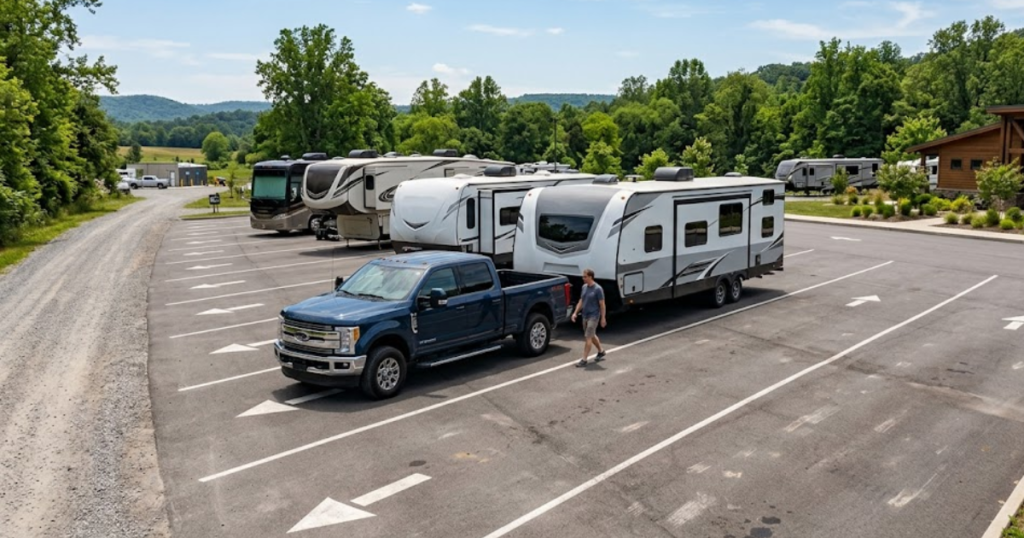
You just spent a long, exhausting weekend competing at the showgrounds. You drive home in the dark, pulling your heavy, 32-foot gooseneck trailer with two tired horses in the back. You turn down your property’s driveway, only to realize the path dead-ends directly into the barn door.
To park, you have to cut the wheel sharply, line up the rig, and back it down a narrow, unlit 150-foot gravel driveway lined with mature trees and expensive fencing. Your headlights blind your side mirrors, your horses start shifting restlessly, and you are one wrong turn away from taking out your own gatepost.
When searching for horse properties colorado buyers love, everyone remembers to check the stalls and pastures, but they completely overlook the driveway logistics. Pulling a trailer forward is easy; backing it up after a grueling day of riding is where the stress hides.
Here is how to evaluate a property’s layout for effortless “pull-through” trailer parking before you buy.
Is There "Trailer Parking" That Doesn't Require Backing Up?
Quick Summary: The Rig Stress Test
- The Pull-Through Luxury: True pull-through parking means you can drive your truck and trailer straight into the parking area, unhook or park overnight, and drive straight out when you leave—zero stressful reversing required.
- The Gooseneck Radius: A massive 3-horse or 4-horse gooseneck trailer requires a huge turning radius. Narrow driveways, low-hanging tree branches, and tight barn corners can easily trap a long rig.
- The Jackknife Hazard: Backing a large trailer into a tight, dead-end driveway is a recipe for jackknifing, which can severely dent your truck bed, bend your trailer tongue, or shatter your rear window.
- The Sub-Base Secret: Trailer parking pads must be built over a heavily compacted road-base gravel sub-structure. Parking a multi-ton rig on soft native soil or lawn will cause it to sink and get hopelessly stuck during the spring thaw.
Trailer logistics shape daily stress more than many buyers expect. A property can have a great barn and still feel frustrating if every arrival and departure turns into a backing challenge.
1. The Circular Driveway Gold Standard
The absolute best layout for any active equestrian estate is a dedicated, wide circular driveway or a continuous loop system.
- The Flow: A proper loop allows you to pull off the main county road, drive past the barn or house, park the rig on a wide pad, and exit through the same or a secondary gate moving forward.
- The Width Requirement: A standard passenger car can easily loop around an island with a 30-foot radius. A full-sized dually truck pulling a long horse trailer needs a road width of at least 12 to 14 feet and a much wider turning radius to prevent the trailer tires from tracking over lawns, boulders, or flowerbeds on the inside of the turn.
- The Y-Turn Compromise: If a property does not have a full loop, look for a spacious Y-turn or hammerhead turnaround area near the barn. This allows you to pull forward into the top of the Y, back up gently into a wide space, and drive out facing forward. It still requires backing up, but it eliminates the nightmare of reversing down a long, narrow lane.
2. Evaluating the Ground: Soft Dirt vs. Engineered Base
A trailer parking pad is only as good as the engineering beneath the gravel.
- The Weight Reality: A loaded 3-horse trailer with living quarters can easily weigh between 10,000 and 14,000 pounds. When you park that massive weight on a single spot for months at a time, it puts immense pressure on the earth.
- The Sinkhole Trap: If a seller tells you, You can just park the trailer out on that flat grass patch next to the arena, be highly skeptical. Without a deep sub-base of crushed rock and compacted road-base, your trailer tires will slowly sink into the dirt. During the wet spring thaw, your rig will get hopelessly stuck, and spinning your truck tires will only dig you in deeper.
- The Weed Barrier: A premium parking pad features geotextile fabric beneath at least 4 to 6 inches of compacted gravel. This blocks weeds from growing up through the stones and binding to your trailer's brakes and axles over the winter.
A good trailer spot is not just flat ground. It needs real base preparation, drainage, and load-bearing structure for long-term use.
3. Clearances: The Overhead and Side Obstacles
When assessing trailer parking, you have to look up and out, not just down at the road.
- The Low-Hanging Tree Line: A standard horse trailer stands between 7.5 and 9 feet tall. Many beautiful, older Colorado horse ranches for sale feature long driveways shaded by mature cottonwood or pine trees. If those branches are not aggressively trimmed back to a height of at least 12 feet, they will scrape your trailer's roof, tear up your air conditioning units, and rip off your vent covers.
- The Overhang Squeeze: Gooseneck trailers pivot tightly over the bed of your truck. When making a sharp turn into a parking space, the back end of the trailer swings out wide in the opposite direction, the tail swing. If the parking pad is built tight against a barn wall, a fence line, or a power pole, that tail swing can easily smash into the structure.
4. Hookups and Long-Term Storage Logistics
If you are parking a trailer long-term, convenience means having the right utilities nearby.
- The Power Clean: A top-tier trailer parking pad features a dedicated electrical pedestal, ideally a 30-amp or 50-amp hookup if you have a living-quarters trailer. This allows you to plug the trailer in days before a show to cool down the refrigerator, charge the internal batteries, and run the lights while you pack your gear.
- The Barn Hydrant Proximity: You need a frost-free water hydrant located within a standard hose-length of the parking pad. This allows you to effortlessly pressure-wash the inside of the trailer after a trip and fill up the trailer's onboard water tanks before you hit the road.
We Test the Turnaround Before You Buy
We do not just look at the listing photos; we map the turning radiuses of the driveway.
When our team helps you navigate the market, we look at the complete operational flow of the property. We analyze the entry gates, measure the clearances near the barn, and evaluate the structural integrity of the parking pads. We want to ensure that every time you bring your horses home, parking your rig is the easiest part of your day.
Contact Us Today to find premium horse properties Colorado buyers trust for highly functional, trailer-friendly layouts.
Browse Active Colorado Horse Properties: Browse active Colorado horse ranches for sale or ask our team about finding a horse property for rent Colorado with excellent driveway access while you search for your permanent equestrian sanctuary
Frequently Asked Questions (FAQ) About Trailer Parking
Can I park my horse trailer on a slope or hill?
It is highly discouraged. Parking a heavy trailer on an incline puts immense strain on the trailer's landing gear jacks and parking brakes. It also makes unhitching and hitching back up incredibly dangerous, as the trailer can shift or roll. Your parking pad should always be as close to perfectly level as possible.
Will an HOA prevent me from parking my trailer outside on my property?
Yes, frequently. Even in rural covenants, many upscale equestrian HOAs have strict rules stating that horse trailers cannot be visible from the main neighborhood road. They may require you to park the trailer completely inside a dedicated equipment shed, or tucked behind a solid privacy fence that matches the architectural style of the home.
How much space do I need to park a truck and trailer comfortably side-by-side?
If you want to park a truck and trailer parallel to each other, or leave room to walk around the rig with horses, your parking pad should be a minimum of 20 to 25 feet wide. This ensures you can fully open the trailer's escape doors, drop the rear ramp safely, and load or unload tack without stepping off the gravel base.