
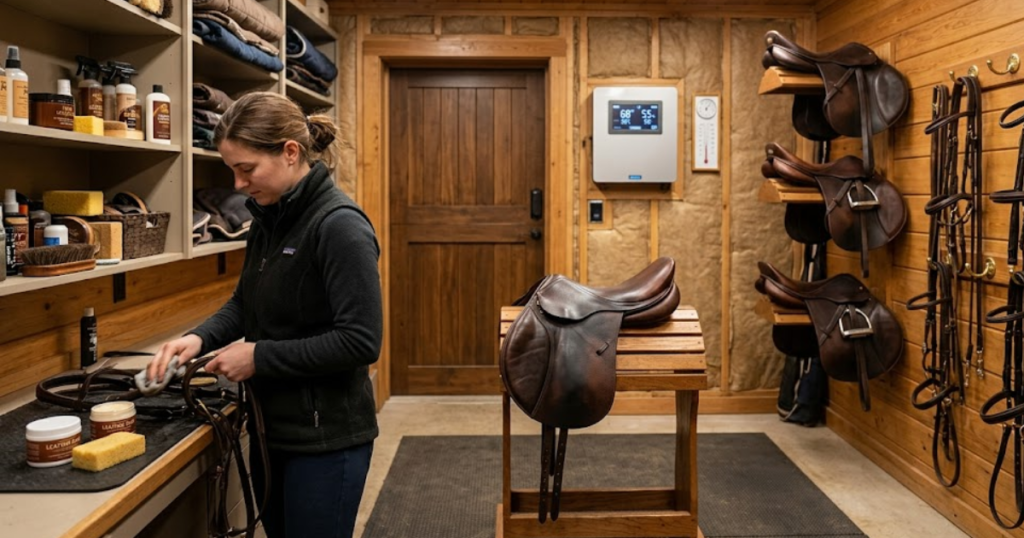
You just moved your horses into a beautiful, rustic wooden barn on your new property. You proudly hang your $5,000 custom French saddles and premium bridles on the racks of the spacious tack room.
In January, a massive cold front drops the overnight temperature to minus 10 degrees. You walk out to the barn the next morning to grab some liniment for your horse. When you open the tack room door, you find that every bottle of fly spray and shampoo has frozen and exploded, covering the floor in a toxic slush. You reach for your saddle, and the leather is frozen so stiff it feels like plywood. By the time spring arrives, your premium leather goods are deeply cracked, and mice have chewed through your expensive wool half-pads.
When evaluating a barn, buyers often mistake a “feed room with saddle racks” for a true tack room. If you own high-end tack or store liquid veterinary supplies, the tack room cannot just be a wooden box; it must be built to the same thermal standards as your house.
Here is how to evaluate the insulation and climate control of a barn’s tack room before you buy.
Is the Tack Room Insulated and Climate-Controlled for Leather Care?
Quick Summary: The Leather Death Sentence
- The Temperature Trap: Colorado’s extreme temperature swings, from zero degrees in winter to 100 degrees in summer, will rapidly dry out, stiffen, and permanently crack expensive leather saddles and bridles if left in an unconditioned space.
- The Exploding Liquids: Fly sprays, liquid supplements, veterinary medicines, and leather conditioners will freeze solid and burst their containers if the tack room drops below 32 degrees.
- The Rodent Fortress: A properly finished, insulated, and sealed tack room is the only defense against field mice turning your expensive wool saddle pads and fleece girths into winter nesting material.
- The Space Heater Hazard: Relying on a cheap electric space heater to keep a tack room warm is the number one cause of catastrophic barn fires. True climate control requires dedicated, hardwired infrastructure.
A true tack room is not just storage with saddle racks. If you keep premium tack, liquids, or textiles in the barn, the room needs real thermal protection and controlled conditions.
1. The Colorado Climate vs. Premium Leather
Leather is skin. It requires specific ambient conditions to maintain its structural integrity and flexibility.
- The Low-Humidity Threat: Colorado is essentially a high-altitude desert. The extreme lack of ambient humidity acts like a sponge, constantly pulling the natural oils and moisture out of your leather goods.
- The Freeze-Thaw Cycle: When unheated tack rooms drop below freezing, the residual moisture inside the leather freezes, causing the fibers to stiffen. If you saddle a horse with freezing, stiff leather, the movement immediately creates micro-cracks across the surface.
- The Heat Bake: In the summer, an uninsulated tack room with a metal roof becomes a literal oven, baking the leather and turning the stitching brittle. To preserve the resale value and safety of your tack, the room must maintain a stable temperature between 50 and 75 degrees year-round.
2. The Logistics of Liquid Storage
Every equestrian accumulates a massive pharmacy of liquids, and winter changes how you must manage them.
- The Freeze Line: Shampoos, detanglers, fly sprays, liquid joint supplements, and critical veterinary medications, like Banamine or sedatives, are mostly water-based. If they freeze, they are ruined.
- The Daily Haul: If the tack room is not climate-controlled, you will be forced to pack up every single bottle of liquid into a plastic tote every October and haul it into your house’s mudroom or heated garage. You will then spend all winter carrying bottles back and forth to the barn every time you need to groom or treat a horse.
- The Heated Sink Requirement: A true luxury tack room also features a deep utility sink with running hot water for cleaning bits and washing tack. If the room is not heated, the pipes feeding that sink will freeze and burst inside the walls.
A tack room’s usefulness is not just about square footage. It also determines whether sensitive liquids and plumbing can safely stay in the barn through winter.
3. Creating a Pest-Proof Vault
Insulation is not just about temperature. It is about creating an impenetrable barrier against wildlife.
- The Mouse Magnet: Barns are naturally full of grain, which attracts mice. Once the temperature drops, those mice will aggressively seek out warm, soft materials to build their winter nests. Your expensive wool saddle pads, fleece girths, and polo wraps are their primary targets.
- The Sealed Envelope: A tack room constructed with exposed wooden studs and gaps in the siding is an open invitation for rodents. A properly built tack room is fully insulated, often with closed-cell spray foam, meticulously drywalled, and sealed tightly around the floorboards and doorframe, creating a vault that mice cannot penetrate.
4. The Fire-Safe Heating Solution
If you buy a barn with an unheated tack room, how you choose to heat it dictates the safety of your entire herd.
- The Space Heater Danger: Never use a portable ceramic or oil-filled space heater in a barn. The extreme dust load in the air and the proximity to dry hay make them catastrophic fire hazards. Insurance companies will often deny claims if a fire is traced back to a portable heater.
- Hardwired Baseboards: A safer, entry-level solution is a hardwired, sealed electrical baseboard heater. However, they are notoriously inefficient and expensive to run constantly.
- The Mini-Split Gold Standard: The ultimate climate control solution is a ductless mini-split HVAC unit. Mounted high on the wall, it safely provides both highly efficient winter heating and summer air conditioning. Before buying, we must check the barn’s electrical sub-panel to ensure it has the 220V capacity required to support this upgrade.
We Inspect the Infrastructure Before You Buy
We do not just look at the finish of the wood; we look at the thermal envelope protecting your gear.
When Mark Eibner and Belinda Seville represent you in buying a rural estate, we evaluate the barn’s specific utility. We look for properly insulated tack rooms, check the electrical capacity for heating upgrades, and ensure the infrastructure matches the value of the horses and equipment you are moving into it.
Contact Us Today to find premium horse properties Colorado buyers trust for professional-grade barn amenities.
Browse Active Colorado Horse Properties: Browse active Colorado horse ranches for sale or ask our team about finding a horse property for rent Colorado while you plan your permanent move to a property with perfect equestrian infrastructure
Frequently Asked Questions (FAQ) About Tack Rooms
Does a tack room need active ventilation if it is perfectly sealed?
Yes. If a room is heavily insulated and completely airtight, the sweat and moisture from a recently used saddle or a washed bit have nowhere to go. This can cause mold to bloom on the leather. A premium tack room should have a passive wall vent, an exhaust fan, or a mini-split system that naturally dehumidifies the air.
Is a metal shipping container, Conex box, a safe alternative for a tack room?
No, they are actually the worst possible environment for leather. Shipping containers are uninsulated steel boxes that suffer from extreme temperature swings and severe internal condensation, the sweating effect. They will rapidly bake, freeze, and mold your expensive tack.
Can I store my grain in the heated tack room to keep it from freezing?
Sweet feed, grain with molasses, can freeze into solid blocks in the winter, so keeping it in a heated room is convenient. However, doing so dramatically increases the risk of rodents chewing through the drywall to get inside. If you store grain in the tack room, it must be locked inside heavy-duty, galvanized steel trash cans with tight-fitting lids.