
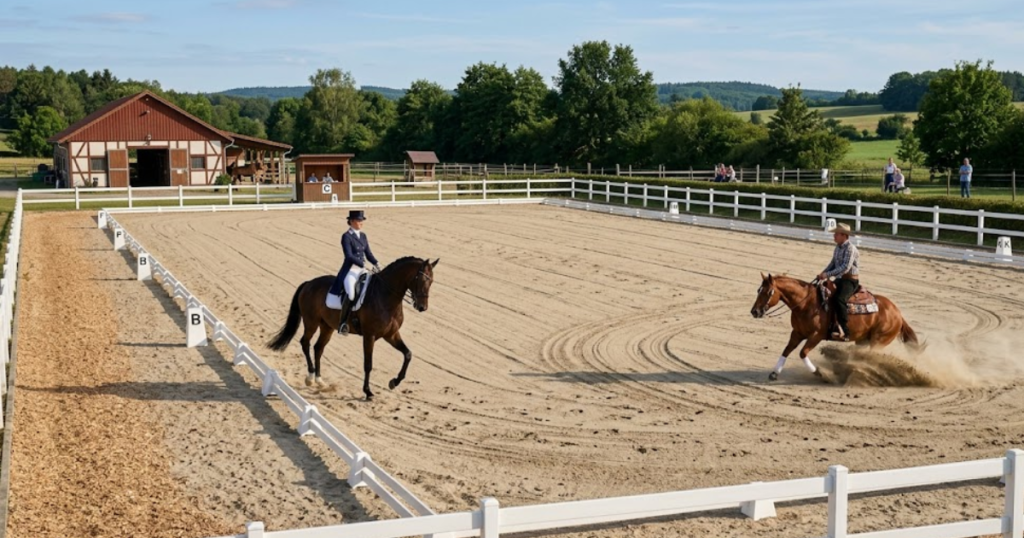
You fall in love with a beautiful Colorado horse property. The listing proudly advertises a “professionally graded outdoor riding arena.” You buy the farm, haul your 17.2-hand Warmblood in, and tack up for your first ride.
As you ask for the canter, you suddenly realize you are hugging the fence line on every single stride. You try to ride a simple diagonal, and you reach the other side in three strides. What the seller called a “riding arena” is actually just a slightly oversized 60×100 foot turnout pen. You cannot train; you can only ride in tight, frustrating circles.
When touring properties, visual scale is incredibly deceiving. A patch of sand might look huge when it is empty, but it shrinks dramatically the moment you are in the saddle. If you are a competitive rider, knowing the exact dimensions of an existing arena is the most critical factor in your property search.
Here is how to evaluate arena sizes for your specific discipline before you buy.
What Is the "Standard Size" of the Arena (Is It Regulation Dressage/Reining)?
Quick Summary: The Spatial Deception
- The Standard Myth: In the rural real estate world, the term standard arena means absolutely nothing. A casual backyard riding ring is vastly different from the highly specific dimensions required for competitive training.
- The Dressage Discipline: A regulation competition dressage arena requires an exact footprint of 20x60 meters, approximately 66x197 feet. If the width is off by even a few feet, you cannot accurately practice your 20-meter circles.
- The Western and Jumping Requirement: Reining, roping, and show jumping require massive square footage for sliding stops, wide turns, and related distances. For these disciplines, a 100x200 foot arena is considered the absolute minimum functional size.
- The Expansion Trap: Do not assume you can easily push the fence back to make a small arena bigger. Expanding a riding pad requires professional excavation, grading, and re-engineering the drainage base, which can easily cost tens of thousands of dollars.
Arena size is one of the easiest features to misjudge visually and one of the hardest to fix cheaply after purchase.
1. The Myth of the "Standard" Backyard Arena
Real estate listings frequently use the word arena loosely.
- The Casual Footprint: Many non-competitive horse owners clear a flat, 80x120 foot patch of dirt, throw down some sand, and call it an arena. While this is perfectly fine for light exercise or lunging, it is completely inadequate for serious training.
- The Stride Squeeze: A large, athletic horse has a 12-foot canter stride. In a tiny arena, your horse is constantly bracing for the next sharp turn, causing them to drop on their forehand and ruining their balance and your training progress.
- The Tape Measure Test: Never trust the visual eyeball test or the listing agent's guess. When touring a property, you or your agent must physically walk the fence line with a 100-foot measuring tape or a laser distance measurer to verify the true usable riding footprint.
2. The Exacting Geometry of Dressage
Dressage is a sport of absolute precision, and your home arena must reflect that.
- The Regulation Court: A standard, competition-sized dressage arena is exactly 20x60 meters, roughly 66 feet wide by 197 feet long.
- The Width Problem: The 20-meter width is the most critical factor. If you buy an arena that is only 60 feet wide, you physically cannot ride a correct 20-meter circle without clipping the fence or cutting your corners. Your horse will learn to anticipate the wrong geometry, costing you massive points in the show ring.
- The Arena Within an Arena: A highly desirable setup is finding a property with a massive 100x200 foot jumping or reining arena. This allows the dressage rider to set up a temporary, regulation 20x60 meter white rail court perfectly in the center, giving them the exact geometry needed while leaving room on the outside track for warming up.
Close is not good enough on arena dimensions. A few missing feet can make correct geometry impossible for serious flatwork and test preparation.
3. The Massive Footprint for Western and Jumping
If you want to jump courses or train sliding stops, you need a runway.
- The Reining and Cow Horse Standard: Western performance horses require significant length to build speed for run-downs and sliding stops. A 100x200 foot arena is the widely accepted minimum standard. For large-scale cutting or roping operations, an even larger 150x300 foot arena is highly preferred.
- The Hunter/Jumper Space: Jumping courses require room to navigate related distances between fences and sweeping, balanced turns at the ends of the ring. Trying to cram a five-jump course into an 80-foot-wide arena is claustrophobic and dangerous. Like reining, hunters and jumpers generally look for that premium 100x200 foot minimum footprint.
4. The Financial Nightmare of Expansion
Buyers often look at a small 80x120 foot arena and think, I'll just hire a guy with a tractor to push the dirt back another 80 feet. This is a massive financial miscalculation.
- The Drainage Grade: A proper arena is built like a parking lot. It has a crowned, highly compacted sub-base specifically sloped at 1% to 2% to shed rainwater. If you push the arena out 80 feet, you have to perfectly match and blend that highly engineered sub-base grade, which requires professional laser-guided excavation.
- The Retaining Wall Reality: Unless the property is perfectly flat, expanding an arena usually means cutting deep into a hillside or building up a massive dirt pad on the low side. This often requires the construction of expensive, engineered concrete or timber retaining walls to keep the new dirt from washing away in the first rainstorm.
- The Footing Match: If you add 5,000 square feet to the arena, you now have to buy thousands of dollars' worth of new premium sand and textile footing, and have it professionally blended into the old footing to ensure there are no dangerous hard spots or deep bogs on the track.
We Measure the Footprint Before You Buy
We do not just look at the sand; we measure the stride.
When Mark Eibner and Belinda Seville represent you in buying an equestrian estate, we bring the measuring tape. We know the exact dimensions your specific discipline demands. We help you verify the true footprint of existing arenas and evaluate the topography to see if expanding a too-small arena is a financially viable option or a guaranteed money pit.
Contact Us Today to find premium horse properties Colorado buyers trust for competitive-grade training facilities.
Browse Active Colorado Horse Properties: Browse active Colorado horse ranches for sale or ask our team about finding a horse property for rent Colorado while you search for a permanent farm with the perfect regulation arena
Frequently Asked Questions (FAQ) About Arena Sizes
What is the size of a small dressage arena?
A small dressage arena, used for lower-level tests and eventing, is 20x40 meters, approximately 66x131 feet. While it fits into smaller spaces, riders training above First Level will eventually need the full 20x60 meter court to practice extended gaits and flying changes.
Do indoor arenas need to be the exact same size as outdoor arenas?
Yes, the training requirements do not change just because there is a roof over your head. However, because steel clear-span buildings are incredibly expensive to build, many indoor arenas in Colorado are compromised at 70x140 feet or 80x150 feet to save money. A true 100x200 foot indoor arena is a massive, multi-million-dollar premium asset.
What is the standard size for a round pen?
For general lunging and starting young horses, a 60-foot diameter round pen is the gold standard. Anything smaller than 50 feet puts too much torque and strain on the horse's joints due to the constant, tight turning radius.