
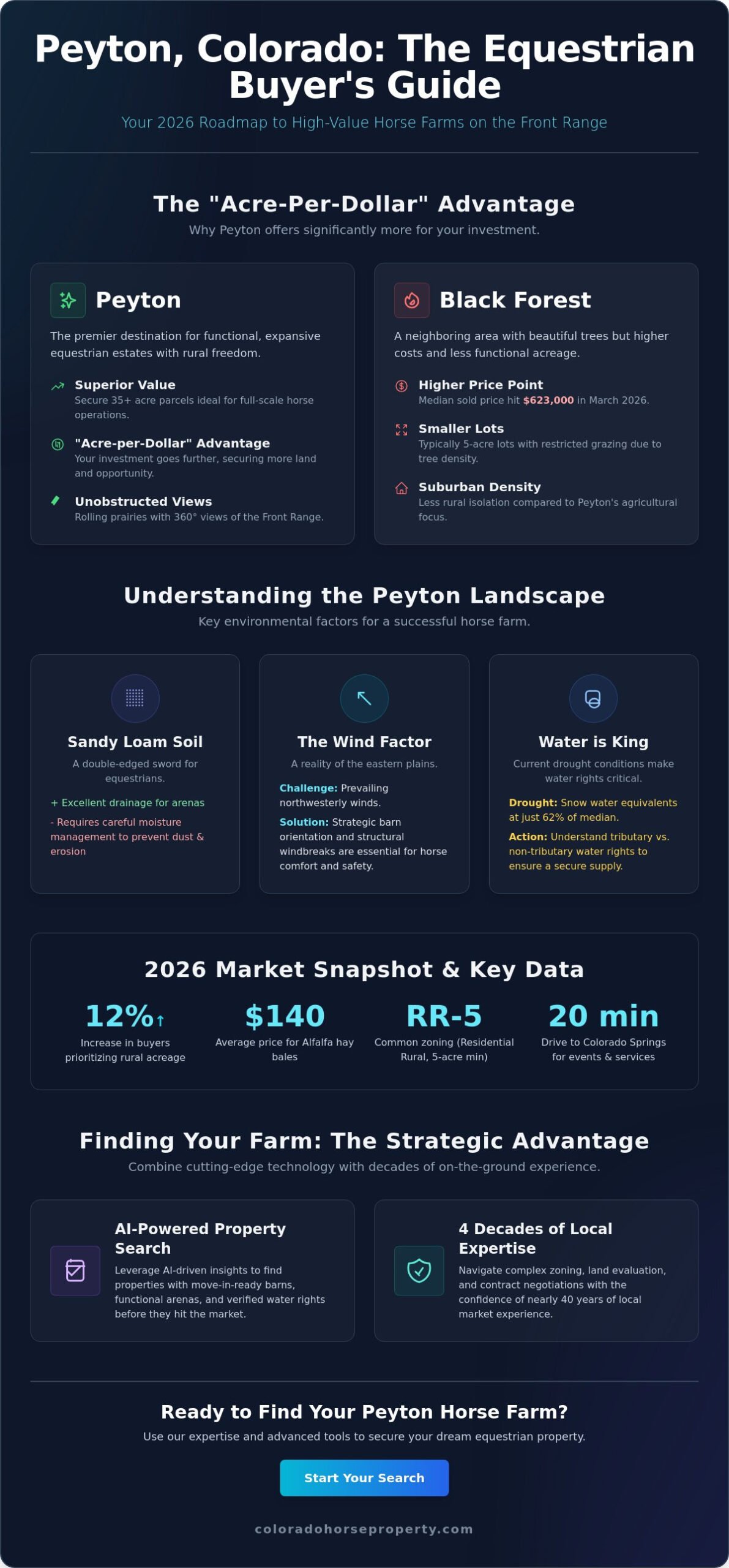
While neighboring Black Forest saw median home prices climb to $623,000 in March 2026, Peyton remains the Front Range’s best-kept secret for high-value equestrian estates. You know that finding 5 to 35 acres with a functional arena feels like a race against rising costs. It’s difficult to balance your dream of rural freedom with the reality of El Paso County’s current drought. As of mid-March, snow water equivalents sit at just 62 percent of the median. Choosing the right Peyton Colorado horse farms requires more than just a love for the landscape. It demands the kind of strategy only nearly four decades of local experience can provide.
This 2026 guide will show you exactly why Peyton offers the ultimate “acre-per-dollar” advantage. You’ll learn how to use AI-driven insights to secure a property with functional barns and reliable water rights. We’ll break down the essentials of RR-5 zoning, current hay pricing like $140 Alfalfa bales, and how to mitigate wind concerns on the eastern plains. By the end of this article, you’ll have a clear roadmap to finding a property that fits your lifestyle and dreams without the Black Forest price tag.
Key Takeaways
- Learn why Peyton serves as a premier high-plains haven, offering significantly more acreage for your dollar than neighboring Black Forest or Falcon.
- Identify the best practices for managing sandy loam soil and placing windbreaks to protect your livestock and maintain optimal arena footing.
- Understand the critical legal distinctions between tributary and non-tributary water rights to ensure your Peyton Colorado horse farms have a secure water supply.
- Evaluate essential infrastructure for the eastern plains, including why high-visibility fencing and specific barn ventilation are vital for horse safety.
- Discover how to leverage AI-powered search tools and nearly four decades of local expertise to find properties with move-in-ready barns and arenas.
Why Peyton, Colorado is a Premier Destination for Horse Farms
Peyton is a dedicated equestrian community that feels worlds away from the city while remaining just 20 minutes northeast of Colorado Springs. This high-plains haven attracts buyers who prioritize functional land over suburban density. For those searching for Peyton Colorado horse farms, the area provides a rare combination of accessibility and rural isolation. It’s a place where the local culture revolves around the arena and the pasture rather than the shopping mall. The community has resisted the suburban sprawl seen in other parts of the Front Range, maintaining a lifestyle centered on ranching and equine activities.
The town of Peyton, Colorado is situated perfectly for the modern equestrian. It offers easy access to major event centers in the Pikes Peak region, making it simple to transport horses for shows or veterinary care. In the 2026 market, this proximity is a major driver of property value, as more people seek a balance between remote work and agricultural passions.
To better understand the scale and beauty of these properties, watch this look at a local ranch:
The Peyton Landscape: Open Skies and Pikes Peak Views
The topography of the 80831 zip code consists of rolling prairie that stretches toward the horizon. Unlike the dense timber of Black Forest to the west, Peyton offers unobstructed, 360 degree views of the Front Range. This “big sky” atmosphere provides more than just a scenic backdrop. It offers clear sightlines for monitoring livestock and allows for natural drainage patterns that are essential for outdoor arenas. The psychological benefit of this open space is a hallmark of the Colorado lifestyle. Property owners here trade the shade of the pines for the golden light of the plains and the most dramatic sunsets in El Paso County.
Peyton vs. Surrounding Areas: A Buyer’s Comparison
Buyers often choose Peyton because it offers a significant “space advantage.” In March 2026, the median sold price in Black Forest reached $623,000, representing a 13.3% increase month-over-month. Those prices often buy smaller, 5 acre lots with restricted grazing. In contrast, Peyton Colorado horse farms remain the primary destination for those seeking 35+ acre parcels. The market in 2026 shows a 12% increase in buyers prioritizing rural acreage over suburban density. While areas like Falcon have seen rapid residential growth, Peyton maintains its agricultural roots. It is the “sweet spot” for those who want land that can actually support a full-scale horse operation while benefiting from the long-term appreciation of the Peyton-Falcon corridor.
Understanding the Landscape: Soil, Climate, and Zoning in Peyton
Successful ownership of Peyton Colorado horse farms starts with the ground beneath the hooves. Unlike the heavy clay found in other parts of the state, Peyton features a high concentration of sandy loam. This soil type is a double edged sword. It provides excellent drainage for outdoor arenas, meaning you can ride sooner after a heavy rain. However, it’s also susceptible to erosion and requires careful moisture management to prevent dust. You can use the Web Soil Survey from the USDA to check the specific composition of any parcel you’re considering before you buy.
The “Wind Factor” is another reality of life on the eastern plains. Effective property design in Peyton accounts for the prevailing northwesterly winds. When planning your layout, orient your barn to minimize wind resistance and place living quarters or arenas behind established tree lines or structural windbreaks. Proper orientation doesn’t just protect your structures; it significantly reduces stress on your horses during winter storms.
Zoning in El Paso County dictates your daily operations and long term plans. Most Peyton Colorado horse farms fall under RR-5 (Residential Rural, 5 acre) or A-35 (Agricultural, 35 acre) designations. In an RR-5 zone, a private stable is a use by right. However, if you plan to run a commercial boarding or training facility, you’ll need a Special Use Permit. On a 5 acre lot, you’re generally allowed to keep four horses, whereas 35 acre parcels offer much greater flexibility under agricultural standards. You can search by acres to find properties that already meet these specific zoning requirements for your herd size.
Managing Pastures on the Eastern Plains
Peyton receives roughly 15 inches of annual rainfall, making pasture management a precise science. You should focus on native, drought resistant grasses like Blue Grama and Buffalo Grass. These species thrive in semi arid conditions and provide high nutritional value when managed correctly. Rotational grazing is essential to prevent land degradation. In the context of Peyton’s limited rainfall, overgrazing is defined as the point where livestock consume more than 50 percent of the available forage, which leads to root death and permanent soil exposure.
Zoning and Building Regulations for Arenas and Barns
Building a large scale indoor riding arena requires specific permits from El Paso County to ensure structural safety against wind and snow loads. You must also adhere to strict setback requirements for any equine infrastructure. For instance, manure stockpiles must be located at least 100 feet from any property line to comply with local health and zoning codes. As of 2026, local regulations have become more favorable toward “accessory living quarters.” This allows owners to build smaller dwellings for ranch hands or trainers, provided the property meets specific acreage and septic requirements.
Essential Features for a Successful Peyton Equestrian Property
Evaluating Peyton Colorado horse farms requires a critical eye for infrastructure that can withstand the high-plains environment. A functional barn is more than just a shelter; it’s a tool for health and safety. In the dry Colorado climate, ventilation is your top priority to prevent respiratory issues caused by dust. Stalls should be at least 12 by 12 feet to allow horses to move comfortably and rest properly. Security in your tack room is also vital, as specialized equine equipment represents a significant financial investment.
Fencing choices on the plains differ from those in more sheltered, timbered areas. Traditional wood fencing often fails here because horses tend to chew it during the dry months; it also requires constant painting and repair. Most successful owners in this region prefer pipe fencing or high-visibility electric tape. These options stand up to the high winds characteristic of the area and remain visible to livestock even during heavy spring snowstorms.
Your arena needs a professional base to remain usable throughout the seasons. While the local sandy loam provides a good start for drainage, you must install a compacted base layer, typically road base, to prevent shifting. A slight crown in the center of the arena ensures that water drains away from the riding surface. This prevents the “puddling” effect that can ruin expensive footing and lead to injuries. Large turnout spaces are non-negotiable for Peyton Colorado horse farms. Horses need the freedom to move and graze, which helps maintain their physical and mental well-being in a semi-arid landscape.
Water Infrastructure: Tanks, Hydrants, and Automatic Waterers
Water is the most critical resource on any ranch. You must ensure the property has frost-free hydrants installed at every critical point. These are essential for preventing frozen pipes when temperatures drop below zero in January and February. Before finalizing a purchase, you should verify the well’s production rate and specific permit type. The Colorado Division of Water Resources provides data on well permits and historical flow rates that are vital for land evaluation. Placing water troughs in areas protected from the wind will help prevent surface freezing and encourage horses to drink more during the winter months.
Storage Solutions for Hay and Equipment
Proper storage is a financial necessity for any horse owner. According to the USDA’s Colorado Direct Hay Report from April 23, 2026, Alfalfa in medium square bales costs between $140.00 and $155.00 per bale. To protect this investment, you need a dry, well-ventilated hay shed that can hold a full winter’s supply. You also need dedicated space for equipment. Storing tractors and horse trailers under cover extends their lifespan and keeps them ready for use. Creating “mud-free” zones with crushed rock around barn entrances and gates will save you hours of maintenance during the spring thaw and keep your horses’ hooves healthy.
Navigating the Purchase: Water Rights and Land Evaluation in Peyton
Water rights often dictate the true value of Peyton Colorado horse farms. In a state governed by the Prior Appropriation Doctrine, being “first in time” means everything. As of mid-March 2026, Colorado’s statewide snow water equivalent sits at just 62 percent of the median, the second lowest level in 46 years. This scarcity makes understanding your water decree vital. Most properties in Peyton draw from the Denver Basin aquifers. You must distinguish between tributary water, which is connected to surface streams and subject to “calls” from senior users, and non-tributary water, which is generally more secure for long term ranching operations.
Researching well permits is a mandatory part of your due diligence. You should never assume a well provides enough water for a full stable just because it’s currently functioning. A standard “Domestic Well” permit on 35 acres typically allows for household use, fire protection, and the watering of domestic animals and livestock. However, “Household Use Only” permits, often found on smaller parcels, strictly prohibit outdoor watering or livestock use. You can verify these details through the Colorado Division of Water Resources to ensure the land can legally support your lifestyle and dreams.
The Role of Water in Property Valuation
On the high plains, water rights can be more valuable than the residential structures themselves. If you plan a larger equestrian operation, you may need an augmentation plan to replace the water you consume. This legal process ensures that your usage doesn’t negatively impact senior water rights holders downstream. For a broader perspective on how these laws vary across the Pikes Peak region, consult our equestrian real estate Colorado guide. Understanding these complexities early prevents expensive legal battles after you close on the property.
Environmental and Topographical Due Diligence
The rolling prairie of Peyton contains hidden topographical challenges like seasonal arroyos. These dry creek beds can transform into fast moving flood zones during heavy spring rains. You must identify these features to ensure your barn and arena are built on high, stable ground. A professional land survey is essential for multi-acre parcels to confirm property boundaries and identify existing utility easements. You should also inspect the pasture for toxic weeds like Locoweed or Leafy Spurge. These invasive species thrive in overgrazed soil and can be lethal to horses if not properly managed through a dedicated mitigation plan.
If you’re ready to find a property with secure water and high quality land, browse our current Peyton horse farm listings today.
Finding Your Peyton Horse Farm with AI-Powered Search
Generalist real estate platforms often classify any property with a few acres as “equestrian,” but horse owners know better. Finding the right Peyton Colorado horse farms requires a search tool that understands the difference between a decorative shed and a functional four stall barn. Our AI powered search engine analyzes property descriptions and listing data to identify specific infrastructure that matters to you. It filters for critical assets like high visibility fencing, heated tack rooms, and professional grade arenas. This technology saves you hours of manual sorting by presenting only the properties that actually fit a rancher’s requirements.
While technology provides the data, nearly four decades of local experience provides the context. A generalist realtor might miss the nuances of El Paso County’s RR-5 zoning or the specific well permit restrictions we discussed earlier. We move beyond the standard MLS to identify niche listings and off market opportunities that haven’t hit the public eye yet. High value equestrian transactions involve complex variables like water decrees and livestock limits; this makes specialized representation a necessity rather than an option. You need a partner who knows which side of the highway has the best soil and which parcels are most protected from the plains’ wind.
The Power of Niche Equestrian Search Tools
Our platform allows you to refine your search with surgical precision. You can filter by specific acre counts to find exactly what you need, whether it’s a manageable 5 acre plot or a sprawling 35+ acre estate. If your horses require specialized care, you can search for properties with indoor arenas or facilities designed for senior horse management. For those looking to expand their search beyond the 80831 zip code, our horse property for sale in colorado guide provides a comprehensive overview of the state’s best equestrian regions and current market trends.
Partnering with Realty Oasis for Your Lifestyle and Dreams
Mark and Alison Eibner bring a personal, seasoned approach to the search process. They don’t just sell land; they match riders to ranches that support their specific lifestyle and dreams. From the initial search to the final coordination of title and escrow, we provide full cycle transaction management. We understand that buying a horse farm is a significant life investment. We are here to ensure that every detail, from soil quality to water rights, is verified and secured. Our team handles the technical complexities so you can focus on the future you’re building for your horses and your family.
Start your AI-powered Peyton horse farm search today!
Securing Your Future on the Colorado High Plains
Peyton offers a unique opportunity to build a lifestyle that balances expansive acreage with proximity to the Front Range’s premier equestrian hubs. You now understand how the region’s sandy loam and open topography demand specific strategies for pasture management and barn orientation. Mastering the complexities of Denver Basin water rights and El Paso County zoning is the difference between a successful investment and a costly mistake. Success in this market requires a partner who understands the land as well as the law.
With nearly 40 years of specialized experience in Colorado real estate, we provide the expert guidance you need to verify every detail of your purchase. Our specialized AI technology filters through the noise to find Peyton Colorado horse farms that meet your exact standards for infrastructure and land quality. We help you move beyond general listings to find the specific barns, arenas, and water decrees that secure your legacy on the plains.
Find Your Dream Peyton Horse Farm with Our AI Search Tool and take the first step toward your high-plains sanctuary. Your vision of a functional, beautiful equestrian estate is within reach, and we’re ready to help you make it a reality.
Frequently Asked Questions
How many horses can I have per acre in Peyton, Colorado?
Zoning designations like RR-5 or A-35 dictate horse limits rather than a simple per-acre rule. In a standard RR-5 (Residential Rural, 5-acre) district, keeping four horses for private use is a use by right. If you intend to board horses commercially, you must apply for a Special Use Permit through El Paso County. Always verify specific covenants that might be more restrictive than county code.
Do Peyton horse farms typically come with water rights?
Most Peyton Colorado horse farms include a well permit, but this isn’t the same as owning senior water rights. Colorado follows the Prior Appropriation System, meaning water is allocated based on seniority. Your property will likely draw from the Denver Basin aquifers. It’s essential to confirm if the water is tributary or non-tributary to understand your long-term security during the current drought.
What is the average price for a 10-acre horse farm in Peyton?
Prices vary based on infrastructure, but Peyton consistently offers better value than Black Forest, where the median sold price hit $623,000 in March 2026. Buyers often find that their budget stretches further here, allowing for larger 10 to 35-acre parcels with existing barns. The 2026 market shows a 12 percent increase in demand for these rural acreages over suburban density.
Is the wind in Peyton too strong for outdoor riding arenas?
Outdoor riding is common year-round, provided your arena is designed with the local climate in mind. You should utilize structural windbreaks or established tree lines to mitigate the northwesterly winds. Properly oriented barns and arenas allow for comfortable riding even on breezy days. Many owners choose high-visibility tape or pipe fencing to ensure safety during the high-wind events characteristic of the eastern plains.
What are the zoning requirements for building a barn in El Paso County?
Building a barn requires adherence to specific setback and safety regulations. For example, manure stockpiles must be at least 100 feet from any lot line to comply with health codes. In RR-5 zones, a private stable is permitted by right, but large-scale indoor arenas require permits to ensure they meet wind and snow load standards. Always check for utility easements before finalizing your building site.
Are there public riding trails near Peyton horse properties?
The region offers excellent trail access, most notably at Homestead Ranch Regional Park in the 80831 zip code. This 450-acre park features diverse terrain, including rolling hills and meadows, specifically designed for equestrian use. Many properties in the Peyton-Falcon corridor also have access to informal neighborhood trail systems that connect larger parcels, providing miles of riding without needing to load a trailer.
What should I check on a well permit before buying a Peyton farm?
You must verify the Permitted Use on the document issued by the Colorado Division of Water Resources. A Household Use Only permit forbids watering livestock or irrigating pastures. For Peyton Colorado horse farms, you ideally want a Domestic and Livestock permit. This allows for inside use plus the watering of animals, which is critical for maintaining a functional equine estate.
How does AI-powered search help me find a horse property faster?
Our AI technology identifies properties based on specific equestrian infrastructure that generalist sites miss. Instead of manually checking every 5-acre listing, the system filters for horse-ready features like indoor arenas, specific stall counts, and fencing types. This data-driven approach, combined with nearly 40 years of local expertise, ensures you only spend time touring properties that truly fit your lifestyle and dreams.